December 2008

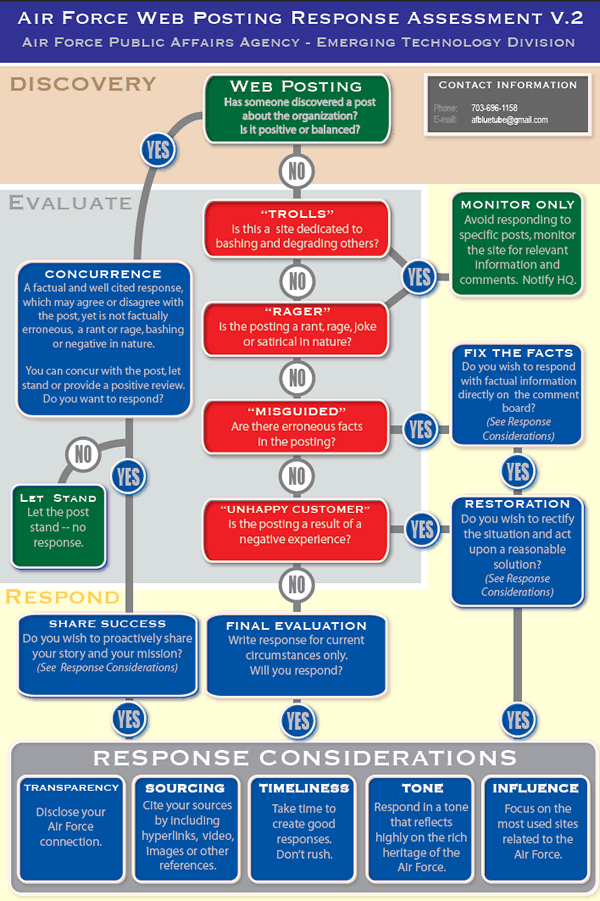
Update, January 5, 2008: Captain David Faggard, Chief of Emerging Technology for the U.S. Air Force, sent me an updated version of their chart, whose changes are based on your comments. The chart appears in this article, and you can click on it to download a full-sized PDF version.

You’ve probably seen many articles on companies and organizations saying that they take social media seriously. Here’s one such organization that you might not expect: the United States Air Force. Take a look at the Air Force Blog Assessment chart, reproduced below:

U.S. Air Force's "Web Posting Response Assessment V.2" chart
Click the diagram to download the PDF version (455K).

The “rules of engagement” are quite good. You might find them to be useful for your own blogs, whether personal or corporate.

WebInkNow recently covered the Air Force’s approach to social media, which is far more involved than many companies who only pay lip service to the idea. They’ve assigned someone the role of “Chief of Emerging Technology”, whose job is to develop strategy, policy and plans for the Air Force’s “communicators” and whose mission is to use or build web applications as a means of engaging Airmen and the general public in conversation. The goal is to make every single Airman a communicator.

The Air Force has quite a presence on the web, which includes:

As with the Blog Assessment chart, you might want to use the Air Force’s social media strategy as a model for your own. Check out WebInkNow’s article for more.

{ 127 comments }

The Old Univac Ad, Remixed

by Joey deVilla on December 30, 2008

Call me easily entertained, but I still find remixes inspired by the movie 300 funny, such as Brian Jepson’s remix of the Univac ad from the previous entry:

tonight_we_divide_by_zero

You can click the photo above to see the remix at full size or here to see it in Brian Jepson’s Flickr collection.

{ 0 comments }

An Old Univac Ad: “You’re Trying to Divide by Zero”

by Joey deVilla on December 30, 2008

Here’s a computer ad from 1956 – it’s for Univac computers, a brand name that was as synonymous with “computer” in the same way that “Xerox” was once synonymous with “photocopier”:

Old Univac ad: "You're Trying to Divide by Zero"
Click the ad to see it at full size.
Ad courtesy of Miss Fipi Lele.

Here’s the text of the ad. If it seems a little strange to your modern sensibilities, it’s because it’s ad copy from the era of Mad Men — that’s just how advertising was back then. Note that lack of technical jargon or specs, neither of which would’ve been useful back then, when very few people would’ve known what they meant:

“You’re Trying to Divide by Zero”

A scientist, testing a formula on Univac recently, was amazed to see the computing system stop, then automatically type the reproof: “You’re trying to divide by zero.” A quick check proved that Univac, as always, was right.

This graphic demonstration points out just one of the many Remington Rand refinements in the art of computer programming and operation. For Univac has been trained to spot human errors. It can now carry out commands given in simple business English. It can even manufacture its own program of instructions automatically – at electronic speeds, with unparalleled accuracy.

These skills have been developed as a direct result of Univac’s unique position in the field of electronic data-processing. Because, with every Univac delivered goes 10 years’ experience in electronic computing…5 years’ experience in the commercial type of data-processing. This wealth of background in programming and operation is unobtainable elsewhere.

The unprecedented savings of Univac data-processing have been proved by solving actual consumer problems – not by working out theoretical solutions with non-existent computers. You can be sure that, when you install the Univac, you’ll get under way faster, surer and more economically because the System has already handled similar work.

Univac is now at work in leading organizations throughout the country. And, in today’s competitive market, the company which cuts its overhead first comes out on top. So don’t wait until 1957…1958…or 1959 to cash in on the tremendous savings available to you now with the Remington Rand Univac System.

Some observations:

  • Error messages: while old hat to even modern laypeople, must’ve seemed like a great leap forward back then.
  • “Univac, as always, was right.” Can you imagine even Apple’s blowing-sunshine-up-your-ass ads making that claim about their machines today?
  • “It can now carry out commands given in simple business English.” I’m guessing that they mean COBOL. One era’s technological wonder is another era’s coding horror.

    [Update: Looks like I got my programming language timelines wrong. “mistercow” points out on Reddit that COBOL didn’t appear until 1959 and suggests that the “commands in simple business English” language is probably FLOW-MATIC, one of COBOL’s predecessors.]

  • “…with every Univac delivered goes 10 years’ experience in electronic computing…5 years’ experience in the commercial type of data-processing". These short timeframes may seem quaint, but keep in mind that the concept of what is computable isn’t even 100 years old yet. You should also note that web applications are only slightly older than 10 years and that XMLHttpRequest, which makes Ajax possible, turns ten in the new year (it was released by Microsoft as an ActiveX object for Internet Explorer 5 for Outlook Web Access in 1999).

And finally, two things that a programmer in today’s economy should keep in mind. It’s almost as if they’re special messages sent through time:

  1. “The unprecedented savings of Univac data-processing have been proved by solving actual consumer problems – not by working out theoretical solutions with non-existent computers.”
  2. “…in today’s competitive market, the company which cuts its overhead first comes out on top.”

Although these statements were made back when computers were rare and extremely expensive and well before there was a computer on every office desk – in fact, well before computers could even fit on desks – they hold true today. If you’re a programmer looking to make a living in 2009, it’ll pay to develop applications that solve actual problems and either help people make money or save it. To borrow a line from Don Dodge at Startup Empire, make sure your applications are aspirin (must-haves), not vitamins (nice-to-haves)!

{ 25 comments }

Off for the Holidays

by Joey deVilla on December 24, 2008

The aftermath of a Santa/U.F.O. collision with Santa filing a report and the cops hauling an alien away

It’s Christmas Eve and I’ve got a lot of family stuff to do over the next couple of days. You never know, I just might get the chance to sneak in a blog entry or two, but I’m going to play it safe and say that Global Nerdy (and its bigger, older brother blog, The Adventures of Accordion Guy in the 21st Century) will return on Monday, December 29th.

Merry Christmas, Happy Chanukah, Joyous Festivus, Happy Holidays – however you choose to spend the next couple of days, stay safe, enjoy yourself, and I’ll see you soon!

{ 1 comment }

Ruby on Rails and Merb Merge!

by Joey deVilla on December 23, 2008

The Merb/Rails rivalry could’ve gone as depicted on the cover of the science fiction “classic” shown below…

the_human_bat_v_the_robot_gangster


(I think Merb would be the Human Bat and Rails would be the Robot Gangster.)

…but instead, the two projects have merged! The result will be the upcoming Rails 3.

The merger is commemorated on a “plaque” page on the Rails site titled The Day Merb Joined Rails, which I’ve excerpted below:

Merb was started two years ago by Ezra Zygmuntowicz as a tiny framework to serve ERb templates from Mongrel. This quickly grew into much more and carved out a niche as an alternative Rails stack. Merbists focused on among other things a small speedy core, being ORM/JavaScript agnostic, and having a rigorous API for extensions.

Along with the expansion in ambition came the fact that Merb and Rails started sharing more and more of the same ideas and even implementation. This lead to a fair amount of unnecessary duplication on both sides of the fence and lead to some paradox of choice. When do I choose one over the other and when?

Rails 3

On December 23rd, we decided to end the duplication and the paradox of choice. That was the day we declared our intentions of bringing the best ideas of Merb into Rails 3. That was the day we announced our commitment to work together.

It’s nice to see this sort of thing happening. It’s more common to see projects forking over the tiniest disagreements, a la “The People’s Front of Judea” in Monty Python’s Life of Brian:

It’s a win for both projects, as well as the users. Rails gets some much-needed optimization, the ability to shed excess weight for speed, framework agnosticism and an API that won’t break with upgrades, and Merb gets a much bigger development community and mindshare momentum that Rails enjoys. Better still, the merger now has both teams’ big brains working on the same project, and isn’t that what the spirit of the DRY principle is all about?

Congratulations to both the Merb and Rails teams! And hey, congrats to all you Ruby/Rails/Merb developers out there too! 2009 just got a little more interesting for all of us.

Links

{ 6 comments }

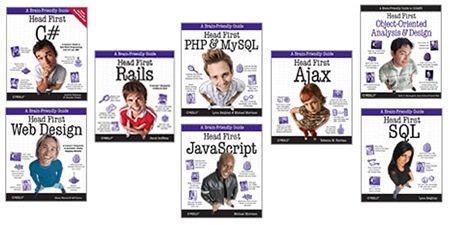
O’Reilly’s “Head First” Books Now Available in PDF

by Joey deVilla on December 20, 2008

head_first_books

These days, I try to get the PDF version of a computer book when it makes sense. When it comes to more timeless books — say Code Complete (the book from which Jeff Atwood gets the name for his blog, Coding Horror) and The Pragmatic ProgrammerI think I’d still prefer a dead-tree edition. For books on a specific version of a language, platform or tool, which have a limited lifespan, I would argue that the PDF version is the better choice. I used to hate reading PDFs onscreen, but in these days of LCD screens with resolutions at least 1200 pixels wide, and especially with a dual-monitor setup, I find them pretty readable.

One book series that I wished was available in PDF form is O’Reilly’s Head First series. A co-creation of Kathy Sierra, who knows how to communicate knowledge and passion at the same time, this series features lively prose, story-telling and pictures aplenty to create some of the most comprehensible and enjoyable tech books out there. Consider the original “Gang of Four” book on design patterns and Head First Design Patterns: while the former is considerably meatier and more rigorous, I consult it rarely, and only as a reference work. The Head First book? I pick it up every now and again and re-read it just for kicks, and it’s the book I send people to when they ask about design patterns. It’s that way with all their books; when I was taking a project management course, Head First PMP was the only book that didn’t anaesthetize me.

O’Reilly has just announced that the entire Head First series is now available in PDF form – even the books that aren’t available in dead-tree format yet, namely:

The PDFs are all priced around US$30, which is about $10 cheaper than the print editions. These prices seem a bit steep compared to the PDF editions of Pragmatic Programmers books, which hover around US$20, but then again, the Pragmatics’ print books are also $10 cheaper than O’Reilly’s. Still it’s nice to have the Head First series available as PDFs. If you’re doing some last-minute Christmas shopping for a geek friend, you could always give one of these PDFs (especially for one of the not-yet-in-print books). If you’re feeling especially generous, you could give it on a USB key.

{ 0 comments }

HoHoTO

by Joey deVilla on December 16, 2008

hohoto_logo

What happens when Toronto geeks decide to throw a party on short notice to raise money for the local food bank, using Twitter to put forth the initial idea and as a way to publicize the event? HoHoTO happens, and 600 people show up and over CAD$20,000 gets raised!

To find out more, go read my article on the HoHoTO on my personal blog, The Adventures of Accordion Guy in the 21st Century.

{ 0 comments }

Taking Windows 7 for a Spin

by Joey deVilla on December 15, 2008

windows_7_ultimate_installer

I had my first look at the next version of Windows – Windows 7 – at Microsoft’s Professional Developers Conference in Los Angeles back in October, a week after I joined the company. By the powers vested in me as a Developer Evangelist with Microsoft, I got my paws on an installer for a recent beta edition and a spare machine – a Dell Latitude D830 with a 2GHz Core Duo processor and 4GB RAM — on which to take the new operating system for a test run.

The installation of the Windows 7 beta went considerably better than my experience installing the Windows Vista beta back in 2006: this time, it worked.

setup_is_preparing_windows

Over the next little while, I’m going to spend some time – perhaps a day a week – doing actual daily work on the Windows 7 machine in order to really experience it. It’ll also give me a chance to try out some “developing for Windows 7” example code. I’ll post my observations here on Global Nerdy – at least as much as the non-disclosure rules allow.

Links

{ 0 comments }

“Raving Rabbids” Cookies

by Joey deVilla on December 11, 2008

Thinking of doing some baking for someone with a Wii? How about cookies shaped like “Rabbids”?

raving_rabbids_cookies
Photo courtesy of Miss Fipi Lele.

{ 4 comments }

IronPython 2.0 Released!

by Joey deVilla on December 11, 2008

Python icon

Hot on the heels of the release of Python 3.0 (a.k.a. “Python 3000”) comes the release of IronPython 2.0, the .NET implementation of the Python programming language. Some quick facts about IronPython:

  • It runs on the .NET 2.0 SP1 redistributable
  • It’s compatible with CPython 2.5 with a few differences
  • It’s fast: it runs up to 1.8x faster than Python 2.5 on the standard PyStone benchmark
  • It can call on most standard Python and all .NET libraries

If you want to get your paws on IronPython 2.0, head on over to its page on Microsoft’s CodePlex, Microsoft’s open source project hosting site, where you can download the IronPython 2.0 installer and code samples.

I’ll be posting IronPython tutorials and sample code…watch this space!

{ 0 comments }

Cue the “Damien” Choir

by Joey deVilla on December 10, 2008

I haven’t been posting much this week because I’ve been pouring heart, soul and brain cells into my first presentation at a Microsoft conference – TechDays 2008 in Calgary — which happens at 1 p.m. Mountain Time today. My regular posting should resume tomorrow or Friday at the latest.

The Empire’s still got some money to throw around, so every speaker gets two official button-down dress shirts with logos, one for each day of the conference. I have to admit I never thought I’d seen the day when I’d be wearing one of these:

Joey deVilla at TechDays 2008 calgary wearing a Microsoft shirt

My friend and co-worker John Bristowe keeps singing the “Damien” choir music from the The Omen every time I run into him with this shirt on.

{ 3 comments }

Gojko Adzic points to this photo taken at QCon San Francisco 2008 by John Grae. It’s a slide featuring YAGNI, the Development Assistant, the programmer’s answer to “Clippit”, a.k.a. “Clippy”:

yagni_development_assistant_qcon_slide
Photo by John Grae.
Click the photo to see its Flickr page.

YAGNI, short for “You Aren’t Gonna Need It” is a development maxim that suggests to programmers that they shouldn’t add features or functionality to applications that aren’t necessary at the moment, but might be in the future. YAGNI has the DRY (“Don’t Repeat Yourself”) Principle has a cousin and among its ancestors are Occam’s Razor and the KISS Principle (as in “Keep It Simple, Stupid” and not “I Wanna Rock and Roll All Night (and Party Every Day”).

YAGNI, the Development Assistant comes from Bunk and Rambling, a blog by Darren Smith, where he put it forth as an IDE feature request back in May 2006, when he wrote:

While pair programming helps you to write high quality code in an efficient manner there are times that a pair of programmers will end up going off on a tangent and working on something that ultimately ends up not being necessary. To counter the unbridled enthusiasm that usually causes this to occur I give you Yagni, the Development Assistant.

YAGNI is meant for developers who believe strongly in test-driven development, so here’s how it would hypothetically pop up if you tried to create a class and started entering non-test methods first:

YAGNI, the Development Assistant: "It appears that you are creating a class without a unit test. Would you like to * discard code? * create unit test?"

I’ll leave it to other people to argue over whether or not you always have to have unit tests. 

Here’s another notice from YAGNI:

YAGNI, the Development Assistant: "This development spike appears to be going too long. Would you like to * discard code? * go longer?"

And finally, what I feel is YAGNI’s most important message – a warning that you’re in danger of embarking on a long, “let’s reinvent the wheel” project:

YAGNI, the Development Assistant: "It look like you're trying to write a framework. Would you like to: * discard code? * find an open source framework instead? * find a new job?"

Since YAGNI’s not likely to appear in any IDE soon, you, your pair programming partner or whoever does code reviews with you will have to play its role for the foreseeable future.

{ 1 comment }

Python 3000 Released!

by Joey deVilla on December 4, 2008

Guido van Rossum’s head on Andre 3000’s body
If there’s an Andre 3000 and a Python 3000,
why not a Guido 3000?
(This photo originally appeared in this entry.)

Python 3000, or Python 3.0 as it’s officially known, is out! If you want to get your paws on it right now, here’s its download page.

Python BDFL (Benevolent Dictator for Life) and Google employee (Python’s his “50% project”) Guido van Rossum makes it very clear in What’s New in Python 3.0 that this is the first-ever intentionally backwards-incompatible Python and features more changes that in a typical Python release. Although this is the sort of thing that usually invites screams from anguished developers, I’m cool with it; although if found Python to be a very pleasurable language to work in, there’s a fair bit of junk that’s accumulated as both the language and the programming scene have evolved. Guido says: “after digesting the changes, you’ll find that Python really hasn’t changed all that much – by and large, we’re mostly fixing well-known annoyances and warts, and removing a lot of old cruft.” Sometimes you have to break backward compatibility to move forward.

I’m hoping to noodle with Python 3000 during the Christmas downtime, but if Python is your bread and butter, I suggest you start looking at the new version ASAP. They’re changes a-plenty that you might stumble on, but as Andre 3000 might say, “It’s all hood.

Links

{ 1 comment }

Cheap as in Crap

by Joey deVilla on December 4, 2008

coby_midget_pc Just over a year ago, I quipped that Acer – the world’s most successful vendor of slightly sub-par but very cheap computer hardware – didn’t have any more sub-par vendors to buy after acquiring Gateway and the dreaded Packard Bell (which I prefer to call “Taco Bell” since both offer dirt cheap products yielding unpleasant results once you’ve consumed them). This was a good thing, I thought, as gathering all the crappy vendors into a single uber-crappy vendor makes them rather easy to avoid.

However, these are tough times, when “cheap and crappy” becomes attractive to customers. As if in answer to the credit crunch, the good news is that there’s been an announcement about a new netbook that promises to be sub-$100 (well, technically $99.95 is below $100).

The bad news? It’s being made by Coby.

coby_logo If you’ve never heard of Coby, you probably don’t hang out in Chinatown, “grey market” electronic stores or Walmart. They’re a manufacturer of consumer electronics of dubious quality bearing a logo that I always found suspiciously similar to Sony’s. They’re the sort of electronics you buy when you need something decent-seeming to give away as prizes at a fundraiser or when your diet consists largely of Top Ramen. I’ve seen too many people burned by the false economy of a Coby purchase to have any faith in the company.

Still, my curiosity cannot help but be piqued. The availability of cheap, very portable, network-capable, almost-disposable computers that you’d pick up at places like discount stores, drug stores and perhaps even those kiosks in the middle of the aisles at your local shopping center is a potential game-changer for both everyday life and us developers. If you look at schoolyards and playgrounds, you’ll see that the Nintendo DS has changed kids’ recreation; what would a grown-up version like dirt-cheap netbooks do?

Here’s what can be gleaned from Inidymedia Arkansas’ article about Coby’s netbook:

  • Expected release date: March 2009
  • Expected models: PoquetMate-7” and PoquetMate-9” (“PoquetMate” is pronounced “pocket mate”), with 7- and 9-inch screens, respectively
  • Processor: Something made by Loongson

I expect that at $100, it’ll run some flavour of Linux. I wonder if it’ll be another case of “Worse is Better” and beat the OLPC at its own game. I may end up picking up one of these suckers on a lark.

{ 2 comments }

I’m in Calgary Next Week

by Joey deVilla on December 4, 2008

downtown_calgary

tech_days_calgary

I’ll be in Calgary from Monday to Friday next week, catching up with my friend and co-worker John Bristowe (he’s Microsoft’s Developer Evangelist for Western Canada) and speaking at the Tech Days conference.

If you use (or are thinking of using) The Empire’s technologies, Tech Days is a pretty good place to get immersed. It’s a conference focused on learning about Microsoft tech on its target platforms – PC, web and phone – both current and upcoming. It’s also a chance for Microsoft developers to get together and network, and you leave the conference with a nice package of free stuff, including a full version of Visual Studio 2008 Professional Edition. (And just between you and me, if your company’s paying for it, Tech Days is also a good excuse to get a couple of paid days out of the office.)

In addition to the conference notes and reportage that you’ve come to expect from Global Nerdy and the accordion playing you’ve come to expect from me, I will be contributing in another way: I’m delivering the A Deep Dive into the ASP.NET Ajax Extensions presentation (it’s part of the web development track and taking place on Wednesday, December 10th at 1:00 p.m.. Here’s the abstract for the presentation:

The ASP.NET AJAX Extensions are the server half of ASP.NET AJAX. Aside from adding controls such as ScriptManager and UpdatePanel to the platform, they extend the ASMX model to support client-side callbacks and JSON serialization. In this session, we’ll explore ASP.NET AJAX on the server – both inside and out – in order to provide you with the knowledge you will need to exploit it to its fullest.

(If I had more time, I think I’d write my own abstract.)

I looked at the time slot I was given and went “uh-oh”. It’s one p.m., right after lunch, which is what people used to call the sexta hora in Latin. That means “sixth hour” and refers to the sixth hour of being awake, which is when people start to get a little bit sleepy. That’s where the word siesta comes from – it’s a bastardization of sexta hora. I’m going to have to make sure that I keep things interesting – I welcome that challenge.

See you in Calgary!

{ 2 comments }