Facebook

Facebook came on a little strong with all the changes to its interface, which left users feeling ike the abuela (grandmother) in the video above…minus the laughing. I think they also imagine the dog with Mark Zuckerberg’s face, screaming “GILF! GILF! GILF!

This article also appears in The Adventures of Accordion Guy in the 21st Century.

{ 0 comments }

Why You Should Keep Your Facebook Profile Private

by Joey deVilla on August 20, 2010

A hilarious worst-case scenario involving Facebook and a job interview. Contains some weird adult situations, which is why it’s so funny:

Found via Gizmodo.

This article also appears in The Adventures of Accordion Guy in the 21st Century.

{ 0 comments }

I Don’t Think They Wanted to Use That Photo

by Joey deVilla on May 13, 2010

Take a look at the photo accompanying the SFGate article below, which is about the all-hands meeting being called at Facebook over complaints about their approach to privacy:

sfgate facebook privacy article

Click the image to see the original article.

While the photo is probably not the one they wanted to use for the article, it’s a pretty good metaphor for the scene at a company when they call emergency all-hands meetings of this sort.

This article also appears in The Adventures of Accordion Guy in the 21st Century.

{ 1 comment }

The Facebook/.NET SDK

by Joey deVilla on November 10, 2009

facebook sdk

Facebook has announced official support for the just-released 3.0 version of Microsoft’s Facebook SDK (also known as the Facebook Developer Toolkit). The kit was written with one goal in mind: to make it easier for .NET developers to write applications that integrate with Facebook.

I’ll leave it to the Facebook SDK Overview to do the talking:

The main entry point is the API (Facebook.Rest.Api) class in the Facebook.dll assembly. This class wraps the Facebook REST API and provides an easy to use interface for calling the different methods currently available in the Facebook API. We’ve also provided samples and tools for helping develop Facebook applications in the various .NET platforms including: ASP.NET, Silverlight, WPF and WinForms. Additionally, we’ve provided all the source code for the API, components, controls, and samples for you to explore.

The toolkit is comprised of the following core assemblies:

  • Facebook.dll: This is the main assembly that will be used by all applications. This has all the logic to handle communication with the Facebook application. This assembly also has specific support of XAML applications (Silverlight and WPF) to enhance the Facebook platform to make databinding and data caching easier.
  • Facebook.Silverlight.dll: This is the Silverlight version of the main assembly that will be used by all Silverlight applications. This has all the logic to handle communication with the Facebook application. This assembly also has specific support of XAML applications to enhance the Facebook platform to make databinding and data caching easier. The REST API in this assembly is Asynchronous only.
  • Facebook.Web.dll: This assembly should be used by Canvas applications. The main functionality supported in this assembly is to encapsulate the handshake between the Facebook application and a canvas application (both FBML and IFrame)
  • Facebook.Web.Mvc.dll: Provide a support building canvas applications using ASP.NET MVC. Separated from Facebook.Web.dll to avoid all developers from needing to install the MVC bits.
  • Facebook.Winforms.dll: This assembly provides support for writing Facebook applications using Winform technology. This provides a Component that wraps the API to make it easier to use from Winforms. This also contains some user controls to help display Facebook data easily.

To get started, download the SDK, then consult these docs:

If you create any Facebook apps using the SDK, let me know by dropping me a line. I’d love to feature it here!

This article also appears in Canadian Developer Connection.
{ 1 comment }

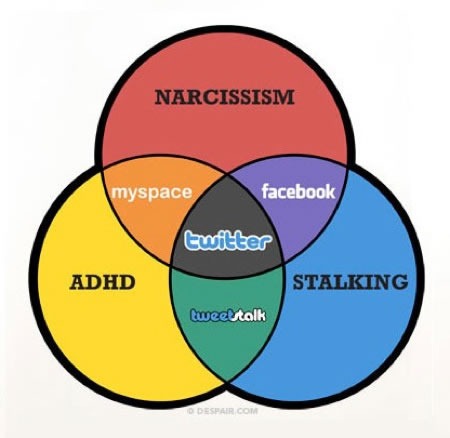
Social Software Venn Diagram

by Joey deVilla on September 8, 2009

Yeah, that’s about right:

social_software_venn_diagram

And better yet, it’s available as a T-shirt!

venn_diagram_t-shirt

[Found via Kevin Kelly.]

{ 2 comments }

My Question About the Twitter/Facebook DDOSing

by Joey deVilla on August 7, 2009

Matt Damon as Jason Bourne

When I read that Twitter and Facebook were attacked for the sake of targeting one guy, my first thought was “Who is this guy, Jason Bourne?”

{ 0 comments }

Today: Coffee and Code, and Other Geeky get-Togethers

by Joey deVilla on February 24, 2009

This article originally appeared in Coffee and Code.

The cast of "Hackers"

Coffee and Code is happening today, Tuesday, February 24th, from about 1:30 p.m to 5:30 p.m. at Le Gourmand, (152 Spadina, on the west side, south of Queen and north of Richmond).

It’s not the only geeky get-together in Toronto today:

  • The Developer Lunch (the 10th so far!) takes place today at Noon at Sky Dragon restaurant, on the top floor of Dragon City mall, at the southwest corner of Spadina and Dundas.
  • Later this evening, I’ll be at HacklabTO’s open lab, which takes place every Tuesday night. I’m bringing the Xbox 360 with me, although the Rock Band kit will have to wait for some other night.
  • Also tonight is FacebookCamp 5, a.k.a. Facebook Developer Garage. It’s at MaRS and starts at starts at 6:30. Admission is free.
  • UX Book Club Toronto is meeting tonight at C’est What at 6:30 p.m.. Tonight’s book: user experience guru Bill Buxton’s Sketching User Experiences: Getting the Design Right and the Right Design.

{ 2 comments }

Future Man Tried to Warn Us

by Joey deVilla on February 23, 2009

Early 1960s businessmen talking to man in astronaut suit: "So you're saying people will 'tweet' what they're eating for breakfast?" "And 'upload' pictures of their breakfasts to a 'Facebook'?" "And other people will look at the breakfasts and make comments?" "No offense, future man, but is everyone in your time retarded?" "Sorry to burst your bubble, dudes, but you asked. Yes, that's the future."
Click the photo to see its source.

{ 3 comments }

“You have an Angry Mob invitation!” mock-up

For the second time in a week, a group of Canadian Facebook users may have broken the law by publishing the names of youths charged under Canada’s Youth Criminal Justice Act. This law puts limitations on the publication of the identity of people charged under it; the basis for this is that revealing their names would be detrimental to rehabilitation and to public safety. The publication ban also applies to the identities of victims and witnesses in cases where people are charged under the act. There are exceptions to this gag order, such as in cases where the crime is transferred to adult court or if the youth court has found the accused guilty and imposed an adult sentence.

It happened with the first homicide of the year here in Toronto, in the case of a 14-year-old girl who was murdered on New Year’s Day. While newspapers, TV and radio stations and their associated websites complied with a 24-hour ban forbidding the publication of the victim’s name, some Toronto Facebook users created a memorial group in which both the victim and her two accused killers — a 17-year-old boy and 15-year-old — were named. The group was created by a 16-year-old who said “felt entitled to ‘pay attention’ to someone who was special to him and who had no idea he might have been violating the Youth Criminal Justice Act.

It happened again, this time in Alberta, where the names of four teenage boys accused of microwaving a cat to death were published in a Facebook group. Reactions were (understandably) harsh, with posted comments like “I think people like that should be shot”, “They will all get their faces smashed in by January 6th” and ” would say these monsters should be tortured, let society at them”.

These appear to be cases where technology has entered a grey area with the law. Referring to the case of the 14-year-old murdered in Toronto, a Toronto area constable said that “It’s a very good question if the people who post things on Facebook are actually breaking the YCJA. I guess it all boils down to whether Facebook is eventually determined by somebody that it is a publication.” In the story on the Alberta boys who accused of killing the cat, a British Columbia lawyer is of the opinion that the YCJA was broken and — as even someone at their first day of law school will tell you — ignorance of the law is no excuse.

My own opinion is that posting things online, whether in a blog, social network site, wiki or any other public online forum, is publication, even if you’re not doing it professionally. If online publishing gives you at least the same potential audience and reach as a city newspaper, then as an online publisher, you also have the same legal and ethical responsibilities that a city newspaper has.

Luckily for me, I worked at Crazy Go Nuts University’s main student newspaper, where we got brief on Canadian law and journalism and benefited from having one of the Globe and Mail’s lawyers do a regular Q&A session with us. I may not be able to quote chapter and verse of Canadian journo law, but I think I’ve can do a decent job at “sniff testing” to see if a posting will get me in legal hot water. I think that a number of bloggers — people who post articles on a regular basis — have made themselves familiar with the legal aspects of blogging, although I’m sure a number haven’t. Things can get hairy on online forums like Facebook, which is made for people who don’t publish regularly but do want some kind of online presence. On these places, users probably don’t think of themselves as publishers and might be unaware that they’re opening themselves up to charges of libel, defamation or violating the YCJA.

Paging Canadian lawyers who specialize in the internet — fellow neighbourhoodie Rob Hyndman, and friend-by-correspondence Michael Geist, I’m lookin’ at you! Do you know of any places where a Canadian blogger or Facebook user can find out more about the law and online publsihing?

{ 1 comment }

Gag Orders in a Facebook Age

by Joey deVilla on January 5, 2008

“For 24 hours, newspapers, TV and radio stations were legally forbidden to release Stefanie Rengel’s name [a teenage girl in Toronto allegedly murdered by a teenage boy, allegedly at the request of his girlfriend, also a teen], but on the Internet tributes to the slain teen – and the names of her accused killers – sprang up almost immediately, including on the social networking site Facebook.

{ 0 comments }

Unwitting Facebook Spokesmodels

by Joey deVilla on January 2, 2008

If you’re going to become a fan of a business on Facebook, you’d better make sure that your profile photo is a good one — you might end up as that company’s unwitting spokesmodel!

{ 0 comments }