
If you were at spARK Labs in St. Pete last night for AI Salon: St. Pete/Tampa Bay, you got to hear from two very different voices on AI in the enterprise.
Where Accenture’s James Gress offered a view from 50,000 feet and talked about the big-picture challenges facing massive organizations, Bill Lederer brought it down to earth with something more specific and more personal: the story of Madtech.AI, his B2B SaaS startup, built in St. Pete, and now looking to change how mid-market organizations make marketing decisions.
Bill’s been in this space a long time. He’s been a Wall Street executive, a professor, and now he’s a founder. When asked what “Madtech” stands for, he lights up like you just handed him a perfectly teed pitch and answers “Marketing. Advertising. Data. Technology.” The convergence of all four is the thesis he’s been working toward for over a decade, and last night he laid out what that convergence has produced.
Bill’s Madtech presentation
The Problem: Your data’s a mess, and you know it!
Madtech.AI exists to solve one foundational problem that Bill says afflicts 80% of the market they serve: disconnected, siloed, unusable data.
This isn’t not a glamorous problem. It doesn’t make for great conference keynotes. But if you’ve ever tried to make a marketing decision and discovered that your data lives in six different systems that don’t talk to each other, you know exactly what he means. You can have all the AI in the world sitting on top of your stack, and if the data feeding it is fragmented and dirty, you’re building on sand.
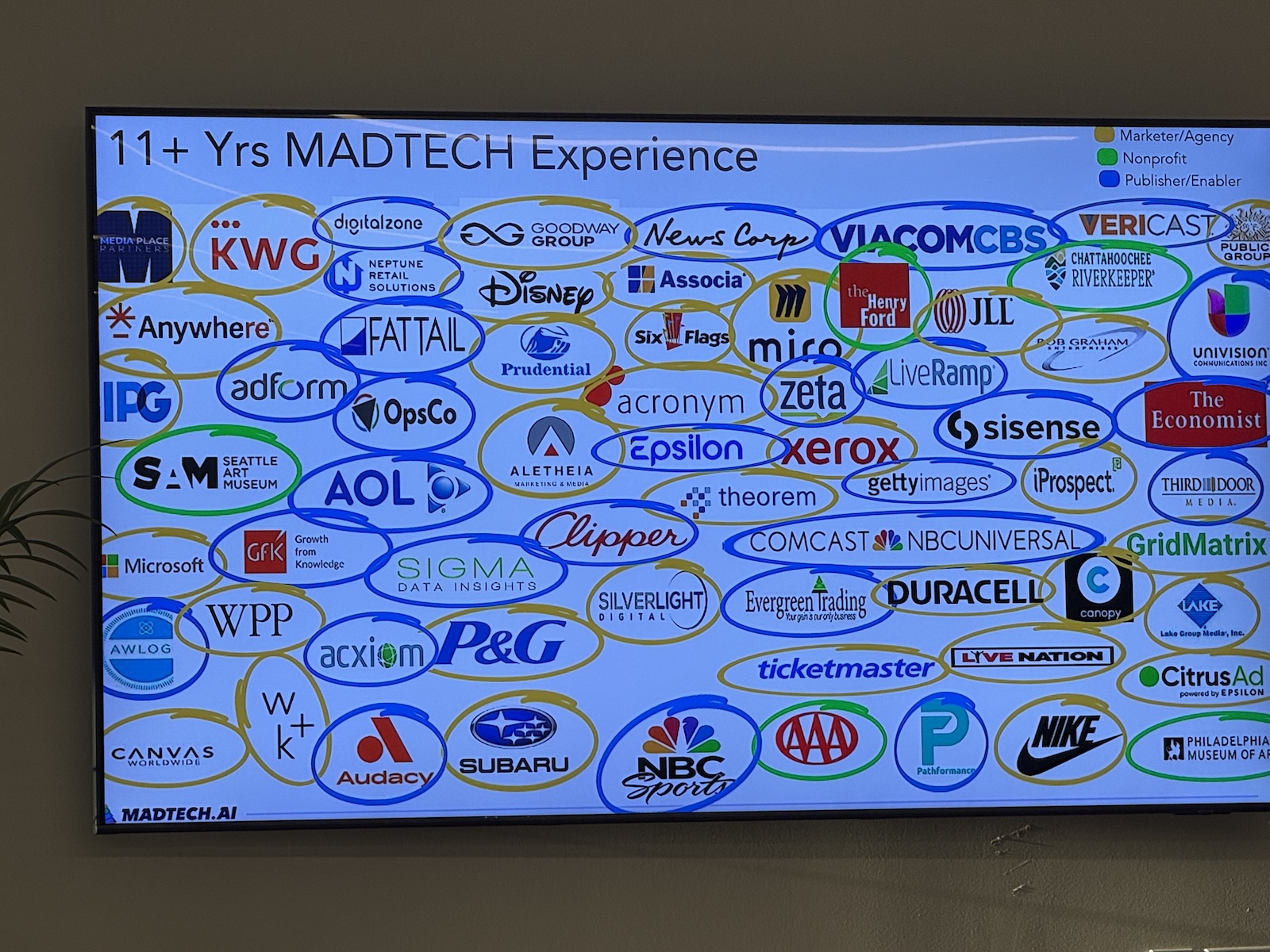
Bill and his team have spent roughly ten years in the unglamorous trenches of this problem, building data connectors, ETL and ELT pipelines, transformation tools, data warehousing. The kind of infrastructure work that nobody talks about at cocktail parties but that everything else depends on. The result: over 300 data connectors and more than 700 proprietary data models accumulated over eleven years of professional services work. That’s a significant moat, even if it doesn’t sound like one.
The metric that stopped the room
Here’s the number that got people’s attention (mine included): building a data pipeline used to take six to nine person-hours. Madtech.AI has that down to three minutes, fully deployed and tested. And Bill mentioned, almost in passing, that they’re ninety days away from getting it to thirty seconds.
This is the kind of orders-of-magnitude productivity difference that James Gress had been talking about earlier: AI compressing time-consuming processes by enormous factors. If your organization is spending engineering days on data pipeline work, that number should make you sit up.
Who they’re built for (hint: probably you!)
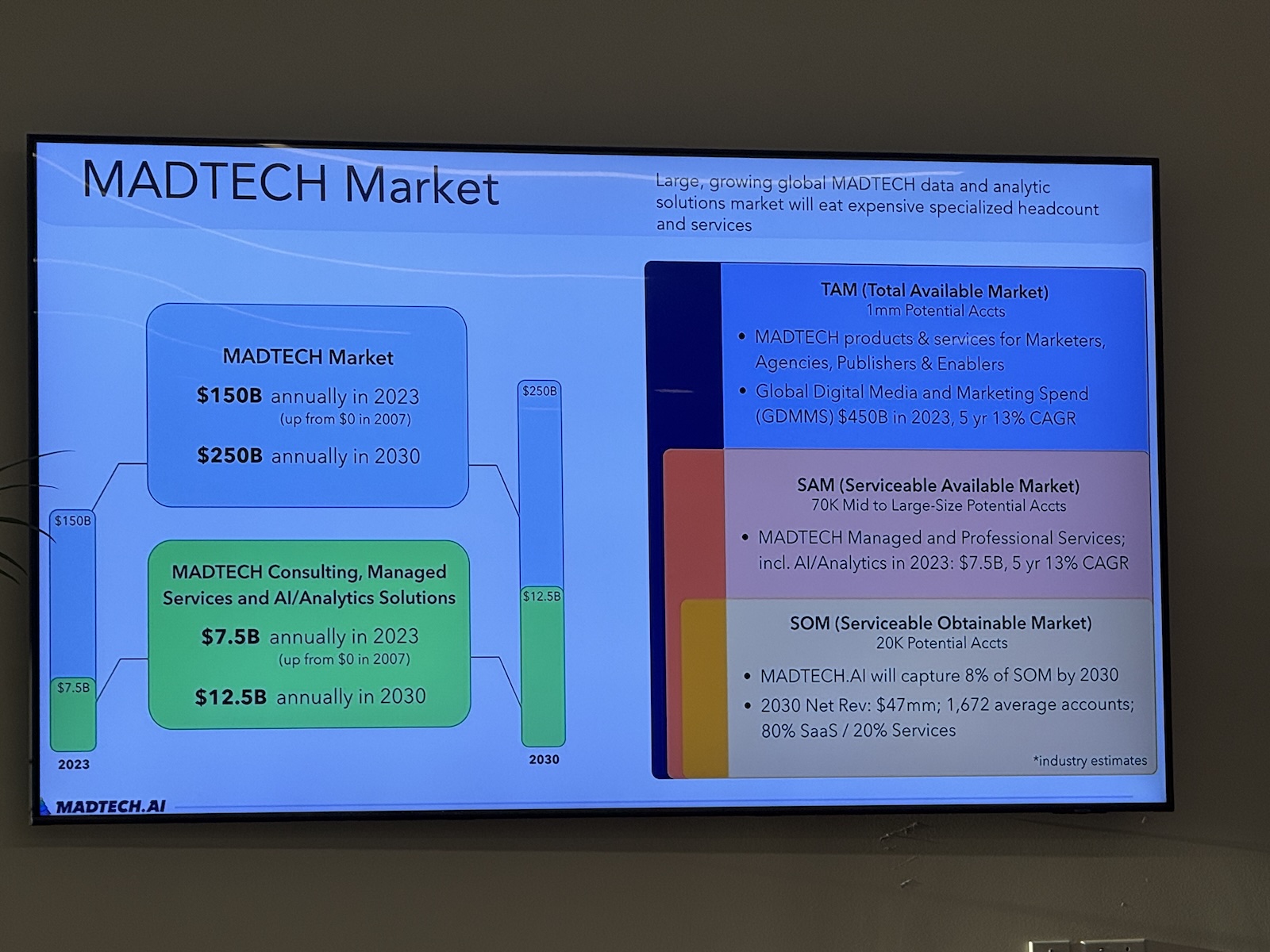
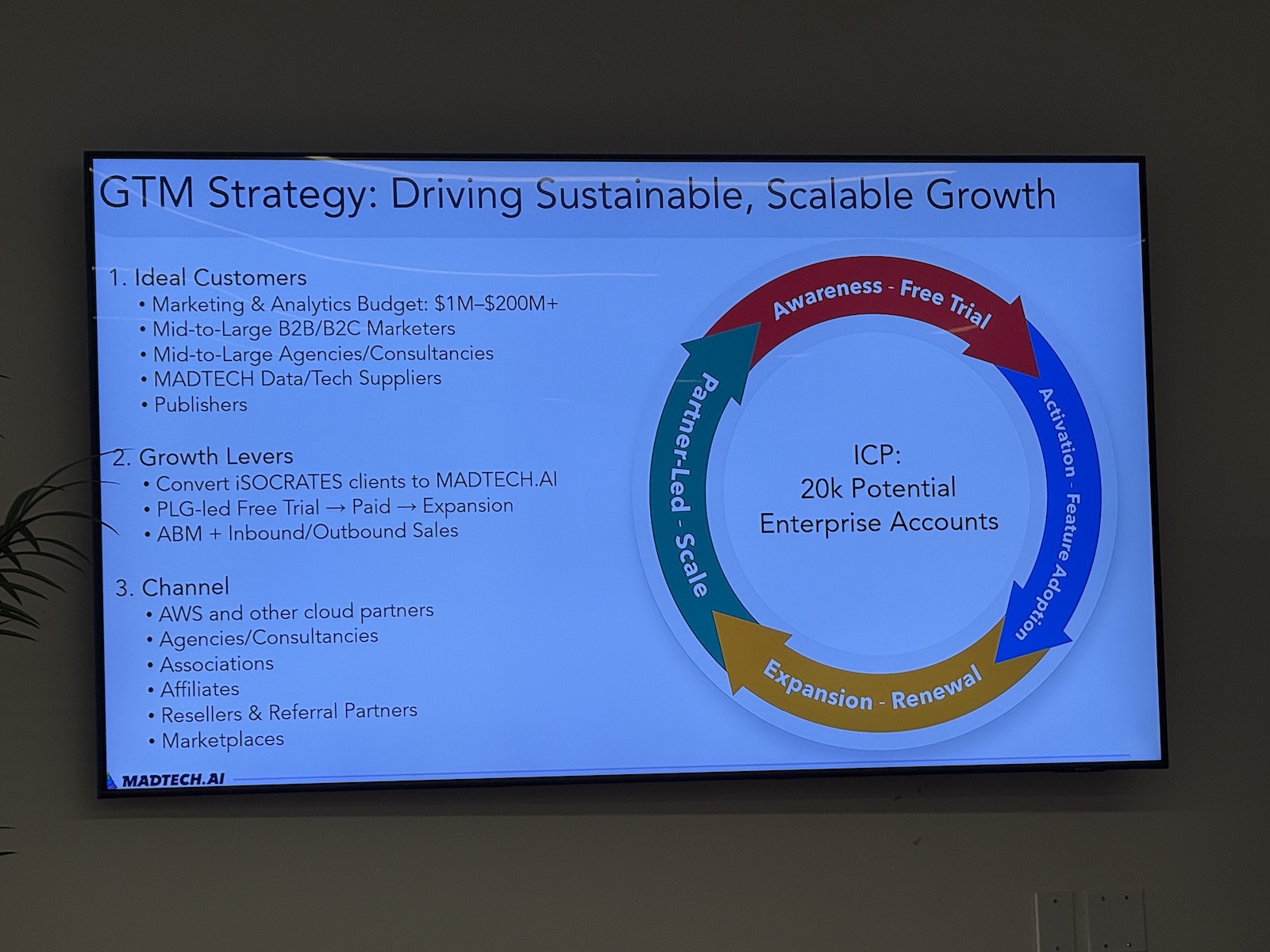
Bill was explicit about Madtech.AI not chasing the Fortune 500. He wasn’t thinking about enterprise clients when he built the platform. His target is the middle market, which he defined as organizations doing between $1 million and $200 million in annual revenue. They’re actively going after.about 20,000 target enterprises.
Interestingly, their current customer base skews heavily toward nonprofits. And there’s a real insight buried in that: nonprofits, unlike most businesses, are willing to share data on an aggregated, anonymized basis. That willingness unlocks something powerful. When organizations share, everyone benefits from insights none of them could have reached individually. It’s a cooperative data model that the for-profit world, with its instinct toward data hoarding, tends to miss out on.
Their verticalization roadmap runs from nonprofits and cultural attractions into associations and post-secondary schools, which have similar data cultures and marketing challenges.
The price point is the point
The platform, which includes a full data unification and transformation suite plus a marketing decision intelligence layer, runs $5,000 a month. Flat. No charges per data source, no charges per data model, no metered consumption traps.
Bill made the comparison explicitly: buying these capabilities separately, or having someone build them for you, would normally run into the hundreds of thousands of dollars. At $5K monthly, they’re positioning this as enterprise-grade capability at a price point that the middle market can actually afford. That’s the bet.
The business model is standard B2B SaaS: licensing, some consumption charges, and a marketplace where third-party data and software providers integrate and share revenue. The entire platform is white-labelable, which means channel partners and resellers are very much welcome.
They’re raising, and they’re hiring
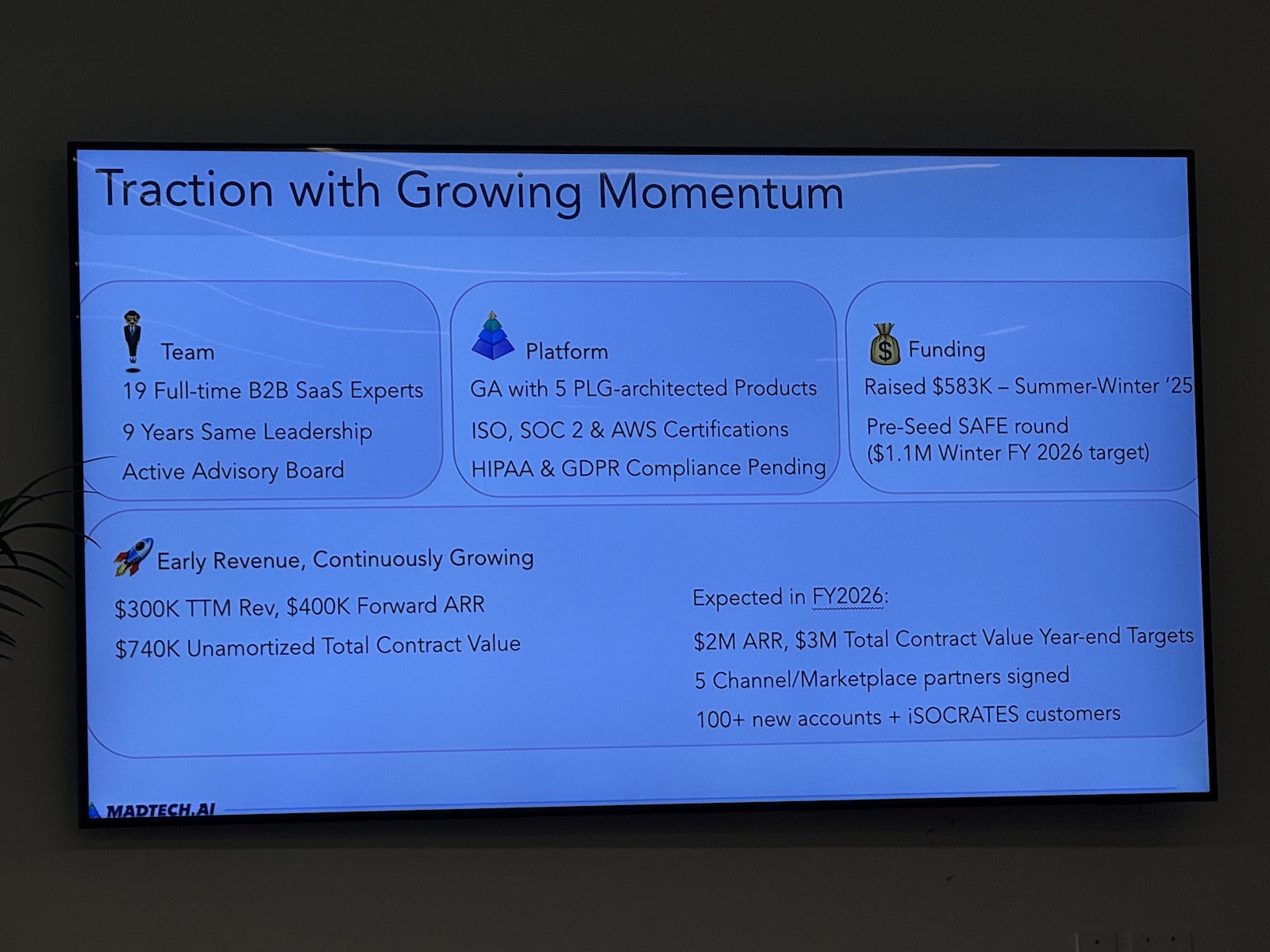
Bill was refreshingly direct about where Madtech.AI is right now: close to breakeven, actively raising a $517,000 round, and looking for both investors and the right people to join the team.
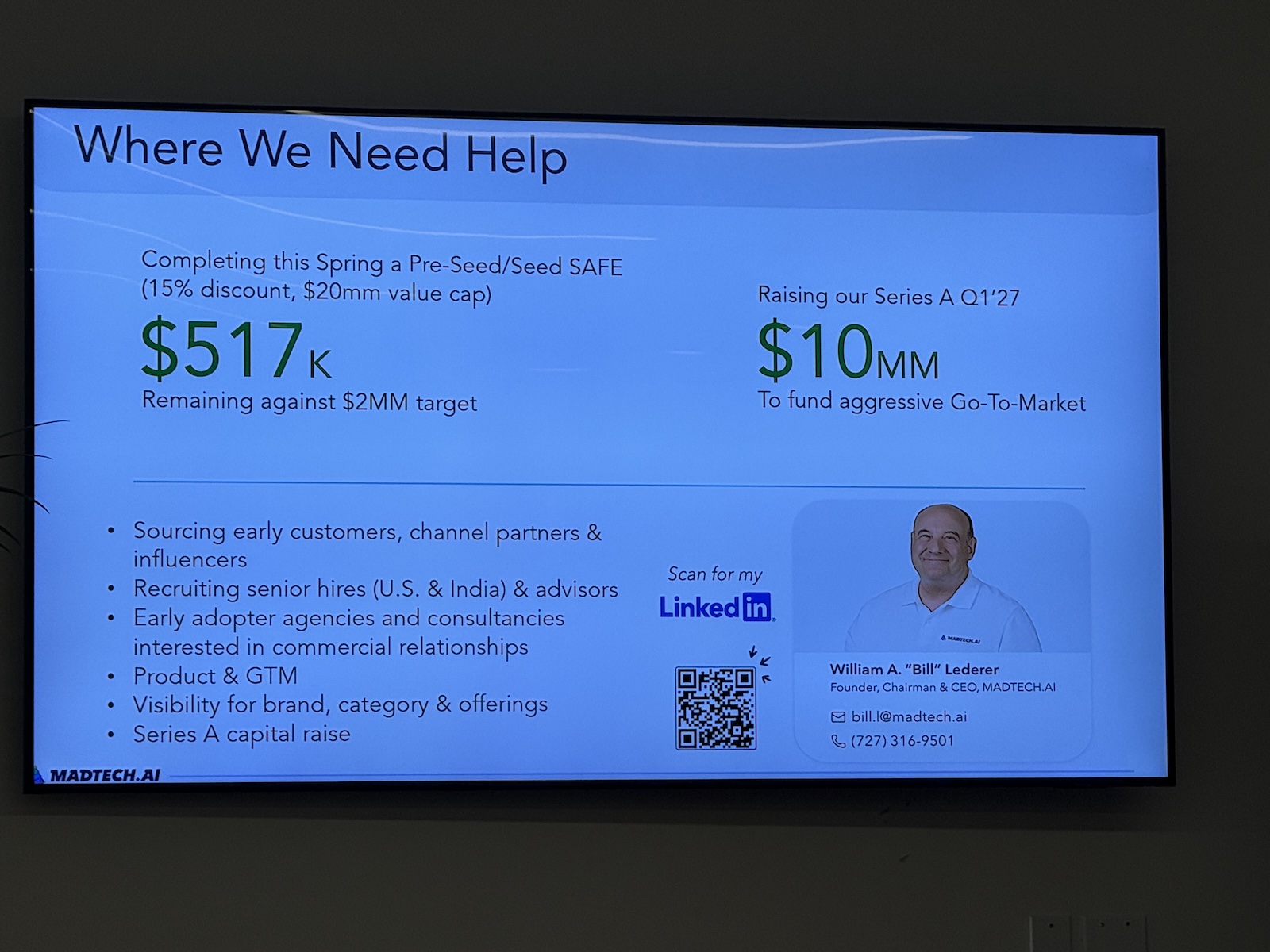
He also announced that Kyle Shea, a friend of twenty years, has joined as Chief Revenue Officer, relocating to St. Pete from Fort Lauderdale. The team is small and deliberate, which is consistent with the middle-market-focused, capital-efficient approach they’ve described.
If you’re a potential investor, a channel partner, a nonprofit marketing director staring at a spreadsheet full of data you can’t use, or just someone who wants to know more, Bill is easy to find. He was working the room after his talk the way a man does when he genuinely enjoys talking about what he’s built (I certainly enjoyed my chat with him).
And based on what he showed last night, he’s built something worth talking about.