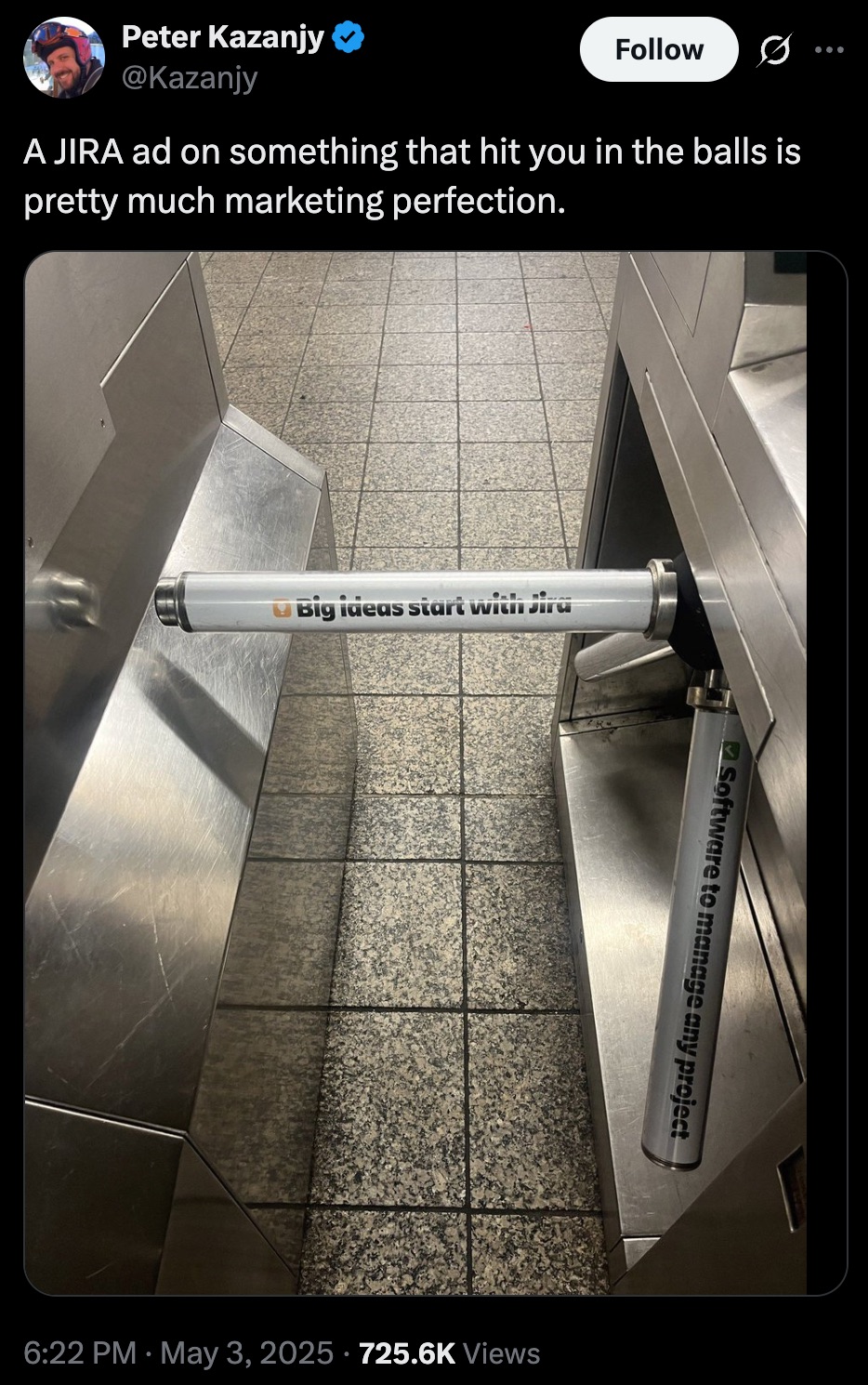
This was just too funny to save for next Saturday’s picdump. I don’t think Jira’s as bad as everyone makes it out to be, but I still laughed out loud when I saw this.
This was just too funny to save for next Saturday’s picdump. I don’t think Jira’s as bad as everyone makes it out to be, but I still laughed out loud when I saw this.
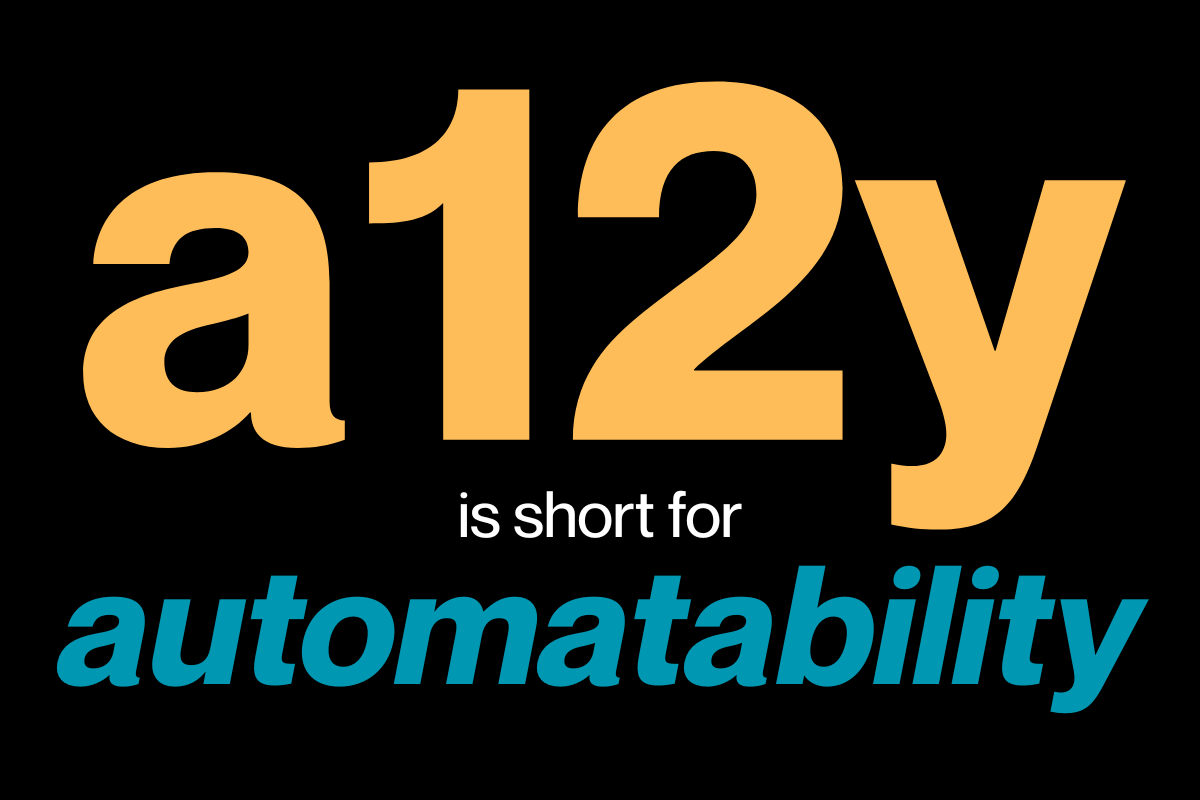
Let me introduce you to a shorthand term that I think will be useful soon: a12y, which is short for automatability, which is the ability to be automated.
(The term a12y indicates that the first letter is a, the final letter is y, and there are 12 letters between them. There’s a similar, better-known. shorthand term, a11y, which is short for accessibility.)
Automation is nothing new. It’s one of the reasons we use technology — from mechanical devices to computers to software and online services — to perform tasks with to reduce the work we have to do, or even eliminate the work entirely.
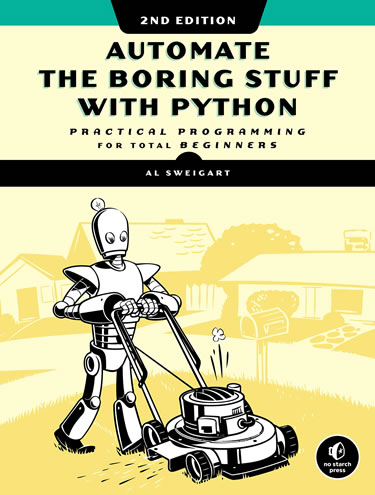
In the Python courses I’ve taught a few times at Computer Coach, I’ve covered how you can use Python to automate simple day-to-day work tasks and provided examples from one of the course’s core textbooks, Automate the Boring Stuff with Python (the entire book is available to read online for free!).
I’ve also created a number of Python automations that I use regularly. You’ve even seen some of their output if you’re a regular reader of this blog, since the weekly list of Tampa Bay tech, entrepreneur, and nerd events is generated by my automation that scrapes Meetup pages.
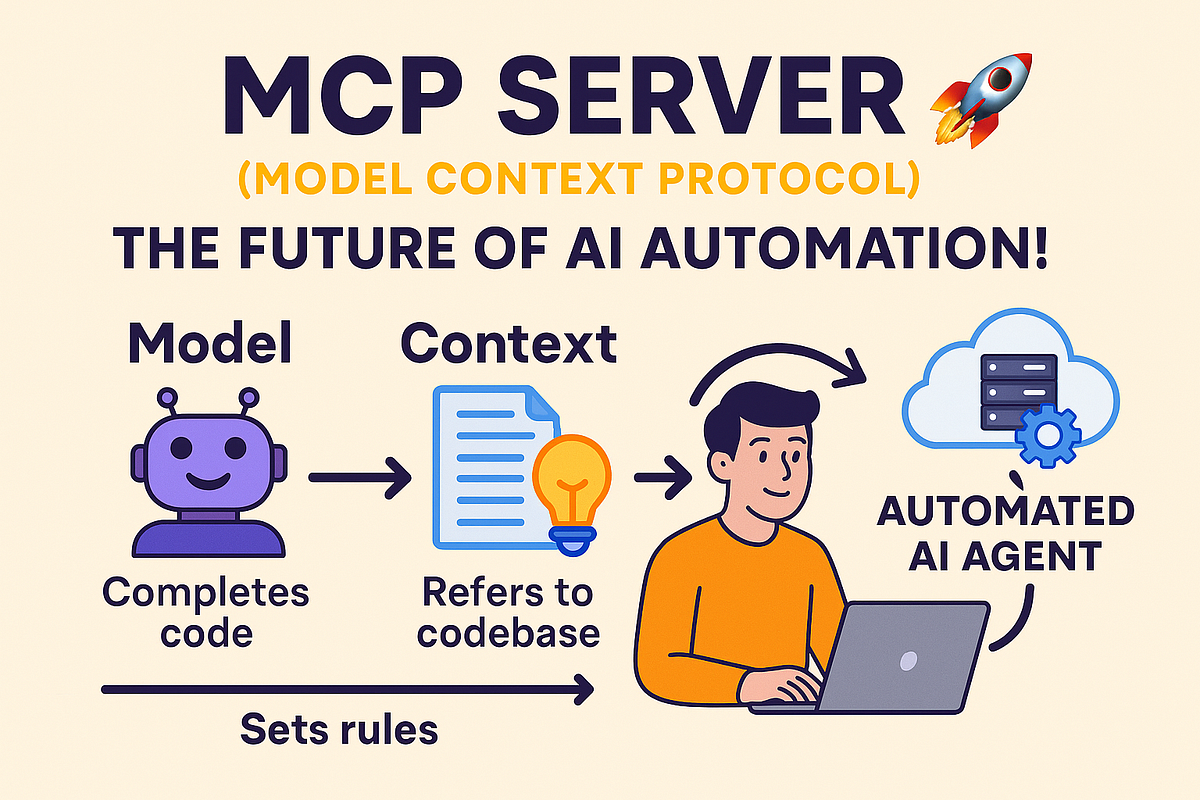
MCP is the latest buzzword in both AI and automation, or a12y with AI. Short for Model Context Protocol (and not Master Control Program in the Tron movies), MCP is a standardized way for AI models to go beyond simply generating answers and interact with external tools and data sources, such as APIs, databases, file systems, or anything else that’s connected to the internet and can accept commands to perform actions.
Simply put, it’s the next step in the path to creating AI agents that can perform tasks autonomously.
(Come to think of it, a10y might be a good shorthand for autonomously.)
We’ll cover all sorts of a12y topics in the upcoming Tampa Bay Python meetups! I’m currently working on the details of booking meetup space and getting some food and drink sponsors, but they’ll be happening soon. Watch this blog, the Tampa Bay Python Meetup page, and my LinkedIn for announcements!
 On Thursday, May 8th from 11 a.m. to 3:00 p.m. Eastern, O’Reilly Media will host a free online conference called AI Codecon. “Join us to explore the future of AI-enabled development,” the tagline reads, and their description of the event starts with their belief that AI’s advance does NOT mean the end of programming as a career, but a transition.
Here’s what I plan to do with this event:
Here’s the schedule for AI Codecon, which is still being finalized as I write this:
In case you missed organizer Joe Blankenship’s announcement, he’s become quite busy with his new venture, A Valid Company, and won’t have the bandwidth to run Tampa Bay Python.
As not only the organizer behind Tampa Bay Python, but also the Chief Data Officer of Certus Core and one of the people behind the Data4 conference, he’s a tech powerhouse, and we should expect to see great things from A Valid Company! I’d like to thank Joe for all the work he’s done for the local Python and tech communities.

…that would be me.
In case you’re not aware, I’ve been programming in Python since 1999. I had to learn it while on vacation the week before a Python programming job, and said vacation was at Burning Man ’99.

My favorite way to describe Burning Man is like a circus-meets-rave in the desert, and it’s up to you to provide the entertainment. The motto at the time was “There are no spectators; only participants.”

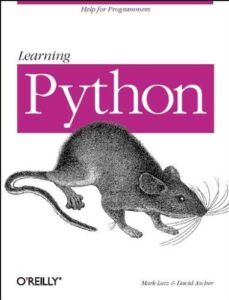
It turns out that most of the partying happens at night, and mornings at Burning Man are relatively mellow. The mornings were when I learned Python, armed with my trusty Toshiba Satellite 4015CDT (Pentium II running at 266 MHz; I’d boosted the RAM to 96 MB) and a paperback copy of Mark Lutz’s book, Learning Python (first edition, of course). I fell in love with the language — after all, any language that you can learn amidst the chaos of Burning Man has to be a good one!

Since then, I’ve been using Python for all sorts of things, including generating the weekly tech events list that appears on this blog every Friday. I’m honored to be the new organizer for Tampa Bay Python!
I’m already working on ideas for upcoming Tampa Bay Python meetups, but if you have suggestions for topics that Tampa Bay Python should cover, I’d love to hear them — just drop me a line at joey@joeydevilla.com or via any of my social media accounts.

PyLadies is an international mentorship group whose goal is to encourage more women to become active participants and leaders in Python’s open-source community. There are PyLadies chapters all over the world, including one right here in Tampa Bay: TampaBay PyLadies.
The problem is that the TampaBay PyLadies Meetup group doesn’t have an organizer, and if one doesn’t step up, Meetup will automatically close that group.
We need a PyLadies group here. Python is expected to be a high-demand programming language for some time (it’s still at the top of the TIOBE Index), and let’s face it: programming is a sausage party. We guys are pretty good at things, but we need the knowledge, wisdom, and perspective that women provide.
If you’re a woman in the Tampa Bay area and would like to help keep TampaBay PyLadies up and running, please consider becoming an organizer for TampaBay PyLadies Meetup. You don’t need to be an expert at Python; all you need is to be interested in Python and have enough organizational know-how to run a Meetup (it’s relatively straightforward) and the time to do so. And if you need help, we in the Tampa Bay Python community — myself included — will gladly provide it.
Want to step up and become TampaBay PyLadies’ organizer? You can do so on the TampaBay PyLadies page!

I’ve just been informed that I’ll be one of the speakers at the 2025 edition of KCDC — Kansas City Developer Conference — which takes place August 13 through 15!
This will be the 16th KCDC, and it’ll take place at the Kansas City Convention Center in downtown Kansas City, Missouri.

KCDC draws 2000+ attendees each year and features tracks for the following topics:
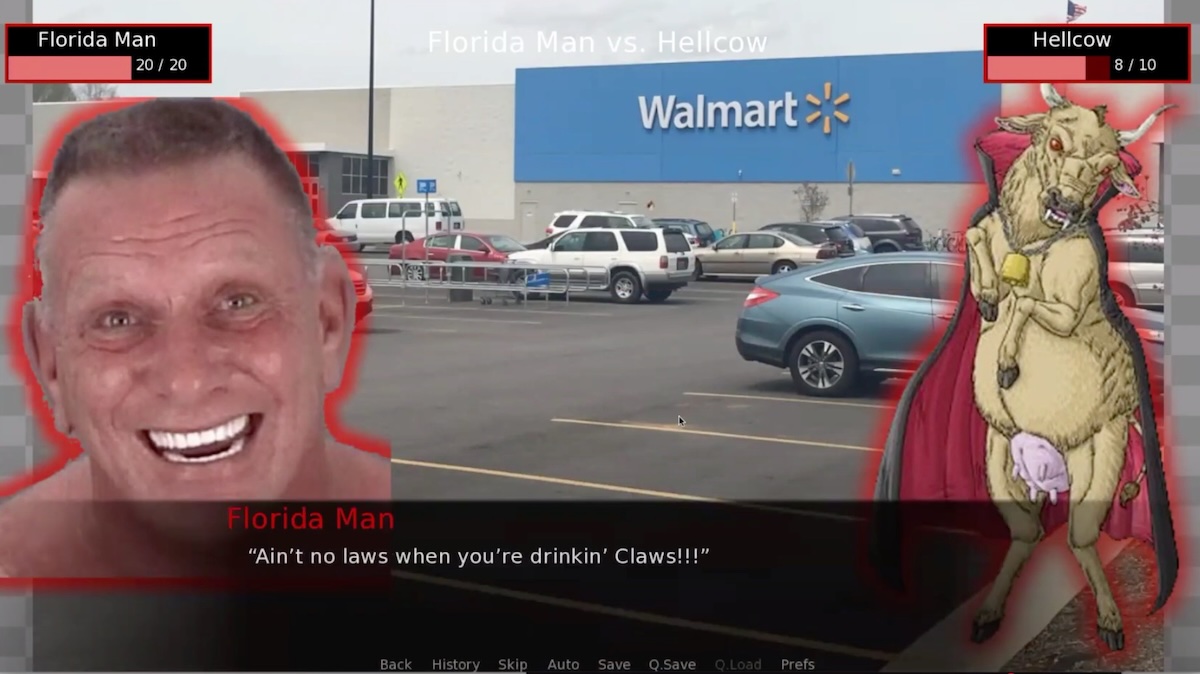 My talk, titled The Best, Most Fun Python Platform You’ve Never Heard Of, is a programmer’s introduction to the powerful, fun, and all-too-often-ignored Ren’Py. While Ren’Py is called a “visual novel engine,” I prefer to think of it as the fastest, most fun way to create Python applications.
Here’s the description for my talk:
Python’s occupied the number one spot on the TIOBE Programming Community Index for the past couple of years, and it’s the preferred programming language in for AI and data science. Perhaps you’ve been thinking about learning it, but the thought of having to do another set of “Hello World” style exercises is filling you with dread. Is there a more fun way to get up to speed with Python?
Yes, there is, and it’s called Ren’Py. It’s billed as a visual novel engine and often used for writing dating simulation games, but it’s so much more than that. It’s a platform that lets you code in Python (and more) and deploy to desktop, web, and even mobile platforms, and with a fraction of the effort required by React, Vue, or Angular. It’s a fun framework that’s been used to produce games you can find on Steam, but it’s got applications well beyond amusement.
In this session, we’ll look not just at the basics of Ren’Py development, but the building of a dating game based on KFC’s official game, “I Love You Colonel Sanders,” a simple turn-based combat game starring Florida Man, and building mobile apps in a way that’s less frustrating than usual.

Better still, I won’t be the only Tampa Bay geek speaking — Chris Ayers will be there too, and he’ll be delivering his talk, The Power of Dev Containers and GitHub Codespaces:
Dive into the future of software development with our session on Dev Containers and GitHub Codespaces. Dev Containers bring reproducibility and consistency across any platform with Docker, simplifying project onboarding and setup. GitHub Codespaces takes this a step further, offering scalable, cloud-hosted development environments, accessible from anywhere.
In this session, you’ll gain insights into:
- Dev Containers Fundamentals: Understand their role in creating consistent development environments.
- GitHub Codespaces Integration: Explore how Codespaces enhances Dev Containers, providing flexible, cloud-based development.
- Practical Implementation: Learn to configure Dev Containers for your projects, including tool installation, VS Code extensions, port forwarding, and software setup.
- Maximizing Codespaces: Discover how to customize Codespaces for remote development efficiency.
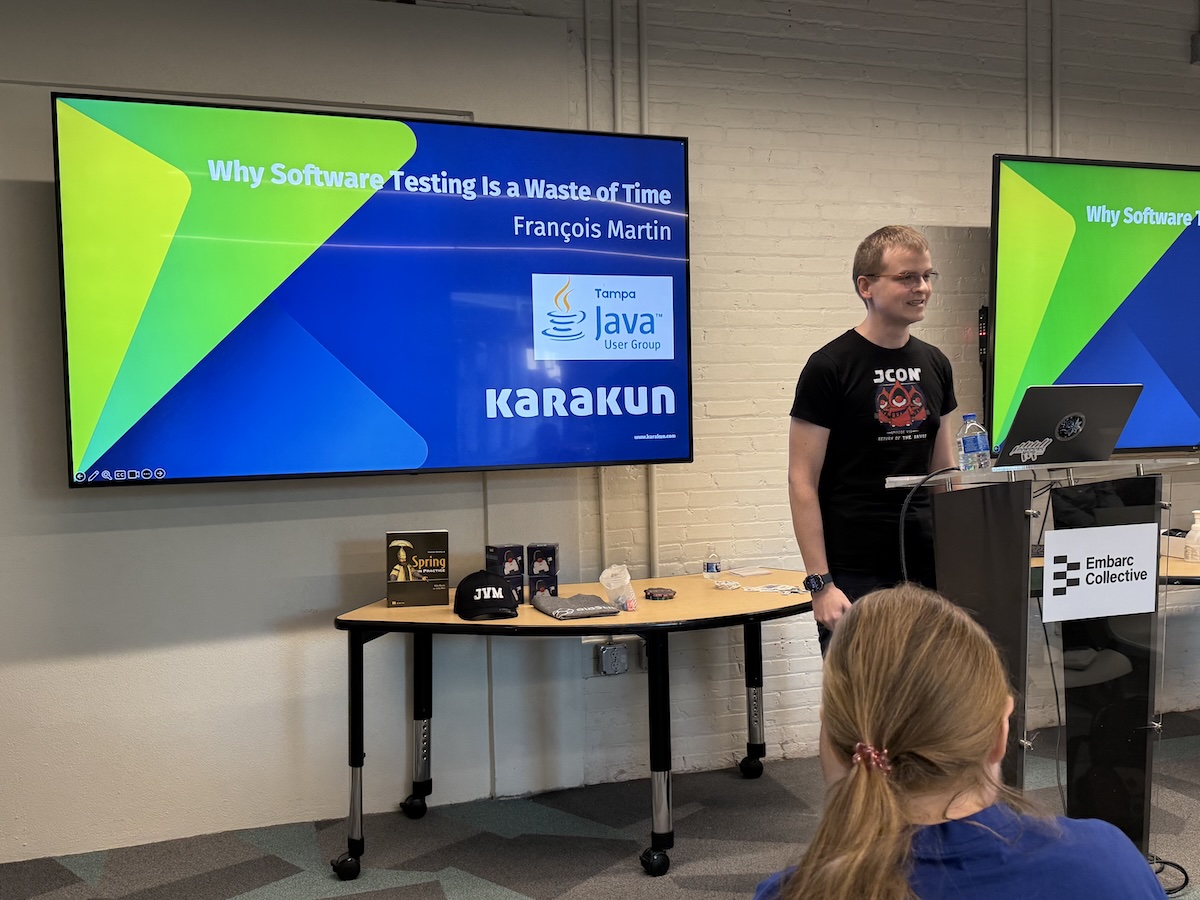
If you were at the March Tampa Bay Java User Group meetup, you saw François Martin deliver a presentation with a not-at-all-controversial title: Why Software Testing is a Waste of Time.
Anitra and I had the pleasure of taking him around Tampa while he was in town, and I even lucked out by being able to catch up with him for dinner while we were in Greece earlier this month!
He’ll deliver two talks at KCDC: