May 2007

Steve and Bill, Now

by Joey deVilla on May 31, 2007

Now that I’ve posted the “Steve and Bill, Then” video, here’s the highlight reel from their big keynote at the Wall Street Journal’s “D: All Things Digital” conference:

If you’re a “completist” sort and want to see the video of the entire talk, you can — the nice folks at the All Things Digital conference have put videos and a transcript of the entire keynote online:

{ 0 comments }

Steve and Bill, Then

by Joey deVilla on May 31, 2007

Here’s a video, courtesy of the D: All Things Digital folks that shows some key moments from a couple of times that both Steve Jobs and Bill Gates shared a stage:

  • The “Macintosh Dating Game”, from 1983
  • 1997′s “Let’s be friends again” presentation

{ 0 comments }

RAM Ain’t What it Used to Cost

by Joey deVilla on May 31, 2007

Preview of old computer magazine ad: “64K for $1495″
Click the image to see it at full size.
Scan courtesy of Miss Fipi Lele.

Wow, did RAM cost a lot back when S-100 Bus-based computers were big stuff.

As a point of comparison, consider today’s featured deal at NewEgg.com: 2 Gigs of RAM for $144.00. That’s more than 30,000 times the storage space for about one-tenth the price. The deal gets better if you expend the effort to mail in the form for the $50.00 rebate.

{ 0 comments }

“Spam King” Robert Soloway Arrested

by Joey deVilla on May 31, 2007

Let’s Go to Prison

Before I get carried away with news about Google Gears, Jobs and Gates at D5 and Palm’s why-the-Hell-did-they-make-that device, I thought I’d open with this little bit of news that shouldn’t be forgotten amidst all the current news noise.

It looks as though Robert “Spam King” Soloway is one step closer to becoming a Pruno connoisseur.

From a Yahoo! News report:

SAN FRANCISCO (AFP) – US prosecutors said they captured on Wednesday a nefarious Internet marketer responsible so much junk e-mail they called him “Spam King.”
ADVERTISEMENT

Robert Soloway, 27, was arrested in Seattle, Washington, a week after being indicted by a federal grand jury on charges of identity theft, money laundering, and mail, wire, and e-mail fraud.

Soloway is accused of using “botnets,” networks of computers, to disguise where e-mail originated and of forging return addresses of real people or businesses that wound up blamed for unwanted mailings.

If convicted as charged, Soloway will face a maximum sentence of more than 65 years in prison and a fine of 250,000 dollars.

Spamhaus has more details about Soloway’s career as a spammer:

Soloway has been a long term nuisance on the internet. He has been sending enormous amounts of spam for years, filling mailboxes and mail servers with unsolicited and unwanted junk email. In addition, he has fraudulently marketed his spam services to others as legitimate ‘opt-in’ services when they were anything but that, duping innocent users and then failing to provide promised customer support or refunds. Because Soloway spammed through hijacked computers and open proxies, he has repeatedly violated both the Computer Abuse and Fraud Act of 1984 and the CAN-SPAM law of 2003.

Soloway first appeared in the Spamhaus Block List (SBL) in 2001. In 2003, he was listed on Spamhaus’s Register of Known Spam Operations (ROKSO), a list of the world’s “worst of the worst” criminal spammers. Spamhaus spamtraps continued to receive spam solicitations from Soloway advertising his services through the weekend before today’s indictment.

Soloway’s violations of the U.S. CAN-SPAM law and various state anti-spam laws resulted in his being sued successfully by a number of plaintiffs, including Microsoft Corporation and Robert Braver, owner of an Oklahoma-based ISP. Both Microsoft and Braver received damage awards of millions of dollars. Soloway never paid these awards, claiming that he lived off of the proceeds of a family trust and was therefore “judgement-proof.” In September 2005 in Oklahoma City, after Soloway had fired his lawyers and then failed to appear to represent himself in court, U.S. District Judge Ralph G. Thompson issued a permanent injunction against Soloway, forbidding him to continue sending spam that violated the CAN-SPAM act. Soloway ignored this injunction as well and continued to spam.

For the incredibly curious (or if you’re one of those people who’s seen every episode of every variant of Law & Order), here’s a link to a PDF of Soloway’s Arrest Warrant.

{ 0 comments }

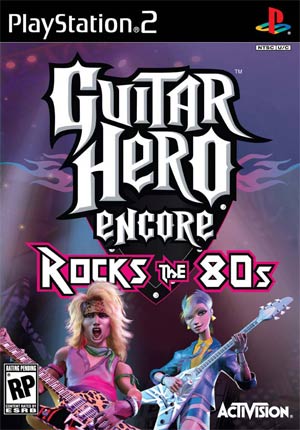
July 17th: Guitar Hero Encore Rocks the 80s

by Joey deVilla on May 30, 2007

Guitar Hero 2 Rocks the 80s

I was 12 when the 80′s began and 22 when they ended, so the music of that decade is pretty much seared into my consciousness. Hence my jumping for joy when I found out that a new Guitar Hero game featuring 80s rock is due on July 17th. Here are the tracks known to be included with the game:

  • Asia – Heat of the Moment
  • Billy Squier – Lonely Is the Night
  • Bow Wow Wow – I Want Candy
  • Dio – Holy Diver
  • Eddie Money – Shakin’
  • Extreme – Play With Me
  • Faster Pussycat – Bathroom Wall
  • Flock of Seagulls – I Ran (So Far Away)
  • Poison – Nothin’ But A Good Time
  • Police – Synchronicity II
  • Quiet Riot – Bang Your Head (Metal Health)
  • Ratt – Round & Round
  • Skid Row – 18 And Life
  • Twisted Sister – I Wanna Rock

As far as I can tell, it’s a PlayStation 2 exclusive. Since I am the owner of a PS2 (a Christmas present from my lovely and very understanding wife), I am left with one complaint: Where the Hell is the AC/DC?!

Party at my house on July 17th!

{ 8 comments }

Mesh Conference 2007

by Joey deVilla on May 30, 2007

Mesh Conference LogoIn all the hubbub about the D: All Things Digital conference, you may not be aware that the Mesh conference is taking place today and tomorrow in Toronto at the MaRS Centre, pictured below:

MaRS Centre in Toronto, close up.

Mesh is Canada’s premier web conference and features some big names for its keynote speakers. This morning, Mathew Ingram had a “fireside chat” with Michael Arrington, and tomorrow Stuart McDonald will do the same with Richard Edelman.

It looks as though the conference has already had its share of interesting moments. During his keynote, when Arrington spotted Ted Murphy, CEO of PayPerPost, he pointed him out and called him “the most evil person in the room”. I’m certain that the stuffed shirts at D5 (the popular shorthand for the D: All Things Digital conference) are too WSJ-run-event genteel to get into discussions this colourful.

There were a very limited number of tickets to the Mesh conference, so many people — your truly included — missed out as they sold out rather quickly. For those of you who still want to get in on the networking action at Mesh, thereare a couple of options:

  • There’s an unofficial unconference taking place in the open-to-the-general-public food court of the MaRS building. I may check it out tomorrow.
  • There’s an open-to-anyone-interested dinner tonight taking place at the Boiler House in Toronto’s Distillery District. The fun starts at 7 and I plan to be there, probably with wife and accordion.

{ 0 comments }

Yesterday, I wrote about how the “cyberwar” in Estonia seemed rather different from the way William Gibson depicted cyberattacks in his “Sprawl series” novels, most notably Neuromancer. I thought that as long as I was comparing speculations of what future tech would be like against how the future actually turned out, I should tie it in with the hot news of the moment, Microsoft Surface.

Microsoft Surface’s Promo Videos

In case you haven’t seen the promo videos for Surface yet, I’ve posted them below. Here’s the first one: Microsoft Surface – The Magic:

Thos one’s called: Microsoft Surface – The Power:

And finally, Microsoft Surface – The Possibilities:

Sun’s Starfire Concept Video (1992)

I mentioned Sun’s Starfire project in my post about Surface, but thought it deserved a front-and-centre mention. Starfire wasn’t a project to develop an actual platform, but to develop concepts that would eventually find their way into future platforms when the technology made it possible and show them in a video. The video is available online in MPEG-4 format, but you’d better have a good connection: it’s 270 megs in size:

Still from Sun’s “Starfire” video.
Click the image above to view the Starfire video.

Apple’s Knowledge Navigator Video (1987)

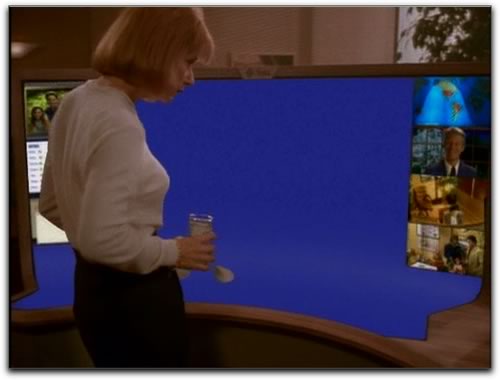
If the Starfire video gives you a sense of deja vu, it’s probably because you’ve seen Apple’s Knowledge Navigator concept video, shown below:

If the Starfire and Knowledge Navigator videos bear similarities to each other, they should; Apple UI guru Bruce “Tog” Tognazzini helped create both.

Next…

I’m going to post some notes on some of the concepts in the Starfire video that appear to have come to fruition with Surface as well as my notes on what they thought 2004 would be like back in 1992.

{ 2 comments }

This Thing’s Gonna Make Porn AWESOME!

by Joey deVilla on May 30, 2007

Somebody had to say it about Microsoft Surface; I just thought it might as well be me.

Microsoft Surface Spousal Swap

{ 0 comments }

“Microsoft Surface” logo.Microsoft’s Midnight Surprise? It’s Microsoft Surface, a large-area screen-and-multi-touch-surface computer. Here are some places to get started:

It’s pretty nifty technology, the sort of which we’d been waiting for since Bruce Tognazzini showed the world (okay, maybe not the world, but a couple of really interested people at Sun and whoever bought Tog on Software Design) his “Starfire Project” concept back in 1992, in which he showed a theoretical multi-touch surface computer hooked to a global network in the far-off year of 2004.

That’s all I’m writing for now; this Global Nerd’s gotta go beddy-bye.

{ 1 comment }

Microsoft’s Midnight Surprise

by Joey deVilla on May 29, 2007

Box in a plain brown wrapper with a question mark.

One minute after midnight tonight, Microsoft’s Entertainment and Devices division — the folks behind the XBox and Zune — will announce “something totally new…and it’s going to change the way people interact with technology.”

Here’s what Gizmodo has to say
:

The timing is good, since tomorrow is when Bill Gates and Steve Jobs get to point fingers at each other under the grandfatherly gaze of Grand Vizier Walt Mossberg, and in these heady iPhone days, Gates needs all the ammo he can get. But what the heck is it? We’re convinced Zune 2.0 is still a ways off, but then again, what else would this division be up to? Stay tuned, and we’ll get back to you with the details right around midnight.

PC World takes Gizmodo’s point and runs with it a little farther:

…while the two will likely talk about the last three decades of computing, when it comes to current tech Jobs is walking in armed with major-league cool. I’m sure Gates is hoping this new techno-thingie will let him talk about new Microsoft developments without audience members snickering.

Whatever it is, it’s not likely to be worth staying up for, but I’ll be up at midnight anyway, so I’ll report on what it is they’re unveiling.

{ 0 comments }

Cyberwar Ain’t What It Used to Be

by Joey deVilla on May 29, 2007

Cover of the 1984 paperback edition of “Neuromancer” by William Gibson.

In his “Sprawl” series of short stories and novels, William Gibson made many references to World War III’s “cyberwar” component, especially in the novel Neuromancer. Willis Corto, an important character in that novel, is the sole survivor of a particularly important but forgotten operation in WWIII called Screaming Fist, which I’ll let Wikipedia summarize:

Operation Screaming Fist was an American military operation aimed at introducing a major virus into a Russian military computer. One of the main characters of the book, Corto, took part in the operation as a colonel. The operation was significant in that it involved dropping the team assembled for it by flying them across enemy lines on light gliders, with each member plugged into the first prototype cyberdecks. Unfortunately, the operation had been grossly mismanaged and had not taken into account certain aerial defenses. As a result, Russian EMP weapons were used against the gliders shortly after they entered Russian airspace. In the ensuing chaos, Colonel Corto escaped in a Soviet helicopter gunship and was the only survivor.

While it wasn’t as visually dramatic as soldiers and hackers on ultralights descending on a Russian military computer installation in a daring night raid, the denial-of-service attack on Estonia is just as Gibsonian, judging by the way the news outlets have been tossing about terms like “cyberattack”, “first war in cyberspace”, “cyberattack” and “digital Maginot Line.

What I find really interesting is that the only futuristic thing about the whole affair are the “cyber-” terms used to describe it. The actual attack itself isn’t anywhere as exotic or future-tech-y as Neuromancer and all those other cyberpunk novels of the ’80s and ’90s made such things out to be. In fact, a lot of it seems so damned ordinary:

Cyberpunk stories Real world
Cyber-attacks often required physical infiltration of a heavily-guarded site by a team comprising crack paramilitary troops and “console cowboys”. The cyber-attack didn’t require anyone to physically go anywhere; it was all done online.
Cyber-attacks often required specialized viral software (“icebreakers” in Gibson’s novels, where “ICE” stood for “Intrusion Countermeasures Electronics”) that had to be written by AIs and were available only to the military or from specialized black market dealers like The Finn. Cyber-attacks do make use of specialized viral software, but they’re written by humans — often teenagers with plenty of spare time — and are relatively easy to obtain if you hang around the right online circles (or wrong ones, depending on your point of view).
Cyber-attacks were typically pulled off using very specialized hardware built by hardware gurus. Here’s a line from hardware specialist Automatic Jack from the short story Burning Chrome:

I knew every chip in Bobby’s simulator by heart; it looked like your workaday Ono-Sendai VII, the `Cyberspace Seven’, but I’d rebuilt it so many times that you’d have had a hard time finding a square millimetre of factory circuitry in all that silicon.

This cyber-attack was carried out by a botnet, which is essentially a lot of ordinary home computers — stock machines and “commodity hardware” — whose spare cycles are being harnessed by a virus that probably found its way in there via spam, malware site or some other rather ordinary vector.
Cyber-attackers interfaced with their machines by “jacking in”; that is, linking themselves to their machines through electrodes, through which they’d operate in a virtual reality-like environment.

If they ran into “Black Ice”, a deadly form of anti-malware countermeasures, their nervous systems would get fried.

Cyber-attackers interfaced with their machines by “logging in”; that is, linking themselves to their machines through a keyboard, mouse and monitor, through which they’d operate in a command-line environment.

If they typed too long without a break, they’d get carpal tunnel syndrome and their wrists would get fried.

Cyber-attack targets were fancy-pants specialized computer installations accessible to few, such as military supercompters in Neuromancer’s backstory or the AI complex in its climax. The cyber-attack target was the Estonian internet, which people used for everyday activities, from banking to email to looking at pictures of other people’s cats with funny captions.
Fashion: Many hackers wore leather, black jeans and mirrored shades. Hey, this is also true in real life! Score one for Gibson!

{ 18 comments }

Shut Up and Play

by Joey deVilla on May 29, 2007

In Ars Technica article titled Meet the “users”: We don’t talk, we don’t like you, we just want to play, Ben Kuchera writes:

I’d like to introduce you to one of the more unknown tribes in the online community. We rarely talk about them because they’re not as annoying as the griefers or as rampant as the “I have to take a bong hit now” people on Xbox Live, but they’re out there. I’m ashamed to say I’m one of them. We’re users. We don’t hook up our headsets, we mute your voice, and we just play the damn game. We’re not here to make friends, and if you extend an invite, it will just get rejected. We rarely leave feedback. For us online gaming isn’t social; most people on Xbox Live aren’t worth being social with. You may be on the other end of the line chattering away about the game, but we’re not listening.

Part of the problem with a system where you can play with any idiot out there is just that: you can play with any idiot out there. How long would you be able to tolerate these guys yelling into your headset?

In a Facebook/MySpace/Twitter world, it’s easy to forget that there are reasons why gamers go online other than social networking. Before the internet became a household world, people played networked games for a very simple reason: human opponents are far more interesting than AIs.

Ben Kuchera’s article is something that game designers should keep in mind, but it’s also something that developers of social networking applications should also consider. One of the reasons that social networking applications are popular is that there are ludic or game-like aspects to many of them, and as with games, sometimes we’d rather you just shut up and play.

{ 0 comments }

LOLCODE, the LOLCat Programming Language

by Joey deVilla on May 28, 2007

Cat at computer: “I can has programming language?”

The moment Anil Dash published his now-famous blog entry on the grammar used by lolcats, Cats Can Has Grammar, the door to studies that were equal parts silly and serious was opened. Not to be content with mere lexical and semiotic analysis of lolcats, some folks have taken it to the next level: the LOLCODE programming language.

LOLCODE is your standard Algol-style programming language (Algol is the grandfather of just about every popular current programming language) married to the lolcat captioning style — that is, ALL CAPS and I CAN HAS SILLY CAT GRAMMER AND SPELING KTHXBYE.

Here’s HAI WORLD, the LOLCODE version of “Hello, World!”:

HAI
CAN HAS STDIO?
VISIBLE "HAI WORLD!"
KTHXBYE

Here’s something that outputs the numbers 1 through 10, a classic beginner’s exercise:

HAI
CAN HAS STDIO?
I HAS A VAR
IM IN YR LOOP
	UP VAR!!1
	VISIBLE VAR
	IZ VAR BIGGER THAN 10? KTHXBYE
IM OUTTA YR LOOP
KTHXBYE

And finally, here’s a program to print the contents of a specified file:

HAI
CAN HAS STDIO?
PLZ OPEN FILE "LOLCATS.TXT"?
	AWSUM THX
		VISIBLE FILE
	O NOES
		INVISIBLE "ERROR!"
KTHXBYE

If someone’s working on an IDE for this language, I have very important stylistic advice: it should make heavy use of the Impact font, just like all those lolcat captions. Bonus points if it’s Impact with a white fill and black stroke!

{ 18 comments }

A Million Fools and Their Money Have Been Parted

by Joey deVilla on May 28, 2007

Somehow — Mind control? Bribes? “Buy this Zune or we’ll kill this puppy”? — a million Zunes will have been sold by the end of June, according to Robbie Bach, president of the Entertainment and Devices Division of Microsoft.

As good as this news is for Microsoft, this is even better news for you if you’re about to do some dog-and-pony shows for investors. You can simply pull out this story and say “This is why we’ll be able to find customers: somewhere, out there, are at least a million people who’ll buy anything.”

1 Million Zune Fans Can Be Wrong
My apologies to the King for riffing on his album design.

Over at CrunchGear, Vince Veneziani put these numbers in context:

I can understand maybe a smaller company getting excited over selling a million devices, but Apple in Q4 of last year alone sold 14 million iPods. Yeah, 14 million people bought iPods. Now those Zunes seem pretty dinky in comparison, eh?

Other esteemed colleagues in the tech blogosphere are equally unimpressed. Engadget says:

While Bach sees that as a “good start” he admits that the Zune hasn’t quite gotten as social as the company would like, saying that “when your installed base is a million, the benefits of sharing, frankly, aren’t as wide as we hope to see in the future.” Unfortunately, Bach didn’t get very specific about any future Zune plans, choosing instead to talk up the pink and watermelon-colored Zunes, which’ll surely make all the difference.

Dan at UNEASYSilence:

This weekend I made a conscious decision to give my iPod a week off and go Zune only. Come on, the thought of access to unlimited subscription music, and FM radio (not a fan of the brown, but whatever). So, I kicked my second laptop into BootCamp, made the Vista plunge and installed the Zune software.

Long story short; the software installation process was quite possibly the worst experience ever, but that was quickly eclipsed by the HORRIFIC ass backwards annoying Zune software/syncing experience. After HOURS of coaxing I think I have the damn thing working. I’ll report back at the end of the week on how the rest of the experience was, but I am left puzzled HOW Microsoft sold a million of these to suckers customers?

{ 0 comments }

Zombies Less Annoying Than MySpace Users

by Joey deVilla on May 27, 2007

Zombie biting iMac at the San Francisco Apple Store.
“Hey, buddy! You bite it, you bought it!”

I’ve always suspected it, but now I have proof. Consider what happened when a flash mob-like gathering of zombies in San Francisco passed by the downtown Apple Store:

It may be worth noting that the Westfield Mall and Disney security tried to bar the zombies from entering, but Apple store security did not. In fact, salespeople were jostling one another for a position where they could take the best photo of the zombies (or themselves with the zombies, or their brains being eaten by the zombies).

MySpace mom and daughter.
Note the blank, soulless eyes, the mindless expressions, and the hunger for destruction and human brains. These are MySpace users.

Contrast that with why Apple Stores have made it so you can’t access MySpace pages on their display machines:

An Apple Store employee (who does not work in the Fifth Avenue store), confirmed to CNET News.com that this has been an ongoing problem. “MySpace is a big issue for the Apple stores because people come in, Photobooth themselves (using Macs’ built-in webcams), then stick their picture up on their MySpace account and loiter at machines for hours,” the source said in an e-mail. “It is especially troublesome at the flagships and high-volume stores, and for a while there was no official word on how to deal with it.”

Based on these two stories from this week, I must conclude: the shambling, bloody and moaning legions of the undead are far more easy to put up with and less disruptive to business than the shambling, moody and whining legions of MySpace users. And now we have proof.

Excerpt from Wondermark! #223.
Excerpt from a Wondermark! comic. Click the image to see the full comic.

{ 0 comments }