by Joey deVilla on August 25, 2007

Last Night in the Hipster Trap
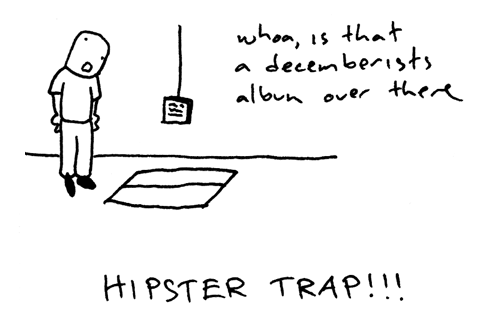
Although Toronto’s Tranzac Club was founded in the 1930s as a place for the preservation of Australian and New Zealand culture, it’s also a Hipster Trap.
The club is located in the neighbourhood known as The Annex, a tree-lined old residential neighbourhood close to the University that’s home to both students and faculty. Bloor Street, Toronto’s main east-west street is its southern border, and as a result, the stores, restaurants and bars tend to cater to the crowd that likes to hang around university neighbourhoods. Hence the high concentration of Hipster Traps.
I was at the Tranzac Club along with my wife, the lovely Ginger Ninja, to see my old college buddy Karl Mohr, who was performing his songs on solo piano as the opening act for the Parkdale Revolutionary Orchestra. Karl’s performance could be described as a goth vaudeville musical act (imagine Peter Murphy dressed as a warrior from Dune, while the Parkdale Revolutionary Orchestra turn pop on its ear by combining orchestral instruments and arrangements with operatic vocals and not-quite-conventional song structures.
I wasn’t just an audience member, either — I was also there to provide accordion backing and a solo for Karl’s final number, a maudlin-yet-catchy tune titled Can Your Remains Be Buried With Mine? For this number, Karl stepped away from the piano and sang while guitarist Ian Revell and I backed him up. He got a volunteer from the audience to participate in some pantomime, “dying” through the song’s four verses.
It was the last place I expected to hear a conversation about Facebook development.
Overhearing an Unlikely Developer
After joining Karl for his last number, there was the usual between-act shuffle as people went to the bar to get more drinks, to go to the bathroom or to chat with their friends. My cold was getting worse, so I figured I wouldn’t be able to stay for the full main act. We took a couple of seats near the door, and as I sipped the last of my beer, I overheard a conversation at the next table.
“Everybody’s on Facebook now. We’re supposed to be one of the biggest Facebook cities on the planet [for a while, we were the city with the most Facbookers, but we've since been beaten out by London. We've still got them beat on a per-capita basis]. It’s so big that I think I’m going to learn PHP just so I can write a Facebook application.”
I turned to see who was talking. The would-be Facebook developer was a woman in her twenties, in a brown t-shirt and wearing art school glasses, with her hair pulled back into two meatball-shaped ponytails. Probably a fan of Clap Your Hands Say Yeah or maybe even Danielson Famile if my busker senses are still working. She said that even though she hadn’t written a program since a computer class in high school, she had an idea for a Facebook app.
I don’t want to give away her idea before she’s even had a chance to try and make it real, but it should be enough to say that it’s cutesy-girly and no guy I know would ever install it (not even the gay ones), but I’m quite sute that she and her friends — the target audience for her app — would love it.
It’s one thing to see the Usual Suspects of Toronto’s tech community, the TorCampers — a large and active community of techies, marketers, entrepreneurs and others who work in high tech — express interest in developing Facebook apps at our usual gatherings as well as special get-togethers like the recent FacebookCamp. It’s something else to see someone outside our field say that she wants to learn some programming so that she can build a Facebook app for her and her friends. I don’t think I’ve seen a platform get a non-developer this excited about programming since HyperCard.
The Facebook API’s 3-Month Anniversary
It’s hard to believe that only three months have passed since the Facebook API was made available to the general public. In that short time:
- A number of Facebook developer get-togethers, including FacebookCamp Toronto, which was attended by over 400 people, have taken place. Facebook has flown representatives to some of these gatherings, including the Toronto one.
- Over 3,000 Facebook-approved applications written, with who-knows-how-many more that haven’t yet been submitted for review.
- The number one Facebook app, Top Friends, has been over 13 million users. Just under 50 apps have netted 1 million installations. The next 100 in rank have a total of over 100,000 users.
- The avenues connecting money to developers keep coming: there are a number of ad networks looking to place ads in facebook apps and venture capitalists seeking out developers to pair up with cash.
I wonder what we’ll be saying once the six-month anniversary rolls around. Hey, I wonder what I’ll be overhearing from unlikely developers come that time.
by Joey deVilla on August 24, 2007
by Joey deVilla on August 23, 2007
I’m rather fond of books that look at the strange connections between seemingly unrelated phenomena and turn ideas upside-down, so The Pirate’s Dilemma: How Youth Culture Reinvented Capitalism, a book coming out in January 2008, has caught my interest. It asks the question: Do we fight pirates, or do we learn from them?
In the copy-and-paste spirit of the book’s thesis, here’s the meat of the “About the Book” section of the book’s website:
How do you start a movement with a marker pen? What’s the connection between the nun who invented disco, and file sharing? How did a male model messing with disco records in New York in the 1970s influence the way Boeing design airplanes? Does hip-hop really hold the secret to world peace? How did three eleven-year-olds revolutionize the video game industry by turning Nazis into Smurfs? And what’s going to happen to Nike when it’s possible for kids to download sneakers?
The Pirate’s Dilemma tells the story of how youth culture drives innovation and is changing the way the world works. It offers understanding and insight for a time when piracy is just another business model, the remix is our most powerful marketing tool and anyone with a computer is capable of reaching more people than a multi-national corporation.
Ideas that started within punk, disco, hip-hop, rave, graffiti and gaming have been combined with new technologies and taken to new heights by the generations that grew up under their influence. With a cast of characters that includes such icons as The Ramones, Andy Warhol, Madonna, Russell Simmons, Pharrell and 50 Cent, The Pirate’s Dilemma uncovers, for the first time, the trends that transformed underground scenes into burgeoning global industries and movements, ultimately changing life as we know it, unraveling some of our most basic assumptions about business, society and our collective future.
As a result people, companies and organizations are now struggling with a new dilemma in increasing numbers. As piracy continues to change the way we all use information, how should we respond? Do we fight pirates, or do we learn from them? Should piracy be treated as a problem, or a solution? To compete or not to compete - that is the question – that is the Pirate’s Dilemma, perhaps one of the most important economic and cultural conundrums of the 21st Century.
As with any sort of book of this sort, its author, Matt Mason, has a supplementary blog. Its current article is titled 10 Industries Being Transformed by Pirates (For The Better). These 10 industries are:
- The Drug Industry
- The Movie Business
- The Law
- Doctors
- The Music Industry
- Phone Companies
- Body Parts
- Energy
- Education
- Wooly Mammoths
If all this has piqued your interest, you may also find the Q&A with the author, Matt Mason, interesting.
Tagged as:
youth
by Joey deVilla on August 23, 2007
What’s a blog for, if not to toot one’s own horn, or at least the horn of the company for whom he is a spokesmodel?
Tucows, where I’ve worked for four years and where I hold the title of Technical Evangelist, is on Canadian Business’ 2007 “Tech 100″ List, their annual listing of Canada’s 100 largest publicly traded companies. We’re right by the median, ranked at number 49 on the “Performance” list.
I like to think that at least a little chunk of that was my doing.
Tagged as:
Tucows
by Joey deVilla on August 21, 2007
Expect to see more maps embedded in blog entries shortly: Google Maps are now embeddable, YouTube-style. No longer do you need an API key or JavaScript know-how to add a Google Map to your blog entries and web pages — if you know how to embed a YouTube video, you also know how to embed a Google Map. Congratulations to Google on a job well done!
I decided to try it out by getting the code to embed a map showing the location of the Tucows head office, shown below:
View Larger Map
Tagged as:
Google,
User Interface / Usability
by Joey deVilla on August 21, 2007
Mark Mansour at the State of Flux blog wrote this about how he and his fellow developers use a Squishy Cow to do agile development:
At our end of iteration review, like all good agile shops, we go through what’s good, what could be done better, what still puzzles us and what we are going to do next time (but details on this are for another post). We also have The Exceptional Cow™.
Whoever has the cow is responsible for triaging all incoming exceptions for that iteration. At the end of each iteration The Exceptional Cow is ceremoniously passed to the next bovine herder. As the cow herder, you have the responsibility of examining all incoming exceptions and fixing it if it is a no brainer or writing it up as a bug for someone else to fix if you don’t have the time or if someone else has a much better grasp on the issue. Quite often all exceptions for the week are attacked in the final hours before we close off the iteration as we don’t want to start new functionality at that point.
Simply put, whoever currently possesses the cow is responsible for handling any bugs, whether it’s by fixing them or writing them up in a bug report. It’s rather reminiscent of the “talking stick” tradition among North American natives or the conch in Lord of the Flies.
It’s the most interesting and practical use for a Tucows Squishy Cow that I’ve seen yet.
(
)
Tagged as:
Tucows
by Joey deVilla on August 21, 2007
Synthesizer Demo Buttons
I suppose my playing the accordion is a development resulting directly from my dislike of being tied down behind keyboard stacks. That’s why, prior to my getting my first accordion, I was an aficionado of the uncoolest way to play keyboards: the keytar. I’ve rented a number and owned two. My first was the Yamaha SHS-10, pictured below:

The next keytar was the one pictured below, the Yamaha SHS-200. I’m on my second one of these:

These two keyboards were released in the late 1980’s and were among the first wave of synthesizers to come with a “demo button”. The first affordable “workstation” synths were appearing on the market around then — these were synths that had enough sounds for pop songs, from keyboards to strings and horns to guitars and drums — and many of them also had sequencers, which could record “perfomance data” (that is, the keys you pressed and also how you pressed them). Pressing the demo button would start up a built-in song that would demonstrate the sound and recording capabilities of the keyboard. In the case of the SHS-200, the demo song was an obviously Japanese jazz fusion number, while for the SHS-10, Yamaha had somehow managed to licence Last Christmas by George Michael’s old group, Wham! I recall that the Roland D-5 synth had a pretty good intro to its demo song — so good that the Happy Mondays sampled it as the intro to one of their numbers.
Although these demo songs were cheesy, they were still useful in the showroom, as they gave the synth shopper a decent idea of a given keyboard’s sonic capabilities. It’s been a dog’s age since I hung around a keyboard showroom checking out the latest models, but I’m pretty sure that many synths, especially the ones aimed at hobbyists and amateur musicians, still have demo buttons.
html2wiki’s Demo Button
I found the html2wiki page by way of Reddit. It takes HTML that you type or paste in or HTML from an URL and converts it to wikitext, which you can then copy and paste into a wiki:

Click the screenshot to go to the html2wiki page.
When I thought about giving it a try, I thought “Well, I’d better go look around for some suitable HTML to try,” when I noticed the Use Sample HTML at the bottom of the form. I clicked that and a moment later, I had sample HTML as well as its conversion to wikitext.
There’s all sorts of research as well as personal experience that suggests that web users are an impatient sort. A lot of people might have navigated away and never seen html2wiki in action had it not been for that sample button. By providing that “demo button” at the bottom of the form, the creators of the page removed a small but not insignificant barrier to taking html2wiki for a test spin and provided a moment of satisfaction that users will remember.
It’s got me thinking about the software and services that I work on — are there places where a demo button would come in handy?
Tagged as:
User Interface / Usability