Update, January 5, 2008: Captain David Faggard, Chief of Emerging Technology for the U.S. Air Force, sent me an updated version of their chart, whose changes are based on your comments. The chart appears in this article, and you can click on it to download a full-sized PDF version.
You’ve probably seen many articles on companies and organizations saying that they take social media seriously. Here’s one such organization that you might not expect: the United States Air Force. Take a look at the Air Force Blog Assessment chart, reproduced below:
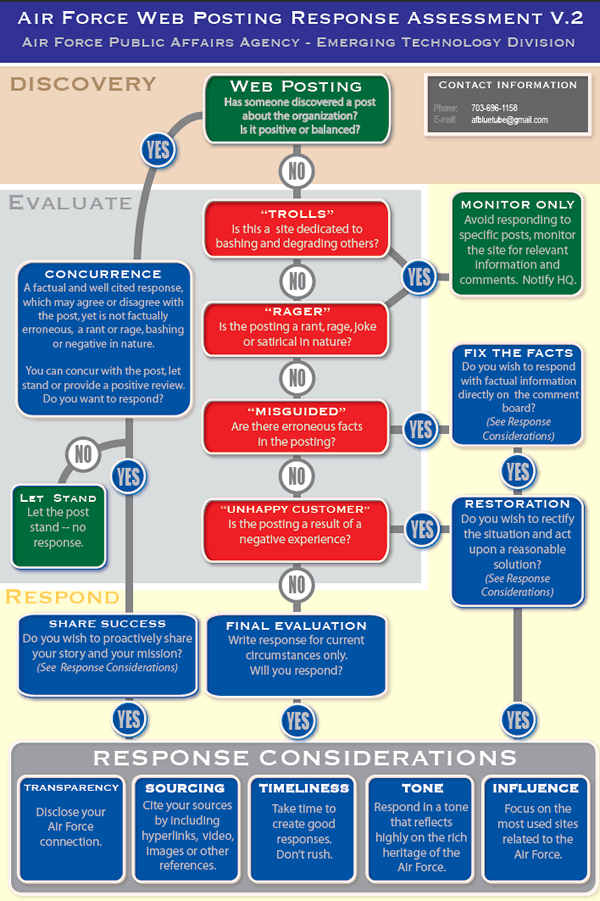
Click the diagram to download the PDF version (455K).
The “rules of engagement” are quite good. You might find them to be useful for your own blogs, whether personal or corporate.
WebInkNow recently covered the Air Force’s approach to social media, which is far more involved than many companies who only pay lip service to the idea. They’ve assigned someone the role of “Chief of Emerging Technology”, whose job is to develop strategy, policy and plans for the Air Force’s “communicators” and whose mission is to use or build web applications as a means of engaging Airmen and the general public in conversation. The goal is to make every single Airman a communicator.
The Air Force has quite a presence on the web, which includes:
- The official blog, Air Force Live
- A Twitter account
- A YouTube page
- Widgets and podcasts
As with the Blog Assessment chart, you might want to use the Air Force’s social media strategy as a model for your own. Check out WebInkNow’s article for more.
147 replies on “The Air Force’s Rules of Engagement for Blogging [Updated]”
[…] Amerikanarna har eget körschema för bloggkommentarer […]
[…] Meanwhile, check out the brilliant infographic on how to engage bloggers, courtesy of the USA Air Force (via GlobalNerdy). […]
[…] have different audiences and goals, and require a slightly different approach. For example, the Air Force has a fabulous flow-chart for responding to online […]
[…] are sorry, we are looking into the problem” (and if you don’t know when to respond, try this flowchart the U.S. Army came up with for responding to blogs). You don’t just get to reap the benefits of real-time when you are a […]
[…] are sorry, we are looking into the problem” (and if you don’t know when to respond, try this flowchart the U.S. Army came up with for responding to blogs). You don’t just get to reap the benefits of real-time when you are a […]
[…] guides. I pointed to the US Air Force’s rules of engagement for social media and Shopify’s employee handbook (pictured here); both are great examples of documents that […]
[…] you like thinking in terms of a flow chart, take a look at this one from the US Air Force that walks you their rules of engagement for bloggers. Every IT manager should print out a copy and […]
[…] you like thinking in terms of a flow chart, take a look at this one from the US Air Force that walks you their rules of engagement for bloggers. Every IT manager should print out a copy and […]
[…] you like thinking in terms of a flow chart, take a look at this one from the US Air Force that walks you their rules of engagement for bloggers. Every IT manager should print out a copy and […]
[…] you like thinking in terms of a flow chart, take a look at this one from the US Air Force that walks you their rules of engagement for bloggers. Every IT manager should print out a copy and […]
I did not understand the basic reason behind this. Why all of sudden US Air force are interested in this blog assessment and what changes they particularly wish to bring about with this?
[…] finally a hat tip to the Air Force for its fantabulous Rules of Engagement for Blogging chart! I am quite often asked about “how one should go about creating blogging guidelines” and […]
[…] This flowchart is similar to the US Air Force’s rules of engagement flowchart, which I wrote about in Global Nerdy a couple of year…: […]
[…] always thought that the epic Air Force’s Rules of Engagement for Blogging flowchart was the mother of all blog assessment charts, but this one by Dell predates it with at […]
[…] (via) […]
[…] you like thinking in terms of a flow chart, take a look at this one from the US Air Force that walks you their rules of engagement for bloggers. Every IT manager should print out a copy and […]
[…] Force One’s rules of engagement: http://www.globalnerdy.com/2008/12/30/the-air-forces-rules-of-engagement-for-blogging/ Những cảm xúc thường đến khi quyết định có trả lời hay không lời phê […]
[…] White of RegEd shared Pfizer’s Social Media Response Flowchart (originally developed by the U.S. Air Force). There was a lot of interest in that; I guess we’re all trying to figure out how to deal […]
The Joint Online Community, the military’s newest social network, is looking for military bloggers. Join today and share your stories and experiences.
http://onlinemilitarybulletin.com/JOC
[…] Force One’s rules of engagement: http://www.globalnerdy.com/2008/12/30/the-air-forces-rules-of-engagement-for-blogging/ Những cảm xúc thường đến khi quyết định có trả lời hay không lời phê […]
[…] UFOs Are Here With An AgendaThe Singularity is near: Tech for StoriesHTML5: the Singularity is nearThe Air Force’s Rules of Engagement for Blogging [Updated] — Global NerdyThe Air Force’s Rules of Engagement for Blogging [Updated] — Global […]
[…] Source HT @AccordionGuy (via blog) […]
[…] Air Force, of all agencies, has an infographic for its comment response policy. It provides a handy flowchart that might help you decide how to respond. Some people suggest […]
[…] para poder enfrentarnos a este tipo de críticas podemos ayudarnos de la siguiente infografía, que nos llega desde Global Nerdy, donde van dando las claves paso a paso dependiendo de la situación en la que nos […]
[…] DO have a plan in place for handling complaints or attacks. The US Air Force (a surprisingly progressive organization from a social standpoint) has their “Rules of Engagement” in an easy-to-follow diagram that is a great model for any company – see it by clicking here. […]
[…] commenting policies and guidelines rooted in transparency and disclosure, like those set out by the United States Air Force, can help prevent these unfortunate outings. As publicists, we recommend that our clients are […]
[…] policies and guidelines rooted in transparency and disclosure, like those set out by the United States Air Force, can help prevent these unfortunate outings. As publicists, we recommend that our clients are […]
[…] helpful tool for responding to social media comments and mentions that we discussed comes from the US Air Force. I’ve also recently found that the US EPA has a similar […]
[…] Air Force One’s rules of engagement Common sense approach for deciding whether or not to reply to criticism. […]
[…] Air Force Public Affairs Agency developed a “Web Posting Response Assessment” process which has become pretty popular with online marketers, and has been used as a […]
[…] via globalnerdy.com […]
This is exactly the second post, of your site I personally checked out.
Yet I like this specific 1, “The Air Force’s Rules of Engagement for Blogging [Updated] — Global Nerdy” the most. All the best -Shona
[…] heeft ook nog een aantal basisregels. Hij verwijst hierbij naar de Air Force Blog Assessment, een set regels voor de luchtmacht waarbij men leert om te gaan met kritiek op […]
[…] luchtmacht van de Verenigde staten heeft een duidelijk schema gemaakt wanneer je wel en wanneer je niet zou moeten reageren op een blog (of een andere uiting in […]
[…] You can find the whitepaper here. And the Air Force Rules Of Engagement for Blogging here. […]
[…] of 2008, the United States Air Force Public Affairs Agency released a simple decision tree. The Air Force Web Posting Response Assessment listed several scenarios to determine if, when and how Air Force representatives should respond to […]
[…] or won’t agree with you. One classic example, made popular on my tech blog, Global Nerdy, is the U.S. Air Force’s “rules of engagement for blogging”, sent to me by Dave Faggard, Chief of Emerging Technology at the Air Force’s Public Affairs […]
[…] DO have a plan in place for handling complaints or attacks. The US Air Force (a surprisingly progressive organization from a social standpoint) has their “Rules of Engagement” in an easy-to-follow diagram that is a great model for any company – see it by clicking here. […]
[…] rules of engagement from the US Airforce, via […]
[…] end of 2008, the United States Air Force Public Affairs Agency released a simple decision tree. The Air Force Web Posting Response Assessment listed several scenarios to determine if, when and how Air Force representatives should respond to […]
[…] Force One’s rules of engagement:http://www.globalnerdy.com/2008/12/30/the-air-forces-rules-of-engagement-for-blogging/ Những cảm xúc thường đến khi quyết định có trả lời hay không lời phê […]
[…] operation security in a time of increased and uncontrolled communication. A chart explaining when and how to respond to comments that the US Air Force produced in 2008 (!) is still being used by many social media […]
[…] The U.S. Air Force has had a set of publicly-available rules of engagement for this sort of thing si… It might be a good idea to emulate them, especially the part about tone: “Respond in a tone that reflects highly on the rich heritage of the Air Force”. […]
[…] back in December, Global Nerdy and Web Ink Now happened across a UFO in the blogosphere. Using a highly classified radar system […]
[…] number of blogs, including Global Nerdy and WebInkNow have lavished praise on the USAF for its commitment to the blogosphere and such […]
[…] number of blogs, including Global Nerdy and WebInkNow have lavished praise on the USAF for its commitment to the blogosphere and such […]
[…] Which is why it might be helpful to create a decision tree to facilitate the process. A decision tree is a way to flowchart the criteria that will be used to make the decision. For example, the U.S. Air Force put together a decision tree to explain their rules of engagement for social medi…. […]