If you’re pressed for time, the graphic below – which takes its inspiration from these articles by Kathy “Creating Passionate Users” Sierra — captures the spirit of this article rather nicely:
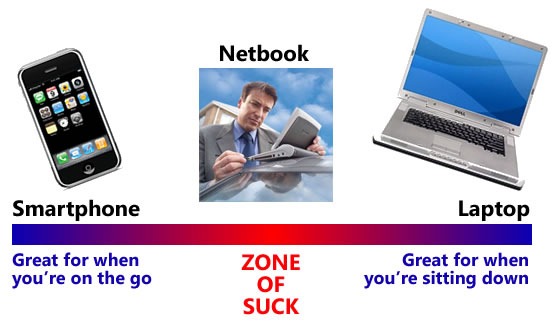
If you have a little more time to spare, I’m going to explain my belief that while netbooks have a nifty form factor, they’re not where the mobile computing action is.
A Tale of Two Pies
When I was Crazy Go Nuts University’s second most notorious perma-student (back in the late ‘80s/early ‘90s), I took a handful of business courses at the recommendation of my engineering and computer science professors. “You’re going to have to learn to speak the suits’ language,” they said. Crazy Go Nuts University has a renowned business school and I thought it would be a waste not to take at least a couple of business courses. I especially liked the Marketing couse, and one lecture stands out in my mind: a case study comparing the dessert offerings of two major fast food chains.
In the interest of not attracting the attention of their lawyers, I’m going to refer to the chains as:
- Monarch Burger, whose mascot is a mute monarch with a glazed-over face, wearing a crown and associated paraphernalia, and
- Jester Burger, whose mascot is a clown in facepaint and a brightly-coloured jumpsuit who loves to sing and dance.
Both Monarch Burger and Jester Burger offered a dessert that went by the name “apple pie”. Let’s examine them.
Monarch Burger’s Pie
 Monarch Burger went to the trouble of making their apple pie look like a slice of homemade apple pie. While it seems appealing in its photo on the menu, it sets up a false expectation. It may look like a slice of homemade apple pie, but it certainly doesn’t taste like one. Naturally, it flopped. Fast-food restaurants are set up to be run not by trained chefs, but by a low-wage, low-skill, disinterested staff. As a result, their food preparation procedures are designed to run on little thinking and no passion. They’re not set up to create delicious homemade apple pies.
Jester Burger’s Pie
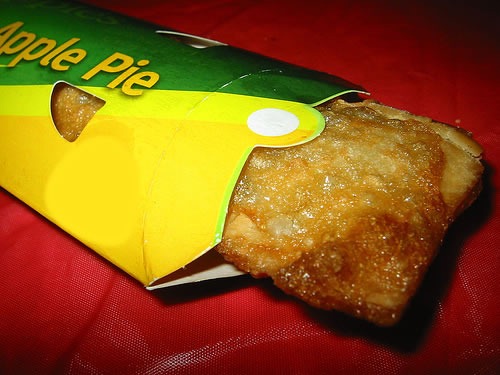
Jester Burger’s approach was quite different. Their dessert is called “apple pie”, but it’s one in the loosest sense. It’s apple pie filling inside a pastry shell shaped like the photon torpedo casings from Star Trek. In the 70s and 80s, the pastry shell had bubbles all over it because it wasn’t baked, but deep-fried. After all, their kitchens already had deep fryers aplenty – why not use them?
Unlike Monarch Burger’s offering, Jester Burger’s sold well because it gave their customers a dessert reminiscent of an apple pie without setting up any expectations for real apple pie.
Jester Burger’s pie had an added bonus: unlike Monarch Burger’s pie, which was best eaten with a fork, Jester Burger’s pie was meant to be held in your hand, just like their burgers and fries.
At this point, I am obliged to remind you that this isn’t an article about 1980s-era desserts at fast food burger chains. It’s about netbooks and smartphones, but keep those pies in mind…
Netbooks are from Monarch Burger…
Netbooks remind me of Monarch Burger’s apple pie. Just as Monarch Burger tried to take the standard apple pie form and attempt to fit it into a fast food menu, the netbook approach tries to take the standard laptop form and attempt to fit it into mobile computing. The end result, to my mind, is a device that occupies an uncomfortable, middle ground between laptops and smartphones that tries to please everyone and pleases no one. Consider the factors:
- Size: A bit too large to go into your pocket; a bit too small for regular day-to-day work.
- Power: Slightly more capable than a smartphone; slightly less capable than a laptop.
- Price: Slightly higher than a higher-end smartphone but lacking a phone’s capability and portability; slightly lower than a lower-end notebook but lacking a notebook’s speed and storage.
To summarize: Slightly bigger and pricier than a phone, but can’t phone. Slightly smaller and cheaper than a laptop, but not that much smaller or cheaper. To adapt a phrase I used in an article I wrote yesterday, netbooks are like laptops, but lamer.
Network Computers and Red Herrings
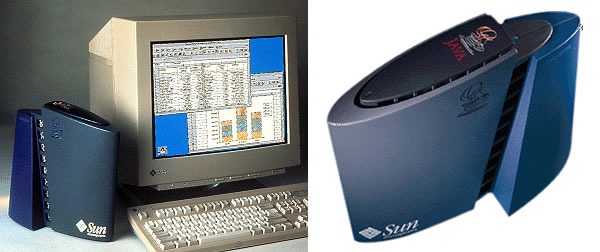
The uncomfortable middle ground occupied by the netbook reminds me of another much-hyped device that flopped – the network computer, which also went by the name "thin client". In the late 90s, a number of people suggested that desktop computers, whose prices started at the mid-$1000 range in those days, would be replaced by inexpensive diskless workstations. These machines would essentially be the Java-era version of what used to be called "smart terminals", combining local processing power with network-accessed storage of programs and data.
A lot of the ideas behind the network computer ended up in today’s machines, even if the network computer itself didn’t. Part of the problem was the state of networking when the NC was introduced; back then, broadband internet access was generally the exception rather than the rule. Another major factor was price – desktop and even laptop computers prices fell to points even lower than those envisioned for NCs. Finally, there was the environment in which the applications would run. Everyone who was betting on the NC envisioned people running Java apps pushed across the network, but it turned out that the things they had dismissed as toys — the browser and JavaScript, combining to form the juggernaut known as Ajax — ended up being where applications "lived".
When I look at netbooks, I get network computer deja vu. I see a transitory category of technology that will eventually be eclipsed. I think that laptops will eventually do to netbooks what desktop machines did to network computers: evolve to fill their niche. Just as there are small-footprint desktop computers that offer all the functionality and price point of a network computer along with the benefits of local storage, I suspect that what we consider to be a netbook today will be just another category of laptop computer tomorrow.
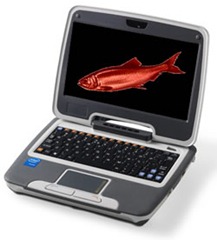
I’m going to go a little farther, beyond stating that netbooks are merely the present-day version of the network computer. I’m going to go beyond saying that while their form factor is a little more convenient than that of a laptop, the attention they’re getting – there’s a lot of hoo-hah about who’s winning in the netbook space, Windows or Linux – is out of proportion to their eventual negligible impact. I’m going to go out on a limb and declare them to be a dangerous red herring, a diversion from where the real mobile action is.
…and Smartphones are from Jester Burger

A quick aside: The photo above is not of a Jester Burger fried apple pie. In response to their customers’ so-called health concerns (really, if those concerns were real, they’d stop eating there), they started phasing out the fried pies in 1992 in favour of the baked kind. There are still some branches of Jester Burger that carry the fried pies, but a more reliable source is a fast food chain that I’ll refer to as “Southern Chicken Place”, or SCP for short. Those pies in the photo above? They’re from SCP.
Jester Burger made no attempt to faithfully replicate a homemade apple pie when they made their dessert. Instead, they engineered something that was “just pie enough” and also matched the environment in which it would be prepared (a fast food kitchen, which didn’t have ovens but had deep fryers) and the environment in which it would be eaten (at a fast food restaurant table or in a car, where there isn’t any cutlery and everything is eaten with your hands). The Jester Burger pie fills a need without pretending to be something it’s not, and I think smartphones do the same thing.
Smartphones are truly portable. They really fit into your pocket or hang nicely off your belt, unlike netbooks:

And smartphones are meant to be used while you’re holding them:

Just try that with a netbook. In order to really use one, you’ve got to set it down on a flat surface:

The best smartphones make no attempt to faithfully replicate the laptop computer experience in a smaller form. Instead, they’re “just computer enough” to be useful, yet better fit the on-the-go situations in which they will be used. They also incorporate mobile phones and MP3s – useful, popular and familiar devices — and the best smartphones borrow tricks from their user interfaces.
Smartphones, not netbooks, are where the real advances in mobile computing will be made.
Smartphone vs. Netbook: The People Have Chosen
One again, the thesis of this article, in graphic form:
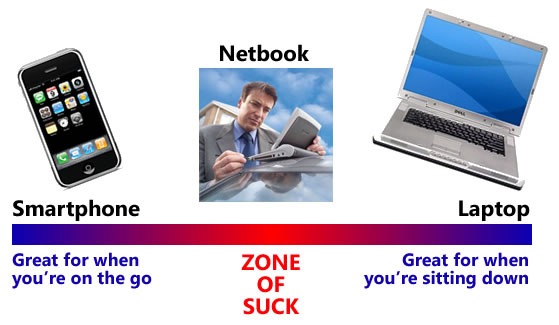
In the late 80s and early 90s, the people chose the fast food apple pie they wanted: the convenient, if not exactly apple pie-ish Jester Burger pie over Monarch Burger’s more-like-the-real-thing version.
When people buy a smartphone, which they’ve been doing like mad, they’re buying their primary mobile phone. It’s the mobile phone and computing platform that they’re using day in and day out and the device that they’re pulling out of their pockets, often to the point of interrupting conversations and crashing the trolley they’re operating.
When people buy a netbook, they’re often not buying their primary machine. It’s a second computer, a backup device that people take when their real machine – which is often a laptop computer that isn’t much larger or more expensive – seems like too much to carry. It’s a luxury that people might ditch if the current economic situation continues or worsens and as the differences between laptops and netbooks vanish. Netbooks, as a blend of the worst of both mobile and laptop worlds, will be a transitional technology; at best, they’ll enjoy a brief heyday similar to that of the fax machine.
The people are going with smartphones, and as developers, you should be following them.
52 replies on “Fast Food Apple Pies and Why Netbooks Suck”
Every time when I look at a netbook, it always reminds me a unborn baby whom was killed 2 years ago – Foleo. (Google it if you don’t know)
I think you’re right, Joey. I liked the idea of the Asus eeeeeeeeeepc but when I got my hands on one it felt like a computer but with a tiny screen and an annoying keyboard. My G1 feels like the future.
My impression of the netbook in its current form has a future. But not as a consumer commodity or the next big thing. I see it being the replacement of textbooks and notebooks for students in primary and secondary schools, possibly even in a post secondary environment where power and capacity is not as much an issue. The first netbook I’ve ever seen was the OLPC XO “laptop”. I’d personally like to see those introduced and sold to developed countries to make the mass production available for it to be producible at $100 a piece for developing countries.
I think netbooks appeal to those with very little technical knowledge of computers, who want something they can touch-type on and check e-mail, browse the web, maybe do some basic word processing. For example, I’ve recently been wanting to get back to doing some writing, and my old Toshiba A-71 (crappy, old laptop which is defective and currently under class action lawsuit – DO NOT WANT) is way too hot, way too heavy, and way too outdated for my needs, but I need something to replace my currently slow method of writing via pen and paper (as romantic as it is) and go with something that my 85 wpm touch-typing speed can keep up with. Obviously for that, smartphones are out of the question, and your conventional laptop isn’t something I can just whip out and start tapping away at whenever I see a pretty girl- ur, young woman. So in that sense, I do need something that fits somewhere in size, capability and price between a smartphone and laptop. Since I can type much faster than I can write cursively (and it would save me the trouble of typing up my illegible-due-to-speed handwriting later), a netbook of some kind would probably be ideal for me.
Except I really had to make the toss-up between getting myself a new desktop which I need, which I could get for a similar pricepoint, and get something much, much better than what I have or have had in the last little while (was looking at an AMD Phenom II x3 Black Edition / ATI Radeon 4770 system for all my moderate gaming needs)… or go with a netbook so I can actually force myself to go out to a cafe or something and write. I have to admit, when I weigh the two, with summertime in bloom, I’m starting to prefer the latter option seeing as how I can always game on my XBox 360, so it’s not like I NEED a gargantuan desktop overclockable to 3.2Ghz with a potentially unlockable fourth core (I’m just a geek and want one, really).
Hence my looking at the ASUS N10J-A1/A2 – a netbook sized/priced (well, almost) with a discrete video card in the form of the NVidia GeForce 9300. Unfortunately, although everyone who’s gotten one seems to be happy with it (and they say it gets a lot of second glances when whipped out in public- that came out all wrong), it still seems to be too much of a compromise between the more expensive and larger option of a gaming laptop (which can easily run into the $1600-$3000 range) and a regular netbook ($300ish) and still not handle HD video well, or have a large enough screen/resolution for gaming purposes. That, and I’d still need to get a portable USB slim drive, so tack $70-80 to the total.
So… I’d consider waiting for dual Atom for netbooks (not just servers) or hope that NVidia and OEMs will start putting out Ion-powered netbooks in the next couple of months.
However, the current sale price at Infonec in the GTA for the N10J-A1 has me mighty tempted.
Any suggestions for an alternate solution would be most welcome.
[…] Yup, another article originally published in my tech blog, Global Nerdy. As with the previous two, this one is of interest not just to programmers, but anyone using portable and mobile computing devices, such as smartphones, netbooks and laptops. […]
But the thin-client IS making headway — but not as hardware. It’s the browser.
Netbooks will enjoy a brief heyday similar to that of the fax machine? That means Netbooks will be around for the next 30+ years.
Seriously, I agree that cell phones are where the action will be. Also, netbooks will soon be called notebooks/laptops again (which is what they are), but they aren’t going to go away anytime soon.
[…] Fast Food Apple Pies and Why Netbooks Suck — Global Nerdy 2009 May 27 tags: Apple Pie, Geek Stuff, Laptops, Netbooks by depatty Fast Food Apple Pies and Why Netbooks Suck — Global Nerdy […]
Heh – soo true. I got an Asus EEE when it was first introduced for my daughter for school.
So – gave it about 1 month. It wouldn’t run her games, the screen was way too small, the keyboard too small, the machine too slow. It has sat in a drawer for about a year now…
I refer you to “Netbooks will be huge in 2010” – http://colinizer.com/2009/05/23/netbooks-will-be-huge-in-2010/
Not having a qwerty keyboard on a smartphone (with tactic response) is a real issue.
Think like a student and someone who wants a second machine and you can see netbooks as huge next year, an perhaps for a couple of years more…
… they are not a red herring, but a stepping stone towards what will happen when we get the foldable screen – then the smart phone becomes something useful and big enough. One step further with foldable tacticile feedback touch-screens, and it’s smart-phones all the way – even going up the chain and wiping out many of the smaller notebook too.
McDonalds. Burger King. Kentucky Fried Chicken.
You pussy.
bbot: When I wrote it, I thought I was going to post it on Canadian Developer Connection a blog owned by Microsoft, and didn’t want Legal and Corporate Affairs up my ass. Since then, I decided to just keep it on Global Nerdy and didn’t bother with reverting the names to McDonald’s, Burger King and the last restaurant, which is KFC, not Kentucky Fried Chicken…you dumbass ;).
So I was going to scream “You are full of crap!” at you.
But I realized you are probably right.
I want a netbook. Why? Because the Job gives me my very own MacBook Pro. And I want a laptop where I can edit my pictures of nearly naked people and surf the web and not worry about something the corporate IT department tried to use to protect us all from naked people.
At the same time, I don’t need a whole lot of power or storage because I’ve got a desktop stuffed to the gills with hard drives and RAM.
But does it matter if I get a 15″ LCD or a 10″ LCD? Not really, although a 10″ LCD is likely “good enough”. I do know that the early 7-9″ LCD versions were too small to not be displaced by my Windows Mobile smartphone, largely on account of my textual input speeds being no different.
So, yeah, what’s really going on is that the Netbook market is more an aberration and an artificial construction. It’s artificially constructed in that MS won’t sell you XP if the computer is too powerful (allegedly). And it’s an aberration in that if they sold the exact same machine with a 13-15″ LCD it wouldn’t hit the price points right now but will down the road.
A new laptop, even a cheap one, runs at least $400. We picked up an Asus EEE for less than $200. My wife loves it–she can check e-mail if I’m gaming on the desktop, take it to bed to read e-books or listen to audiobooks, or play a little solitaire before falling asleep. A cell phone that could do those things would cost more to do the same thing with a clunky interface.
I love my netbook. I was sick and tired of carrying my laptop on my knees. I can do most of the things I did with my laptop. I even run Linux on my netbook.
Joey-
Right on, when I travel for business now I just take my iPhone. It does 90%+ of what I need a laptop for on teh road (e-mail, surf, enter my time into corporate time-tracking app, etc) AND I don’t have to take it out of the bag etc. at the airport for the TSA.
You are so right on this, the smartphone is where the action is and where it will be.
-Mike
Brilliant article and spot on correct.
Netbooks may cannibalize some laptop sales, particularly with the ‘subsidized’ netbooks now appearing ($0 with 2 year contract) but Smartphones are were the action is. Part of that is the phenomenal success of Apple’s App Store model, which is driving software development in a way I have not seen in 30 years in this business,
Everytime I see people comparing PC/laptop with smart-phone usage reminds me of comparing apples and oranges; note that aove you compared apple-pie to apple-pie but then switch to apples (smartphone) and oranges (netbook/laptops).
Yes, phones are primary machine for a totaly different use-case than a laptop.
Comparing netboas William said, Netbooks will steal market from Laptops. Here there will be a very large segment of people that find/will find Netbooks very appealing; 1) for people who doesn’t care, 2) don’nt want to carry, and 3) more importantly want but *can’t afford* a laptop (this is a very, very large segment); for the latter, note that Netbooks will be given away “for free” by network operators in exchange for a data plan that drives mobile bandwidth usage…
ceo
[…] article from a couple of weeks ago, Fast Food Apple Pies and Why Netbooks Suck, got a lot of reactions from both the “You’re right!” and “You’re dead wrong!” camps […]
[…] you haven’t already read Joey deVilla’s phenomenal Fast Food Apple Pies and Why Netbooks Suck, do it now. And if you have, re-read it. Joey has a followup, Like I Said, Netbooks Suck, with […]
[…] deVilla (The Accordion Guy from MSDN Canada) has started a crusade against Netbooks: Fast Food Apple Pies and Why Netbooks Suck Like I Said, Netbooks Suck Netbooks, […]
[…] Fast Food Apple Pies and Why Netbooks Suck […]
I have to agree with you. Netbooks are utter pants for power-users, but they are just in the sweet spot price:performance range for less technical users and activies. I have hated every netbook I’ve ever used and I don’t expect I will ever buy one. For the record, I hate smartphones too (they’re too big, clumsy and expensive) but even less-than-mediocre not-smartphones these days are fairly internet-capable, which suits me fine. If I am computing, I want a capable computer. If I am phoning, I want a capable phone. The netbook formula will never cut it for me.
disclaimer – I’m probably the exception to the rule. I’m a developer, and I’ve got the token beefy desktop setup at home… but I didn’t buy a droid or an iphone for myself for xmas, I bought a netbook. My phone is still an embarrassingly worthlessly cheap piece of crap… but it sends text messages and makes calls just fine, and all I really want from a smart phone is mobile internet browsing. Netbooks might be less portable…
… but price was a consideration – I picked up an Acer Aspire One for $225, and I’m packing it with an extra gig of ram and a faster harddrive for a little under an additional $100. But those upgrades are really just for fun, because truth be told it already does exactly what I bought it for:
– It’s lighter than a regular laptop, so it’s easier to carry around to meetings both in and out of the office
– It’s powerful enough to do about 95% of web browsing, the keyboard layout is useable enough that I can code on it in a pinch if a client needs a quick fix and I’m not at home.
– The battery life is such that I can easily get 5-6 hours while it’s in constant use – I very rarely check the battery icon, since it’s usually a safe assumption that it has plenty of juice left.
– I can recline in the most ridiculous of positions and precariously balance it on the side of my knee while I’m half-watching something on TV and still get both my hands to it to type without tipping it over.
– it runs starcraft perfectly, which allows me to lounge around the living room in front of the fire, playing a LAN game that would’ve required several big desktop boxes and a null modem cable a decade and a half ago.
Really , simply put (TL;DR) it’s genuinely a pleasure to interact with. If we’re going with your fast food example, it;’s like someone made bitesized jester burger apple pies that you can take out of the freezer and fry up for yourself whenever you feel like having a tasty snack – like frozen potsticker dumplings, mmm. A lot of your complaints are valid, but they just don’t apply to people like me – it might not hurt to qualify your analysis as pertaining only to a particular segment of your audience. Or not, whatever, I’m gonna go play some starcraft.
[this comment sent from matt’s netbook]
Hmmm, it makes me wonder what I must be doing wrong.
I’m a professional software developer and have an Asus Eee PC 1000 series netbook as my only home computer. I do a lot of home ASP.NET development with Visual Studio 2008/2010 Beta 2, SQL Server 2008 and 3rd party refactoring tools. Yes, it runs a little slow at times if I’m careless with how many tools I’m running at once, but on the whole I have no problems with it at all (and believe me I’m *not* a patient person when it comes to coding).
Which makes me wonder – if a netbook is good enough for me to build a $100K web site, what are others trying to do that makes them so poor?
Netbooks hit a perfect sweet spot – people who need to work/create whilst mobile.
Try writing a whole document, or even a detailed email response, on a smartphone. It isn’t a pleasant experience. Try writing code on a smartphone. Almost impossible.
Now, try to use a notebook on an aeroplane or train. Unless you’re travelling first class, in which case you probably don’t need to work, your notebook just won’t fit. And if you’re in business class with just enough space to open the screen, the battery will run out 1-2 hours into the flight.
Netbooks are a perfect solution. My first netbook was a MSI Wind. It wasn’t a great choice because of a compromised keyboard layout, but I was able to work when/where I needed. I just upgraded to an Acer 1810TZ, and that machine is just about perfect. I get 8+ hours of battery (one day I got over 10 hours of writing), a slightly larger screen and a much better keyboard.
Sorry, but there is a large market of people for whom Netbooks are a perfect mobile computing solution. Smartphones might work as viewers, but they’re a long way from being practical creation tools.
[…] restriction, not the customer who buys the device. If I buy a netbook – a concept seen by some as threatened by the rise of the smartphone – I can install any software I like on it and use […]
Netbooks ARE laptops — the line is arbitrary. A netbook can run the same apps and perform *any* task that a laptop/desktop computer can, just in a less comfortable way. Portability, battery life and price are where netbooks excel.
Even a small 13″ laptop is difficult to carry — it weighs 2-3kg and generally requires a dedicated medium-sized bag. A netbook can fit into a purse (or pretty much any bag) with space left over. A laptop can be carried, a netbook is convenient to carry.
The fact that a fine netbook costs $300 (vs $800-$1200 for a decent laptop), makes a difference on the road — I won’t sweat if I lose one due to theft or damage.
Battery life of 8h (vs 2h for laptops) makes a huge difference as well. A typical laptop always runs out of power on a medium or long haul flight, and doesn’t fit on the tray table either.
Smartphones are an entirely different category. Even if they could run a desktop OS (read “Windows”), try writing anything more than an SMS, or reading more than several pages of text and the difference becomes painfully obvious. They’re strictly for *communication* and can do little practical work. For most information workers, smartphone can get you the “you need to get back to the home/office now” notification — on a netbook you could actually do the task immediately.
Netbook is the smallest thing you can carry with you and still be able to do all the computing tasks you’re used to. They’re here to stay.
Of course, in a year or two, netbooks will certainly have as much power as today’s laptops — it’s a form factor that defines them, not the Atom processor.
I love my netbook. At 8.9 inches and hardly a few pounds, it fits nicely in my backpack and allows me to do many things my smart phone does not, without the added burden of a laptop and it’s shock sensitive moving parts.
I’ve taken this thing around with me for about two years. Right now I’m at school in the library typing away (a pain with my phones little qwerty). I wouldn’t try bringing my laptop here with me. My backpack is already stuffed full and weighed down with books. I would fear that the screen would break or a bad bump would kill the precious hard drive. With the solid state drive on the netbook, and the small rugged design (EeePC 900) I don’t have these fears.
After commenting here I plan on doing some research and coding, all on the netbook!
crocodilexp nailed it. I don’t believe there is a such thing as a netbook. It’s just a small notebook. At what point does a netbook become a notebook as it gets larger and more powerful? There’s no dividing line.
A netbook (or what people commonly refer to as netbooks) is small and light enough to conveniently carry around (all the time) and still lets you do almost anything you’d do on a notebook.
The only reason they’re called netbooks is because of marketers. There is a virtually continuous spectrum of these machines, ranging from huge 10 lb./19″ machines to 2 lb/9″ ones. If no marketer ever invented the term netbook, would you be writing a blog post called “Computers less than 3 lbs and with screens less than 12 inches suck, computers greater than 3 lbs. with screens greater than 13 inches are great”?
The netbook is not going after the smartphone market, but rather the laptop market. There is a large part of the laptop market that doesn’t need a full-size machine and doesn’t want to pay extra for one.
Sure, the user base for smartphones may be larger, but the netbook will not be a flop.
This entire post is predicated on the false premise that netbooks are more expensive than cell phones and only slightly less expensive than laptops.
Where are you finding a modern smartphone with even half the computing power of a netbook, or at a lower price? Or a laptop for remotely close to the price of a cheap netbook?
To be more precise, the iPhone 3GS has a 600MHz CPU and 256MB of RAM and retails for something like $600. A cheap laptop from Dell will run you $500 with a 2GHz CPU and 1GB of RAM. My Asus eee 905 cost $230 brand new, has a 1.6GHz CPU and 1GB of RAM.
Comparison fail.
But, a netbook isn’t more expensive than a smartphone.
Not even close. Just look @ the $50-$100 monthly charge, for two years.
Plus, the network appliance IS next. I saw a little atom based machine 2 weeks ago @ best buy ($199). I want one for my wife (unless she decides she wants the netbook).
And here come the Tablets… There must be plenty room between laptops and smartphones, because tablets are targeting the market in between netbooks and smartphones.
[…] is a regular reader of another blog called Global Nerdy, where a recent article suggested that Netbooks occupy the arena between Smartphones and Laptops. While Coding Horror comes to the defense of netbooks, their reasons are different from my […]
[…] A Democracy of Netbooks, Jeff rebuts an article of mine from late last May, Fast Food Apple Pies and Why Netbooks Suck. The thesis of my article was that netbooks occupied an unhappy, “worst of both worlds” middle […]
[…] it, Atwood criticises another blog post, Fast Food, Apple Pies, and Why Netbooks Suck, written by Joey DeVilla. DeVilla had written: The end result, to my mind, is a device that […]
[…] Joey deVilla verbosely misses that point by such a large margin, I’m not sure whether he’…. Slightly more capable than a smartphone; slightly less capable than a laptop. […]
I partially agree with this article. Netbooks are kind of lame when it comes to carrying them around while trying to use them. But they have their uses (ultra low cost starter systems with good battery life).
However, nobody mentioned UMPCs! UMPCs are different than “netbooks”.
The UMPC market is actually quite important. Many UMPCs are actually about the size of a “smart phone”, except they don’t have the monthly fees/contracts/restrictions/etc. yet have the power of an actual desktop (OQO, Panasonic U1, etc.)
Even still, I think that the UMPC market is largely untapped (mainly because they are usually alot more expensive, )
I don’t know about you, but I hate having my devices locked down/neutered like most “smart phones” are!
[…] friend Jeff Atwood recently wrote, in response to this post by Joey deVilla, that netbooks are the future: If the internet is the ultimate force of […]
Have to disagree with this article and think they server a great niche fully equipped…maybe not running xandros linux like the 1st netbooks…
I am running an acer aspire one 10″ netbook…
1.6ghz atom processor.
2gb ram
160gb hdd…
win7
this setup was 250 bucks …got laptop for 199 bucks on sale at target, ram upgrade for 50 at crucial.
if i need to dock it i can and it easily pushes 1920x1080p on my 24″ monitor
it provides the perfect zone for me of just enough on the go for what i need to do, would be fine for a weekend trip, throw it in a bag, its 1″ thin and a little over 2 lbs.
it would be a big deal if i lost it for sure but, not near as big of a deal if i lost a 2000 dollar laptop. and this happens pretty frequently as well as they get damaged very frequently.
for a main workstation for me ANY laptop is just too little processing power and not even close to a desktop, (i run dual processers, dual video cards, 16gb ram etc.) so I’m glad companies are going for the “just enough” mobile processing market.
smart phones of course, i can do no developing on whatsoever. i know a LOT of developers who have netbooks… or at least very small laptops (which is what it is)
I agree with much of your argument, but then there’s this – everyone I know that has a netbook loves the damn thing. Especially for travel. They need to stay under $300 though, and they really should have SSDs.
I love my netbook(now using a Dell mini, my first was an ASUS EEE). I’m about as “power” as a user can be, and the netbook almost perfectly fits the paradigm of what I’ve wanted in a laptop for a long, long time.
Side note: I think its dumb to compare smart phones vs. netbooks vs. laptops. We should be comparing netbooks vs. laptops and leave smartphones out of it. A smart phone couldn’t possibly let me type at 60+ words per minute or quickly perform complex programming or scripting tasks.
As I said, the netbook fits my criteria for a dream laptop that I’ve had for a long time. Namely:
1) light weight
2) long battery life
3) ubiquitous internet connection – i.e. anywhere where wifi and possibly 3g are available
Light weight and battery life trump all when you’re hauling something around all day, for instance, on a road trip, at a college campus, or on a long flight.
Further, a netbook does not need to be very powerful. It merely needs to be quick at either connecting to the internet or to other servers. If what I need to do can’t be performed with a browser or lightweight text editor, I can vpn to a server or more powerful desktop and remotely perform the work.
[…] that time, I came across Joey Devilla’s “Fast Food, Apple Pies, and Why Netbooks Suck“. His conclusion, as you might surmise, was pretty predictable: Netbooks, as a blend of the […]
so I got an acer 1810 the other day… OMG I’M LOVIN’ IT!
1. it is so light that you can actually stand at the bus stop and hold it in one hand while typing e-mails or twitter messages with the other for 10 minutes straight.
2. it has enough power to allow working with photoshop, eclipse, VS2008.
3. the keyboard is “OK” for typing, not perfect but it still runs circles around smartphones.
4. it lasts a whole day, no carrying around a charger or a second power cell. you don’t even need a fucking bag, you just take it and carry it around with you on the campus or w/e. the only thing you *might* want to have is a small cordless mouse in your pocket.
5. it still is a motherfucking PC! you can install linux or even goddamn OS X, you can run any app, install any browser or plugin, you can even go and plug your 50″ TV into it and watch HD pr0n. show me a smartphone that can do all that.
[…] it, Atwood criticises another blog post, Fast Food, Apple Pies, and Why Netbooks Suck, written by Joey DeVilla. DeVilla had written: The end result, to my mind, is a device that […]
[…] it, Atwood criticises another blog post, Fast Food, Apple Pies, and Why Netbooks Suck, written by Joey DeVilla. DeVilla had written: The end result, to my mind, is a device that […]
[…] it, Atwood criticises another blog post, Fast Food, Apple Pies, and Why Netbooks Suck, written by Joey DeVilla. DeVilla had written: The end result, to my mind, is a device that […]
[…] sits somewhere in the “Zone of Suck” from my 2009 article, Fast Food Apple Pies and Why Netbooks Suck (I’m going to have to revise the graphic to include tablets as well as the Galaxy […]
[…] machines, Dell’s design department have been thrashing about cluelessly from netbooks (and you probably know what I think of them) to “ultrabooks” to “slates” to […]