In the wake of the PyCon 2013 “Dongle” incident and the ensuing fallout, the emails — but notably, no tweets, Facebook comments or any sort of messages delivered in the open – have been trickling in, asking what my thoughts on the matter were, given that:
My reputation for having a ribald sense of humour.
My answer: wait.
With the intersection of a lot of “hot button” issues: privacy, privilege, sexism, racism, back-and-forth accusations of misogyny and misandry and conflicting visions of justice, there’s been far too much bile being passed back and forth for listening and civil discourse to take place.
I’d like my contribution to the discussion to be one that benefits rather than harms, and you can’t do that by “shooting from the hip”. That will take time and thought, care and consideration.
In the meantime, since the incident has caused more than a few people to ask “What is a developer evangelist, anyway?” Here are some links you may find useful:
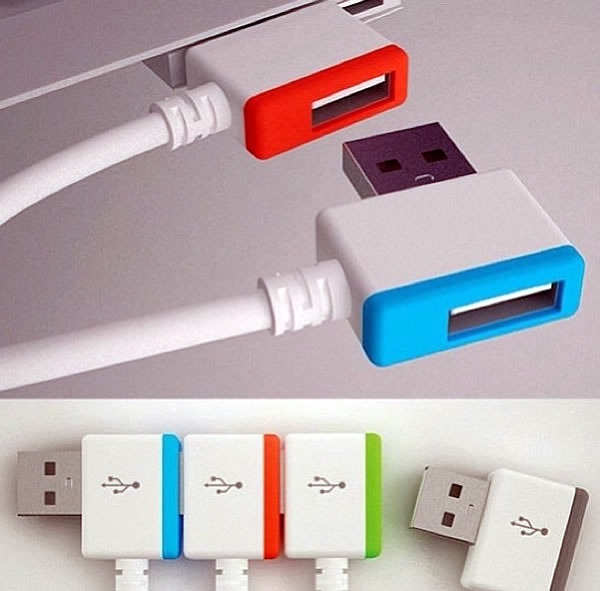
Given the trend towards skinny notebooks like the MacBook Air and lookalike “ultrabooks” as our main axes, many of us have to work with a measly one or two USB ports. The colour-coding’s also helpful. I’d love to see more stacking USB cables like this.
There’s anything really wrong with using your personal technology to suit your needs, even if those needs are “selfies” (self-photographs, or as the folks on Tumblr say, GPOY — Gratuitious Photos Of Yourself). It is an interesting observation on how technology changes drive usage changes, what with the difference between bulky 1960s film cameras and today’s portable networked pocket computers that just happen to take photos. If Neil Armstrong had a modern day phone or camera and better than 50-50 odds of making it back to Earth alive (they asked William Safire to write a speech for President Nixon to use should the astronauts be stranded on the moon), he might’ve taken more pics. Probably would’ve shot some video, too.
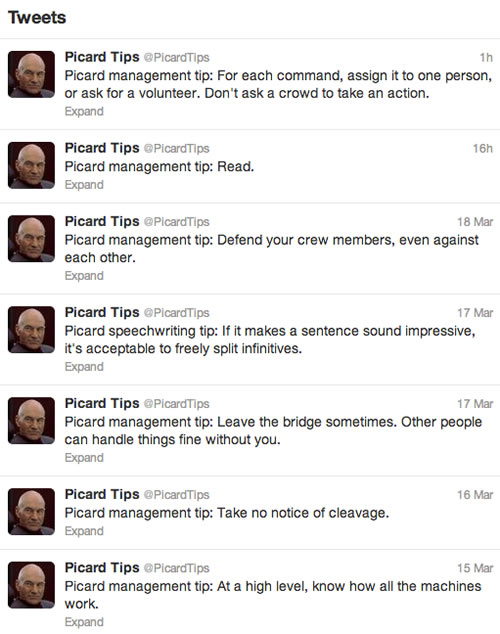
If you’d like a steady stream of tips on how to run your enterprise from a guy who most certainly knows how to run his, check out the Picard Tips Twitter account!
An actual scene from the Samsung Galaxy S4 preview.
After watching last night’s preview of the Samsung Galaxy S4, my first thought was “Well, that was weird”. Held in New York’s legendary Radio City Music Hall, they couldn’t resist going Broadway with really corny and overacted skits in which the features of their upcoming flagship phone were demonstrated. It had everything you’d expect from a matinee performance of Guys and Dolls that you’d expect from a touring company performing at a community theatre in some small midwestern town: orchestral segues built on a recurring leitmotif (in this case, the “Samsong” — the familiar tune that Samsung uses as its default ring), an annoying child actor, hammy over-emoted performances from everyone onstage, jokes bad enough to make you groan out load (including a number of just-sexist-enough ones) and believe or not, an actual tap-dancing number.
The entire thing was overseen by Broadway actor Will Chase, who seemed to be doing his level best to channel the spirit of actor-turned-”I’ll promote anything”-pitchman Troy McClure from The Simpsons, right down to the I-can’t-tell-if-he’s-being-ironic-or-not delivery.
All it needed for it to be completely over-the-top surreal would be appearances by Big Bird and Bishop Desmond Tutu. Too bad Qualcomm already had that idea:
If you still need proof that mobile devices have really caught on, take a look at NBC news’ comparison between the 2005 and 2013 crowds gathered at St. Peter’s Square in Vatican City to see the newly-selected Pope.
If you’re a Canadian entrepreneur looking for some money to get your business idea off the ground, you should check out BDC, the Business Development Bank of Canada. They’re a bank owned by the Canadian government charged with the task of helping Canadian entrepreneurs get the funding and advice they need to be successful. I’ve had the pleasure of getting their financial assistance for my company, CTS, and they’ve been very helpful — in fact, a delight to work with. I cannot recommend their services highly enough.
Francois Viau and Bradley Munro,
two of the presenters.
Yesterday, the BDC held a short seminar and lunch featuring a talk on innovation at their downtown Toronto office at the corner of York and King Streets. I’ve had my head down in work and wasn’t really looking forward to attending it; I’ve sat through all sorts of presentations like this and have often come out saying “Well, there’s a couple of hours of my life that I won’t get back.” I was pleasantly surprised with this one: this had some interesting, engaging presenters, and I found myself taking copious notes on my iPad as they talked. All right, BDC, you’ve really won me over now (and hey, thanks for the business loan).
My notes from the presentation are below. Enjoy!
Innovation (presented by Bradley Munro)
Intro
The 2 key problems that small businesses face:
Lack of money to work on innovation
Lack of people to come up with solutions
Peter Drucker: “Because its purpose is to create a customer, the business enterprise has two — and only two — basic functions: marketing and innovation”
Marketing: creating profitable relationships with customers
Innovation: a demonstration to your customers that you’re trying to solve problems
Innovation means growth, and growth means survival
There are 1.2 million small business in Canada, and they account for 1/3 of the GDP
That means that there’s lots of competition — innovation differentiates you!
What is Innovation?
It’s the constant pursuit of strategic change, and a commitment to evolving your business model
It’s about surprising and delighting your customers, getting better at what you do and helping customers solver their problems
It’s a process that is disciplined and systematic
It’s embraced at all levels, starting at the top
It’s the responsibility of everyone in the organization – from the mail room up
How to you capture your employees’ ideas, filter them and synthesize them?
Consistency is key
The process is customer-oriented, so it must involve customers
Big Innovation or Small?
The often-cited big, disruptive innovation.
Most people think of big, disruptive innovation
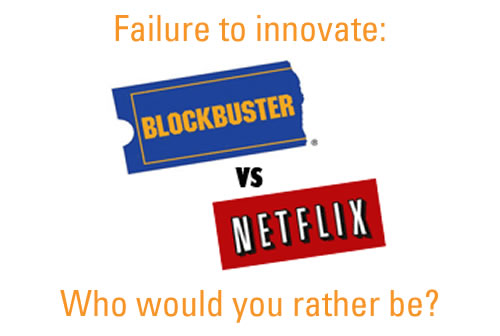
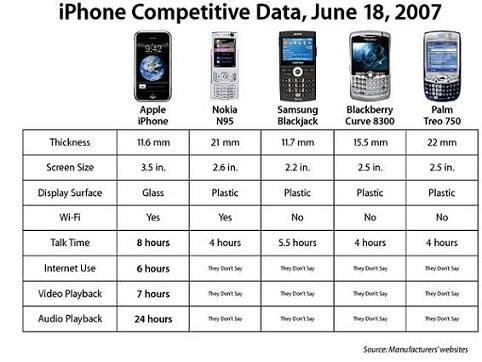
A favourite example of this sort of innovation is Apple, and how they disrupted the RIM, Nokia and Motorola
This type of innovation is incredibly rare, the exception rather than the rule
Most innovation is small, incremental
Think about innovation as your retirement portfolio – you wouldn’t bet your retirement fund on a single oil and gas stock
For SMEs, big, disruptive innovation should be the furthest from your mind
A good example of small, incremental innovation: Tim Hortons
Strange to think of the evolution of a coffee and donut shop as innovation, but it is!
They managed to stay on top and give us a reason to think of it as a destination for daytime meals
Constant delivery of new products and services
Stock has climbed steadily since 2009 and performing better than S&P 500
Innovation is a demonstration of why the company cares about the customer and why the customer should think of the company as a service provider
If you’re wondering if you should innovate, ask yourself: “Is my business growing?”
Innovation vs Product Development
The difference is risk and your appetite for it:
Small companies tend to be risk takers
Medium-sized companies tend to be risk managers
Large companies tend to be risk avoiders
Small companies have the appetite for risk, but not the money nor the people
Innovation
Product Development
High risk
Moderate/low risk
Uses new technology / capabilities
Uses existing capabilities
Lower success rate
Higher success rate
Idea
Commercialization
Game-changing
Incremental
Creative and collaborative
Process-oriented
Corporate
Functional
More with less
More with the same
Microsoft is particularly guilty of this.
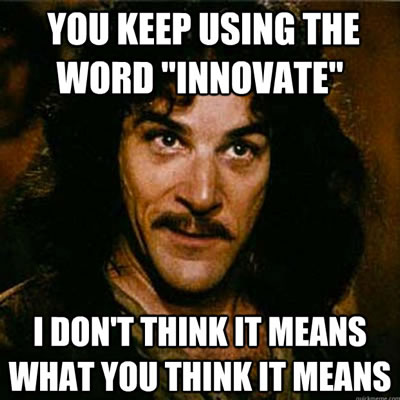
The term gets misused a lot
Most of what is called “innovation” is really product enhancement
Minimizing innovation risk
Take a portfolio approach: diversify your investment
Don’t bet the farm on one idea or a large project unless you have the resources to absorb failure
Use a mix of small, medium and large projects
Be strategic: do the ideas you’re considering fit the vision and long-term objectives for the company?
Be disciplined in how you allocate resources – choose your battles carefully
Have clearly-defined objectives: “I want x% of my revenue coming from these projects by this date”
We all work better knowing what the expected outcome is
Some companies are great at ideas but have no idea how to filter or execute them
Some have great execution, but lack the imagination to come up with new ideas
Take advantage of existing tax credit programs, such as SR&ED
Lots of government programs to help offset the cost of developing new products
Requires paperwork and effort, but the payoff is handsome
Four Key Factors in Innovation
Strategy
Take a portfolio approach – separate small from medium from big, and prioritize – low/medium/high risk, low/medium/high opportunity
As owner/operators, set the tone with clear vision and objectives
Set parameters for innovation ideation process (customers play a valuable role in this process)
Establish performance criteria for new ideas
Expect failure and support it – manage the process so that the ones that fail aren’t the news you went out n a limb for
Take action: nothing kills innovation like being all talk but no action
Demonstrate to others in the company that you’re listening and taking action on employee ideas
Write off your R&D expenditures
Structure
More for medium size companies with more resources
You don’t want to isolate your innovation efforts and keep people collaborating
Use integrated teams and promote collaboration
Successful companies ease back on the reins and lets people collaborate, giving people latitude to explore ideas
Nothing drives lethargy in a company like doing nothing new for a long time
Companies that don’t spend time on innovation end up spending their time on administration
Be open to systematically testing and learning – you can do this incrementally
Hold regular brainstorming sessions – once a month is fine
Document what you’re doing – formally recapture innovation and R&D activities
Skills
Strong leadership: good communicator, relationship builder, broad business perspective
Takes a team approach
Look for partners to collaborate with and build new products and services
Look for different perspectives
Innovation requires good project management skills: you’re working from a blank slate
Small businesses shy away from process, but it’s needed to go from small to medium and medium to large
Process
To be good at innovation, you need to be good at three things:
Coming up with ideas
Filtering them
Developing them
Innovation killers
Setting the bar too high, especially with financial hurdles
DCF/ROI/NPV criteria are ways to set yourself up for failure
Unreasonable assumptions, unrealistic projections
Home run syndrome – think of it as starting a little garden
Not having discipline around project management
Don’t let the innovation project fall by the wayside because everyone’s too busy
Not taking action, even on small ideas
Over-reliance on industry wisdom and “knows” – keeps you in the box
Summary
Successful innovation is a disciplined process
Best place to start for small companies is to inject some process around innovation
Set reasonable, achievable
Focus on customer, don’t sweat profits: they’ll come
Smart small, test and learn
If you have the benefit of resources, manage the risk with a portfolio approach
Expect failure
Maximize available tax credits
Q&A
Q: How do you take a company from entrepreneurial to process-oriented?
The best way to think about it is documentation
Start with a proposal or product definition document
Document critical stages of moving customer from in the door to out the door
All projects should have documentation that has been written, reviewed and approved
Documentation is the essence and underpinning of the innovation process
Process is documentation!
As you evolve the business and complexity and risk increase, you need more process
Process is discipline
Process is risk management
Documentation is also necessary for tax credits
Q: Relying on customers can sometimes limit innovation. What can I do about it?
Customers play a fundamental role in the early stage
Don’t want them “in your kitchen” as you develop and enhance your product, but you still want them as checkpoints
Anything process-oriented is eligible for SR&ED
SR&ED, Innovation and R&D (presented by Rowda Mohamud)
Innovation: transform new ideas into high potential ROI
To innovate you may need to conduct R&D
R&D happens in places you don’t expect: it even happens in bakeries
Vast majority of R&D is being done in SMEs
Half of Canada’s full-time R&D people are in Ontario
R&D is an investigative process that improves upon industry standard practice leading to:
Development of a new product or process
Improvement of an existing product or process
Challenging the knows, the folk tales
Successful innovation requires formal project management of R&D
Leads to greater confidence when undertaking riskier projects
The processes you adopt effectively transform company culture so innovation becomes embedded
Throw out the idea of trial and error and go with research and development
Trail and error is random, haphazard
Processes lead to confidence
SR&ED gives $3 to $4 billion annually to R&D and is a model for the world — other countries emulate it
40% goes to small companies
Its purpose: to help Canadian entrepreneurs take on technologically challenging projects
The structure and execution of R&D projects will determine the amount of investment tax credits
Effective management of innovation-driven R&D projects requires
Defining technological objectives and key success criteria
Proper planning of investigative and experimental activities
Clear identification, allocation and tracking of R&D resources
Creating a systematic documentation process that is ongoing
Software companies lag in claiming SR&ED; they’re doing R&D without even knowing it
People don’t do their basic due diligence
SR&ED projects have to be on a gap with your industry
You don’t have to patent
Encourage your employees to be truthful – there are no bad ideas
CRA says that SMEs are weak at tracking their time
Language for SR&ED is enshrined in the income tax act, but CRA is free to interpret
BDC (presented by Francois Viau)
The BDC’s mandate to be profitable — it’s not blowing taxpayer money
Currently, it has 2000 employees, 28000 customers and has 16 billion in loans
Complementary to other banks
Why would the government set up a bank?
Unlike commercial banks, BDC works primarily for the entrepreneur
They don’t reproduce what other banks do
BDC would finance an innovation project; most banks would balk
We’d like to show you 2 new BDC product ideas
These products focus more on reach rather than revenue and bottom line
They’re consulting products that are far cheaper than the typical consulting fee of $10 to $30k
New product 1: Customized innovation workshop
One-day session on your premises
Purpose is to engage key members of your organization to stimulate strategic thinking to generate new, actionable ideas
Understand how to manage an effective innovation process
Facilitated by Bradley Munro
Cost: $1000
Outcome will include:
Short list of new products or service ideas
Apply creative thinking to business and tech issues
Be better positioned for future growth
New product 2: Customized SR&ED planning workshop
Full-day session on your premises
Purpose is to train key personnel how to identify, track and capture SR&ED activities to maximize investment tax credits
Facilitated by Rowda Mohamud
Cost: $1000
Outcome will include:
You’ll learn how to mitigate financial risk of innovation by structuring future development to take avatange of investment tax credits
You’ll learn how to apply project management strategies to track SR&ED activity concurrent with innovation efforts