Posts tagged as:

old tech

Multitasking in the “Mad Men” Era

by Joey deVilla on January 15, 2010

square root

Here’s a great video from 1963 featuring the great-granddad of today’s web servers and cloud computing systems. It was just posted by Boston’s Computer History Museum titled Solution to Computer Bottlenecks. Filmed in May of that year, it features MIT Science Reporter John Fitch – who has a classic 1960’s announcer’s voice – interviewing MIT computer scientist Fernando J. Corbato, the guy behind Corbato’s Law (“The number of lines of code a programmer can write in a fixed period of time is the same independent of the language used”).

The subject of the film is the then-new approach of timesharing, which Corbato describes as “connecting a large number of consoles to a central computer”, which made the great (and very necessary – it even gets mentioned in Malcolm Gladwell’s book, Outliers) leap from batch to interactive processing possible. Here’s the video; enjoy all the retro-tech goodness:

This may have been really deep nerd stuff back in 1963, but today, it the sort of thing that you might see covered in a grade school class. Even if you’re not a programmer or IT pro, I think you’ll find it entertaining.

Some Gems from the Video

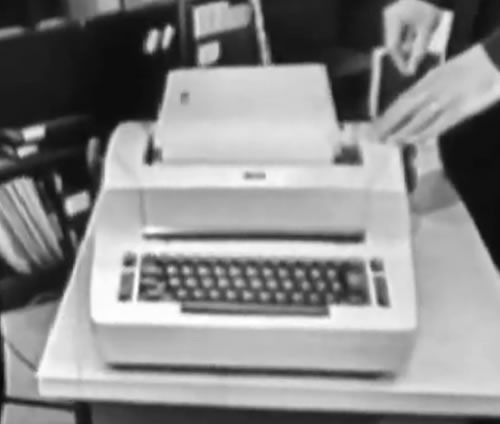
A computer terminal in one’s office isn’t unusual in this day and age, but back in 1963, such a thing must’ve been incredibly super-1337. Here’s the console in Corbato’s office, which he introduces by saying “Here’s one of the consoles we might be using in the future.” Even to the reporter of that era, it looked like an ordinary IBM Selectric typewriter:
1963 future console

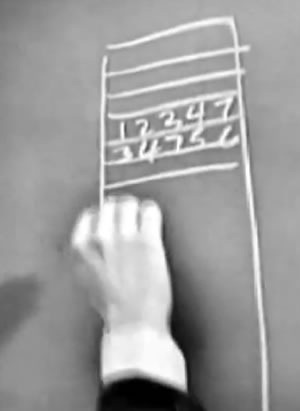
The general principles of digital computers haven’t changed much since those days. Corbato describes memory as “a bunch of pigeonholes” that store numbers, some of which function as data, some of which function as instructions.
memory pigeonholes

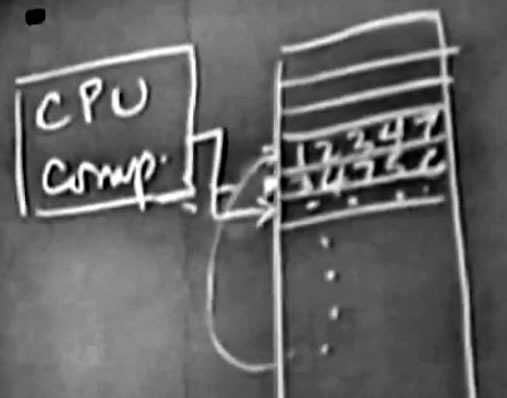
The concept of a CPU, the program counter stepping through memory and looping already existed in 1963:
cpu program counter

He describes the new setup “a set parallel consoles which are not all near the computer in fact, most of them are remote…and let the users use these with a reaction time of a few seconds instead of a few hours.”
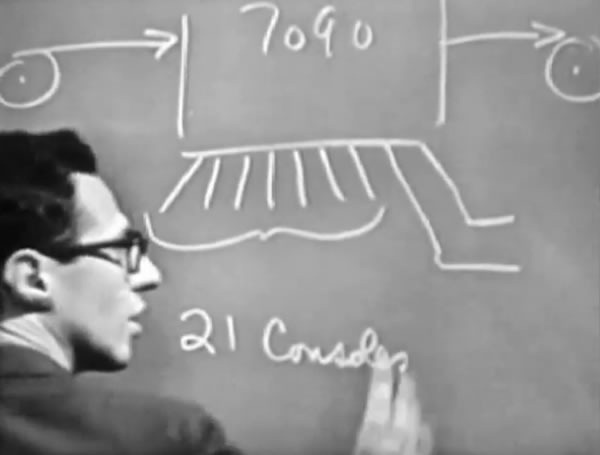
7090

He says that eventually they’d like to switch from “typewriter” consoles to "graphic displays”, but at the time there were still some kinks to be worked out.

One of the “elaborate advanced ideas” that he hints at but says is beyond the topic of the film is going beyond hooking up dumb terminals to the mainframe and attaching smaller computers to it as well, such as the DEC PDP-1 and 1620:
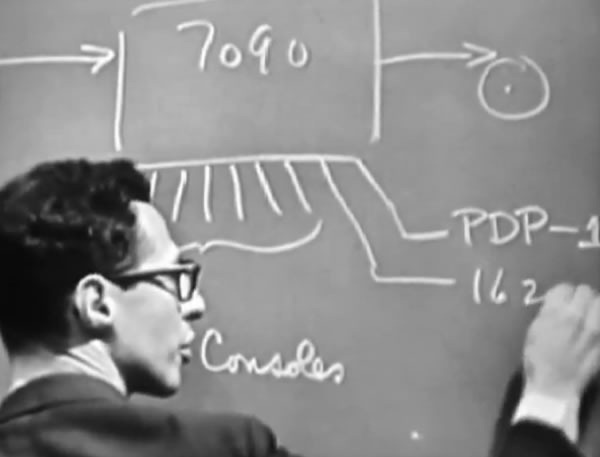
advanced elaborate ideas

When discussing the hard disk and its capacity (9 million words), Corbato has to explain to Fitch that it isn’t a big whirling disk on which you store tape, but a platter coated with a magnetic material like tape. This is old hat to us in the 21st century, but at the time, disks weren’t household items:
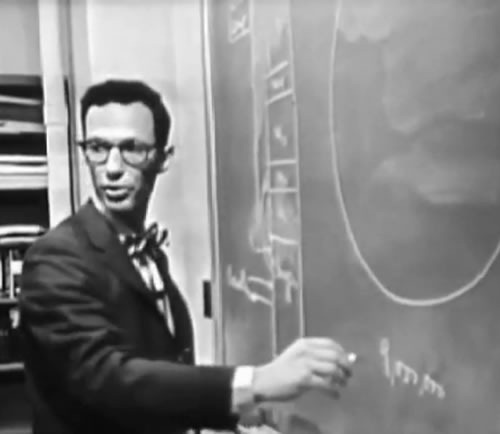
hard disk

At the time, disks had been around for about a year. Corbato confesses that there are still some problems with them: they “haven’t figured out how to keep things from getting mixed up”.

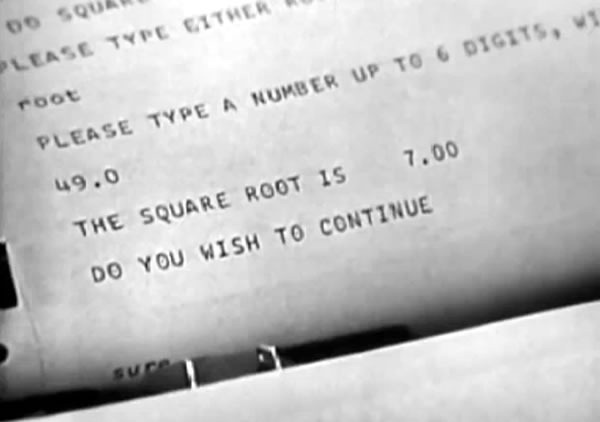
And on it goes with ideas that are still in use today: programming languages (“a particular synthetic language which is largely technical, and which is to some extent algebra too”), the organization of different programs in memory at the same time, multitasking with a scheduler that determines which program gets the processor’s attention at the moment, file loading and management by the operating system, the concepts of “brute-force solutions”, context switching (which they can “keep down to 10%”), input validation and even the phrase “it’s a feature”.

The line of Corbato’s that I love most is his prescient statement about usability and demand: “We’ve really made the computer extremely easy to use here. And so it’s very clear that in the long run, we’re going to increase in the need for computer time by a large amount.”

This video is all sorts of old-school awesome. If you’ve got nothing to do on your lunch break, check it out!

This article also appears in The Adventures of Accordion Guy in the 21st Century.
{ 3 comments }

Old IBM Ad: “150 Extra Engineers!”

by Joey deVilla on August 10, 2009

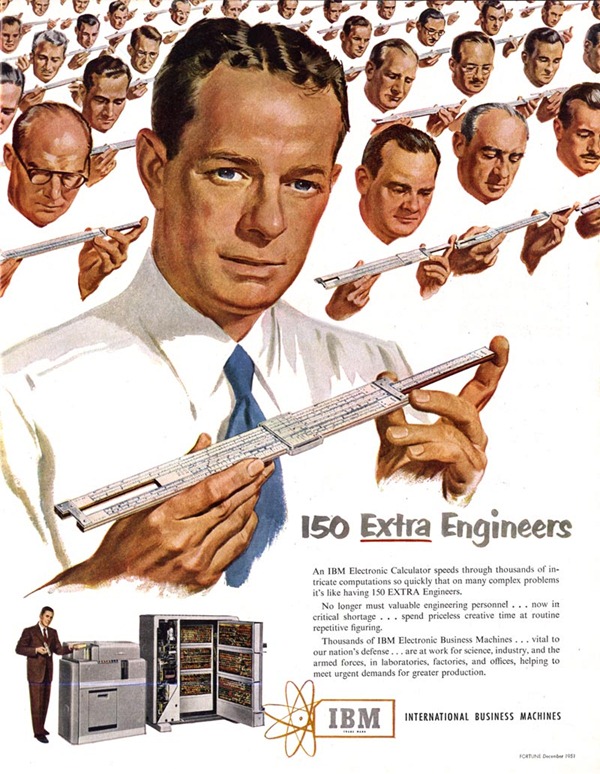
Alternate titles for this ad: 150 Receding Hairlines! 150 Giant Foreheads!

IBM "Electronic Calculator" ad: "150 Extra Engineers" Click the ad to see it at full size.

Here’s the text of the ad:

150 Extra Engineers

An IBM Electronic Calculator speeds through thousands of intricate computations so quickly that on many complex problems it’s like having 150 EXTRA Engineers.

No longer must valuable engineering personnel…now in critical shortage…spend priceless creative time at routine repetitive figuring.

Thousands of IBM Electronic Business Machines…vital to our nation’s defense…are at work for science, industry and the armed forces, in laboratories, factories and offices, helping to meet urgent demands for greater production.

{ 4 comments }

16 Megabytes, Yo!

by Joey deVilla on June 19, 2009

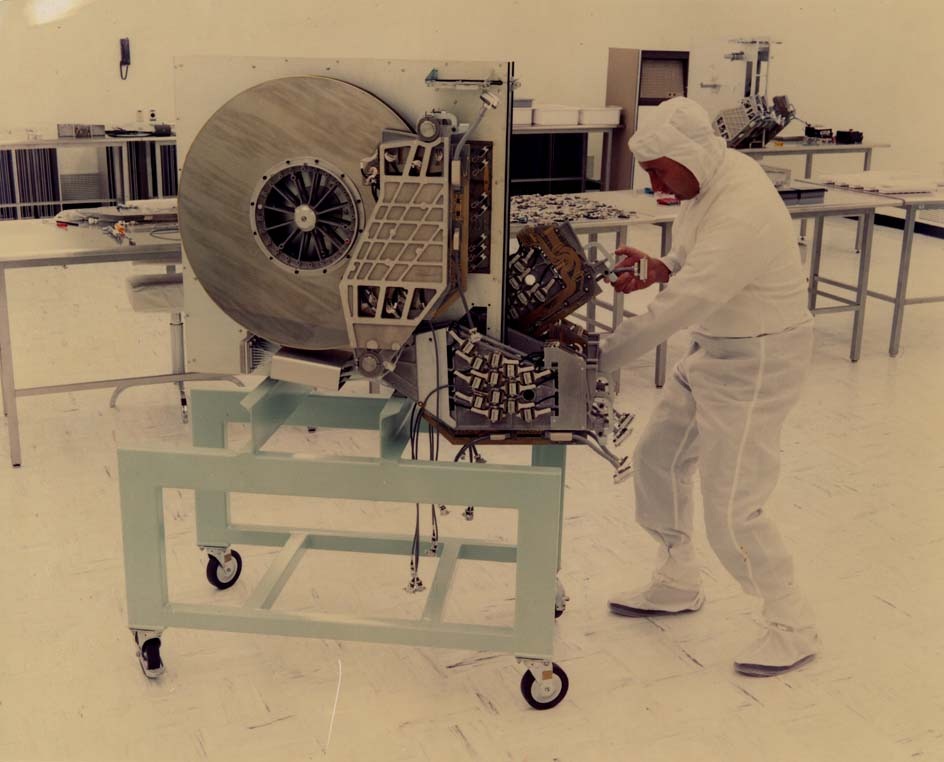
Late '60s/early '70s photo of man in "clean suit" pushing a giant hard drive on a cart in a computer room.Photo courtesy of “SirMildredPierce”.
Click the photo to see it at full size.

I’m sure that this beast of a hard drive is now dwarfed by the USB keys that they give away as swag at tech conferences.

{ 3 comments }

Old Apple ][ ad featuring Ben Franklin: "What Kind of Man Owns His Own Computer?"Click the ad to see it at full size.

From roughly the same time as the Honeywell “What the Heck is Electronic Mail?” advertisement I showed you earlier, comes this Apple ad for the original Apple ][ computer. You have to remember that this was a time when most people didn’t have a computer at their desk; in fact, if an office had a computer, it had just one. And the desktop computers of that era had far less processor power (they typically has 1 MHz 8-bit chips like the Z80 or 6502) and RAM (maximum address space was 64K; machines typically maxed out at 48K RAM) than even the cheapest of today’s mobile phones. And yes, that’s a standard TV set being used as a monitor – its highest resolution was 280 by 192 pixels.

The tricky part about creating such an ad is trying to convince people of that era that they needed a computer. Remember, in those days computers were relegated to their own rooms, the fax machine was still new, mobile phones were toys for the rich and were carried in their own briefcases and when office and even legal documents were typed or written out in longhand. I’ve been trying to think of a present-day analogue for a late 1970s/early 1980s computer ad, but I’m drawing a blank.

Here’s the text of the ad:

What kind of man owns his own computer?

Rather revolutionary, the whole idea of owning your own computer? Not if you’re a diplomat, printer, scientist, inventor…or a kite designer, too. Today there’s Apple Computer. It’s designed to be a personal computer. To uncomplicate your life. And make you more effective.

It’s a wise man who owns an Apple.

If your time means money, Apple can help you make more of it. In an age of specialists, the most successful specialists stay away from uncreative drudgery. That’s where Apple comes in.

Apple is a real computer, right to the core. So just like big computers, it manages data, crunches numbers and prints reports. You concentrate on what you do best. And let Apple do the rest. Apple makes that easy with three programming languages – including Pascal – that let you be your own software expert.

Apple, the computer worth not waiting for

Time waiting for access to your company’s big mainframe is time wasted. What you need in your department – on yourdesk – is a computer that answers only to you…Apple Computer. It’s less expensive than timesharing. More dependable than distributed processing. Far more flexible than centralized EDP. And, at less than $2500 (as shown), downright affordable.

Visit your local computer store

You can join the personal computer revolution by visiting the Apple dealer in your neighborhood. We’ll give you his name when you call our toll-free number…

{ 4 comments }

An Ad for Dharma Initiative Computers

by Joey deVilla on March 25, 2009

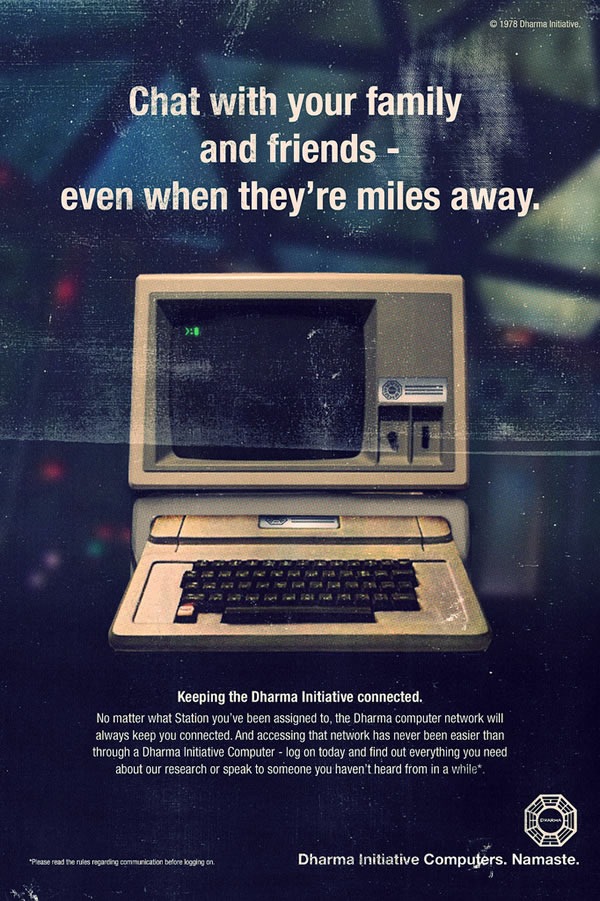
This ad won’t make any sense if you’re not a follower of the TV series Lost. However, if you are, you’ll find it amusing…

Ad for the Dharma Initiative's computers: "Chat with your family and friends -- even when they're miles away."
Click the ad to see the original on its Flickr page.

{ 1 comment }

Help LinuxCaffe Sort Through Their Tech Stuff!

March 20, 2009

Tim Hildred of LinuxCaffe writes:
We have in our storage space a veritable heap of donated pre-loved electronics, some of which we hope to recycle and repurpose, some of which is probably junk. What we need as a small team of people who, in exchange for coffee and snacks, will help us sort it out.  [...]

Read the full article →

Symbolics XL1200 Lisp Machine: Free to a Good Home [Updated]

December 3, 2008

Update
I’m giving the machine to HacklabTO, who were the first to contact me about it. Congrats, guys!

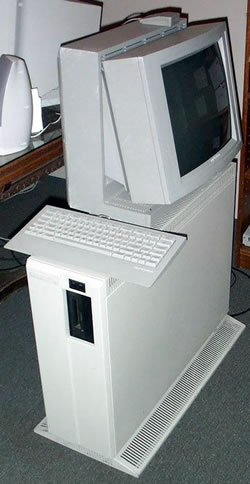
It’s been sitting in my basement long enough, and it’s time that it found a good home. By “it”, I’m referring to my deadbeat ex-housemate’s Symbolics XL1200 Lisp Machine (pictured on the right), a big hulking piece of computer [...]

Read the full article →

Blast from the Past: My Old Notes on the GNUtella Protocol

August 28, 2008

Found these photos while digging through my archives on the backup hard drive and thought you folks might find them interesting. They’re flipchart pages from either June 2000, back when I was working at Cory Doctorow’s startup, OpenCola. These are notes that I wrote on the GNUtella protocol; Chris Cummer and I worked off these [...]

Read the full article →

The Way Computers Were in the Seventies

August 18, 2008

Inspired by my earlier post on the Accordion Guy blog titled The Way Movies Were in the Seventies, I present to you this image showing the way computers were in the seventies:
Illustrations courtesy of Miss Fipi Lele.

Read the full article →

Sayonara, Cassettes

August 6, 2008

Pictured below is the death spasm of a recording format: the compact cassette (a.k.a. “cassette tape”), sitting on the bargain shelf at a drugstore somewhere in the U.S., its price reduced so that it’s one of the cheapest items in the store. Even gum is probably more expensive:
Photo courtesy of Miss Fipi Lele.
Here’s another death [...]

Read the full article →

Netscape 0.9 on the Present-Day Web

January 3, 2008

In honour of Netscape’s passing, Perl & LWP author Sean M. Burke installed Netscape 0.9 and took it out for a spin, with amusing results.

Read the full article →