If you’re like most of our readers and live in the U.S. and Canada, it’s time to enjoy your last week of standard time. Come this Sunday, daylight saving time begins — a full three weeks earlier than usual.
The change to daylight saving time is deceptively simple in appearance. In 2005, the Energy Policy Act was signed into law. This act, whose purpose was “to help every American who drives to work, every family that pays a power bill, and every small business owner hoping to expand”, included among its measures a change to daylight saving time. Starting this year, daylight saving time would be extended by four weeks, starting three weeks earlier on the second Sunday in March and ending a week later on the first Sunday in November. The rationale for this change: if daylight saving time saves energy, then extending it will save even more.
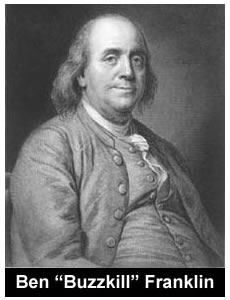
If you’re looking for someone to blame, Ben “Buzzkill” Franklin is a good candidate. In 1784, riffing off his earlier “early to bed, early to rise” nonsense, he wrote a letter to The Journal of Paris titled Daylight Saving. Written in the excessively florid language used only by 18th century statesmen and aliens on Star Trek, Franklin suggested that by waking up earlier, Parisians would enjoy more daylight during their waking hours and as a result use fewer candles and economisez beaucoup francs.
In a move as telling of the stereotype as their coinage of the word schadenfreude, the Germans were the first to put the daylight saving concept into practice in 1916. Eager not to lose the stereotype war, Newfoundland implemented this silly idea a year later. The Americans implemented daylight saving time in 1918 along with the establishment of time zones, but it proved to be so unpopular that it was repealed a year later. Daylight saving time became something that was practiced at the discretion of several localities — a few states and cities — rather than at the national level. This was followed by a whole lot of governmental meddling starting with FDR and currently ending with GWB; you can read the rest of the sordid history over at the WebExhibits Daylight Saving Time site.
The concept of daylight saving originated in a world that predated not only the concept of time zones, but also a globalized economy, ubiquitous computing and a world that runs on timetables, so perhaps “Buzzkill” Franklin can be forgiven for his crime against humanity in light of such extenuating circumstances. However, the current U.S. administration, who live in the current world and who should recall all the work that went into averting the potential problems of Y2K, should know better.
In the New York Times article Time Change a ‘Mini-Y2K’ in Tech Terms, the problem with the change is put simply: Most internal clocks in computing devices are programmed for the old daylight-time calendar, which Congress set in 1986. The end result is that all sorts of tech companies and vendors are scrambling to patch systems programmed to the old spec and that extent of the effect of the change on uncorrected systems is unknown.
The article lists a number of systems that could be affected:
- Email applications
- Calendar applications
- Hotel wake-up call services (many hotel chains’ wake-up calls are centralized under one or two data centers)
- Smart electric meters, especially in systems where the charge for electricity varies on the time of day
- and, of course, the number of appointments and meetings that will be missed as a result of the change to the time change.
The upside is that for most of us, the change to daylight saving time will be an annoyance. As Rich Kaplan, Microsoft’s VP of Customer Service puts it, “It’s not as if you’re going to lose any data — your documents, e-mail, digital music or pictures.” (I quote Mr. Kaplan with the caveat that it is perfectly appropriate and even prudent to worry when a person high up on MS’s org chart tell you that there’s nothing to worry about.)
My advice: download the appropriate patches for your computer and other devices, confirm and re-confirm any appointments that take place during the first three weeks of daylight saving and don’t take the word of any electronic clock in the month of March without corroborating evidence.
Links