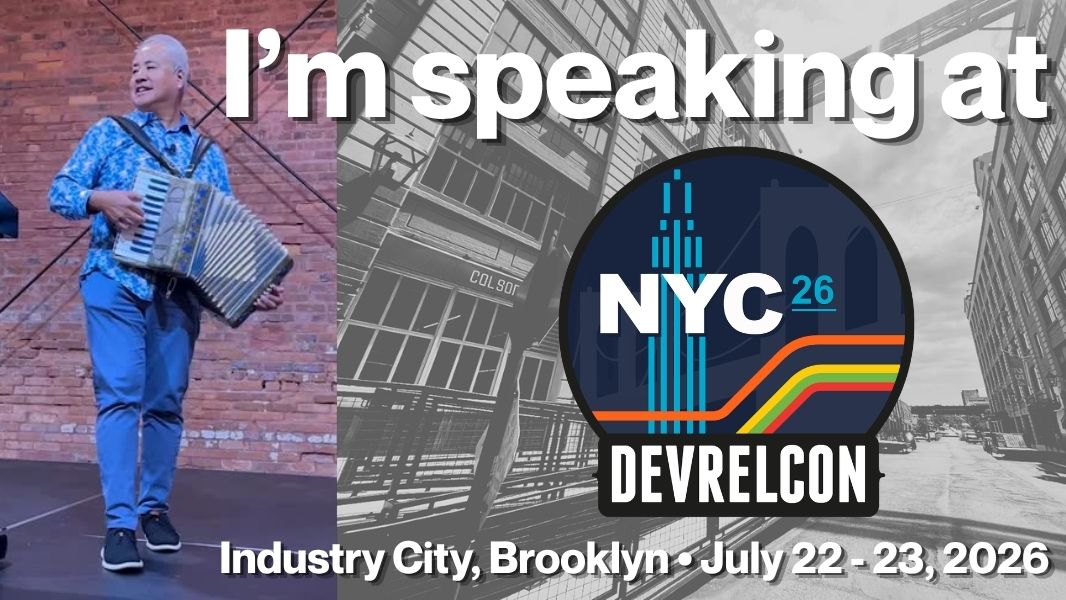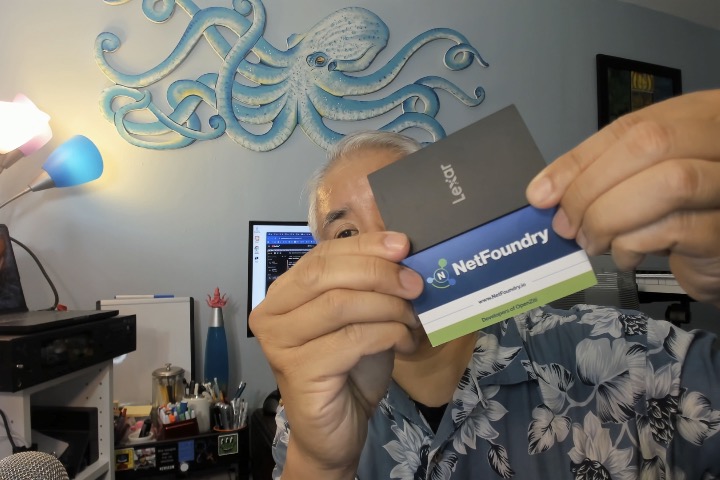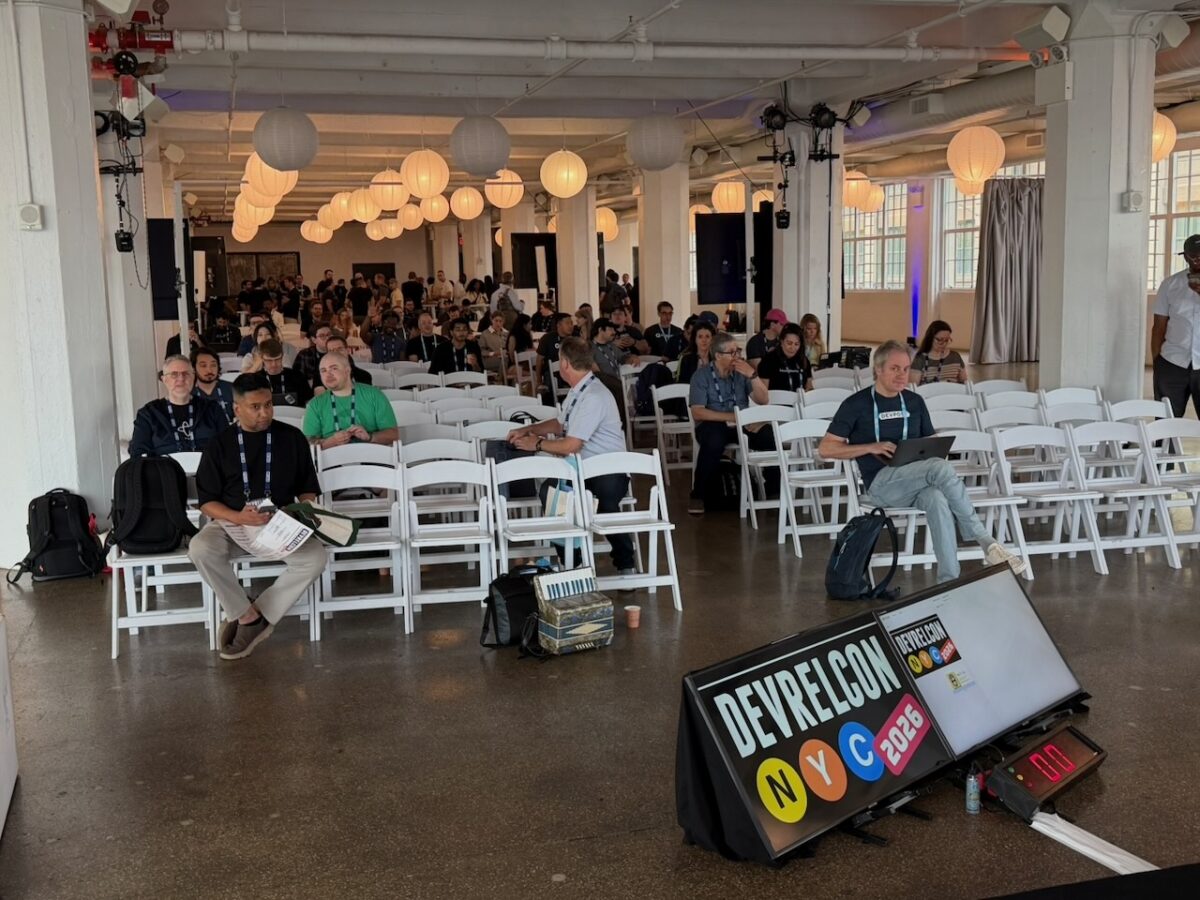
DevRelCon NYC 2026 happens today and tomorrow!
DevRelCon was created by the developer relations agency Hoopy and began in London in 2015. It’s since grown into an international series of conferences with editions in London, Prague, San Francisco, Tokyo, China, Latin America, and online.
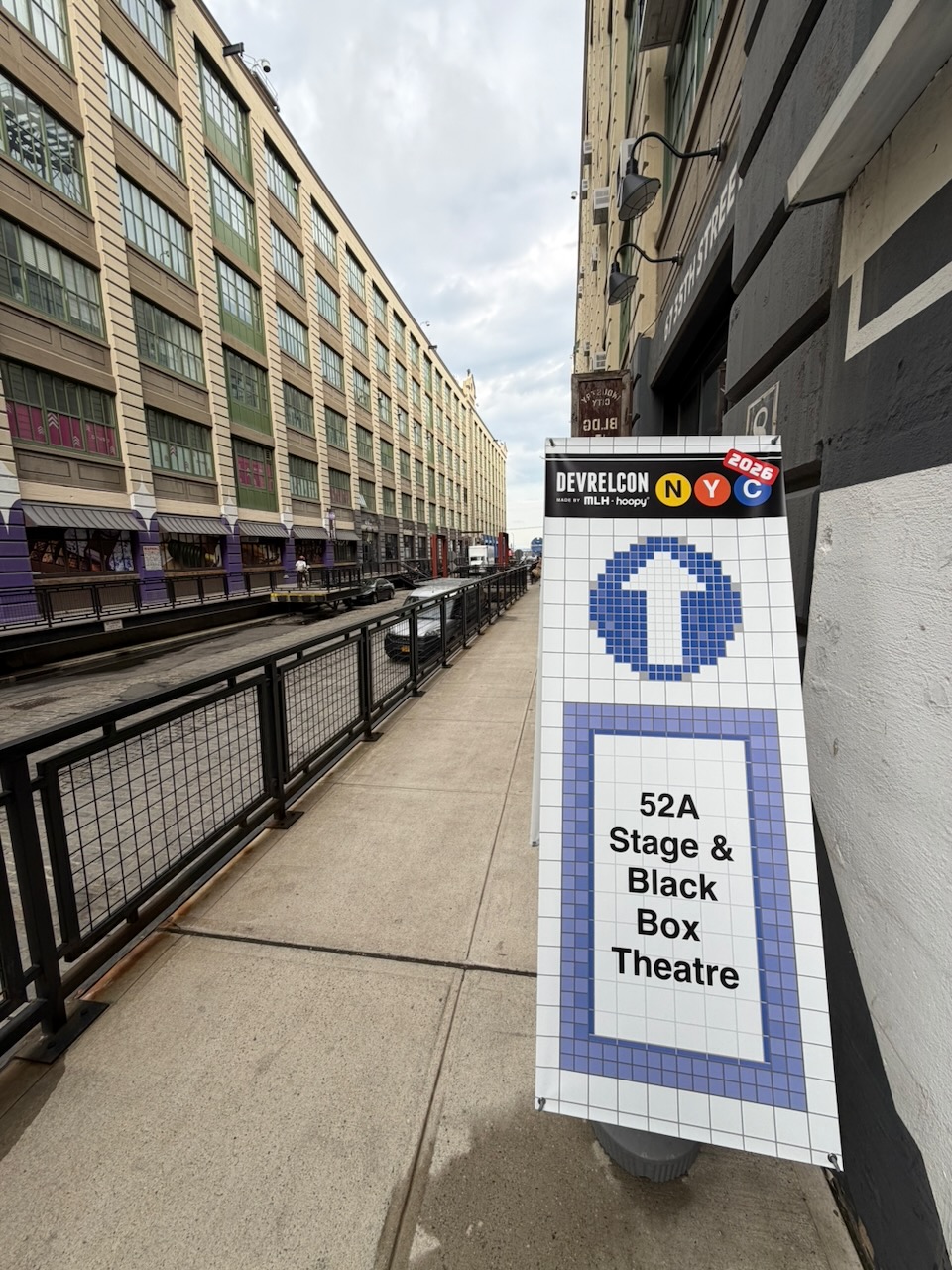
I’m speaking at this event, which is organized by Mike “Swift” Swift and Major League Hacking, the global community for early-career developers and software creators. It’s positioned as the premier conference for anyone working to grow developer adoption, spanning developer relations, developer experience, product marketing, platform product management, and everyone’s favorite three-letter acronym, GTM. In other words, it’s a room full of exactly the people my talk is about, which is either the best or the most terrifying possible audience for a talk on what the DevRel job market is really telling us. (Probably both.)
I’m here as of the many, many people you can meet. But meeting people requires a skill called “working the room.”
Fortunately for you, my life, whether as a developer advocate, musician, community organizer, and generally unhinged extrovert has me working the room regularly, and I’m sharing all my tricks in this article. There are a lot of them; feel free to scan this article, find the tips that work for you, and put them into practice!
Contents
Before the conference
Do some homework
Review the schedule speaker bios, and sponsors (who’ll probably have a table in the exhibitor hall), so that you can determine:
- What sessions do you want to attend? This will provide subject matter for conversations, as well as help you find other people who’ll be attending the same workshops/talks.
- What speakers would you like to talk to? I’m a speaker, and I know that we’ve been told not to hide in the speaker ready room, but get out into the conference to mix, mingle, and start conversations. Think of us as “mini-hosts” for the event, and if our presentation covers a topic you’d like to talk about, please approach us!
- What sponsors do you want to talk to? Is there some gear, software, or service that you’re interested in that some sponsor provides? Make a note to talk to them.
Arrive with goals
Decide what you want to achieve at DevRelCon, which can include any of the following:
- Learning something new
- Making new contacts or re-establishing old ones
- Finding new work / hobby / social opportunities
Prepare your introduction

A one-line self-introduction is simply a single-sentence way of introducing yourself to people you meet at a conference. It’s more than likely that you won’t know more than a handful of attendees and introducing yourself over and over again, during the conference, as well as its post-session party events. It’s a trick that Susan RoAne, room-working expert and author of How to Work a Room: The Ultimate Guide to Making Lasting Connections In-Person and Online teaches, and it works. It’s pretty simple:
- Keep it short — no longer than 10 seconds, and shorter if possible. It’s not your life story, but a pleasantry that also gives people just a little bit about who you are.
- Make it fit. It should give people a hint of the cool stuff that you do (or, if you’re slogging it out in the hopes of doing cool stuff someday, the cool stuff that you intend to do.)
- Show your benefits. Rather than simply give them your job title, tell them about a benefit that your work provides in a way that invites people to find out more. Susan RoAne likes to tell a story about someone she met whose one-liner was “I help rich people sleep at night”. That’s more interesting than “I’m a financial analyst”.
My intro at DevRelCon will be something along the lines of “I’m a rock and roll accordion player, but in my spare time, I do developer relations at NetFoundry!”
Have some “pocket stories” handy
Pocket stories are short, engaging, and easy-to-tell anecdote you keep ready for networking situations. They should be:
- Brief: No more than a minute long; a minute and thirty seconds tops.
- Relevant to DevRelCon or the people listening.
-
Open-ended, so listeners can respond or share their own experiences.
Here’s a tech-related pocket story:
“Last year I tried to refactor a core service during a two-week sprint. Halfway through, we realized we’d basically reinvented a library that already existed. The best part? We ended up contributing to that library instead, and now it’s in production at three other companies.”
“Local flavor” pocket stories are often a good conversation starter:
“This is my first time in Kansas City, and yesterday I went looking for barbecue. I asked a local for the ‘best’ spot… and ended up in a half-hour debate between two strangers about burnt ends. I still don’t know who won, but I definitely left full.”
Bring an interesting thing
We’re nerds! We love interesting gadgets, amusing tchotchkes, and funny techie T-shirts. They’re often interesting conversation-starters, and DevRelCon is the perfect environment for bringing them out!
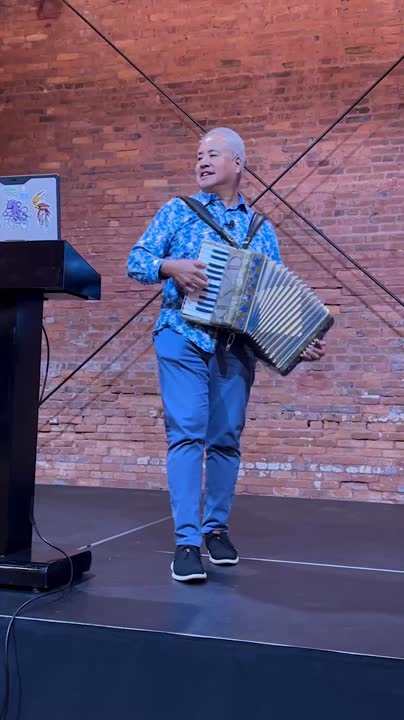
Me? I’m bringing the accordion (of course).
The incredibly simple trick for instantly boosting your social confidence

Here’s the exercise: Before you leave to go to DevRelCon, find some text and read it out loud for three minutes. If for some reason you can’t find some text to read, use this article. You’ll find that it’s a self-confidence booster!
Even after DevRelCon has come and gone, do this exercise daily. Like any skill, frequent low-pressure practice builds familiarity, and if you read alound regularly, you’ll find yourself more comfortable when talking with strangers at networking events.
Choose something different to read out loud every day, and try emphasizing key parts of the text. If you’re reading something with dialogue, try expressing the emotion in that dialogue. If you listen to audiobooks or podcasts, try emulating the way audiobook narrators narrate their material.
Reading out loud boosts your confidence because:
- It helps you get comfortable with your voice. Many people don’t like the sound of their own voice. Reading out loud gets you used to the sound of your voice, reducing any self-consciousness you may have about it. And when you’re comfortable with your voice, you’ll also be more comfortable speaking in social situations and making presentations.
- Your speech will become more clear. The exercise of reading out loud forces you to articulate words clearly and speak at a steady pace. You’ll also become more aware of your tone, rhythm, and pitch, so that you can adjust them to sound clear and confident, and mumble less.
- It makes you more engaging. Read out loud with expression; it’ll give you practice with the kind of vocal variety and emphasis that keeps listeners interested in actual conversations.
At the conference (and conference events)
Use Inigo Montoya’s technique for introducing yourself
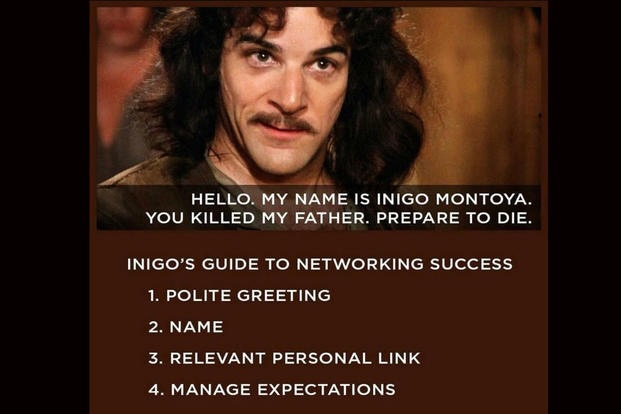
Inigo Montoya from The Princess Bride had the perfect self-introduction. Use his technique for yourself!
Example: “Hi! I’m Joey de Villa. I’m giving the fun Python “choose your own adventure” game talk on Friday. How are you doing?”
Project good posture

Having a good posture is generally good for all sorts of health reasons, but at a conference, it has the additional benefit of showing confidence, competence, and alertness. And because the body is a self-feedback system, you’ll find yourself feeling more confident, competent, and alert.
The general guidance for standing up straight is to imagine a string pulling you gently upward from the crown of your head. Keep your spine straight, knees soft, and feet shoulder-width apart.
When you do this, people will be more likely to approach you because you appear open and self-assured instead of reluctant and uncertain.
The general advice is to put your shoulders back — but not too far back. Your shoulders should be below your ears. Drawing your shoulders back just slightly opens up your chest, which is body language for “Hello. My name in Inigo Montoya. I’m killin’ it here. Prepare to converse.” You’ll appear more engaged and ready to interact.
That’s so much better that the forward, rounded shoulders look, which says “I don’t want to be here, and I definitely don’t want to talk to you.” It makes you look defensive or distracted.
You might find it helpful to roll your shoulders up, back, and down, just enough to relax your chest.

Here’s a WikiHow exercise to help you stand up straight.
Engage with eye contact
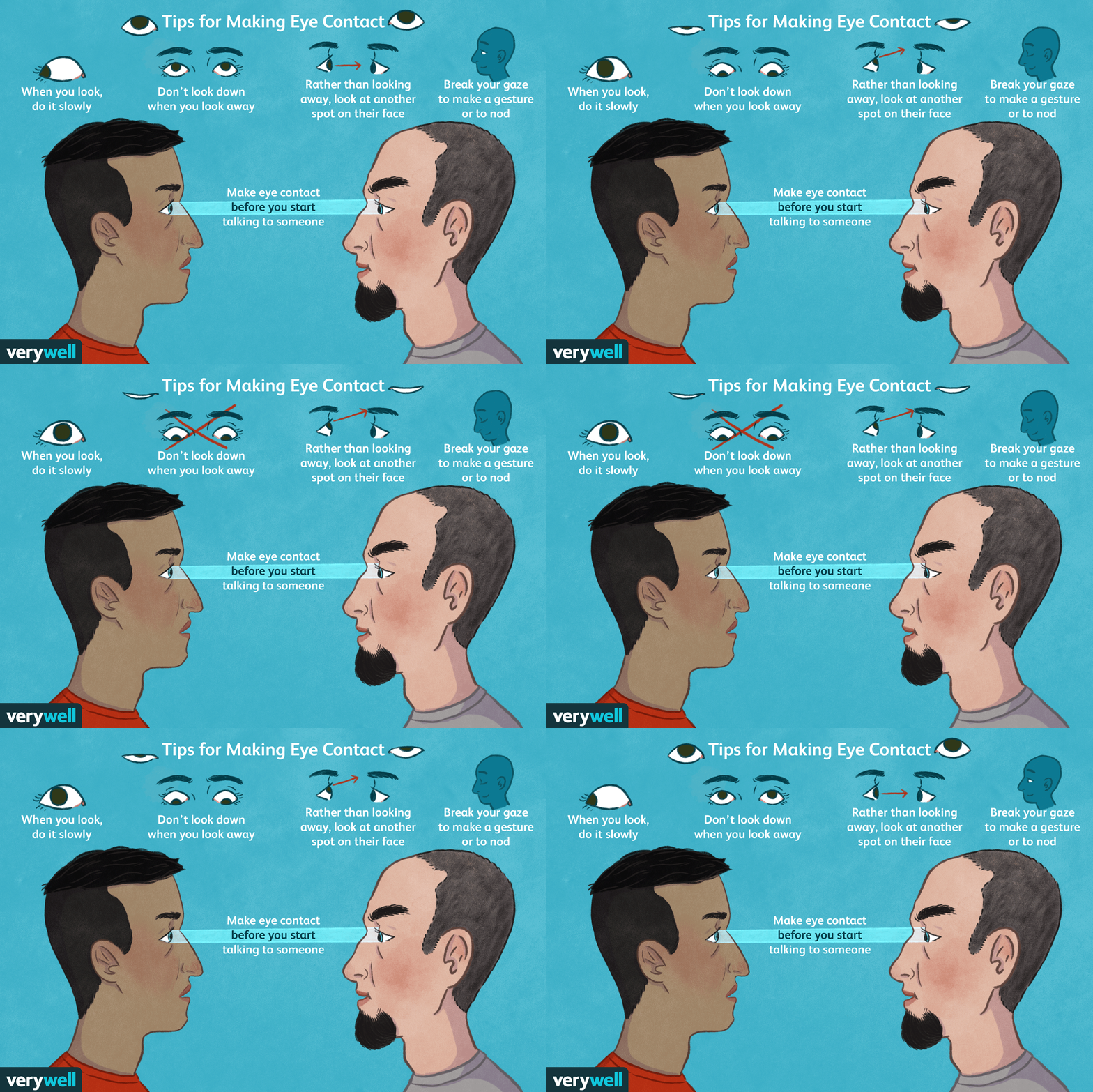
Eye contact — it’s a tricky thing, especially among nerdy types, but is one of the strongest ways to build trust quickly. What better place to brush up on your eye contact technique than DevRelCon?
Here’s how you do it: when you meet someone, make eye contact by looking at them right at their eyes for a “one thousand one, one thousand two” count. That’s long enough to acknowledge them but not so long that it feels as though you’re staring them down.
If looking someone in the eyes isn’t your thing, try looking at some part of their face near their eyes, such as their forehead or cheek.
Done right, eye contact gives others a sense of warmth and attentiveness. It makes other people feel seen, which is crucial in noisy, crowded conference environments.
Find out more about eye contact here.
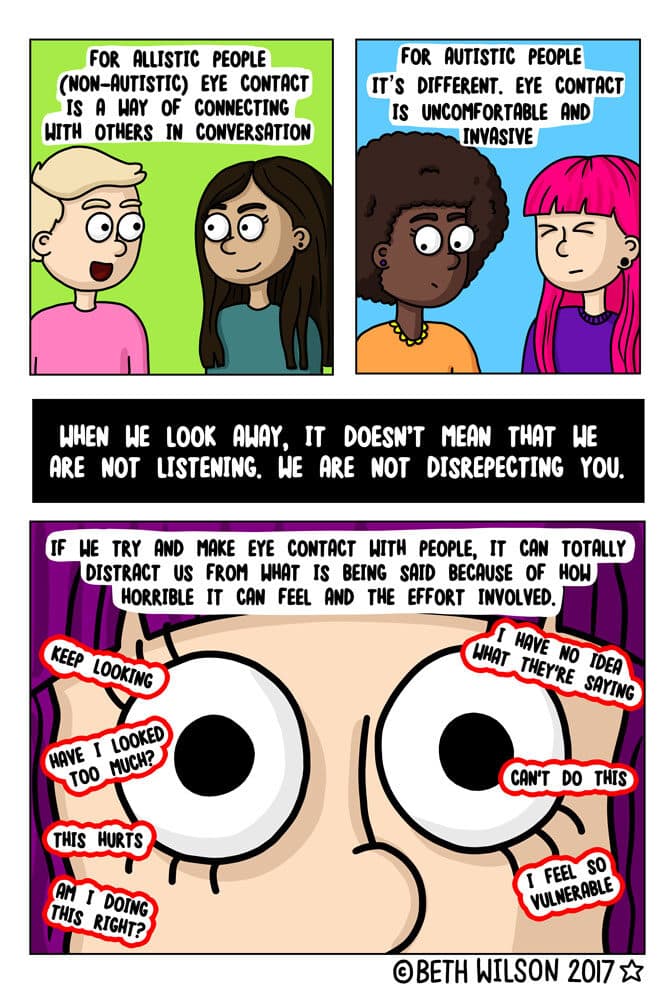 Allistic people — people who aren’t affected by autism — should be aware that people with autism find eye contact challenging. If you find that the person you’re talking to finds eye contact uncomfortable, look at their face, but not directly at their eyes (basically, use the trick I mentioned earlier).
How to join a conversation
You’ll probably see a group of people already engaged in a conversation. If this is your nightmare…

…here’s how you handle it:
- Pick a lively group of people you’d like to join in conversation. As people who are already in a conversation, they’ve already done some of the work for you. They’re lively, which makes it more likely that they’re open to people joining in. They’ve also picked a topic, which saves you the effort of having to come up with one. It also lets you decide whether or not it interests you. If they’re lively and their topic of conversation interests you, proceed to step 2. If not, go find another group!
- Stand on the periphery and look interested. Just do it. This is a conference, and one of the attendees’ goals is to meet people. Smile. Pipe in if you have something to contribute; people here are pretty cool about that.
- When acknowledged, step into the group. You’re in like Flynn! Step in confidently and introduce yourself. If you’ve got that one-line summary of who you are that I talked about earlier, now’s the time to use it.
- Don’t force a change of subject. You’ve just joined the convo, and you’re not campaigning. Contribute, and let the subject changes come naturally.
Feel free to join me in at any conversational circle I’m in! I always keep an eye on the periphery for people who want to join in, and I’ll invite them.
Observe, ask, reveal
 In her book How to Work a Room, Susan RoAne talks about a conversation tool she refers to as “Observe, Ask, Reveal” or “OAR,” which is a way to make interactions feel more natural and engaging. It’s made up of three steps:
-
Observe. Notice something about the person you’re talking to, their surroundings, or the situation. This could be as simple as their choice of drink, something they’re carrying, or something happening in the room.
-
Ask. Follow your observation with a genuine, open-ended question. This invites the other person to share and keeps the conversation flowing.
-
Reveal. Share a little about yourself related to the topic, which helps build rapport and makes the exchange feel balanced rather than like an interrogation.
⚠️ Don’t overshare! TMI often backfires. Also, don’t overdo it with the questions — it should feel like a conversation, not an interrogation.
The idea behind OAR is to create an easy rhythm between listening and contributing to the conversation.
Be more of a host and less of a guest
No, you don’t have to worry about scheduling or if the coffee urns are full. By “being a host,” I mean doing some of things that hosts do, such as introducing people, saying “hello” to wallflowers and generally making people feel more comfortable.
Being graceful to everyone is not only good karma, but it’s a good way to promote yourself. It worked out really well for me — when I first moved to Tampa, I simply attended events and helped out where I could, lending a hand at meetups. I gained a reputation for being helpful and knowledgable, which led me to being invited to speak at events, and I also wound up inheriting a couple of meetups as well!
Use social media
Follow the DevRelCon hashtag — the official one is #devnexus — to find out what’s going on, and to find and connect with attendees online.
Advice for lunch

Lunch at DevRelCon is a great opportunity to meet people! Here are some tips for lunch…
1. Choose your table with intention
-
Arrive early if possible. This gives you more freedom to choose your spot.
-
Look for tables with a mix of people already seated and empty chairs. It’s easier to integrate into an existing conversation than to start from scratch with a fully empty table.
2. Use OAR (“observe, ask, reveal”) to break the ice
Follow the “observe, ask, reveal” conversational framework I wrote about earlier to talk to people at the table.
Example: “I see you got the DevRelCon hoodie — did you brave the merch line this morning?”
3. Introduce yourself to your immediate neighbors first
-
Turn to the people on your left and right, give your name, where you’re from, and a quick “pocket story” or conference-related detail.
-
Then, when there’s a pause in the group’s conversation, introduce yourself to the whole table. This makes you seem approachable, and you’re not barging into the conversation.
4. Keep the conversation inclusive
-
If you notice someone at the table isn’t speaking much, pull them in by looping back to them with a related question.
-
Avoid overly niche technical deep dives unless everyone’s into it.
5. Have a graceful exit
-
When lunch is wrapping up, thank the table for the conversation.
-
Swap contact details or LinkedIn with anyone you clicked with.
-
Mention to people at the table that you might see them in another session. If you know what sessions you’re attending after lunch, let them know!
Advice for social events
Try these out at Thursday’s attendee party, as well as at DevRelCon’ other social events, including the karaoke event (taking place Thursday at 9:00 p.m. in the back room on the ground floor of the AC Hotel):
- Beware of “rock piles”. Rock piles are groups of people huddled together in a closed formation. It sends the signal “go away”. If you find yourself in one, try to position yourself to open up the formation.
- Beware of “hotboxing”. I’ve heard this term used in counter-culture settings, but in this case “hotboxing” means to square your shoulders front-and-center to the person you’re talking to. It’s a one-on-one version of the rock pile, and it excludes others from joining in. Once again, the cure for hotboxing is to change where you’re standing to allow more people to join in.
- Put your stuff down. Carrying your bag or other stuff is a non-verbal cue that you’re about to leave. If you’re going to stay and chat, put them down. When you’re about to leave, take your stuff and start saying your goodbyes.
- Save the email, texts, and social media posts for later, unless they’re important.They’ll draw your attention away from the room and also send the message “go away.”
After the conference
1. Organize your contacts soon after the conference
-
Review any business cards, LinkedIn connections, or conference app contacts you collected. Strike while the iron is hot — do this by the end of the following week!
-
Tag or note:
-
How you met
-
What you talked about
-
Any action items (e.g., “Send them article on API security”)
-
This makes your outreach to people feel more personal and less generic and spammy.
2. Send a brief, specific follow-up
-
Timing: ideally within 3 days of the conference.
-
Keep it short, but reference something from your conversation to jog their memory.
Example: “Great chatting with you at the DevRelCon lunch table about AI security. Here’s that GitHub repo I mentioned.”
3. Continue the conversation
-
Share a useful resource, article, or code snippet related to what you discussed.
-
Offer help or collaboration, even if it’s small. This shifts you from a “one-time meet” to a peer in their network.
4. Connect on the right channels
-
LinkedIn for professional connections and ongoing career updates.
-
GitHub for technical/code collaboration.
-
Twitter/X or Mastodon if you connected over shared interests in tech culture, events, or industry news.
5. Keep the relationship warm
-
Interact with their posts, star or fork their repos, or comment thoughtfully on something they’ve shared.
-
When you come across a relevant opportunity, event, or resource, send it their way with a short note.
6. Build a “conference alumni” list
-
Keep a lightweight spreadsheet or note with names, contact info, and event details.
-
Before your next DevRelCon (or other conference), skim this list so you can reconnect with past contacts.