Categories
Uncategorized

Developers Aim to Lure Women to Adult Games, A Little More Hesitant About the Gay Dudes

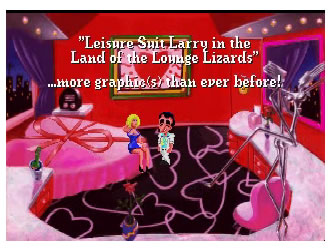
Leisure Suit Larry in the Land of the Lounge Lizards

The article Developers aim to lure women to adult games starts off like any other article about attracting women to videogames, with the usual talk of the problems inherent in games designed for a specific demographic, namely the white straight techo-savvy male.

The first sign that it’s not like most articles about the gender imbalance in gaming is the admission of a truth that anyone who’s ever worked at a bar (George and I did in college) knows: if you want to lure the men, you’ve got to lure the women.

Then, after the halfway point, the article — either intentionally or not — just gets sillier. First, there’s the explanation by the creators of the Jenna Jameson [link safe for work] game Virtually Jenna [link not safe for work] of how they made their game more appealing to women by emphasizing the story aspects of the game:

We’re evolving [the] story like Penthouse Forum, and you finish it off, so it gets more cerebral.

Having read heard about some Penthouse Forum letters myself, I cannot recall any cerebral aspects.

When presented with the question of why gay men are underserved by adult games, out come the weasel words:

Several participants in the discussion said that gay men and women are also underserved. And one main reason, it was agreed, is that because straight couples have different body movements when having sex than do gay men or women, there’s often too much animation work required to satisfy those markets.

“Everything we want people to be able to do has to be animated separately,” Dudley said. The way that men interact with men differs from how men interact with women. So if we’re going to deal with gay sex, which we do, then the amount of work we have to do” skyrockets.

Working in an area of Toronto that is known for the number of offices for adult web sites and knowing some of their employees, I’ve heard graphic artists and animators boast of the long hours they spend toiling over their beloved craft. I think that they’re just making excuses — these guys, faced with the prospect of long sessions of animating hot man-on-man action, are simply looking for a (ahem) back door. Surely they can find some gay animators who’d love doing that work as much as their straight counterparts enjoy working on the Jenna kinematics.

After all, they boasted about a certain feature in the straight-male-oriented Virtually Jenna that sounded it required a lot of extra work:

Abram said that Virtually Jenna allows players to highly customize their characters, including giving those wanting men with different size genitalia the ability to get what they want.

The same goes for what Abram called “ass physics,” essentially the firmness of the male buttocks.

“I guarantee you, ‘ass physics’ has never been said at GDC before,” Brathwaite said.

I can guarantee that it’s never been said at Global Nerdy until just now.
Categories
Uncategorized

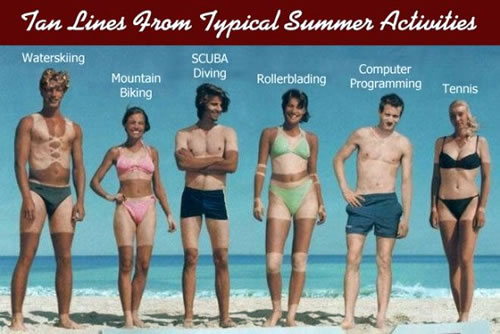
Tan Lines from Typical Summer Activities

A cute image, courtesy of Reddit:

Tan Lines from Typical Summer Activities

Categories
Uncategorized

My Dirty Network Neutrality Secret

I have a confession to make: in spite of the fact that I work for an internet services company and get paid to wirte on internet-related topics all the time, I haven’t fully worked out my position on network neutrality.

Don’t get me wrong: I tend towards the pro-neutrality side. It’s just that my leaning is based not on serious study of the issue, but on a general gut feeling. That’s not necessarily a bad thing. I’d be willing to bet that most of you can look back on your life experiences and say that the times you wished you’d gone with your gut outnumber the times you’ve asked yourself “Why did I trust my stupid instincts?”.

What I haven’t done is work out some reasoning to either back up or disprove that gut feeling. I’m devoting way more brain cells to revamping the Tucows web sites for which I am responsible, working out new applications for the company APIs, mastering Ruby and Ruby on Rails, and working on some ideas with George. Guys like Om and the Valleywaggersthey have the time and resources to look at the problem from all angles and perhaps work out a rationale. I wish I did.

What’s partly responsible for my gut feeling is my distrust of the people who are campaigning against network neutrality, and the latest volley of spin from Hands Off the Internet, as written up in the TechDirt article Hands Off the Truth only helps to justify it. One of the Mikes from TechDirt writes:

If we get something factually wrong, we’ll admit it and correct our mistakes. Apparently, Hands Off The Internet doesn’t feel the same way. They certainly don’t allow comments on their blog. I emailed them to point out their mistakes and to suggest they make a correction — but rather than do so, they put up a second post referring to our post, without bothering to correct their factually incorrect statements. While we might have some common ground with them — though our position isn’t as extreme as theirs — it really makes you wonder why they’re so disconnected from the truth. It doesn’t make anyone any more likely to support their side. It just makes us wonder how truthful even their seemingly legitimate points are. If they play so fast and loose with the facts on such obvious points, perhaps they can’t be trusted on anything else as well.

Link

Categories
Uncategorized

Newspapers Need Nerds!

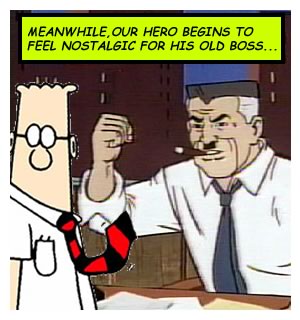
Dilbert and J. Jonah Jameson

Although it may not seem obvious at first, publishing and nerds go hand in hand. Think back to college or even high school, where no yearbook or newspaper staff was complete without its nerds.

George and I did a lot of bonding on Sunday nights at Crazy Go Nuts University’s humor paper, Golden Words, where we took on every task, from brainstorming to writing to editing to typesetting to cartooning to graphic design (and I’ll give George bonus marks for also doing photography). Since it was a paper run by the school’s engineering society, we weren’t the only nerds there; we were two of many who had some kind of affinity for tech. I believe that if neither George nor I had the knack or interest in computers — or perhaps if we’d been born decades earlier, we’d have gone into journalism or publishing.

Working for a college paper in the late 1980s, we saw the transition from traditional layout (when cutting and pasting involved using actual knives and wax or rubber cement) to the introduction of newfangled things we take for granted today: desktop publishing software, laser printers and bitching about how much better it would be if we used Macs instead of PCs. Suddenly having a knack for working with computers was a much sought-after skill in the newsrooms.

Between the old school nerd-newspaper connection and the way “publishing” is increasingly moving away from paper and towards bits (see this entry in O’Reilly Radar where Tim explains why they’re having a publishing conference in Silicon Valley rather than New York), it’s no wonder that my reaction to this article on PBS’ MediaShift site — Web Focus Leads Newspapers to Hire Programmers for Editorial Staff — was “Well, it’s about time!” rather than “Huh?”

The article covers a number of people who mash up newspaper work with software development:

  • Adrian Holovaty, creator of the Python-based Django framework, “the web framework for perfectionists with deadlines”, and ChicagoCrime.org, a mash-up that cross-references the city’s crime blotter with Google Maps to provide a map of where crimes took place.
  • Aaron Ritchey, who functions as a “news programmer” at Tacoma’s News-Tribune, where he’s put together all manner of applications such as map mash-ups, survey generators, article formatters and reader-searchable databases.
  • Jacob Kaplan-Moss of the Lawrence Journal-World, who says “If you find the right newspaper, working for a newsroom can be far better than working for any dot-com. My job is hands-down the best job I’ve ever had, in no small part because newspapers need us for their very survival. Most news organizations, although slow to adapt and late to the party, are finally realizing just how compelling web-based journalism can be, and they’re creating positions for us faster than we can fill ‘em.”

Also covered in the article are such topics as:

  • Computer-assisted reporting
  • Concerns programmers taking over journalists’ jobs
  • What journalism school can do to prepare students for the journalism world to come
  • Getting the techies working for newspapers out of the IT ghetto and into the newsroom
  • Motivating newsrooms to hire programmers

As for why a programmer would want to take a job at a paper rather than a tech company, especially when the pay scales at tech companies tend to be better, Aaron Ritchey has a good answer:

At the News Tribune, I am the programmer. If I were working at a company that hires dozens of programmers, I would be just a programmer. I enjoy the extra responsibility of being the planner, the developer, and the tester.

It sounds like the reason I took my first job at a CD-ROM multimedia company, where I was a computer science grad surrounded by people who went to art school.

Link