
It’s adorable, and it describes the job pithily.
It’s adorable, and it describes the job pithily.
Dev/Nexus 2026 starts today and continues on Friday. Located in Atlanta, founded in 2004, and with 1,500+ attendees expected, it’s a huge, long-running conference with an international reputation, and it’s also a fantastic networking opportunity!

Anitra and I are here, and we’re just two of the many, many people you can meet. But meeting people requires a skill called “working the room.”
Fortunately for you, my work as a developer advocate requires me to work the room regularly, and I’m sharing all my tricks in this article. There are a lot of them — feel free to scan this article, find the tips that work for you, and put them into practice!
Review the schedule speaker bios, and sponsors (who’ll probably have a table in the exhibitor hall), so that you can determine:
Decide what you want to achieve at Dev/Nexus, which can include any of the following:
A one-line self-introduction is simply a single-sentence way of introducing yourself to people you meet at a conference. It’s more than likely that you won’t know more than a handful of attendees and introducing yourself over and over again, during the conference, as well as its post-session party events. It’s a trick that Susan RoAne, room-working expert and author of How to Work a Room: The Ultimate Guide to Making Lasting Connections In-Person and Online teaches, and it works. It’s pretty simple:
My intro at Dev/Nexus will be something along the lines of “I’m a rock and roll accordion player, but in my spare time, I do developer relations and I’m currently doing a developer contract optimizing an MCP server for Hammerspace!”
Pocket stories are short, engaging, and easy-to-tell anecdote you keep ready for networking situations. They should be:
Open-ended, so listeners can respond or share their own experiences.
Here’s a tech-related pocket story:
“Last year I tried to refactor a core service during a two-week sprint. Halfway through, we realized we’d basically reinvented a library that already existed. The best part? We ended up contributing to that library instead, and now it’s in production at three other companies.”
“Local flavor” pocket stories are often a good conversation starter:
“This is my first time in Kansas City, and yesterday I went looking for barbecue. I asked a local for the ‘best’ spot… and ended up in a half-hour debate between two strangers about burnt ends. I still don’t know who won, but I definitely left full.”
We’re nerds! We love interesting gadgets, amusing tchotchkes, and funny techie T-shirts. They’re often interesting conversation-starters, and Dev/Nexus is the perfect environment for bringing them out!

Me? I’m bringing the accordion (of course).

Here’s the exercise: Before you leave to go to Dev/Nexus, find some text and read it out loud for three minutes. If for some reason you can’t find some text to read, use this article. You’ll find that it’s a self-confidence booster!
Even after Dev/Nexus has come and gone, do this exercise daily. Like any skill, frequent low-pressure practice builds familiarity, and if you read alound regularly, you’ll find yourself more comfortable when talking with strangers at networking events.
Choose something different to read out loud every day, and try emphasizing key parts of the text. If you’re reading something with dialogue, try expressing the emotion in that dialogue. If you listen to audiobooks or podcasts, try emulating the way audiobook narrators narrate their material.
Reading out loud boosts your confidence because:
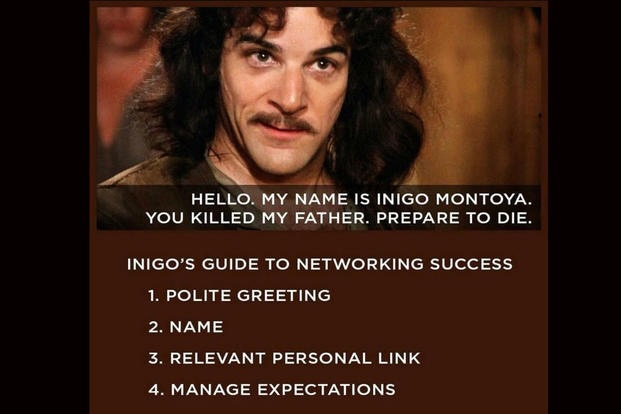
Inigo Montoya from The Princess Bride had the perfect self-introduction. Use his technique for yourself!
Example: “Hi! I’m Joey de Villa. I’m giving the fun Python “choose your own adventure” game talk on Friday. How are you doing?”

Having a good posture is generally good for all sorts of health reasons, but at a conference, it has the additional benefit of showing confidence, competence, and alertness. And because the body is a self-feedback system, you’ll find yourself feeling more confident, competent, and alert.
The general guidance for standing up straight is to imagine a string pulling you gently upward from the crown of your head. Keep your spine straight, knees soft, and feet shoulder-width apart.
When you do this, people will be more likely to approach you because you appear open and self-assured instead of reluctant and uncertain.
The general advice is to put your shoulders back — but not too far back. Your shoulders should be below your ears. Drawing your shoulders back just slightly opens up your chest, which is body language for “Hello. My name in Inigo Montoya. I’m killin’ it here. Prepare to converse.” You’ll appear more engaged and ready to interact.
That’s so much better that the forward, rounded shoulders look, which says “I don’t want to be here, and I definitely don’t want to talk to you.” It makes you look defensive or distracted.
You might find it helpful to roll your shoulders up, back, and down, just enough to relax your chest.

Here’s a WikiHow exercise to help you stand up straight.
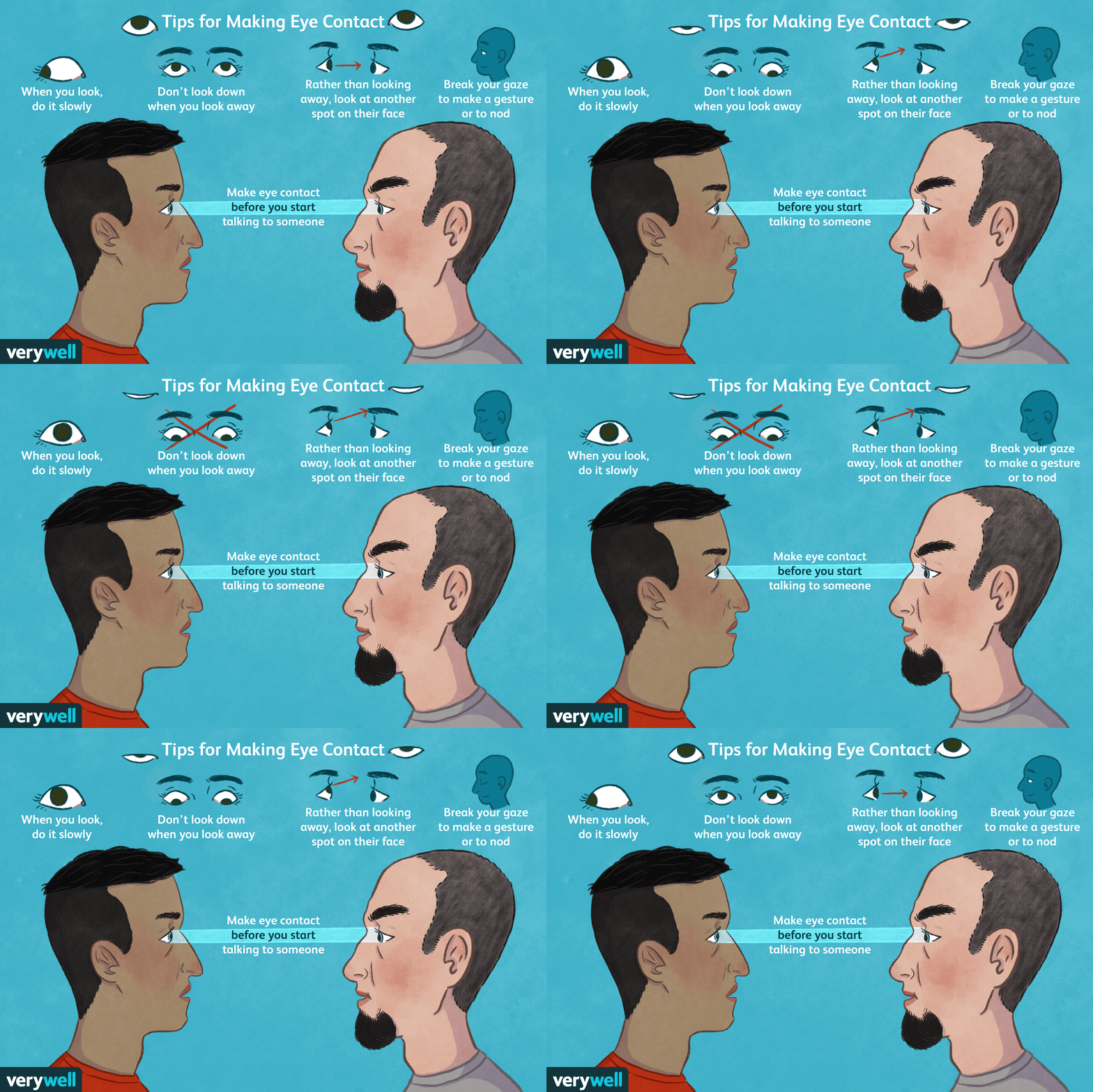
Eye contact — it’s a tricky thing, especially among nerdy types, but is one of the strongest ways to build trust quickly. What better place to brush up on your eye contact technique than Dev/Nexus?
Here’s how you do it: when you meet someone, make eye contact by looking at them right at their eyes for a “one thousand one, one thousand two” count. That’s long enough to acknowledge them but not so long that it feels as though you’re staring them down.
If looking someone in the eyes isn’t your thing, try looking at some part of their face near their eyes, such as their forehead or cheek.
Done right, eye contact gives others a sense of warmth and attentiveness. It makes other people feel seen, which is crucial in noisy, crowded conference environments.
Find out more about eye contact here.
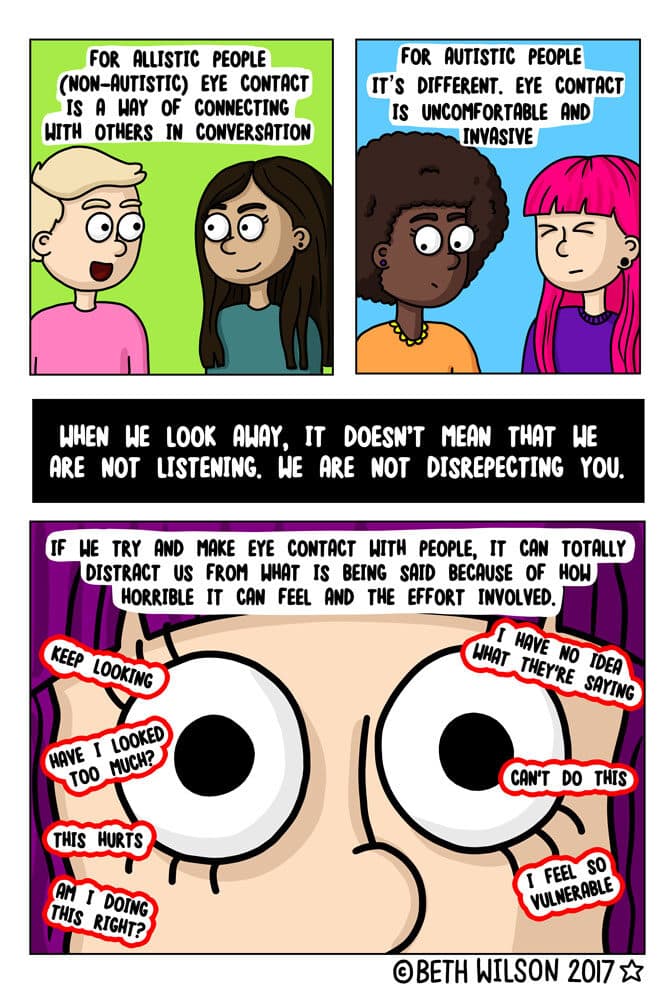 Allistic people — people who aren’t affected by autism — should be aware that people with autism find eye contact challenging. If you find that the person you’re talking to finds eye contact uncomfortable, look at their face, but not directly at their eyes (basically, use the trick I mentioned earlier).
You’ll probably see a group of people already engaged in a conversation. If this is your nightmare…

…here’s how you handle it:
Feel free to join me in at any conversational circle I’m in! I always keep an eye on the periphery for people who want to join in, and I’ll invite them.
 In her book How to Work a Room, Susan RoAne talks about a conversation tool she refers to as “Observe, Ask, Reveal” or “OAR,” which is a way to make interactions feel more natural and engaging. It’s made up of three steps:
Observe. Notice something about the person you’re talking to, their surroundings, or the situation. This could be as simple as their choice of drink, something they’re carrying, or something happening in the room.
Ask. Follow your observation with a genuine, open-ended question. This invites the other person to share and keeps the conversation flowing.
Reveal. Share a little about yourself related to the topic, which helps build rapport and makes the exchange feel balanced rather than like an interrogation.
⚠️ Don’t overshare! TMI often backfires. Also, don’t overdo it with the questions — it should feel like a conversation, not an interrogation.
The idea behind OAR is to create an easy rhythm between listening and contributing to the conversation.
No, you don’t have to worry about scheduling or if the coffee urns are full. By “being a host,” I mean doing some of things that hosts do, such as introducing people, saying “hello” to wallflowers and generally making people feel more comfortable.
Being graceful to everyone is not only good karma, but it’s a good way to promote yourself. It worked out really well for me — when I first moved to Tampa, I simply attended events and helped out where I could, lending a hand at meetups. I gained a reputation for being helpful and knowledgable, which led me to being invited to speak at events, and I also wound up inheriting a couple of meetups as well!
Follow the Dev/Nexus hashtag — the official one is #devnexus — to find out what’s going on, and to find and connect with attendees online.

Lunch at Dev/Nexus is a great opportunity to meet people! Here are some tips for lunch…
1. Choose your table with intention
Arrive early if possible. This gives you more freedom to choose your spot.
Look for tables with a mix of people already seated and empty chairs. It’s easier to integrate into an existing conversation than to start from scratch with a fully empty table.
2. Use OAR (“observe, ask, reveal”) to break the ice
Follow the “observe, ask, reveal” conversational framework I wrote about earlier to talk to people at the table.
Example: “I see you got the Dev/Nexus hoodie — did you brave the merch line this morning?”
3. Introduce yourself to your immediate neighbors first
Turn to the people on your left and right, give your name, where you’re from, and a quick “pocket story” or conference-related detail.
Then, when there’s a pause in the group’s conversation, introduce yourself to the whole table. This makes you seem approachable, and you’re not barging into the conversation.
4. Keep the conversation inclusive
If you notice someone at the table isn’t speaking much, pull them in by looping back to them with a related question.
Avoid overly niche technical deep dives unless everyone’s into it.
5. Have a graceful exit
When lunch is wrapping up, thank the table for the conversation.
Swap contact details or LinkedIn with anyone you clicked with.
Mention to people at the table that you might see them in another session. If you know what sessions you’re attending after lunch, let them know!
Try these out at Thursday’s attendee party, as well as at Dev/Nexus’ other social events, including the karaoke event (taking place Thursday at 9:00 p.m. in the back room on the ground floor of the AC Hotel):
1. Organize your contacts soon after the conference
Review any business cards, LinkedIn connections, or conference app contacts you collected. Strike while the iron is hot — do this by the end of the following week!
Tag or note:
How you met
What you talked about
Any action items (e.g., “Send them article on API security”)
This makes your outreach to people feel more personal and less generic and spammy.
2. Send a brief, specific follow-up
Timing: ideally within 3 days of the conference.
Keep it short, but reference something from your conversation to jog their memory.
Example: “Great chatting with you at the Dev/Nexus lunch table about AI security. Here’s that GitHub repo I mentioned.”
3. Continue the conversation
Share a useful resource, article, or code snippet related to what you discussed.
Offer help or collaboration, even if it’s small. This shifts you from a “one-time meet” to a peer in their network.
4. Connect on the right channels
LinkedIn for professional connections and ongoing career updates.
GitHub for technical/code collaboration.
Twitter/X or Mastodon if you connected over shared interests in tech culture, events, or industry news.
5. Keep the relationship warm
Interact with their posts, star or fork their repos, or comment thoughtfully on something they’ve shared.
When you come across a relevant opportunity, event, or resource, send it their way with a short note.
6. Build a “conference alumni” list
Keep a lightweight spreadsheet or note with names, contact info, and event details.
Before your next Dev/Nexus (or other conference), skim this list so you can reconnect with past contacts.

The newest video on the Global Nerdy YouTube channel is now online! It’s called A Fake Recruiter Tried to Scam Me — I Caught Him Using ChatGPT. Watch it now!
It’s the story of how a scammer posing as an executive recruiter tried to con me out of hundreds (and possibly thousands) of dollars using AI-generated emails, a fake job description, and a fabricated “internal document” from OpenAI.
He had me… for thirty seconds, and then I thought about it.
A “recruiter” emailed me out of the blue about a developer relations role. This isn’t out of the the ordinary; this has happened before, and it’s happened a couple of times in the past couple of months.
However, this role stood out: it was Director of Developer Relations role at OpenAI. Remote-first, $230K–$280K base, Python-primary, and AI-focused. It was basically my dream job on paper.
Over the course of several emails, he asked for my resume and salary expectations while giving me nothing concrete in return: no company name, no hiring manager, no specifics.
When I finally got suspicious and asked three simple verification questions:
He went silent for over a day, then came back with a wall of text that answered none of them.
Then came the real play: he told me that OpenAI required three purportedly “professional documents” before I could interview, and they had to be ready in the next 48 hours:
The descriptions of these documents made it look as if they were complex and would take hours to prepare. The recruiter “helpfully” offered to connect me with a “specialist” who could prepare them for a fee.
None of these documents are real. No company asks for them. It’s a document preparation fee scam, and the whole weeks-long email exchange was just the runway to get me to that moment.
But the best part? When I didn’t bite, he followed up with a fake “OpenAI Candidate Review” document showing my name alongside other “candidates” with star ratings. This would be a massive HR violation if it were real:
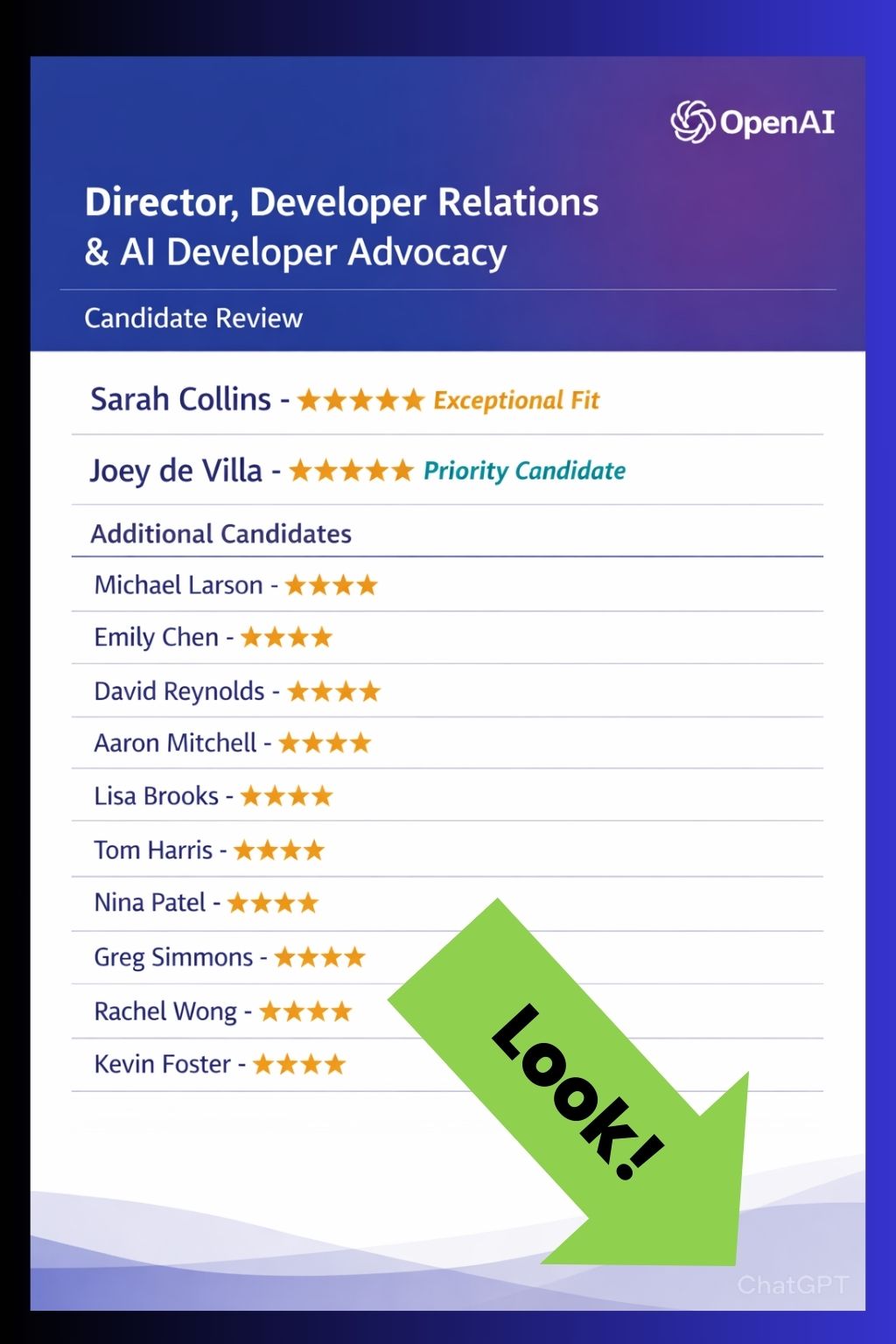
But it wasn’t real! He generated it with ChatGPT. And he left behind evidence — the dumbass forgot to crop out the watermark.
One of the most interesting things about this scam is how AI was both the scammer’s greatest tool and his undoing.
Every email he sent me was written in polished, flawless corporate English.
But in the one paragraph where he steered me toward paying the “specialist,” the grammar suddenly fell apart:
“a professional I have known for years that specialise in this kind of documents with many great and positive result.”
The AI wrote the con. But the human wrote the close. And the seam between the two is where the truth leaked out.
This is a pattern worth watching for. As AI-powered scams become more common, the tell is going to be a shift in quality at the moment where the scammer needs to speak in their own words. You’ll see well-written text, abruptly followed by different writing style marked by poor, non-idiomatic grammar (because they’re communicating with you in a language they don’t know well). Keep an eye out for that sudden transition.
If you’re job searching right now and a recruiter reaches out, ask them these three questions:
A real recruiter answers these in seconds. A fake one dodges, deflects, or disappears.
Based on my experience, here are eight things to watch out for:
This isn’t just my problem. It’s an epidemic:
AI tools are making these scams more polished, more personalized, and harder to detect. The “spray and pray” emails with obvious typos are being replaced by tailored, multi-email campaigns that build trust over weeks before making their move.
If you’re job searching (or know someone who is), please share this post and the video. The more people know what to look for, the less effective these scams become.
Once again, here’s the video, where I walk through the entire scam step by step, from the first email to the ChatGPT watermark:
And if you haven’t already, subscribe to the Global Nerdy YouTube channel. There’s more coming soon, and I promise it’ll be less infuriating than this one. Probably.
If this has happened to you, here’s where to report it:
And if you’ve got your own story about a fake recruiter, drop me a line on LinkedIn! Let’s make these scams harder to pull off.
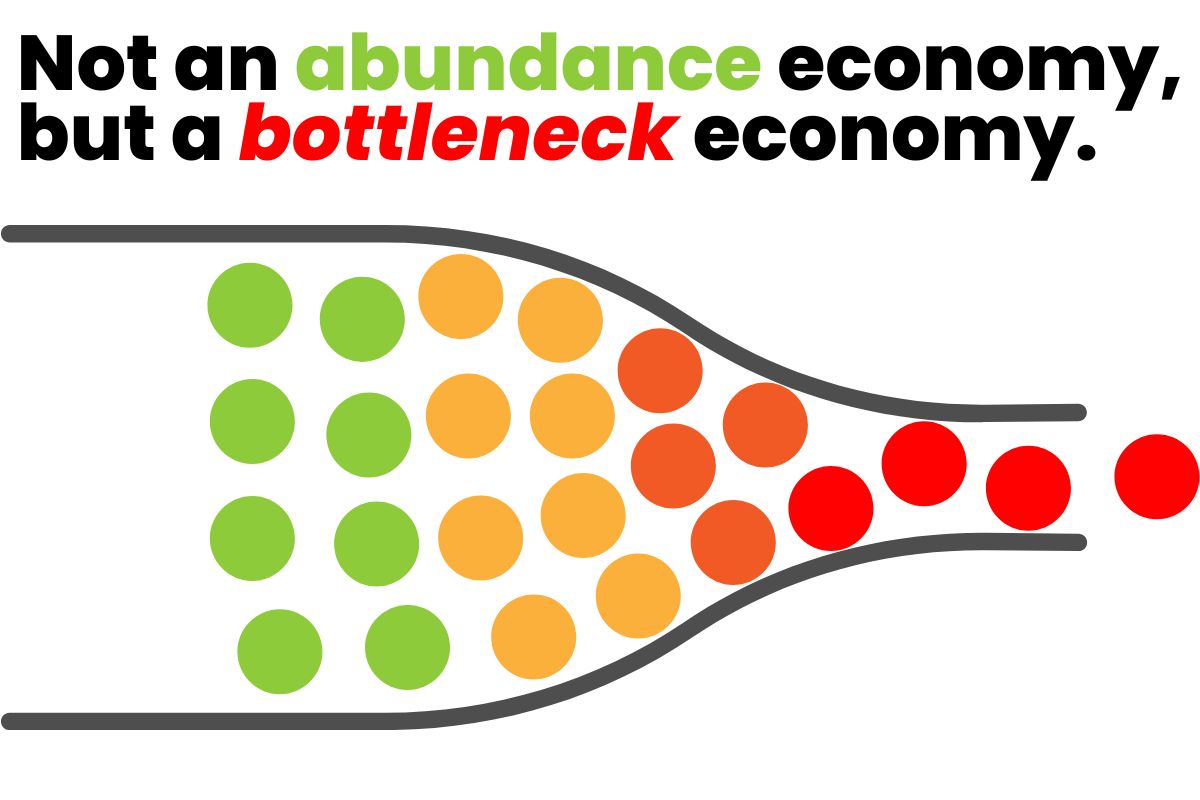
One of Nate B. Jones’ recent videos has the title Why the Smartest AI Bet Right Now Has Nothing to Do With AI (It’s Not What You Think). While the title is technically correct, I think it should be changed to In the Age of AI, You Have to Beat the Bottlenecks.
Many Global Nerdy readers aren’t native English speakers, so here’s a definition of “bottleneck”:
A bottleneck is a specific point where a process slows down or stops because there is too much work and not enough capacity to handle it. It is the one thing that limits the speed of everything else.
Imagine a literal bottle of water.
The body of the bottle is wide and holds a lot of water.
The neck (the top part) is very narrow.
When you try to pour the water out quickly, it cannot all come out at once. It has to wait to pass through the narrow neck.
In business or technology, the “bottleneck” is that narrow neck. No matter how fast you work elsewhere, everything must wait for this one slow part.
My personal rule is that when Elon Musk says something, and especially when it’s about AI, turn it at least 90 degrees. At the most recent World Economic Forum gathering in Davos, he talked a great “abundance” game, with sci-fi claims that AI would create unlimited economic expansion and plenitude for all:
Nate Jones watched the talk with Musk, but came to the conclusion that Musk’s take is the wrong frame for the immediate future. The current AI era will be one of bottlenecks, not abundance. I agree, as I’ve come to that conclusion about any grandiose statement that Musk makes; after all, he is Mr. “we’ll have colonies on Mars real soon now.”
Here are my notes from Jones’ video…
Instead of abundance, Nate suggests that what we are entering is a “bottleneck economy.” While AI capability is growing, the actual value it produces won’t automatically flow everywhere and benefit everyone. Instead, it will concentrate around specific areas based on AI’s constraints and limitations [00:00].
Research from Cognizant claims AI could unlock $4.5 trillion in U.S. labor productivity (and yes, you need to take that figure with a huge grain of salt), and it comes with a massive caveat: businesses must implement AI effectively. Currently, there’s a wide gap between AI models and the hard work of integrating them into business workflows. This “value gap” means that the trillion-dollar impact won’t materialize until organizations figure out how to bridge the distance between models can do in general and what they can specifically do for a company’s operations [01:01].
Physical infrastructure is the first bottleneck. AI capability is increasingly constrained by things it needs from the physical world, specifically land, power, and skilled trade workers. Building the data centers required to train and run models takes years, and not just for the building process, but also permitting and connections to the power grid. This creates a wedge between the speed of software development and building infrastructure [03:56].
Beyond just buildings and power, the hardware supply chain is the second bottleneck. Access to compute, high-bandwidth memory, and advanced chip manufacturing (controlled largely by TSMC) determines who gets a seat at the table. Companies that understand this are securing resources years in advance and treating regions with stable power and friendly permitting as strategic assets. This creates a market where value is captured by those navigating physical constraints in addition to building better algorithms [06:02].
The third bottleneck is one you might not have thought of: the cost of trust. As the cost of generating content collapses to near zero, the cost of trust is skyrocketing. Jone highlights what he calls a “trust deficit,” calling it a major coordination bottleneck. When any content can be fabricated, the ability to verify and authenticate information becomes expensive and crucial. Value will shift to institutions, platforms, or individuals who can mediate trust and provide a reliable signal in world rapidly filling with synthetic media slop [07:36].
For organizations, there’s the bottleneck of applying general AI to specific contexts. A general AI model won’t know a company’s private code base, board politics, or competitive dynamics. The bridge between “AI can do this” and “AI does this usefully here” requires tacit knowledge; that is, the practices and relationships that aren’t written down but live in the heads of the company’s employees. Companies that solve this integration problem will unlock productivity, while those that don’t will spend lots of money on tools they never use [09:55].
The fifth bottleneck is another one you might not have though of: the increasing value of taste. For individuals, and especially for those in tech, the bottlenecks are shifting from acquiring skill to getting good at making judgment calls. AI is commoditizing hard skills like programming (it’s cutting down the time to proficiency from years to months), the really valuable skills are going to be taste and curation. The ability to distinguish between AI output that’s “good enough” versus AI output that’s extraordinary will become the differentiator. Developing taste takes experience, time, and observation. This is going to create a dangerous race for early-career professionals, whose entry-level work is being devalued [14:52].
The combination of problem-finding and execution are the sixth bottleneck. When problem-solving becomes automated, finding the problem and executing on the solution become the new moats. The market will reward those who can frame the right questions and navigate the ambiguity of implementing appropriate solutions. Jones emphasizes that while AI can generate a strategy or a plan, it can’t execute the “grinding work” of follow-through, holding people accountable, and navigating organizational politics. Success depends on identifying these new personal bottlenecks rather than optimizing for old skills that AI is turning into commodities [16:50].
I’ve often been asked “How do you keep up with what’s going on in the AI world?”
One of my answers is that I watch Nate B. Jones’ YouTube channel almost daily. He cranks them out at a rate that I envy, and they’re full of valuable information, interesting ideas, and perspectives I might not otherwise consider.
If you haven’t seen this channel before, he recently published a great “starter video” titled The People Getting Promoted All Have This One Thing in Common (AI Is Supercharging this Mindset). It covers a topic that should be interesting to a lot of you: What to do when the traditional career ladder is getting dismantled, and yes, the answer involves AI.
Here’s the video, and below it are my notes. Enjoy!
The conventional path for white-collar career advancement that’s been around since the end of World War II is being dismantled. It used to be that you’d land an entry-level role, learn through work that starts as simple tasks but gets more complex as you go, and gradually climb the corporate ladder. That’s not the case anymore. If you’ve been working for five or more years, you’ve seen it; if you’re newer to the working world, you might have lived it.
Jones opens the video with these worrying stats:
This isn’t a temporary freeze but a structural shift where the “training rung” of the ladder is being removed. Those repetitive, easier tasks that you assign to juniors (summarizing meetings, cleaning data, drafting low-stakes documents) are exactly what generative AI now handles, and it’s getting better at it all the time.
As a result, the “ladder” is being disassembled while people are still trying to stand on it. Entry-level roles now require experience that entry-level jobs no longer provide because AI has cannibalized the work that used to serve as the learning ground [00:55]. Jones argues that in a world where the passive route of “doing your time”to get promoted is vanishing, the only viable strategy left for career survival and growth is cultivating extreme high agency.
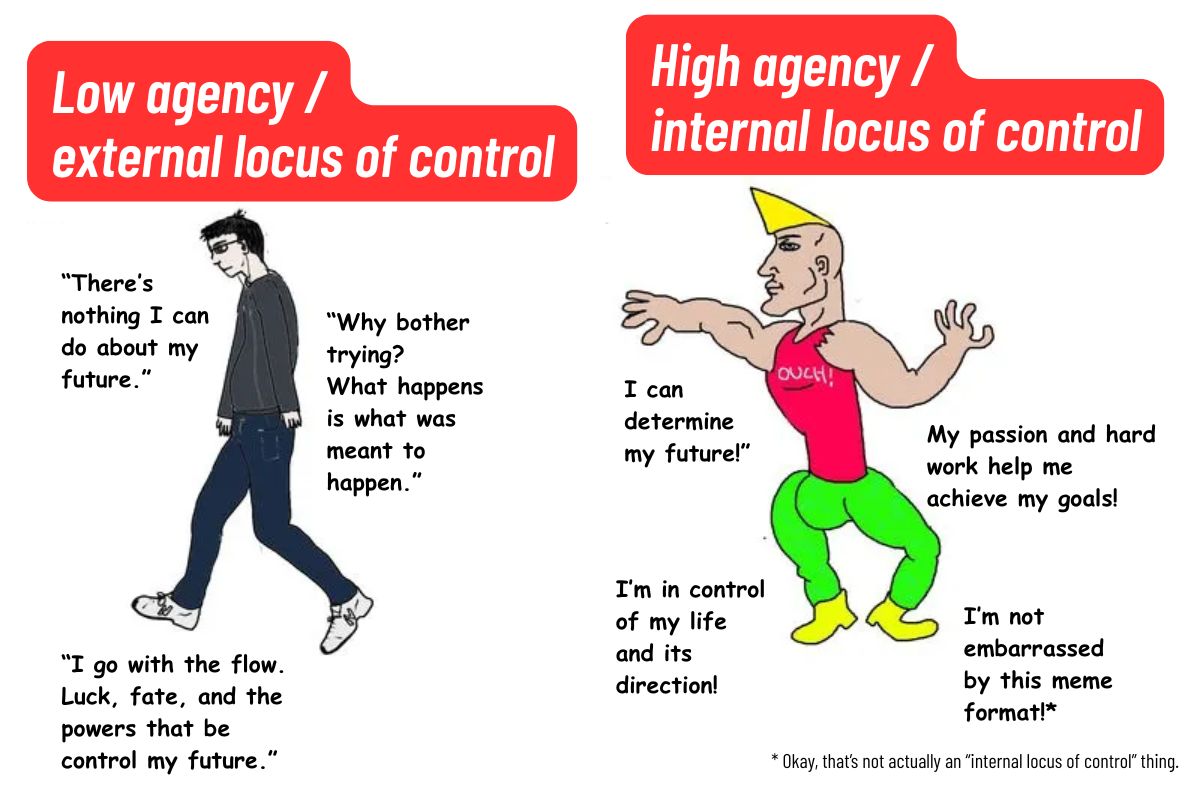
High agency sounds like a feeling of confidence, self-assuredness, or empowerment. It’s best understood through the theory of Locus of Control, which psychologist Julian Rotter developed in the 1950s.
Jones proposes a mental exercise [1:55]: draw a circle and list all major life elements (promotions, skills, family, economy). For low-agency individuals, significant factors like promotions or learning requirements fall outside the circle, perceived as things determined by managers or the market. For high-agency individuals, absolutely everything falls inside the circle.
The high agency mindset dictates that while you cannot control external events, you can control the way you respond, and by extension, your trajectory (sounds like the modern stoicism that’s popular in Silicon Valley circles, as well as at my former company Auth0).
When a high-agency person encounters a barrier that seems outside their control, they reframe it with a four-word Gen Z expression: “That’s a skill issue” [03:23]. Whether it’s lacking a technical skill or not knowing how to navigate office politics, they view the obstacle not as an immovable wall, but as a gap in their own abilities that can be bridged through learning and adaptation.
Jones took the time to address the valid criticism that this mindset ignores systemic unfairness or is that “bootstrap mentality” that ignores structural problems. He argued that high agency is actually most critical for those with the least privilege. He observes that people from disadvantaged backgrounds often display higher agency because they lack the safety nets that more advantaged people have, which often leads them to be more passive [4:48]. When failure isn’t an option, you put in the effort not to fail.
While no one literally controls whether they get laid off, the high-agency mindset focuses on controlling the response: where to direct energy, what to learn next, and how to pivot.
However, Jones warns that an internal locus of control can be taken too far, leading to the tendency to blame yourself for everything that goes wrong. The goal isn’t to beat yourself up for every setback. Instead, it’s to channel that internal orientation into a “challenge” mindset. Instead of thinking “I failed because I’m inadequate,” the high-agency approach is “I haven’t found the right angle of attack yet, but I can figure it out” [5:41]. This distinction, which looks a lot like “growth mindset,” turns potential anxiety into a strategic focus on solving problems.
Jones’ thesis is that AI is the “greatest equalizer for agency that has ever existed” because it acts as a force multiplier for anyone willing to act [5:59]. Barriers that previously required years of expensive education or access to elite networks, such as coding a website, analyzing complex data, or launching a marketing campaign, can now be overcome by a single individual with a laptop and determination. AI doesn’t care about your pedigree; it simply responds to questions and executes commands.
This technological shift allows high-agency individuals to bypass traditional gatekeepers. Jones shares examples of people (including the creator of Base44) moving from dead-end situations to running scaling businesses not because of luck, but because they used AI to relentlessly patch their skill gaps [6:12]. In this new era, if you don’t know a programming language or a business concept, AI allows you to learn and implement it simultaneously, effectively turning “skill issues” into temporary speed bumps rather than dead ends.
A critical consequence of the AI era is the acceleration of the gap between high and low-agency individuals. Jones notes that while this difference used to play out over decades, AI now makes the separation visible in months [7:33]. High-agency people leveraging AI can accomplish 10 to 100 times more than their passive counterparts, compressing career trajectories that used to take twenty years into a fraction of the time (supposedly; consider the myth of the 10x developer). Conversely, career stagnation that once took a decade to notice (you sometimes see this in “company lifers”) now becomes apparent almost immediately.
This acceleration means that waiting for permission or the next rung of the ladder to appear is a strategy for failure. The people currently being tapped for leadership are those who combine high agency with “AI-native” thinking, leading them to redefine roles instead of just filling them [8:11]. In an organizational structure that is inherently malleable and constantly disrupted by scaling intelligence, titles don’t matter. Instead, what really matters is generating value and outcomes.
Jones talks about what he calls the “Say/Do Ratio” as a measure of high agency. It’s the gap between saying you will do something and actually doing it.
Most people have a poor ratio, letting weeks or months pass between intention (“I’m going to learn this skill!” or “I’m going to hit the gym daily!”) and action. They’re either hit by “analysis paralysis” or waiting for perfection [12:37]. High-agency individuals shrink the distance between “say” and “do.” They start immediately, even when they feel unprepared or uncomfortable.
AI serves as a powerful accelerator for improving this ratio by helping users “ship halfway-done” work (think “Minimum Viable Product”) or get past the “blank page” problem instantly.
Jones cites Kobe Bryant as a prime example of this mindset. Bryant viewed nervousness not as an emotion to be managed, but as an information signal that he hadn’t prepared enough, which is a variable that he could control [11:38]. Similarly, in the AI age, preparation and execution are more accessible than ever, allowing those with high agency to move from idea to prototype without getting stuck in the “planning” phase.
The combination of high agency and AI is reshaping the business landscape, and the surge in solo founders and “lean” billion-dollar companies. Jones points out that the share of startups with solo founders has nearly doubled since 2015, and we’re approaching the era of the one-person billion-dollar company [15:13]. He cites the example of solo founder Maor Shlomo, who built Base44 from a side project to an $80 million exit in six months without a full-time team or venture capital, simply by pushing code to production 13 times a day [16:20].
This trend proves that AI allows individuals to operate with the output capacity of entire teams. Founders and operators can now “speedrun” through obstacles that used to require hiring specialists, whether it’s understanding server-side architecture or generating marketing materials. The constraint on building a massive business is no longer headcount or capital, but the agency of the founder to utilize AI to extend their own capabilities and solve problems [16:47].
In the end, the high-agency mindset is grounded in an obsession with pushing value into the world. Jones describes this as a belief that the world is “bendable”: if you generate enough value and contribute enough, the world will eventually respond in your favor [18:15].
This orientation prioritizes contribution over extraction; instead of asking “What can I get?”, high-agency people ask “What can I create?”. Simply put, you get what you give.
This perspective shifts the focus from waiting for opportunities to making them. If you approach AI as a tool to expand your locus of control, you can systematically knock down barriers between you and your goals. Jones concludes that the future belongs to those who don’t wait for the old structures to return but instead use their agency to build, ship, and learn now, viewing the current disruption not as a threat, but as an unprecedented opportunity for growth [21:44].
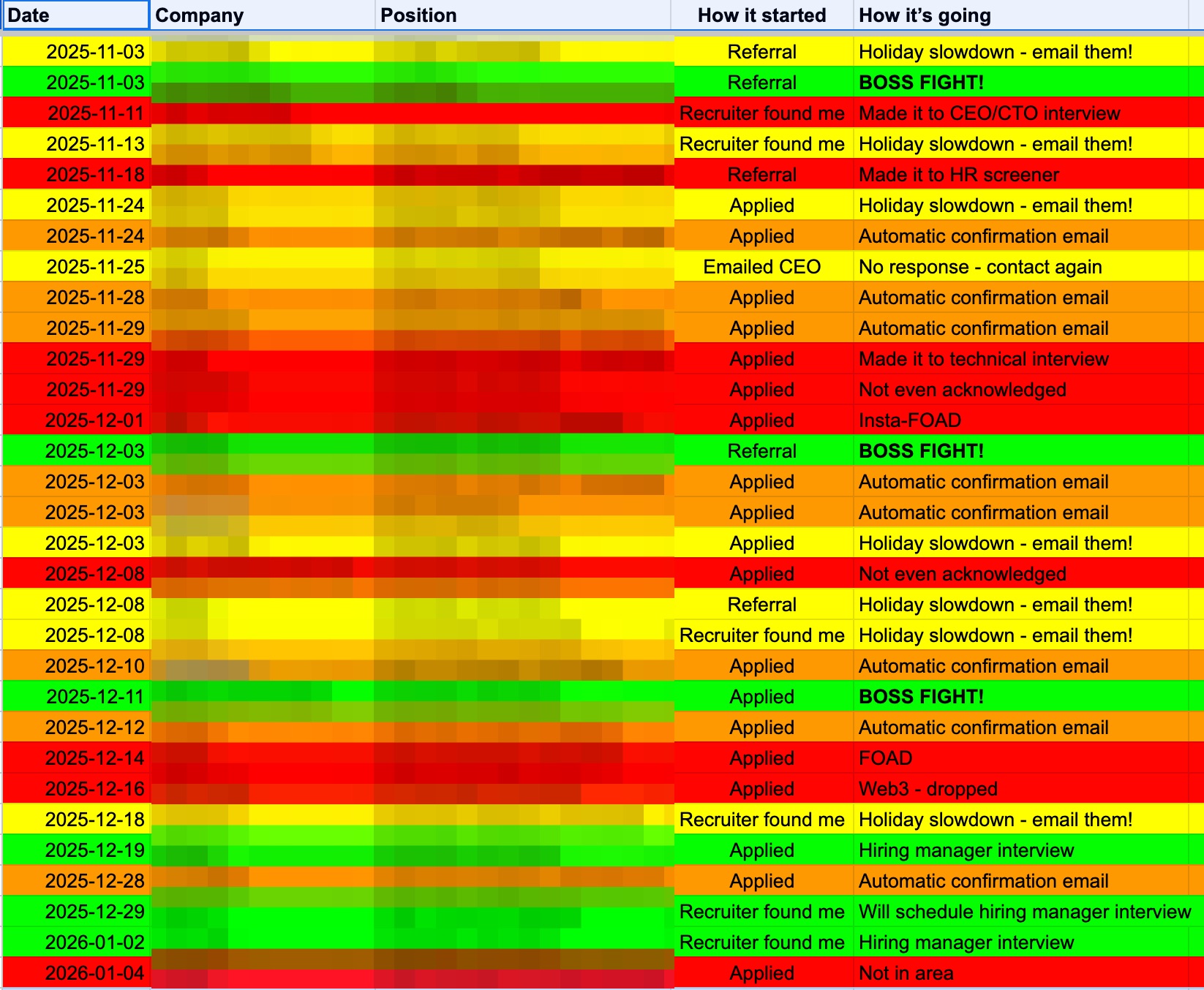
Pictured above is a version of my job search spreadsheet with a couple of columns hidden and some details redacted. But despite the missing info, it still has useful data points for you, namely:

Being noisy on LinkedIn pays off. Did you know there are Recruiter versions of LinkedIn? There’s Recruiter Lite, which can cost up to $2,000 annually, and then there’s Corporate version, which is said to sell for about $10,000 to $12,000 per year per seat.
Recruiters get paid when they match people looking for jobs with employers looking to fill positions, so they’re willing to shell out lots of money for a specialized version of LinkedIn, provided that they get king-sized multiples of that money by finding the right match for their clients. Think of LinkedIn as a search engine for job candidates.
In the spreadsheet pictured above, note than 6 out of 30 opportunities — that’s one in five — is marked in the How it started column as Recruiter found me. They found me on LinkedIn because I post and comment regularly on AI, Python, and technology in general, which in turn generates “signal” on LinkedIn for those topics that clearly points to me. Long story short: You want to get found by recruiters on LinkedIn? You have to post on topics relevant to the job you’re looking for on LinkedIn.
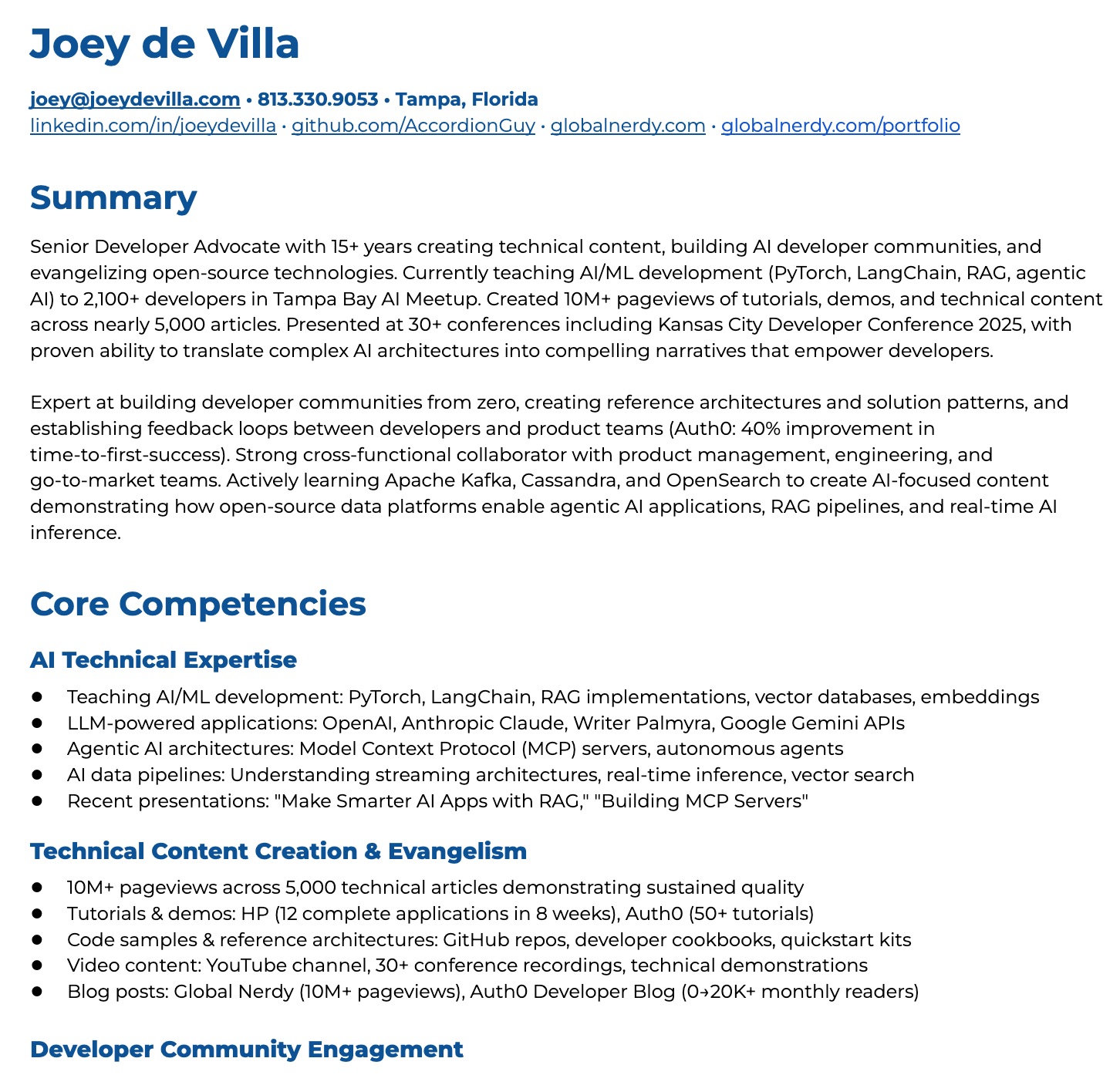 The trick is that my resumes, while long, answer the question “What does this candidate bring to the table?” and that’s really the question recruiters and hiring managers want answered. I customize each resume for each prospect with the assistance of Claude, and it’s worked out quite well for me.I’m betting that you’re reeeeally curious right now, so here’s one of the resumes for one of the BOSS FIGHT! prospects. I hope you find it useful!
See the row above? That’s an opportunity where I’m going to do a final interview that I applied to, cold, with just a resume (and yes, it was a five-pager) and a cover letter.
I didn’t have a referral, and with this particular one, I applied via LinkedIn and not via the company site because that was the only place to do it. And yet I got that initial interview, which led to all the follow-up interviews. According to the recruiter, it was a combination of the resume, cover letter, and LinkedIn presence.
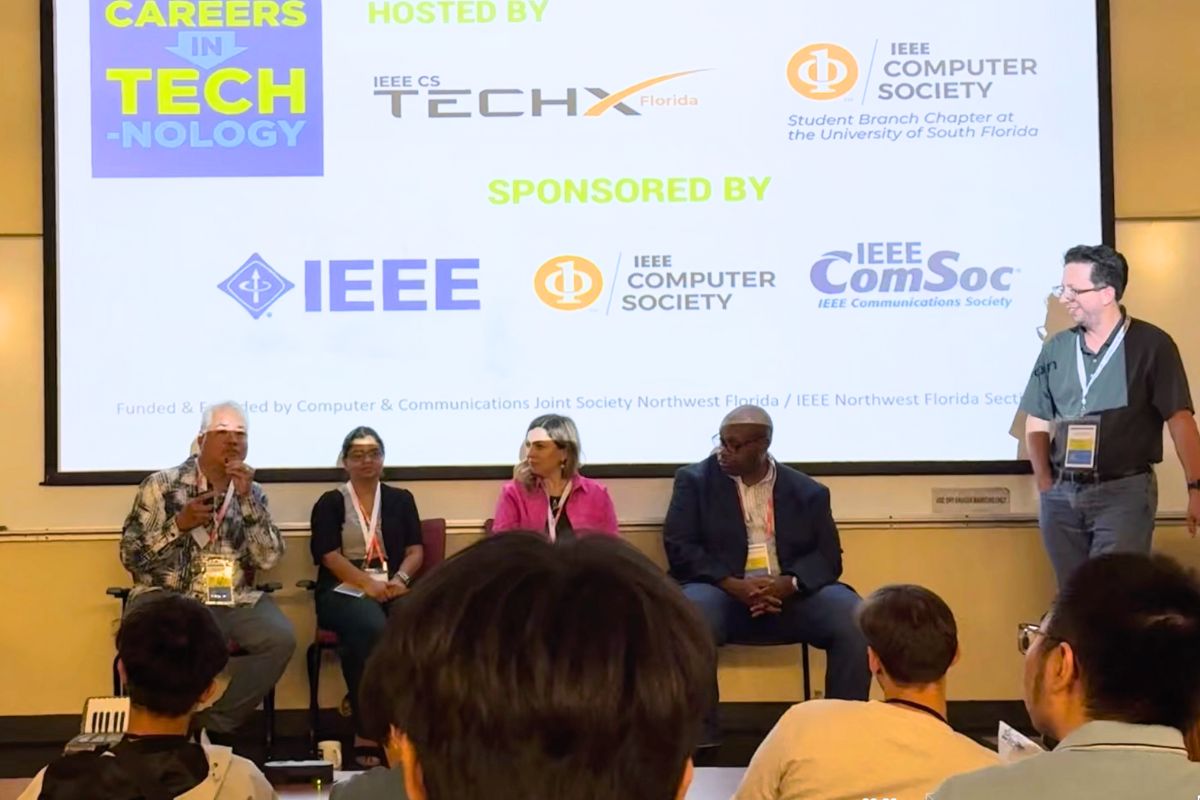
On Saturday, I had the honor of speaking on the Careers in Tech panel at TechX Florida, which was organized by USF’s student branch of the IEEE Computer Society.
On the panel with me were:
We enjoyed speaking to a packed room…
 …and I enjoyed performing the “official unofficial song of artificial intelligence” at the end of the panel:
During the panel, a professor in the audience asked an important question on behalf of the students there: In the current tech industry environment, what are the prospects for young technologists about to enter the market?
I was prepared for this kind of question and answered that technological golden ages often come at the same time as global crises. I cited the examples from this book…
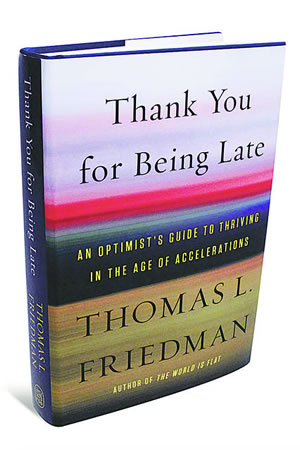
…Thank You for Being Late, by Thomas Friedman, who proposed that 2007 was “one of the single greatest technological inflection points since Gutenberg…and we all completely missed it.”
The reason many people didn’t notice the technological inflection point is because it was eclipsed by the 2008 financial crises.
During the dark early days of the COVID-19 pandemic and shutdown, the people from Techstars asked me if I could write something uplifting for the startupdigest newsletter. I wrote an article called Reasons for startups to be optimistic, where I cited Friedman’s theory and put together a table of big tech breakthroughs that happened between 2006 and 2008.
In answering the professor’s question, I went through the list, reciting each breakthrough. The professor smiled and replied “that’s a long list.”
If you need a ray of hope, I’ve reproduced the list of interesting and impactful tech things that came about between 2006 and 2008 below. Check it out, and keep in mind that we’re currently in a similar time of tech breakthroughs that are being eclipsed by crises around the world.
| The leap | Notes |
|---|---|
| Airbnb |
In October 2007, as a way to offset the high cost of rent in San Francisco, roommates Brian Chesky and Joe Gebbia came up with the idea of putting an air mattress in their living room and turning it into a bed and breakfast. They called their venture AirBedandBreakfast.com, which later got shortened to its current name. This marks the start of the modern web- and app-driven gig economy. |
| Android |
The first version of Android as we know it was announced on September 23, 2008 on the HTC Dream (also sold as the T-Mobile G1). Originally started in 2003 and bought by Google in 2005, Android was at first a mobile operating system in the same spirit as Symbian or more importantly, Windows Mobile — Google was worried about competition from Microsoft. The original spec was for a more BlackBerry-like device with a keyboard, and did not account for a touchscreen. This all changed after the iPhone keynote. |
| App Store |
Apple’s App Store launched on July 10, 2008 with an initial 500 apps. At the time of writing (March 2020), there should be close to 2 million. In case you don’t remember, Steve Jobs’ original plan was to not allow third-party developers to create native apps for the iPhone. Developers were directed to create web apps. The backlash prompted Apple to allow developers to create apps, and in March 2008, the first iPhone SDK was released. |
| Azure | Azure, Microsoft’s foray into cloud computing, and the thing that would eventually bring about its turnaround after Steve Ballmer’s departure, was introduced at their PDC conference in 2008 — which I attended on the second week of my job there. |
| Bitcoin |
The person (or persons) going by the name “Satoshi Nakamoto” started working on the Bitcoin project in 2007. It would eventually lead to cryptocurrency mania, crypto bros, HODL and other additions to the lexicon, one of the best Last Week Tonight news pieces, and give the Winklevoss twins their second shot at technology stardom after their failed first attempt with a guy named Mark Zuckerberg. |
| Chrome |
By 2008, the browser wars were long done, and Internet Explorer owned the market. Then, on September 2, Google released Chrome, announcing it with a comic illustrated by Scott “Understanding Comics” McCloud, and starting the Second Browser War. When Chrome was launched, Internet Explorer had about 70% of the browser market. In less than 5 years, Chrome would overtake IE. |
| Data: bandwidth costs and speed | In 2007, bandwidth costs dropped dramatically, while transmission speeds grew in the opposite direction. |
| Dell returns | After stepping down from the position of CEO in 2004 (but staying on as Chairman of the Board), Michael Dell returned to the role on January 31, 2007 at the board’s request. |
| DNA sequencing costs drop dramatically | The end of the year 2007 marks the first time that the cost of genome sequencing dropped dramatically — from the order of tens of millions to single-digit millions. Today, that cost is about $1,000. |
| DVD formats: Blu-Ray and HD-DVD | In 2008, two high-definition optical disc formats were announced. You probably know which one won. |
| In September 2006, Facebook expanded beyond universities and became available to anyone over 13 with an email address, making it available to the general public and forever altering its course, along with the course of history. | |
| Energy technologies: Fracking and solar | Growth in these two industries helped turn the US into a serious net energy provider, which would help drive the tech boom of the 2010s. |
| GitHub | Originally founded as Logical Awesome in February 2008, GitHub’s website launched that April. It would grow to become an indispensable software development tool, and a key part of many developer resumes (mine included). It would first displace SourceForge, which used to be the place to go for open source code, and eventually become part of Microsoft’s apparent change of heart about open source when they purchased the company in 2018. |
| Hadoop |
In 2006, developer Doug Cutting of Apache’s Nutch project, took used GFS (Google File System, written up by Google in 2003) and the MapReduce algorithm (written up by Google in 2004) and combined it with the dataset tech from Nutch to create the Hadoop project. He gave his project the name that his son gave to his yellow toy elephant, hence the logo. By enabling applications and data to be run and stored on clusters of commodity hardware, Hadoop played a key role in creating today’s cloud computing world. |
| Intel introduces non-silicon materials into its chips | January 2007: Intel’s PR department called it “the biggest change to computer chips in 40 years,” and they may have had a point. The new materials that they introduced into the chip-making process allowed for smaller, faster circuits, which in turn led to smaller and faster chips, which are needed for mobile and IoT technologies. |
| Internet crosses a billion users | This one’s a little earlier than our timeframe, but I’m including it because it helps set the stage for all the other innovations. At some point in 2005, the internet crossed the billion-user line, a key milestone in its reach and other effects, such as the Long Tail. |
| iPhone |
On January 9, 2007, Steve Jobs said the following at this keynote: “Today, we’re introducing three revolutionary new products…an iPod, a phone, and an internet communicator…Are you getting it? These are not three separate devices. This is one device!” The iPhone has changed everyone’s lives, including mine. Thanks to this device, I landed my (current until recently) job, and right now, I’m working on revising this book. |
| iTunes sells its billionth song | On February 22, 2006, Alex Ostrovsky from West Bloomfield, Michigan purchased ColdPlay’s Speed of Sound on iTunes, and it turned out to be the billionth song purchased on that platform. This milestone proves to the music industry that it was possible to actually sell music online, forever changing an industry that had been thrashing since the Napster era. |
| Kindle |
Before tablets or large smartphone came Amazon’s Kindle e-reader, which came out on November 19, 2007. It was dubbed “the iPod of reading” at the time. You might not remember this, but the first version didn’t have a touch-sensitive screen. Instead, it had a full-size keyboard below its screen, in a manner similar to phones of that era. |
| Macs switch to Intel |
The first Intel-based Macs were announced on January 10, 2006: The 15″ MacBook Pro and iMac Core Duo. Both were based on the Intel Core Duo. Motorola’s consistent failure to produce chips with the kind of performance that Apple needed on schedule caused Apple to enact their secret “Plan B”: switch to Intel-based chips. At the 2005 WWDC, Steve Jobs revealed that every version of Mac OS X had been secretly developed and compiled for both Motorola and Intel processors — just in case. We may soon see another such transition: from Intel to Apple’s own A-series chips. |
| Netflix | In 2007, Netflix — then a company that mailed rental DVDs to you — started its streaming service. This would eventually give rise to binge-watching as well as one of my favorite technological innovations: Netflix and chill (and yes, there is a Wikipedia entry for it!), as well as Tiger King, which is keeping us entertained as we stay home. |
| Python 3 |
The release of Python 3 — a.k.a. Python 3000 — in December 2008 was the beginning of the Second Beginning! While Python had been eclipsed by Ruby in the 2000s thanks to Rails and the rise of MVC web frameworks and the supermodel developer, it made its comeback in the 2010s as the language of choice for data science and machine learning thanks to a plethora of libraries (NumPy, SciPy, Pandas) and support applications (including Jupyter Notebooks). I will always have an affection for Python. I cut my web development teeth in 1999 helping build Givex.com’s site in Python and PostgreSQL. I learned Python by reading O’Reilly’s Learning Python while at Burning Man 1999. |
| Shopify | In 2004, frustrated with existing ecommerce platforms, programmer Tobias Lütke built his own platform to sell snowboards online. He and his partners realize that they should be selling ecommerce services instead, and in June 2006, launch Shopify. |
| Spotify | The streaming service was founded in April 2006, launched in October 2008, and along with Apple and Amazon, changed the music industry. |
| Surface (as in Microsoft’s big-ass table computer) |
Announced on May 29, 2007, the original Surface was a large coffee table-sized multitouch-sensitive computer aimed at commercial customers who wanted to provide next generation kiosk computer entertainment, information, or services to the public. Do you remember SarcasticGamer’s parody video of the Surface? |
| Switches | 2007 was the year that networking switches jumped in speed and capacity dramatically, helping to pave the way for the modern internet. |
|
In 2006, Twittr (it had no e then, which was the style at the time, thanks to Flickr) was formed. From then, it had a wild ride, including South by Southwest 2007, when its attendees — influential techies — used it as a means of catching up and finding each other at the conference. @replies appeared in May 2007, followers were added that July, hashtag support in September, and trending topics came a year later. Twitter also got featured on an episode of CSI in November 2007, when it was used to solve a case. |
|
| VMWare | After performing poorly financially, the husband and wife cofounders of VMWare — Diane Greene, president and CEO, and Mendel Rosenbaum, Chief Scientist — left. Greene was fired by the board in July, and Rosenbaum resigned two months later. VMWare would go on to experience record growth, and its Hypervisors would become a key part of making cloud computing what it is today. |
| Watson | IBM’s Watson underwent initial testing in 2006, when Watson was given 500 clues from prior Jeopardy! programs. Wikipedia will explain the rest:
|
| Wii | The Wii was released in December 2006, marking Nintendo’s comeback in a time when the console market belonged solely to the PlayStation and Xbox. |
| XO computer | You probably know this device better as the “One Laptop Per Child” computer — the laptop that was going to change the world, but didn’t quite do that. Still, its form factor lives on in today’s Chromebooks, which are powered by Chrome (which also debuted during this time), and the concept of open source hardware continues today in the form of Arduino and Raspberry Pi. |
| YouTube |
YouTube was purchased by Google in October 2006. In 2007, it exploded in popularity, consuming as much bandwidth as the entire internet did 7 years before. In the summer and fall of 2007, CNN and YouTube produced televised presidential debates, where Democratic and Republican US presidential hopefuls answered YouTube viewer questions. You probably winced at this infamous YouTube video, which was posted on August 24, 2007: Miss Teen USA 2007 – South Carolina answers a question, which has amassed almost 70 million views to date. |