Categories
Artificial Intelligence Process Programming

Projects I’m vibe coding, projects I’m grind coding, and projects in-between

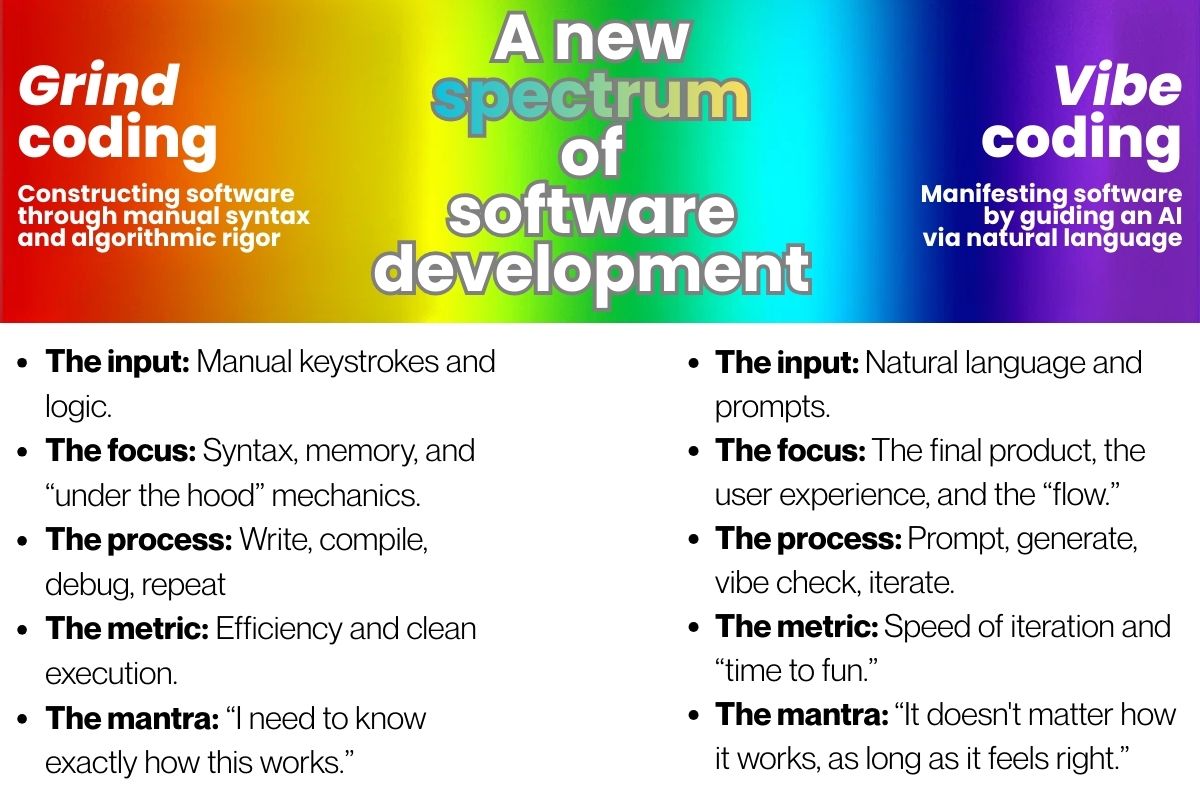
A couple of weeks back, I wrote about how coding happens on a spectrum whose opposite ends are:

  • Vibe coding, a term coined by Andrej Karpathy, is where where developers use natural language prompts to have LLMs or LLM-based tools generate, debug, and iterate on code. Vibe coding is declarative, because you describe what you want.
  • Grind coding, my term for traditional programming, where you specify how a program performs its tasks using a programming language. Grind coding is imperative, because you specify how the thing you want works.

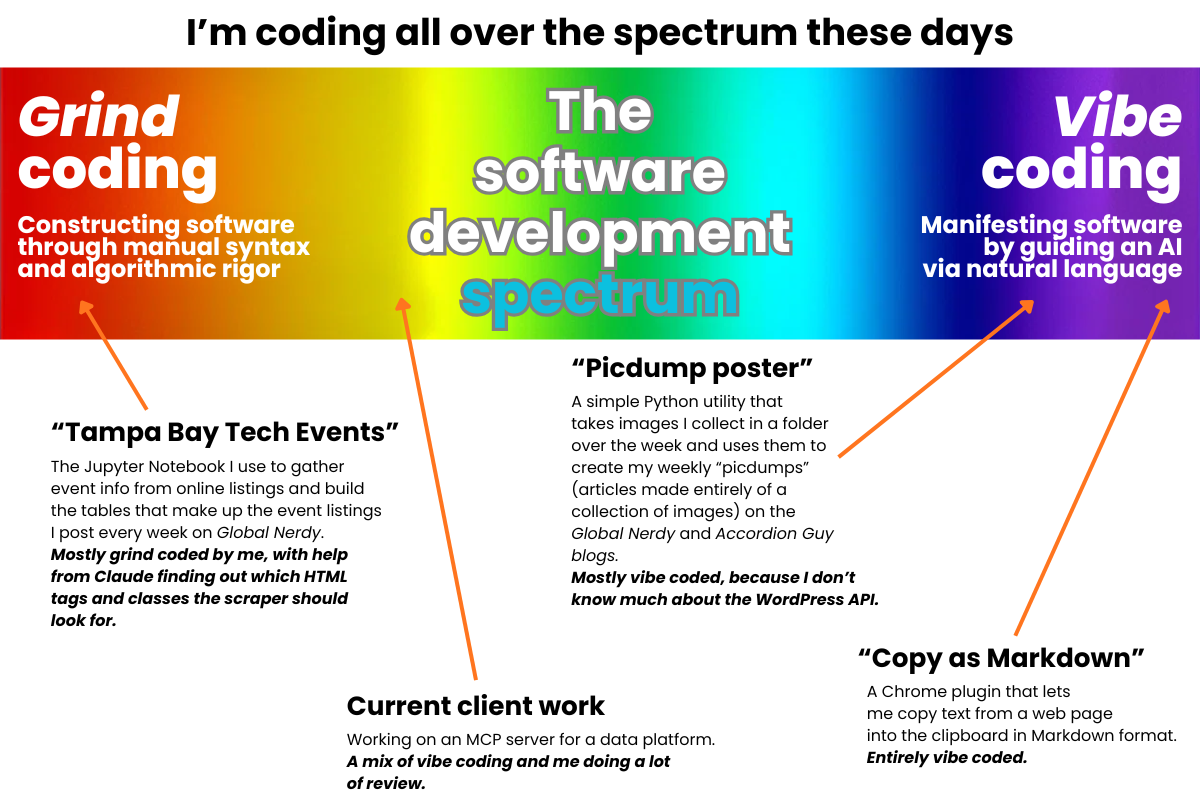
I myself have been writing code for different purposes, on different parts of this spectrum (see the diagram at the top of this article for where they land on the spectrum):

  • The Tampa Bay Tech Events utility: This is the Jupyter Notebook I use to gather event info from online listings and build the tables that make up the event listings I post every week here on Global Nerdy. I wrote the original code myself, but I’ve called on Claude to take the tedious stuff, including analyzing the obfuscated HTML in Meetup’s event pages to find the tags and classes containing event information.
  • MCP server for my current client: This is a project that started before I joined, and was written using a code generation tool. The client is a big platform connected to some big organizations; my job is to be the human programmer in the loop.
  • Picdump poster: Every week, I post “picdump” articles on the Global Nerdy and Accordion Guy blogs. Over the week, I save interesting or relevant images to specific folders, and the picdump poster utlity builds a blog post using those images. It’s a low-effort way for me to assemble some of my most-read blog posts, and it’s more vibe-coded than not, especially since I don’t specialize in building WordPress integrations.
  • Copy as Markdown: Here’s an example of using vibe coding as a way to have custom software built on demand. I wanted a way to copy text from a web page, and then converting that copied text into Markdown format. This one was purely vibe-coded; I simply told Gemini what I wanted, and it not only generated the code for me, but also gave me instructions on how to install it.
Categories
Humor Process Programming

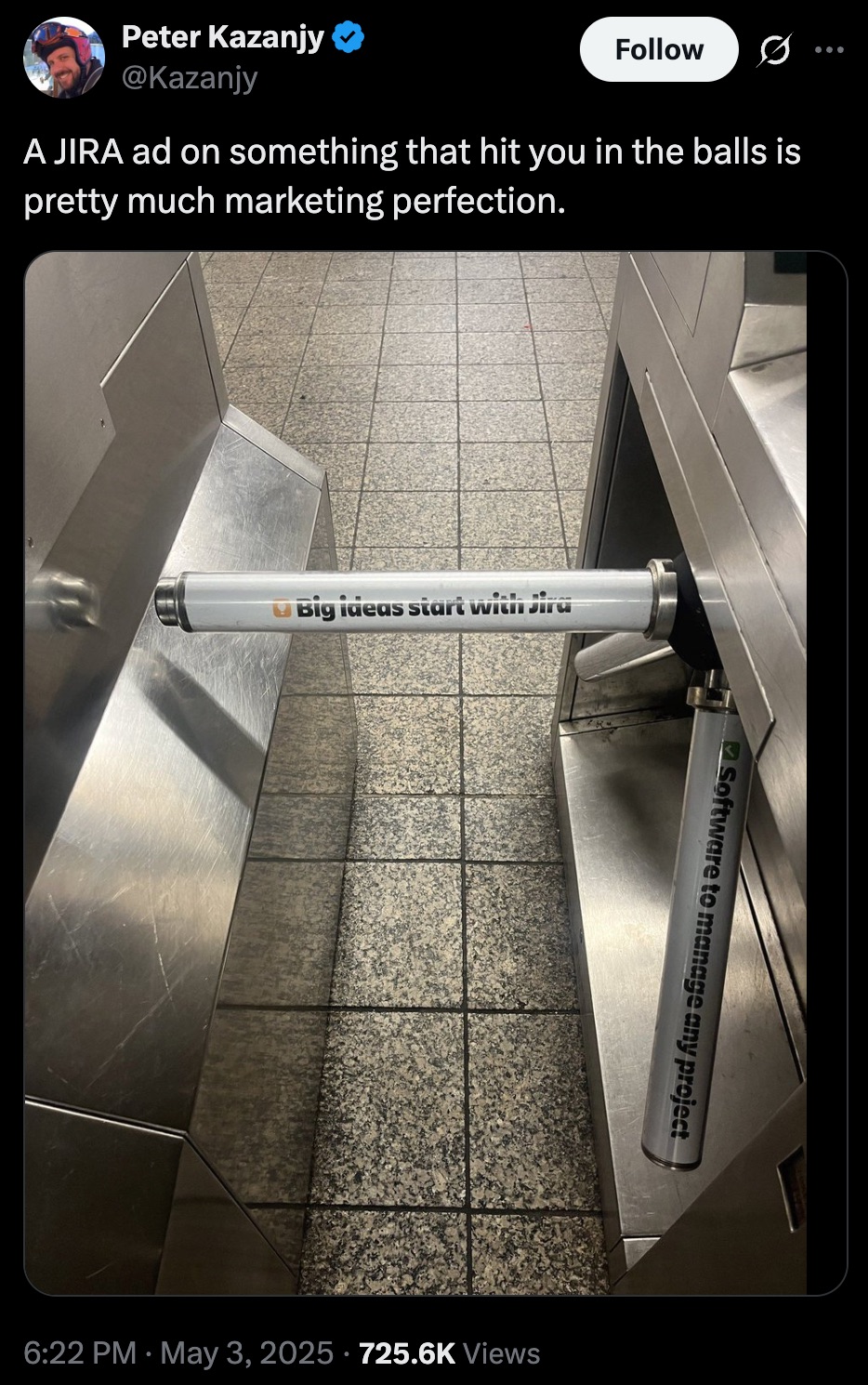
The perfect Jira ad

Tweet by Peter Kazanjy (@Kazanjy) featuring a photo of a turnstile with a Jira ad on each arm. The caption reads “A JIRA ad on something that hit you in the balls is pretty much marketing perfection.”
Tap to view the original tweet.

This was just too funny to save for next Saturday’s picdump. I don’t think Jira’s as bad as everyone makes it out to be, but I still laughed out loud when I saw this.

Categories
Process What I’m Up To

I’m working on the docs for Packfiles’ SaaS, Warp

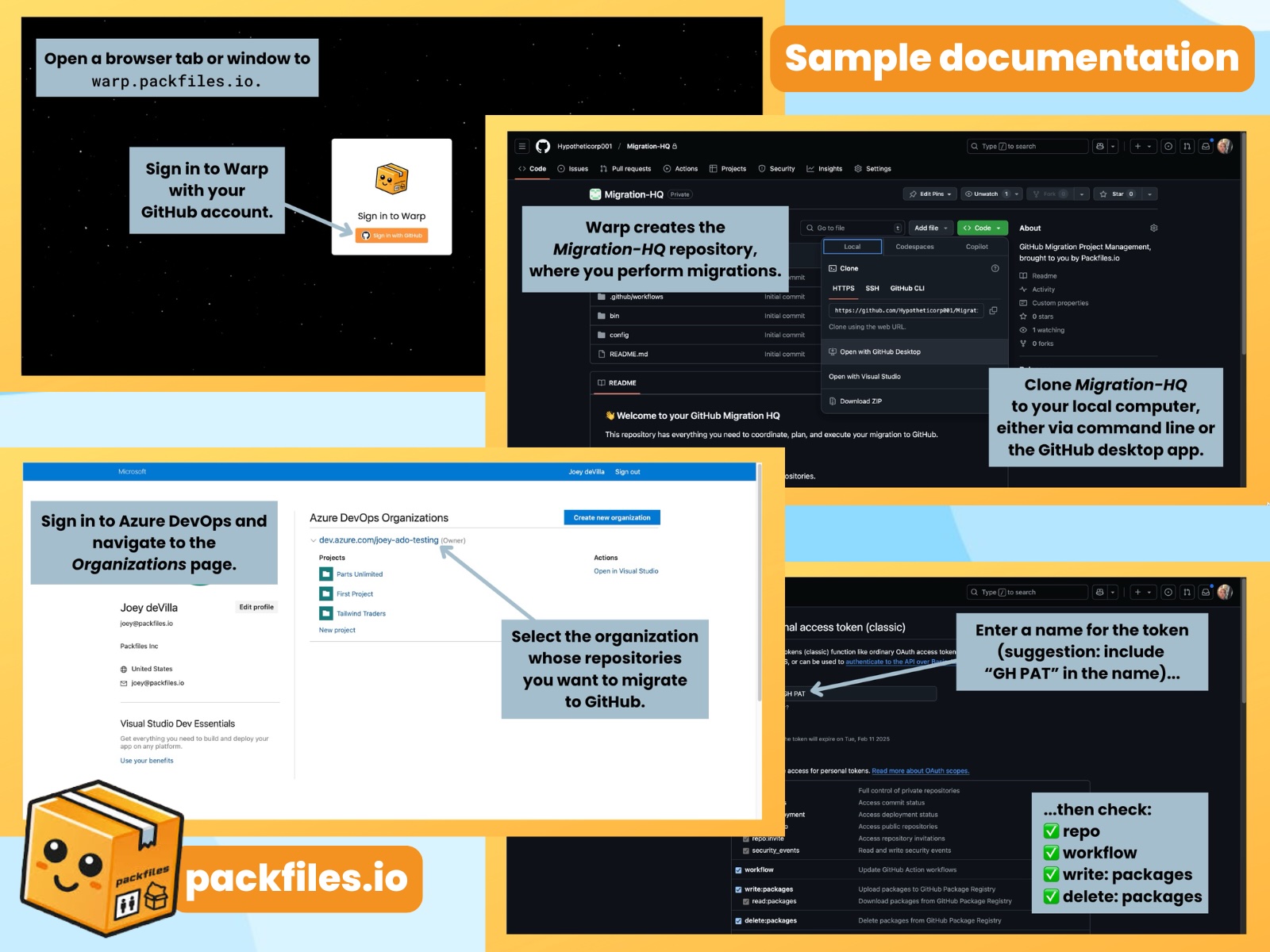
Screenshots from the documentation for Packfiles (https://packfiles.io).

I’m busy at work on the documentation for Packfiles’ SaaS, Warp, which automates the difficult, tedious, and error-prone process of migrating repositories from other source control systems to GitHub. Warp is already operational and it turns days of work into minutes, but it needs a “quickstart” guide, which I’m working on right now!

I’m painfully aware that nobody reads documentation, and I’ve taken steps to ensure that the docs I’m writing are clear, easy to follow, and get to the point ASAP. You won’t need a Ph.D. to read what I’m writing, unless it means “Push here, devops.” I’m trying to make it that simple.

Categories
Career Humor Process

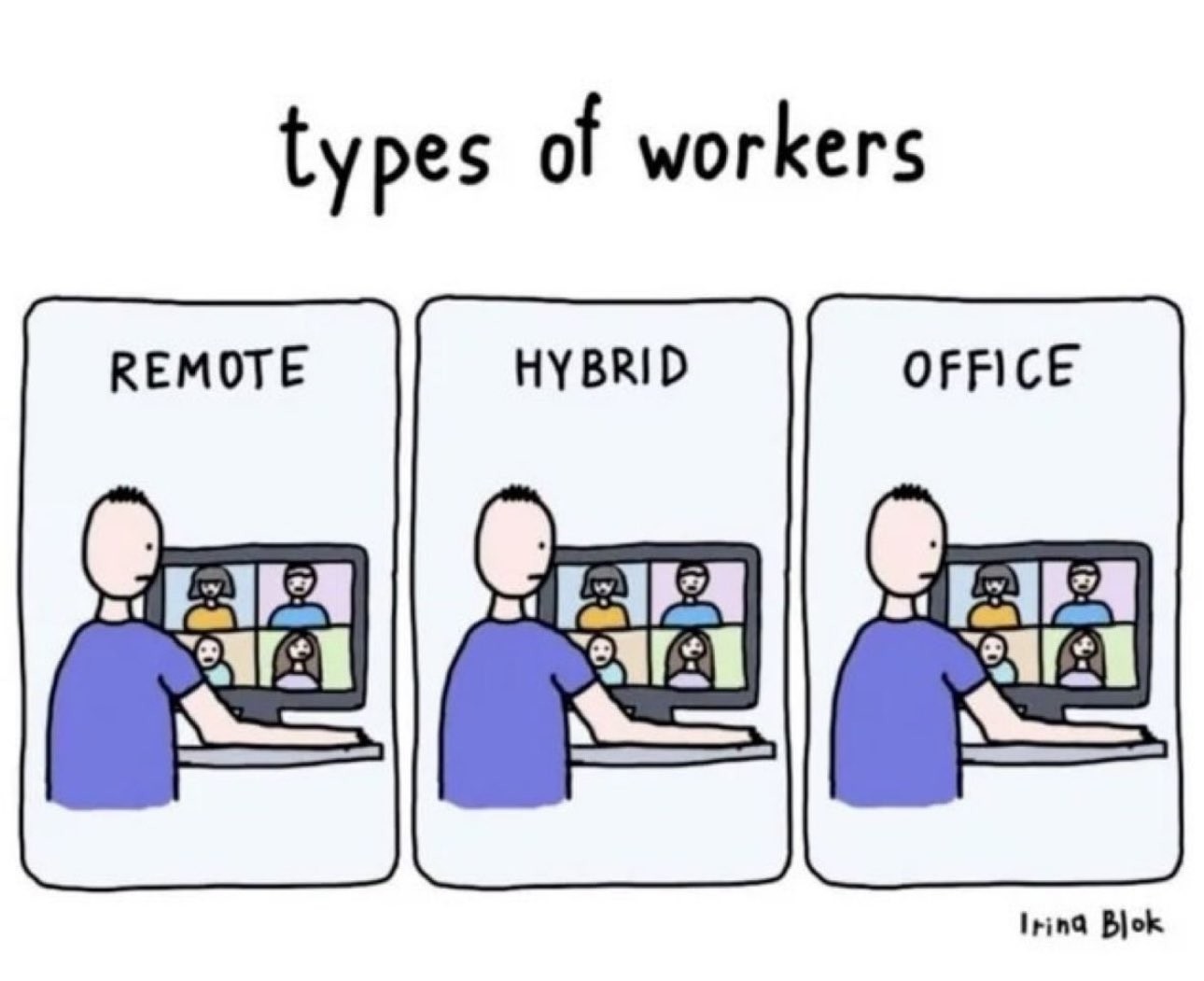
Types of Workers

Comic titled “Types of Workers,” with three images. First image: “Remote,” featuring worker on Zoom call. Second image: “Hybrid,” featuring worker on Zoom call. Third image: “Office,” featuring worker on Zoom call.

Categories
Meetups Process Tampa Bay

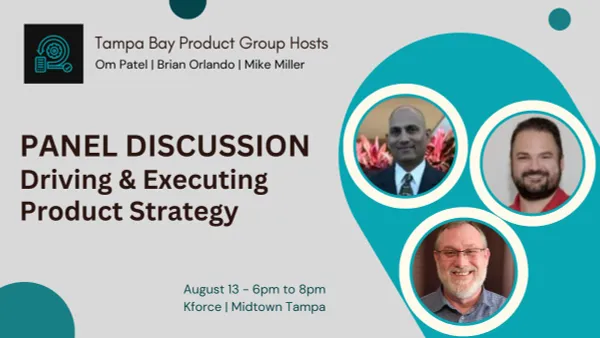
Tampa Bay Product Group meetup this Tuesday!

Banner for Tampa Bay product Group meetup: Om Patel | Brian Orlando | Mike Miller Panel Discussion: Driving and Executing Product Strategy August 13 - 6 pm to 8 pm KForce - Midtown TampaThis month’s Tampa Bay Product Group meetup happens this Tuesday, August 13 at Kforce’s offices in Midtown Tampa. The topic: a panel discussion on driving and executing product strategy featuring:

  • Om Patel
  • Brian Orlando
  • Mike Miller

Want to know more, or attend the meetup? Find out more and register here.

Here’s a little bit about each of the panelists:

Om Patel
Om is an enterprise business agility consultant with many years of experience coaching teams and leadership at clients in several industries. He has played different roles in his career from developer, product manager, project manager, and scrum master. Om has led agile transformations at companies like Walt Disney World, Atex Global, EY and PwC. He is actively involved in the agile community.

Brian Orlando
An expert in business agility, product, and an advocate for product-led growth. Brian builds and connects teams to vision and strategies, and continually transition my organizations toward a product-led culture.
Brian is also host of the Arguing Agile podcast, where he shares learnings, experiences, and stories from across his career. He strives to create quality products that solve real problems for the users and the business.

Mike Miller
Mike Miller is the kind of product nerd you’re glad you have around. With nearly 20 years in IT and 12 of those years dedicated to agile product management, he has seen just a out everything under the sun. Working on digital products in RMM, eComm, manufacturing, and finance* has blessed him with an inside track on the most common dysfunctions in agile product management – and how to solve them!
*Previous recipients of Mike’s wisdom include IBM, Connectwise, Ashley Furniture, PwC, Gerdau, Trellance, Discover, and quite a few more.


Categories
Meetups Process Tampa Bay

This Tuesday: Tampa Bay has a product meetup again!

We needed one, and we now have one again: Tampa Bay has a product meetup and it’s happening this Tuesday, April 9 at Kforce at 6:30 p.m.!

ℹ️ Want to attend this meetup? Register here.

It doesn’t matter if you make or sell physical products, software products, or service products. If you’re in “The Other Bay Area” and you manage (or want to manage) a product — a thing or service that you sell to customers to fulfill a need or want — you’ll want to attend this meetup.

As it says on the page for the upcoming meetup:

This group is for professionals who are passionate about Agile, Product Development, and Product Creation. We connect to share experiences, knowledge, and best practices in Lean Product Development. Whether you’re a seasoned professional or just starting out, this group is the perfect place to network, learn, and grow in the field of product development. Let’s collaborate, innovate, and elevate our skills together!

The hosts will be:

  • Nisha Patel, Product Manager at RevStar, S&R Candle Company, and 3T Career Institute, as well as a co-organizer of Tampa Bay’s chapter of Women in Agile, and all-round regular at local agile events, and
  • Om Patel, Enterprise Business Agility Consultant at ClearlyAgile, organizer of the local Lean Beer events, and co-host of the Arguing Agile podcast!

If you plan to attend, be sure to register for it; registration helps meetup organizers figure out how much food to order. And yes, refreshments will be served.

Location note: For those of you who haven’t been to Kforce in a while, the Kforce office is no longer in Ybor; it’s now in Midtown Tampa, a stone’s throw from the Whole Foods.

Categories
Process What I’m Up To

Why I make handwritten notes when learning or working on an idea

Joey de Villa’s handwritten notes on unified APIs in his new notebook for his new job at Unifed API (unified.to).
Notes from my new work notebook.
Tap to view at full size.

To me, it always felt that I learned better and retained more if I took notes by hand rather than typing them in, and there’s research that backs up my hunch!

Scientific American points to a study published in the January 25, 2024 issue of Frontiers in Psychology with one of those “the answer is in the title” titles: Handwriting but not typewriting leads to widespread brain connectivity: a high-density EEG study with implications for the classroom.

Joey de Villa’s handwritten notes on unified APIs in his new notebook for his new job at Unifed API (unified.to).
More notes from my new notebook.
Tap to view at full size.

The gist of the Scientific American article:

  • Taking notes by hand versus typing results in more electrical activity across many interconnecting brain regions that handle things like:
    • movement
    • vision
    • sensory processing
    • memory
  • It’s slower than typing, which means you have to pick and choose what you record, forcing you to:
    • prioritize the information you’re presented with
    • figure out what the main points are
    • relate what you’re writing notes about to what you’ve learned before
    • …and that means you’re more likely to stay engaged and grasp new concepts better
  • Writing by hand means that your motor and memory systems have to work together, which improves your memory of what you’re writing notes about
A set of various colored pens and a spiral-bound notebook with Joey de Villa’s hand-drawn version of Unified API’s (unified.to) octopus logo on the cover.
My new notebook and many colored pens.
Tap to view at full size.

As Unified API’s newest member and Supreme Developer Advocate, I have a lot of work ahead of me — and a lot of note-taking. So I customized a notebook from a Scrum software vendor (I can’t even remember when I got it) with Unified’s octopus logo (see the photo above) and have been taking furious notes. As a result, I’m retaining what I’m learning, which is very, very important at this very early stage in the game.

If you’re learning something new, trying breaking away from the computer as a note-taking device, get a paper notebook, and try writing notes by hand! You may be pleasantly surprised.

Reading list

And to be thorough, here’s an article that suggests that it’s not as cut-and-dried as the articles and papers listed above say: