Categories
Uncategorized

How to win Startup Weekend Tampa Bay 2018

This weekend marks the end of Global Entrepreneurship Week Tampa Bay, and it’s ending with a bang: the Tampa edition of Startup Weekend! It’s a 54-hour whirlwind event where you get to be part of building a business in a weekend, Silicon Valley style. It’s about pitching, business model creation, prototyping, designing and market validation all in a friendly and supportive team environment, and in Factory 114’s beautiful coworking space.

If you’re participating in Startup Weekend, you’re probably wondering how to maximize your chances of winning. If so, this article’s for you!

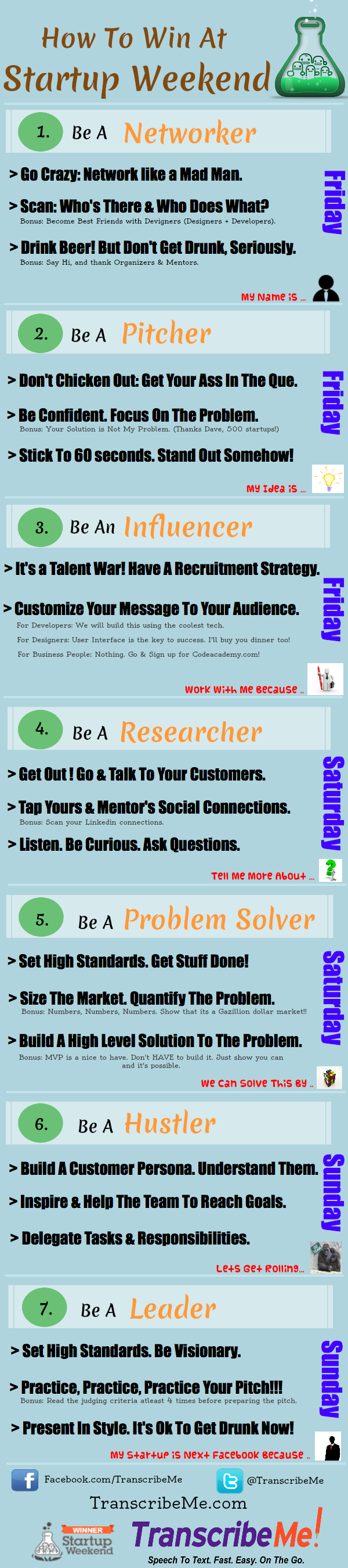
10 Tips To Help You Win Startup Weekend

  1. Designate a project manager from the get-go and define your methods of communication. Pick someone to coordinate the effort, and stick to the simplest possible communication tool that everyone on the team is familiar with.
  2. Work backwards from the end product. Hackathons are chaotic events often held in noisy spaces, and it’s way too easy to get sidetracked, go down technical rabbit holes, or just talk over each other. Keep asking “What’s the goal? What do we want at the end of these 48+ hours?”
  3. Divide and conquer. Come up with a rough idea of the solution and how you’ll get to it, divide the problem into smaller pieces, and split your team into pieces by skill set to tackle those problems.
  4. Validate, validate, validate. Not just your code, but your product idea. Talk to potential customers, either in person, or online!
  5. Check in with your teammates. “Sure, this is touchy-feely and didn’t contribute to hard development, but it helped us become a unified team.”
  6. Take advantage of free advice, but be specific in your ask. Startup Weekend-style events often provide industry experts, and you should make use of them — that’s what they’re there for! Just be aware that they have to support other teams, so be sure to have questions on specific topics for them, and not just general hand-wavey ones.
  7. Show your team you trust them. Don’t micromanage. “Take a leap of faith and let them take a stab at delivering. Then give them your feedback.”
  8. Laugh. Have fun. Sometimes, this is the easiest thing to forget.
  9. Be authentic. “The final pitches that grabbed my attention (and stopped me from glancing at the #swyyc Twitter feed), were the ones where the founder was clearly passionate about the idea and it showed in their eyes.”
  10. Take care of your body: Hydrate. Eat well. And sleep, somewhat. “Don’t just stock up on the sugary treats and salty snacks. Eat lots of fruit, veggies, and get your protein.” Also, a little sleep can go a long way — make sure you get some!

How to Win Startup Weekend: A Hustler’s Guide

  1. Read The Lean Startup by Eric Ries. If you don’t have time to read the book, watch Eric Ries’ 2011 talk at Google on the topic, which he gave when he was still writing the book.
  2. Have a rough idea of your business model. “If you’re going to be pitching an idea, then you should have a basic understanding of how that idea can be turned into a real business.”
  3. Do your research. Who are your competitors? What strategies are similar companies using? Who are your key influencers?
  4. Get to know your fellow participants. You’ll need to do this in order to build your team.
  5. Build your team by selling yourself and your idea. Your pitch format should be along these lines: “Hi, My name is _____ and I’m here today to invite you to join me in <business name> that <main value prop>. My background is in <relevant background> and I’ve seen a problem/opportunity where <problem/opportunity>. I think we can solve this by <how you do it>. I need <mobile app developer / web developer / UX designer /etc.>
  6. Set Friday night goals. 1. Quickly do introductions amongst your team, and sort out roles. 2. Quickly revise your business model canvas, with new input from your team. 3. Register a domain and setup a landing page with an e-mail capture. 4. Work out what your MVP is going to look like.
  7. Saturday: Build it and sell it.
  8. Sunday: Pitch! Focus on 3 things: Is it pretty? Does it work? Can you sell it?

Videos

How to Win Startup Weekend (Prague, early 2018)

Code Without Code’s How to Win at Startup Weekend, Parts 1 and 2

Other articles

Categories
Current Events Tampa Bay Uncategorized

What’s happening in the Tampa Bay tech/entrepreneur/nerd scene (Week of Monday, November 12, 2018)

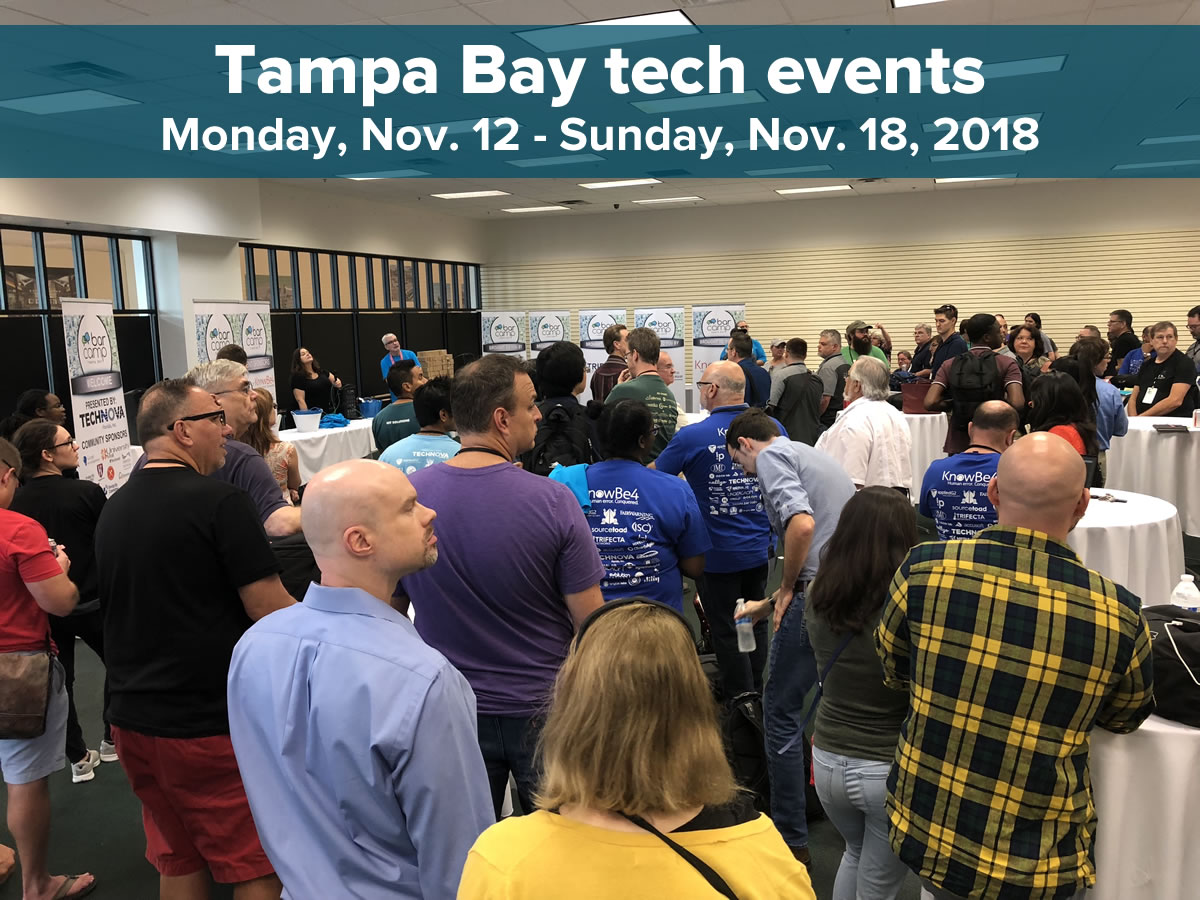
The scene at BarCamp Tampa Bay 2018 last Saturday.

Every week, I compile a list of events for developers, technologists, tech entrepreneurs, and nerds in and around the Tampa Bay area. We’ve got a lot of events going on this week, and here they are!

Monday, November 12


Global Entrepreneurship Week — Happy Hour + Florida Innovation Discussion @ Factory 114, 6:00 PM to 8:00 PM


Tuesday, November 13

Wednesday, November 14

Thursday, November 15


Tampa Bay Cocoaheads — Writing a parser in pure Swift @ ActSoft, Inc., 7:00 PM to 9:00 PM


Friday, November 16


Global Entrepreneurship Week — Techstars Startup Weekend Tampa Bay, powered by KnowBe4 @ Factory 114, Friday 5:00 PM to Sunday, 8:00 PM


Saturday, November 17

Sunday, November 18

Categories
Uncategorized

Data science reading list for Wednesday, November 7, 2018: The job — working together to build trust, the kinds of data scientist, why mothers should do data science, and why not to be a generalist

To build trust in data science, work together

From the Cornell Chronicle:

As data science systems become more widespread, effectively governing and managing them has become a top priority for practitioners and researchers. While data science allows researchers to chart new frontiers, it requires varied forms of discretion and interpretation to ensure its credibility. Central to this is the notion of trust – how do we reliably know the trustworthiness of data, algorithms and models?

The kinds of data scientist

From Harvard Business Review:

In 2012, HBR dubbed data scientist “the sexiest job of the 21st century”. It is also, arguably, the vaguest. To hire the right people for the right roles, it’s important to distinguish between different types of data scientist. There are plenty of different distinctions that one can draw, of course, and any attempt to group data scientists into different buckets is by necessity an oversimplification. Nonetheless, I find it helpful to distinguish between the deliverables they create. One type of data scientist creates output for humans to consume, in the form of product and strategy recommendations. They are decision scientists. The other creates output for machines to consume like models, training data, and algorithms. They are modeling scientists.

Three reasons why mothers should consider a career in data science

From LinkedIn:

For several women, the time during their pregnancy is one of overwhelming happiness, and at times, worry. We worry about things like childbirth and not knowing what to do with our baby after he or she is born. Women with careers have an added worry; we think about how this adorable new addition to our family will impact our careers.

One thing that I’ve discovered over the past four years is that having certain skills can reduce uncertainty around our careers. I’m a mom of two little girls and have a career in data that has provided me with the more flexibility and less stress. Below, I outline the three reasons why mothers should consider a career in data science.

Why you shouldn’t be a data science generalist

From Towards Data Science:

I work at a data science mentorship startup, and I’ve found there’s a single piece of advice that I catch myself giving over and over again to aspiring mentees. And it’s really not what I would have expected it to be.

Rather than suggesting a new library or tool, or some resume hack, I find myself recommending that they first think about what kind of data scientist they want to be.

The reason this is crucial is that data science isn’t a single, well-defined field, and companies don’t hire generic, jack-of-all-trades “data scientists”, but rather individuals with very specialized skill sets.

To see why, just imagine that you’re a company trying to hire a data scientist. You almost certainly have a fairly well-defined problem in mind that you need help with, and that problem is going to require some fairly specific technical know-how and subject matter expertise. For example, some companies apply simple models to large datasets, some apply complex models to small ones, some need to train their models on the fly, and some don’t use (conventional) models at all.

Each of these calls for a completely different skill set, so it’s especially odd that the advice that aspiring data scientists receive tends to be so generic: “learn how to use Python, build some classification/regression/clustering projects, and start applying for jobs.”


Categories
Uncategorized

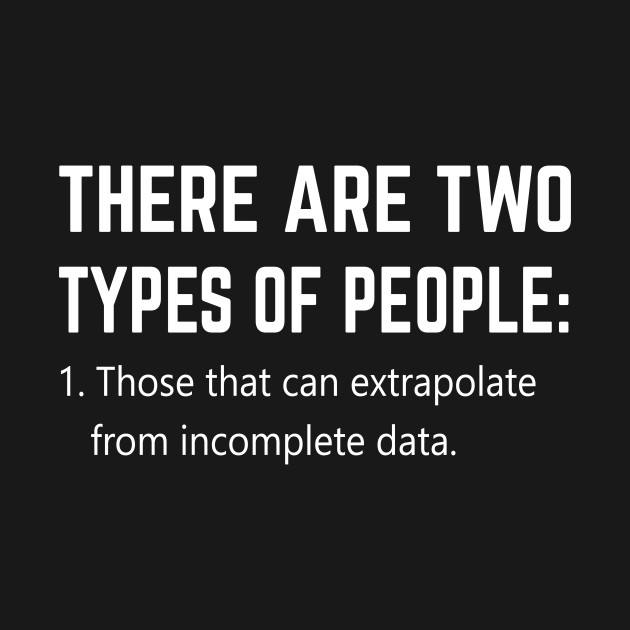
A new mantra worth considering

Click the image to see it at full size.

Categories
Uncategorized

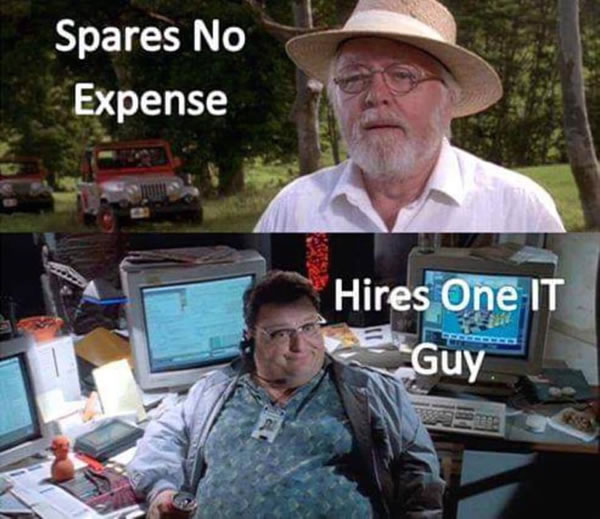
Many businesses still follow Jurassic Park’s model for IT spending…

(They also should’ve done a better job vetting the one IT guy they hired.)

Categories
Current Events Tampa Bay Uncategorized

What’s happening in the Tampa Bay tech/entrepreneur/nerd scene (Week of Monday, November 5, 2018)

Every week, I compile a list of events for developers, technologists, tech entrepreneurs, and nerds in and around the Tampa Bay area. We’ve got a lot of events going on this week, and here they are!

Monday, November 5


Tuesday, November 6

I’m not eligible to vote in the U.S. (I’m a Canadian citizen here on a green card), but if you are, go vote before you do anything extracurricular today!


Wednesday, November 7

Thursday, November 8

Friday, November 9

Saturday, November 10


Sunday, November 11

Categories
Uncategorized

Data science reading list for Friday, November 2, 2018: Education, aspirations, and job descriptions

With Student Interest Soaring, Berkeley Creates New Data-Sciences Division

From Chronicle of Higher Education:

Berkeley’s move follows MIT’s announcement last month that it was investing $1 billion in a new college of artificial intelligence. But leaders at Berkeley say their disclosure of the division today was driven by an imminent international search for a director, who will hold the title of associate provost, putting the program on an institutional par with Berkeley’s colleges and schools. They explain that in creating a division rather than a new college, they are reflecting the way data science has become woven into every discipline.

Berkeley has been planning the division for four years, said David Culler, interim dean for data sciences, and has been rolling it out incrementally through a new data-sciences major approved last year, and corresponding growth in data-science courses. Enrollment in “Foundations of Data Science” has soared from 100 in 2015 to 1,300 in 2018. Enrollment in the upper-level “Principles and Techniques of Data Science” has grown from 100 in 2016 to 800 students. The emerging program has served as a “pilot” for the division, which is now set to evolve under a new director.

The core of the data-science curriculum, said Culler, is computer science and statistics, with additional depth courses in optimization and visualization. But students will also be required to have a “domain emphasis” that would most likely synthesize material from various other departments. For instance, a data-science student’s exploration of social inequality might include courses in sociology, ethnic studies, economics, and philosophy.

‘With a basic degree, you can learn data science on the job’

From SiliconRepublic:

Next week at the National Analytics Conference, [Jennifer Cruise from the Aon Centre for Innovation and Analytics] will be on a panel where she expects to discuss several aspects and challenges that businesses face relating to data, including how to deal with the abundance of information that is now available and, of course, the key issues of skills and resources.

“You can only truly exploit the data if you get the right people in that space, and there’s a double whammy,” she said. “On the one hand, you have a lack of hands-on resources. Skilled data scientists are hard to come by and things are changing quickly, so people who are qualified need to stay on top of things. Then, you also have a gap in the leadership space – the people who can advise you how to turn [data] into revenue for your company, or how to use your data to become more operationally efficient.”

8 common questions from aspiring data scientists, answered

From Tech in Asia:

So, you want to be become a data scientist? Great. But you have zero experience and have no clue how to get started in this field. I get it. I’ve been there and I definitely feel you. This is why this post is for you.

All the questions below came from the community through my LinkedIn post, email, and other channels. I hope that by sharing my experience, you will be enlightened on how to pursue a data science career and make your learning journey fun.

OPINION: How to craft effective data science job descriptions

Graphs made with vintage wooden blocks , pawns and other vintage wooden toys. Compartments with a bar chart, wooden lines and pawns.

From ComputerWorldHK:

In today’s data science job market, demand far outstrips supply, said Chris Nicholson, co-founder and CEO of artificial intelligence and deep learning company Skymind, and co-creator of the open source framework Deeplearning4j. That means organizations must resist the temptation to seek candidates with every last required data science skill in favor of hiring for potential and then training on the job, he said.

“A lot of data science has to do with statistics, math and experimentation—so you’re not necessarily looking for someone with a computer science or software engineering background, though they should have some programming experience,” Nicholson said. “You want folks from physical science, math, physics, natural sciences backgrounds; people who are trained to think about statistical ideas and use computational tools. They need to have the ability to look at data and use tools to manipulate it, explore correlations and produce data models that make predictions.”

Because a data scientist’s job isn’t to engineer entire systems, minimal programming experience is fine, Nicholson said. After all, most organizations can rely on software engineering, DevOps, or IT teams to build, manage and maintain infrastructure in support of data science efforts. Instead, strong data science candidates often have a background in science and should be proficient with data science tools in one or more different stacks.