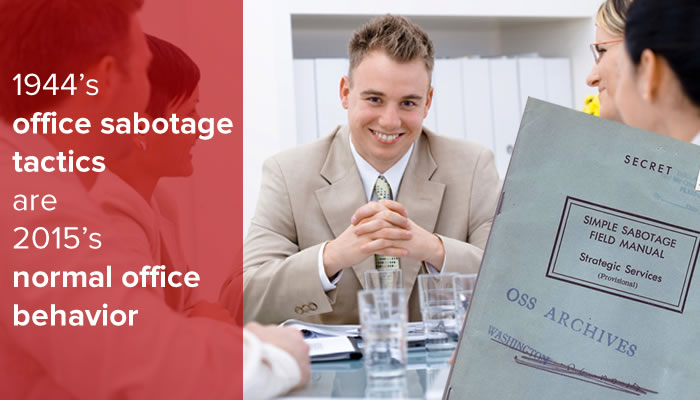
In 1944, the OSS (Office of Strategic Services, the predecessor to the CIA) published the Simple Sabotage Field Manual, a “Sabotage for Dummies” guide filled with handy tips for resistance members in Europe. In 32 pages, it listed a number of acts of anti-Nazi disruption that could be carried out by ordinary people without military or spy training.
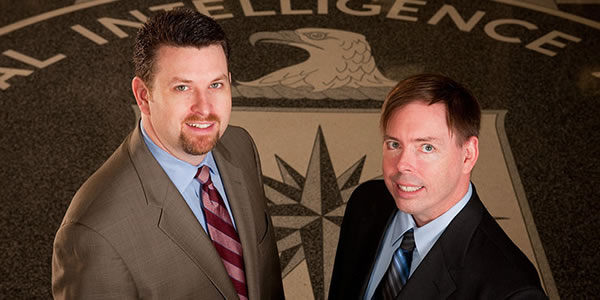
CIA employees Don Burke and Sean Dennehey, who revealed the connection between 1944 sabotage practices and 2015 office behavior.
At the Enterprise 2.0 conference in 2008, CIA employees Don Burke and Sean Dennehey gave a keynote presentation where they talked about the Simple Sabotage Field Manual and made a very important observation:
What the CIA’s predecessor considered to be office sabotage techniques during World War II are normal office behaviors today.
Take a look at the sabotage tactics from the section titled General Interference with Organizations:
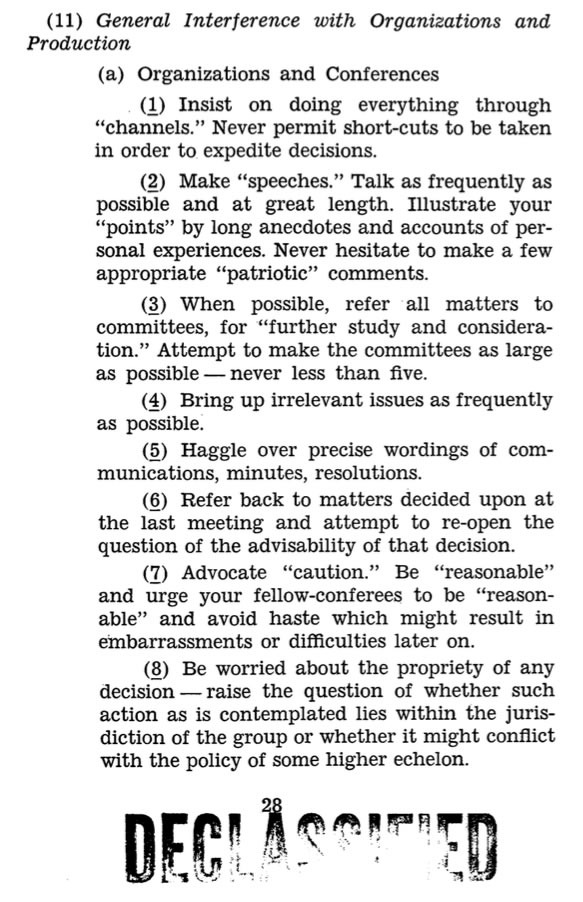
Here’s the text from that page:
(1) Insist on doing everything through “channels.” Never permit short-cuts to be taken in order to expedite decisions.
(2) Make “speeches.” Talk as frequently as possible and at great length. Illustrate your “points” by long anecdotes and accounts of per sonal experiences. Never hesitate to make a few appropriate “patriotic” comments.
(3) When possible, refer all matters to committees, for “further study and consideration.” Attempt to make the committees as large as possible — never less than five.
(4) Bring up irrelevant issues as frequently as possible.
(5) Haggle over precise wordings of communications, minutes, resolutions.
(6) Refer back to matters decided upon at the last meeting and attempt to re-open the question of the advisability of that decision.
(7) Advocate “caution.” Be “reasonable” and urge your fellow-conferees to be “reasonable” and avoid haste which might result in embarrassments or difficulties later on.
(8) Be worried about the propriety of any decision — raise the question of whether such action as is contemplated lies within the jurisdiction of the group or whether it might conflict with the policy of some higher echelon.
If you’ve worked in an office for even one day, the odds are pretty good that you’ve seen at least one of these acts of sabotage.
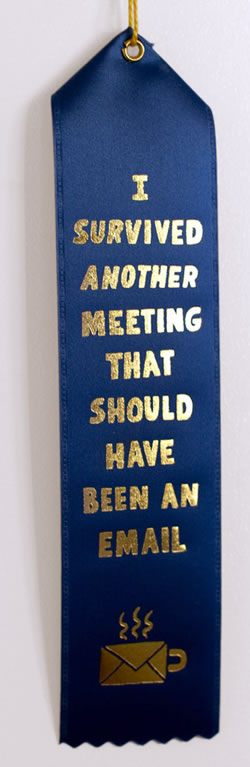
The Simple Sabotage Field Manual has more tips for killing productivity, including my “favorite” pro-tip for managers, “Hold conferences when there is more critical work to be done.” If this trick didn’t work, there’d be no market for an entire line of “I survived another meeting that should’ve been an email” products.
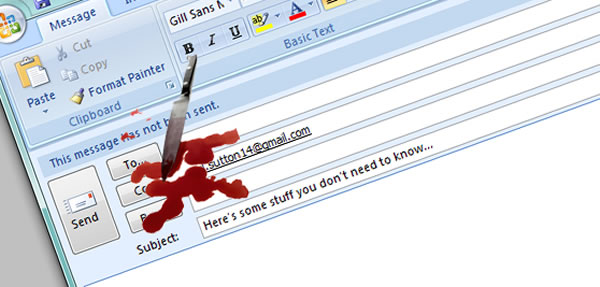
Another office sabotage tip from the manual involved misusing carbon copies to slow things down: “In making carbon copies, make one too few, so that an extra copying job will have to be done”.
For you younger folks, carbon copying was a method of producing multiple copies of a typed letter in the days before photocopiers, never mind computers. This video shows how it was done (as well as why you should be thankful that we don’t live in the dark ages anymore):
Today, carbon copies live on in their descendant, the cc: field of emails (“cc” is short for “carbon copy”). And instead of making too few copies, the internet-era version is to send emails that are cc’d to as many people as possible. In its more innocent form, the sender is just trying to be inclusive, but is likely filling other people’s inboxes with messages that don’t necessarily apply to them. In its nastier version, it’s a way to snitch on someone or throw them under the bus by cc:ing their boss and ensuring that “the wrong words go in the right ears”. No matter the intent, the effect is the same: it disrupts work.
 In their new book, Simple Sabotage: A Modern Field Manual for Detecting and Rooting Out Everyday Behaviors that Undermine Your Workplace, consultants Robert Galford, Bob Frisch, and Cary Greene revive the notion of modern organizational behavior mirroring WWII-era organizational sabotage. They’re quick to point out that most of these acts are carried out with the best of intentions:
Saboteurs make you think that what they’re talking about is relevant and important when in reality what they’re saying is tangential, unimportant, or even inappropriate. They don’t know they’re doing it, so their earnestness and honesty helps make their case. And the people on the receiving end are instantly, innocently swept off course because they believe what they think they see or hear.
It’s not 1940s occupied Europe, so we can’t simply turn over our work saboteurs to our neighborhood friendly occupying army or take them behind the office and have them quietly shot, as tempting as it may seem. After all, we’re supposed to be more enlightened these days, and besides: we probably report to some of those saboteurs. The first step toward making our workplaces more productive is to recognize these behaviors for what they truly are.


If you’re not spooked out by downloading a file from the CIA (and likely adding another item to their file on you), you can download a scan of the book from them. It’s a 2.5 MB PDF file.