Last Tuesday, I had the good fortune of being able to attend a Tuesday luncheon session at the Berkman Center for Internet and Society at Harvard. Doubling my good fortune was the speaker, who was none other than danah boyd, who talked about her research into MySpace and other social networking sites and their use by youth. It was during this presentation that I first heard her thesis about the class divide between MySpace and Facebook, which has since become a popular topic thanks to her recent posting on the topic.
I took notes and photos during her presentation and present them below…

danah boyd making her “MyFriends, MySpace” presentation at the Berkman Center at Harvard, Tuesday, June 19th, 2007.
To Begin, Some Quotes from Teenagers…
- “If you’re not on MySpace, you don’t exist” — Skyler Sierra
- “My mom doesn’t let me out of the house…” — desperate desire to be social, even in the face of increasing strictness
Who is danah boyd and What Does She Do?
- What danah does: ethonography, which means “writing culture”
- Her field of study: youth in America
- In her studies, she’s been moving between online and offline worlds
- Since 2004, she’s been “hanging out in and being present among youth culture”, doing things like:
- Fast food places and malls
- Riding buses when school’s out
- Interviewing not only youth, but parents, pastors, teachers, etc.
- Looking over something int he area of 10,000 MySpace profiles
Networked Publics
- 55% of online American teens 12 – 17 claim to have a profile on some social software system.
- Note that these are teens who will admit this sort of thing in front of their parents; the actual number is porbably higher
- A social software system can be called a networked public
- What is a networked public?
- A space or collection of people that exist within and through tools that network people
- Sometimes it’s a civic space, sometimes it’s not
- Usenet was an early form of networked public
- As time passed, people migrated to mailing lists, which are also a networked public
- Then, with the web explosion, people moved to forums, which are also networked publics
- And now, in the Web 2.0 age, we’ve got social software, which are also networked publics
- Early networked publics — newsgroups, mailing lists and forums — were organized by topic
- Web 2.0 changes rules of organization — now they’re arranged by friends and communities
Friendster
- One of the earliest social software sites
- Not mainstream — its populace fell could be divided into three categories:
- Self-defined geeks. It was popular among geeks in San Francisco, who in 2003 — the afternath of the dot-com bubble bursting — had lots of spare time.
- “Freaks” (as in counter-culture). A large number of the freaks were Burning Man regulars who used Friendster communicate with fellow “Burners”.
- Queers (mostly gay men in New York). Gay men in New York City were using Friendster to arrange “hook-ups”
- In June 2003, Friendster hit the mainstream news, with 300,000 users, most of whom were active
- A distinction arose between real friends and Frienster friends — “She’s not my friend, she’s my Friendster”
- Friendster was originally designed to be a place to find and arrnaged dates
-
- As such, its creators tried to enforce rules that fit its intended purpose:
- No fake images: you were supposed to use only a real photo of yourself in a profile, not an icon or avatar a la LiveJournal
- Profiles were formal
- No “Fakesters” — that is, no fake personas or pseudonyms. Each Friendster profile had to correspond to a real person
- Trying to make people follow these rules was like playing “Whack-a-mole”:
- Rather than treating it like a dating site, as its creators intended, people treated it as a fun online space and a place to experiment with self-expression
- People created fake profiles, a.k.a. “Fakesters” for all sorts of reasons
- Some people created fake profiles — usually with a very attractive photo — simply to build a collection of friends
- Friendster didn’t have groups like Facebook’s, so some people created Fakesters for this purpose. Harvard had a fakester so that Harvard people could find each other.
- While these transgressions of the rules served Friendster’s users well, they did not align with the creators’ wishes
- The creators responded not by listening to their users base, but by killing off the goofy things, which in turn killed off some of Friendster’s useful populations
MySpace
- Right from the very beginning, MySpace was meant to be a complete rip-off of Friendster
- MySpace’s creators reached out to people kicked off from Friendster for various transgressions
- One crowd the MySpace creators actively courted from the beginning were independent rock musicians:
- Many indie rockers were kicked off Friendster for using Fakesters to network with their fans
- They listened to their indie rock band users and added features they requested
- L.A. music promoters started using MySpace as a means of tracking and communicating with music and DJ event fans
- Bands started using MySpace to convince clubs to book them — “Check out our MySpace page! See all the fans we have!”
- The first group of music fans to make use of MySpace were the 21+ crowd
- The younger people began to join
- Kids want to read about youth slightly older than them — consider that the readers of Seventeen magazine are on average 13 years old
- MySpace began extending it “downward reach”, age wise: they dropped the minimum age to join from 16 to 14. 14 is as low as they can go without requiring parental consent or getting into dangerous legal territory
- The first kids to join MySpace were the “arts scene” kids in high school
- They liked being able to collect friends
- A teen found that the MySpace people weren’t too tech savvy, and that they didn’t filter a lot of their input. He found that he could include HTML tags in all sort of MySpace input and started using them
- Rather than try to stop this, the MySpace people allowed it and observed how people took advantage of the oversight
- This led to what danah called “Copy/paste literacy” — people knew enough to figure out what HTML and JavaScript code to copy from other people’s MySpace sites, but not enough to know how it worked
- One side effect of this was the rise of phishing on MySpace
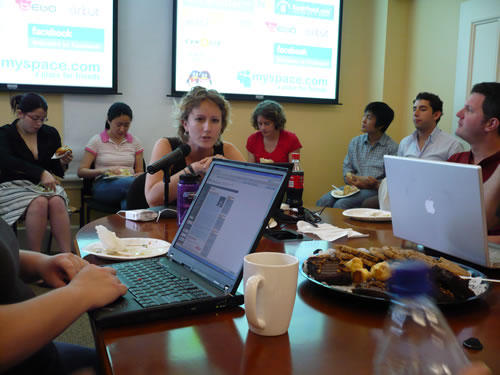
danah boyd’s presentation at the Berkman Center, June 19th, 2007.
Properties of Social Networking Sites
- Most social networking sites provide these three things:
- A Profile, where you can provide a picture and other information about yourself
- A mechanism that allows you to declare other members as “Friends”. Note that “Friends” in the system is a different concept from real-life friends:
- Friends in the system aren’t all people whom you trust or are close to. Sometimes, you declare people as friends when:
- You want to look cool (especially if these people are popular)
- You want to get to know them
- They’re a band you like
- “Why not?”
- It seems impolite to say “no”
- Ability to write public comments. This got started in Friendster as “testimonials” and lives on in MySpace as comments and Facebook as “The Wall”.
- In Friendster, there were two highly followed Fakesters, “Table Salt” and “Pepper”, who would write glowing, gushing testimonials of each other
- Strangely enough, people don’t seem to mind communicating to each other in public. In Facebook, over 66% of the messaging is done by writing on people’s walls, as opposed to using private messages
- Unlike “real-world” publics like the park or the mall, networked publics have these qailities:
- Persistence: What you “say” in a networked public can last at least as long as the service does
- Searchability: And in a matter of seconds, too.
- Replicability: What you “say” in a networked public can easily be copied
- Invisible audience: You don’t know how many “witnesses” are around to “hear” what you “say” — nobody? A few people? Tens? Hundreds? Thousands? Even more?
- Given these properties, young people have found ways to make sense of it all
- Online spaces, like real life spaces, have rules…
- The “like-minds effect” of the early internet disappeared after the boom
- You might have many audiences, for which a different “voice” is best. Which voice do you use?
- Celebrities and their effects on these new publics:
- This generation is growing up with celebrity-style publics
- They’re getting their cues from Paris Hilton, and the lesson is that it’s better to be public and be seen than private and invisible
- Kids are turning to networked publics to get access to publics that would otherwise be denied to them
The Creation of the Teenager and the Rise of Age Segregation
- During the Great Depression, moral reformers teamed up with the government to instill the high school regime
- This led to the rise of age segregation
- They created sports and other extra-curricular activites to keep people off the street and away from labour organizers
- Having adolescents occupied with high school was protection for the labour force, so they wouldn’t be displaced by these younger, more able-bodied people
- High school’s system of age segregation led to the rise of bullying, which was a largely unknown phenomenon before 1950
- The term “teenager” was created in 1941 by marketers
- Another effect of age segregation: adults don’t understand young people
- Fear of things like the Catholic church scandals is reinforcing age segregation
- Another effect: teenagers are kept out of public life
- Teen mobility is becoming increasingly limited:
- Urban and suburban design is such that cars are necessary, limiting access to many places
- Even in cities with good public transit systems, many kids aren’t let out of sight. In the UK, people are practically terrified to let the kids out of the house
- These days, kid time is high structured. Think of the rise of things like “play dates”, the increase is extra-curricular activities and so on — all upper-middle class phenomena
Messaging in Public
- Why are people on social networking sites like Facebook communicating by writing comments on the publicly-viewable wall as opposed to sending private messages?
- One reason: It makes for better “cred” for social interactions
- It provides control of the situation:
- Many kids break up not in person, but in mediated fashion: through phone, IM or MySpace
- Breaking up this way allows for control of the conversation
- It provides witnesses. People “hear” what you said, rather than “what she said you said”
- Database rules as a reflection of real life: in MySpace, deleting a friend deletes their comments. It effectively “wipes them out”, at least in your world
- Friend deletion is rare, which makes deletion a very strong statement
- “You write your community into being”
An Interesting Tidbit About MySpace Profiles
- 2/3 of MySpace profiles are private
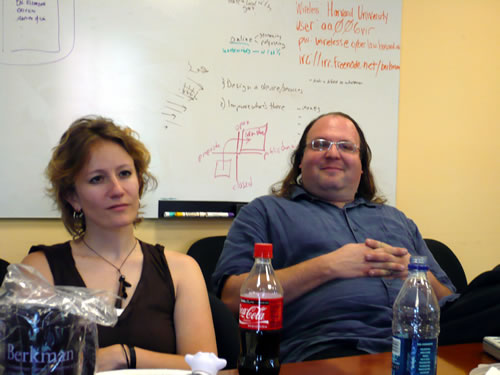
danah boyd and Berkman Center fellow Ethan Zuckerman.
“The Most Dramatic Part of MySpace
- MySpace’s “Top 8” feature — where you can rank friends as your “top 8” — is the most dramatic part of MySpace
- Many fights ensue as a result of people being added to or removed from a friend’s Top 8
- To quote one teenager, MySpace’s Top 8 is “the new dangling carrot for gaining superficial acceptance”
Dodging audiences
- Which audiences do kids want to dodge? It’s people with direct power over them, such as their parents
- “Chi-mos” or child molesters are not as big a problem as spammers and scammers
- How do you evade people in a networked public?
- You can build walls — things that keep unwanted audiences out — through lies
- You can make demands to the people who run the sites, asking for features that allow you to evade people
- You can “play ostrich”, which is the number one way adults deal with panic of publics
- The assumption that what you plut online is public only to people like you is based on an assumption we make based on physical space
Public Life is Changing
- We don’t have the techniques to educate people about how to interact within networked publics
- The new generation is one that wants to socialize, but is constrained by time and structure
- Email is dead to young people. It’s used as a means of communicating with people who have power over them
- In social software, you click on a person’s pic and you know it’s them
- Social software message systems have less spam
- The rates are getting better — better than 10 cents per SMS
- Outside the US, social network sites are profile-centric as opposed to message-centric
- Meanwhile, it’s rude to SMS cause we have to pay to get the message.
Question-and-Answer/Discussion Session
These network publics are for-profit, which means that business decisions shape them. Are the users cognizant of that? Does it affect their decisions?
- My activist self wantsd to believe that the users are aware of that, but sadly, that’s not the case
- To them, seeing ads means that the service is free
- Kids are so used to being blasted with ads that they don’t notice them
- There is a sharp divide between the MySpace and Facebook cultures: Facebook is working class and subculture, which Facebook is upper-middle-class and college-bound
- This divide is playing out at all sorts of levels
- Note that the U.S. military is banning the use of MySpace, but not Facebook. They’re banning what the soldiers are using, not what the officers are using.
- In Facebook culture, it’s better to be less commercial and more tasteful. Ads in Facebook are more like Google ads
- In MySpace culture, it’s all about bling, so loud ads are acceptable and commercialization is cool
- “They don’t know a world that’s not commercial. They don’t know a public life that’s not commercial”
- But there’s no way to support a system like MySpace without commercials
- Advertisers and social netowrking site creators are iterating based on youth desires — it’s not that kids don’t want ads, they don’t want ads that aren’t relevant to them.
What do you think the next step for social networking sites will be?
- That kind of stuff is always hard to predict
- I don’t think that that immersion — a la Second Life or World of Warcraft — will be the next big thing
- Rather, I think that mobile — access via phones or phone-like devices — will be the next big thing
- There are two possible mobile futures:
- Genuine wireless, where there’s no “carrier barrier”
- Something like Blyk, where you get a free mobile phone in exchange for viewing ads
- Growth will affect what becomes the next big thing. If you’re dealing with people on Wall Street, you need to demonstrate that your social networking site will grow.
- But growth means dealing with multiple audiences, which leads to fragmentation
- Consider Facebook: it’s gaining an older audience at the cost of its younger audience
- Successful social software needs cluster effects
- If only 80% of your friends can participate, you won’t
- An interesting aside: many MySpace users have their profiles managed by other people — friends, girlfriends and so on. People know each other’s login credentials
- On successful social software sites, everyone participates at different levels
Can social networking sites be used to counteract some of the effects of age segregation, the way things like Hakim Bey’s “Temporary Autonomous Zones” or World of Warcraft, where people of different ages and other classifications seem to?
- It’s tricky
- The vast majority of teens are talking to ony to people within their groups
- They’re told that all adult strangers are bad
- “My mom says it’s okay to talk to you”
- Recounted a story about a lost boy scout troop that took longer to find because they were hiding from search parties, all of whom were adult strangers. They were rescued only when the search parties clued into this and brought children with them
- The online world is probably not the place to introduce adult strangers
- There’s been a pervasive sense of “Stranger Danger” since 2000
- It’s a problem for reasearchers trying to talk to kids
- Adults are doing a bad job of navigating the future — you’ll have to navigate the future yourself
Have you seen any differences in the ways boys and girls use social networking sites?
- “Most of it’s not surprising”
- Many boys’ profiles are created by their girlfriends
- There seems to be equal numbers of boys and girls
- When it comes to ad-hoc socialization, it seems to be stronger on the girls’ side. Data from Pew Research confirms that they use to maintain contacts
- Boys are more likely to talk to strangers — “especially hot ones” and more likely to collect strangers in their friends lists
- Girls more active in terms of deep participation
- Girls know the copy/paste stuff, boys know HTML and proxies
- The predator panic did damage to MySpace
- Kids are switching to Facebook because “it’s where my friends are and it’s where mom lets me go”
There was some discussion about the “NYU 2011” Facebook group, a group of kids who are graduating from high school this summer and will be attending New York University as the class fo 2011 in the fall. In essence, they’ll be “meeting” each other ahead of time, something that wasn’t possible when most of us were in college.
- This sort of “pre-meeting” online might take away from the excitement
- Might foster self-selecting groups — consider homophily
- It’s not clear what cause-and-effects of homophily are
- More things in common: more likely that you’ll stick
- Consider the side effect of “Stranger Danger”
- Colleges are social experiments
What are the reasons provided by the minority of kids who don’t participate in these sites?
- Parents don’t allow it
- Church doesn’t allow it — although some are providing alternatives like Jerry Falwell’s Battle Cry
- Some claim that they’re “too cool” to participate
- Of the people who aren’t already online, 75% don’t want to be
- Online access transcends race and class, although the kids in inner cities know how to access the proxies
Moms with kids use the net to skip past time constraints. Do teen parents use the net similarly?
- Typically, teens with kids are living at home and get their advice from their parents
- Social networking sites are not being used by teen parents as a way of communicating with other teen parents
Social networking sites are now a part of youth culture. What do you think we should do?
- Currently, there are 57 pieces of legislation to ban these sites
- We need to educate people about negotiating these publics
- Rather than give edicts to young people, make them think about these publics. One way: Morality plays that start with the question “How would you feel if…?” — Ask questions, make ’em work on hypotheticals!
- We make so much fuss about online sexual predators, and then jail them, only to release them a very short time later. Don’t make new laws, enforce the existing ones!
- Street outreach programs have proven their worth in the real world — perhaps it’s time for an online equivalent
- We need to figure out what to do about “Stranger Danger”