Posts tagged as:

entrepreneurs

VeloCity Project Exhibition

by Joey deVilla on November 25, 2008

Yesterday, I (along with David Crow and Barnaby Jeans, my colleagues at Microsoft Canada’s Developer and Platform Evangelism Team) went to the University of Waterloo to see the projects on display at the exhibition of a new initiative at the university called VeloCity.

VeloCity

VeloCity has been described as a “dorm for entrepreneurs”; I’ve also heard it referred to as a “dormcubator”. Taking a cue from successful businesses such as Dell, Facebook, Google, RIM and Yahoo!, which were started by students working in their dorm rooms, the VeloCity project aims to create an atmosphere that will encourage and enable Waterloo’s students to sharpen their technical and entrepreneurial skills, and perhaps even come up with “the next big thing”.

The university converted its Minota Hagey residence from a standard dorm into a place where its residents would have access to a boardroom, a mobile device lab, high-bandwidth wifi, large flatscreens, workstations, programmable lighting and other goodies that you might find at a high-tech company’s campus. Students in the VeloCity program live and work on their projects there; they also attend professional development workshops for entrepreneurs at the nearby Accelerator Centre.

The VeloCity projects are currently treated as extracurricular activity – they’re done in addition to their regular courseload. Adding to the challenge is the short timeline: they’ve only been working on their projects since the start of the school year in September.

Why wasn’t something like this around when I was in university?

The Exhibition

View From Above 2

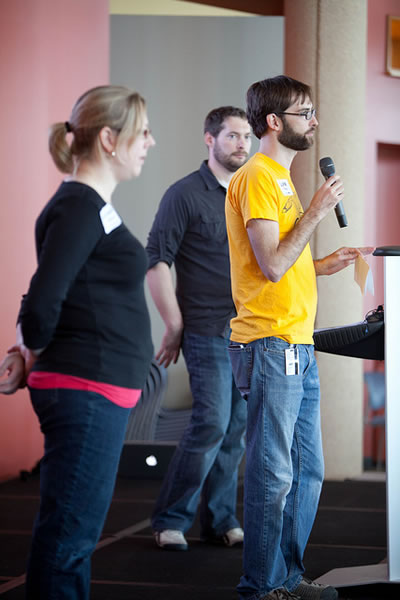
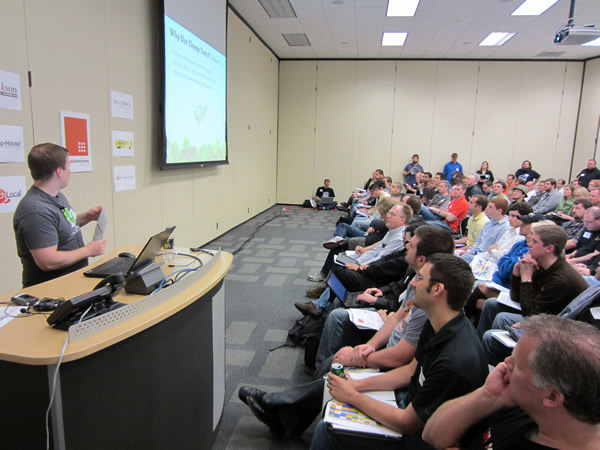
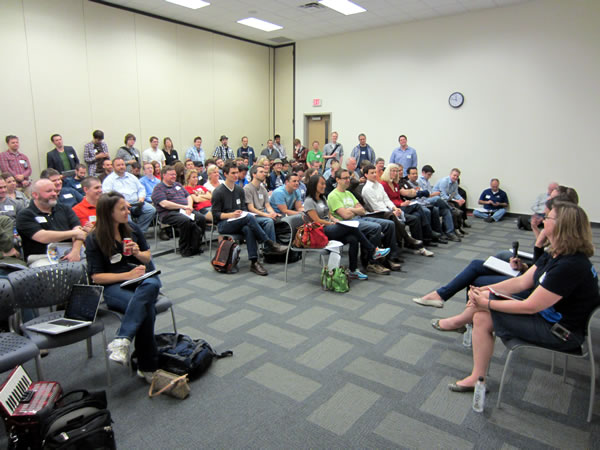
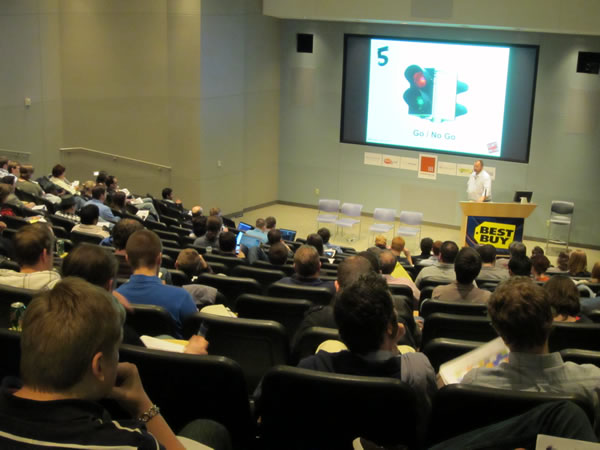
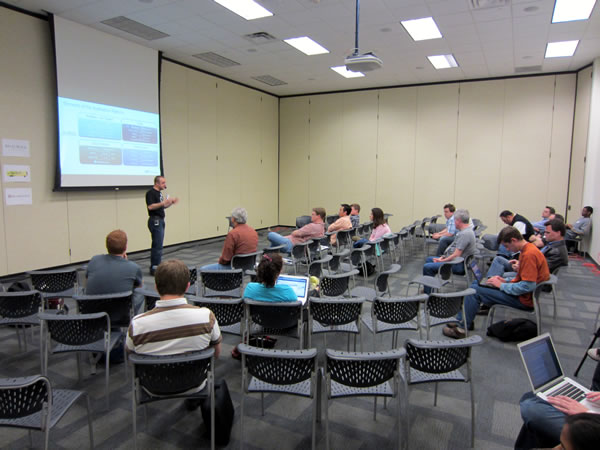
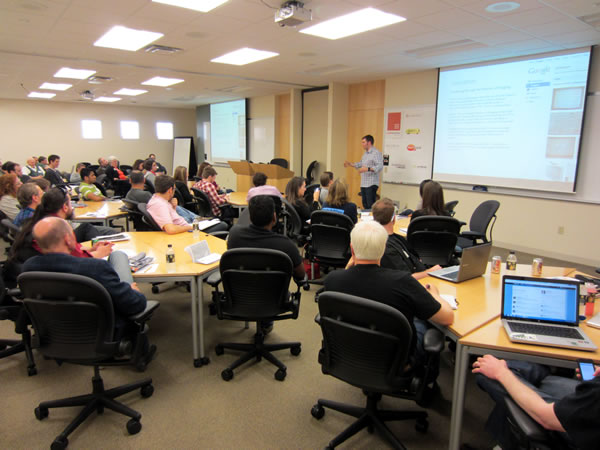
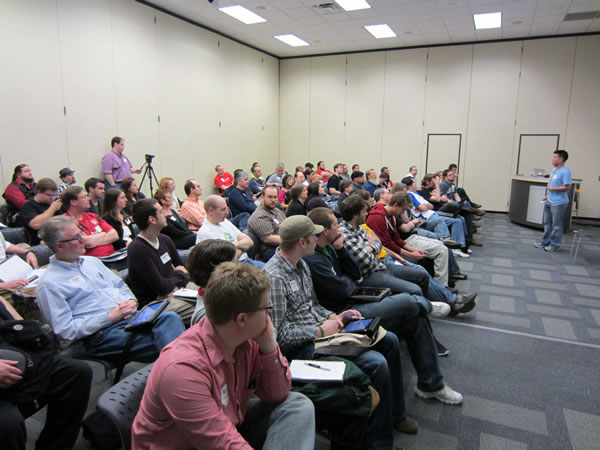
Yesterday’s exhibition was the VeloCity students’ first chance to show off their projects in their current state. Each project team set up a booth science-fair style in the foyer of Waterloo’s Davis Centre and did presentations to attendees and passers-by; they also had to do a three-minute pitch presentation onstage.

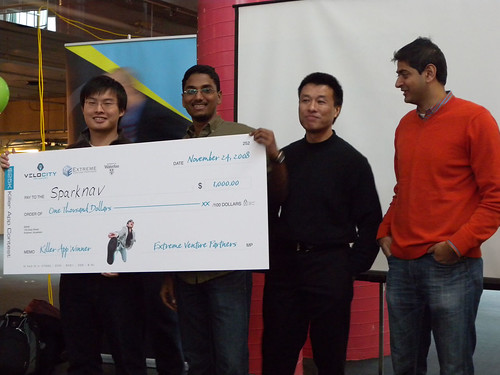
Extreme Venture Partners were there to judge the projects. They would provide $1000 to fund the project they deemed most worthy.

The projects participating in the exhibition are listed below.

Project Description
Grocerus A location-aware web application that helps users create grocery lists and find the best prices for items on that list in their area.
Gruup A web application that lets its users do group purchases of items for volume discounts.
Sparknav A mobile navigation application with a twist: it’s for finding your way around indoor or enclosed spaces, such as malls, airports, university campuses and amusement parks.
Emoshion A mobile app that provides “location-based high-end fashion news”.
Find It Off Campus A web application that helps University of Waterloo students find off-campus housing.
Szello Mobile A consultancy that does mobile UI design and provides a mobile UI development kit.
Fading Hearts / Magical Aces Two projects: Fading Hearts is an anime-style multimedia “choose your own adventure” story-game. Magical Aces is a 2-D vertical shooter arcade game (in the style of Raiden) with manga-inspired story elements.
Ufansi A web application that connects charities with donors, keeps donors apprised of their charities’ activities and helps to lower charities’ administrative costs.
Giftah A web application that creates a marketplace for retailers’ gift certificates and gift cards.
ClassAlbum A web application for managing class schedules and finding vacant classrooms.
Comic Battle A multiplayer Flash-based online fighting game.
My Story An “online platform where authors can share their creativity”. Authors can publish their stories, add media elements such as background music or voice-overs, get constructive feedback from their readers and even collect money for their stories.
CashIn A wallet with an electronic component that acts as a financial advisor, tracking your spending and warning your spending is threatening to break your budget.
inPulse A watch interface that acts as a secondary display for your mobile phone, allowing you to see caller ID, email and SMS messages or your calendar without having to fish your phone from your pocket or its holster.
Threadband A 2-D casual game for the iPhone.
Metacast A web application that combs the internet for video, places them into category-specific channels which can be viewed in a TV-like fashion.


Before announcing the winner, the judges told the audience who their top three picks were:

  • inPulse
  • Sparknav
  • My Story

Of these three, they picked Sparknav.

...Sparknav!

VeloCity will be holding another exhibition in March. It will be interesting to see how far  these project (and the people behind them) progress in the interim.

Suggestions and Observations

Startups vs. Lifestyle Businesses

There is a difference between a startup and what Austin Hill referred to as a “lifestyle business” at the recent Startup Empire conference.

A lifestyle business is a service or consultancy that addresses the needs of a small or localized market. What it doesn’t do is make a product nor does it change the market it’s in or define a new one. There’s nothing wrong with these businesses; they meet certain needs and give their owners some money, ranging from discretionary income to enough to support a pool of small employees. Some notable lifestyle businesses include small development shops like 37signals and Toronto’s own Unspace, popular money-making sites like the Dooce and I Can Has Cheezburger? and applications like 37signals’ BaseCamp, Remember the Milk, Delicious Library and Hampton Catlin’s iPedia. While they are entrepreneurial and even fun to run (I’ve done one), they’re not the sort of thing that investors are looking to fund.

A startup is an attempt to create a new product that often creates a new market, or changes or becomes a big player in its market. It involves the creation of a new technology or the use of existing technology in a particularly novel way to solve a problem, often for a large market, if not the entire world. Apple, Microsoft, Yahoo!, Google, eBay and – to cite a Canadian example –- RIM are particularly big examples of startups. They are the sort of venture that investors are looking to fund.

The line between startups and lifestyle businesses can be fuzzy. A lifestyle business can sometimes grow into something startup-like or even a true startup because it defines a new market or changes the one it’s in. Craigslist falls under this category. Flickr and Blogger are examples of startup-like companies that grew out of side projects and were later acquired. Facebook started off as a lifestyle business but turned into a startup.

I believe that while VeloCity is trying to encourage tech entrepreneurialism in general, what they’re really trying to do is encourage students to become startup entrepreneurs. I think that the VeloCity participants should be mindful of the difference between startups and lifestyle businesses and steer towards projects that are more startup-like in nature.

Look Beyond the Consumer Market

A lot of people come up with product ideas for the consumer market because they’re graspable: they’re easy to think up and easy to implement. There’s a world of problems beyond consumer applications, and sometimes even a small solution can make a big difference. Think of the big issues that are on people’s minds today: the economy, the environment and healthcare, for starters.

Beware of Living Off Advertising

Once again, I’ll take a quote from Austin Hill: Advertising is not a business model. A business model is something that answers the question “How can I get customers no one else will get?”

Perfect your pitches

Pitching is considered a “soft” skill, which is the sort of thing that techies tend to discount. Even businesspeople sometimes consider it unimportant: at the recent Startup Empire, VC Austin Hill said that he’s seen CEOs who couldn’t pitch their way out of a paper bag. This is a mistake: no matter how good or cool your technology is, no one will care unless you can tell a story about it, and tell it well.

In “The Valley”, pitches are so important that they agonize over them. Countless blog posts, articles and books have been written on the art of pitching, and there are regular workshops where they work on their pitches.

Half of what makes a pitch is its content; the other half is its delivery. Your pitch needs to cover what your product is, what kind of problems it solves and why it’s the basis of a viable business. You also have to be able to make your case in two to three minutes, with delivery that engages the audience. You need to practice your pitch to the point that you can do it in your sleep.


One key point to remember is the point of pitching is not to go over your product’s feature set, but about its market and the needs that it will fill. Remember, people don’t really buy drills, they buy holes.

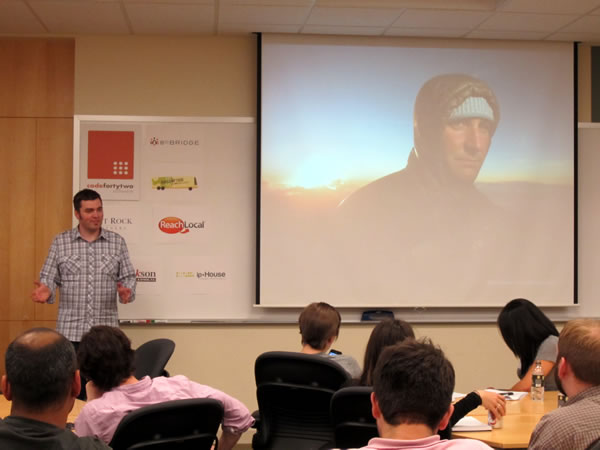
The best pitch of the bunch was delivered by Eric of inPulse, who started with the problem he was trying to solve, presented his “smart watch” phone interface as a solution, and then explained why inPulse was viable as a technology and a business. He quickly explained what the current state of the project was, what his expecting timelines were, his technology partners and what the goal was. His delivery was good, and he had some memorable lines in his pitch, most notably “We want to be the industry leader of smart watches in 2010” and “If you have any question, send an email…directly to my watch!” (David Crow groaned at that line, but I liked it. More importantly, we’ll both remember it.)

Honourable mention for good pitch goes to Caleb, Dane and Eric from CashIn, who also had a good presentation style and structure.

Links

{ 7 comments }

David Cohen at Startup Empire: Boulder and TechStars

by Joey deVilla on November 14, 2008

david_cohen

startup_empireAnother afternoon presenter at yesterday’s Startup Empire was David Cohen, founder and Executive Director of TechStars, which provides a unique opportunity for early-stage startups. Here are my notes from his presentation:

Boulder, Colorado

  • Why did I come here today? Because I’m hearing more about Toronto every day
  • I started out in development
    • Did three startups
    • Then went to the dark side: angel investing
    • Started all kinds of companies in all different ways
  • I’m based in Boulder, Colorado
    • Two of my companies are ZOLL Data Systems, Earfeeder
    • One of my startups failed, but there’s no evidence on the net that it ever existed
    • What’s Boulder known for?
      • Mork and Mindy
      • “4:20”
      • Nearby skiing
      • University of Colorado
    • It’s northwest of Denver and has a population of 125,000 – with students! Denver has about 1 million people

VC in Boulder vs. VC in Toronto

  • VC in boulder
    • $311 million in Q1 2008 in Boulder County
    • Taking into account its population of 125,000, that makes for about $2,500 in venture capital for each person in Boulder
  • VC in Toronto
    • $130 million in Q1 2008
    • Taking into account its population of 5.5 million, that makes for about $23 in venture capital for each person in the Toronto area
  • Toronto has a chicken-and-egg problem
  • We learned in Boulder, VC follows innovation
  • A UFO didn’t land in Boulder and drop off VCs
  • There was a strong telecom industry that grew up there (Colorado is the home of telecom and storage)
  • People who got rich off those industries stayed in Boulder and asked "What can I do with this money?"
  • 2nd- and 3rd-time entrepreneurs decided to become angels
  • Most angels are driven by more than just the money
  • Companies in Boulder: Lijit and Newsgator to name a few
  • The VC followed

The TechStars Concept

  • Along with me, other people mentoring at TechStars are:
  • TechStars is a mentorship-driven seed stage investment fund
  • It’s been referred to as "Incubator 2.0, boot camp for entrepreneurs", but to me it’s mentorship-driven
  • The big benefit for companies in the Techstars program is not small amount of money we provide, but the people we surround you with
  • At Techstars, you share ideas early, get the feedback
  • 10 teams of typically young entrepreneurs come to Boulder for the summer
  • If you get in, you get this incredible mentorship experience
  • Mentors spend time with the 10 companies
  • Atmosphere of camaraderie between the companies
  • Companies get integrated into the tech scene
  • Our “New Tech Meetups” are the 2nd largest in US, after NYC
  • We make our companies uncomfortable – we make them pitch often
  • First month: we ask them not to work on their product so much; it’s laregly about learning
  • At the end of program, they get just enough funding to get them to the next point
  • Techstar’s progress so far:
    • 2 summers = 20 companies
    • Only 1 of the 20 companies is now defunct
    • 2 of the 20 companies experienced positive exits (SocialThing, IntenseDebate)
    • 13 of them have acquired angel or VC funding
    • All told, we’ve invested under $600K in 2 years — positive ROI
  • Benefits
    • 40 jobs in Colorado created (probably 40 more elsewhere)
    • AOL set up an office in Boulder after SocialThing acquisition
    • 9 of the 20 companies have stayed in Boulder

Lessons

  • Try not to focus to much on VC. Focus on product and customers
  • Your community can be more powerful than you imagine if it works together
  • Promote your community when you promote your company
  • Mentorship is the scarce resource that matters

{ 2 comments }

Rick Segal’s Advice at Startup Empire

by Joey deVilla on November 14, 2008

rick_segal

“Never ever take the title of CEO,” said Rick Segal between speakers at yesterday’s Startup Empire conference. “We fire CEOs all the time. Be a founder instead.”

{ 0 comments }

howard_lindzon

startup_empireLater on in the afternoon at yesterday’s Startup Empire conference, Howard Lindzon took the stage. Howard manages a hedge fund and is the creator of the finance news humour site Wallstrip, which he sold to CBS in May 2007. He also has a very popular financial blog at HowardLindzon.com.

I shot some video asking Howard about his idea of “social leverage”; I’ll post it a litter later on. In the meantime, here are my notes from his presentation, Why Now is a Great Time to Start Your Startup.

The Current Situation

  • Capital, which was so plentiful, is now gone
  • Reminiscent of the real estate bubble in Phoenix (where I live half the time)
  • Really important right now to shut out the noise
  • From 2002 – 2006, it was fun to read Valleywag, TechCrunch and make "me too" products. You can’t do that anymore
  • It’s also a bad time to base products on:
  • Sometimes you have to shelf your ideas for when the times are more suitable for them
  • The headlines are all doom and gloom these days:
    • "Financial Ice Age" – BusinessWeek
    • Startup Depression – Calacanis (I’m not a fan)
  • You must remember that even during good times, 80 to 90% of businesses fail
  • The VC model isn’t broken

Social Leverage

  • Financial leverage has come home to roost
  • We’re in a period of deleveraging: there is no bottom, because we don’t know what everyone owns
  • P/E ratios — it’s all about expectation, people expect less
  • You can’t get what you got six months ago
  • Expectations are in "this ratchet-down mode"
  • I also think that "we’re going into a depression" is crazy talk
  • I’m anti-financial leverage
  • Social leverage is all-powerful
    • Nothing you do in social leverage will haunt you
    • It’s a gift from the likes of Facebook, LinkedIn, Twitter
    • Perhaps you shouldn’t start building social leverage with a blog unless your passion is for writing
    • Start small: work with people
    • Be mindful of the etiquette of social networking tools
    • The time to ask people for something is when they’re least expecting it

Too Small to Fail

  • Wall Street was all about "too big to fail"
  • I’m not seeing signs from the presidents about being small – they seem too concerned with conglomerations and unwilling to bust up things
  • Bailouts just prolong the process
  • This is not a headline, it’s a state of being
  • It’s a great time to start a web-based business
  • If you’ve ever played the board game “Risk”, you know:
    • If you’re starting all your armies in Europe, you’re screwed
    • Start off in New Guinea
  • Consider one of my projects, Stocktwits.com
    • I like to stay in businesses I know
    • Started in Twitter — thought it was dumb in the beginning
    • Guys, this should be about ideas
    • Wrote post about how there should be a message board for stocks using the reputation model in Twitter
    • Twitter allows you some sort of reputation — everything you say is there for people to see
    • Stocktwits — one employee, $30K to start
    • Twitter offers possibilities: dating, betting — supports an ecosytem
  • Be careful in whom you trust
  • Embrace social leverage
  • Be too small to fail: do the one thing you do very well
  • Take as little money as you need; things will get better
  • Ignore the people saying that this is “a new Ice Age” – they’re idiots

Fear

  • Zig while others zag
  • Take a look at this graph, in which the pink line is the Vicks index and the blue is RRSPs: 

    fear_zig_while_others_zag

  • From 2003 – 2005:
    • Fear level low
    • Calacanis’s company, TechCrunch and other stupid tech businesses wree founded when fear was low
  • It’s always a good time to start a web business
    • The truth is that it’s never a good time to start any business
    • Successful business can be started anytime
    • 80 – 90% of businesses fail anytime

Why businesses fail

  • It’s important to have structure right from the beginning
  • Mistakes made at start can come back to haunt you
  • Sometimes partners fight, so rules and agreements at made at the the start are valuable
  • The keys: Structure, funding and realistic valuation
  • When it comes to spreadsheets and plans, keep in mind that it’s important to do one thing, do it well and get that customer – this is far more important than the spreadsheets
  • Make sure you’re fishing where the fish are
    • “Swim near the shark”
    • Be around certain ecosystems

My Advice

  • Social leverage: good
  • Financial leverage: bad
  • Be an expert at something
    • For good or bad: mine is finance
    • "I don’t really like the people in my industry"
    • Applications of my expertise:
  • Investing: more art than science

      Q & A

      How do you balance your day?

      • StockTwits is the only thing I run
      • Knightsbridge pays me to be on the road
      • I’m usually up at 5am
      • Private equity: long hours, long weekends

      How do you make use of social leverage?

      • One example: Fred Wilson
      • Two months invested in reading his blog
      • I found out that Fred was a basketball fan and took him to a Phoenix Suns game
      • We talked business
      • Fred just happened to be friends with Jim Cramer
      • Through Fred, I  met everybody else — I counts it as my “real day 1 “
      • “You make your own luck”

      What are you looking for with companies?

      • I’m more of an angel and a scrapper
      • I want to to be early
      • I want to see a finished product
    • { 3 comments }

      Austin Hill at Startup Empire: Slow Down and Speed Up

      by Joey deVilla on November 14, 2008

      austin_hill

      startup_empire The second presenter at yesterday’s Startup Empire conference was Austin Hill. Austin’s one of the founders of the Company Formerly Known as Zero-Knowledge Systems (they’re now Radialpoint), where he served as both Chief Technology Officer, Chief Strategy Officer and Executive Vice President. He’s the co-founder of Montreal-based tech startups Akoha, where he serves as CEO and Standout Jobs, where he is Chairman. Austin’s blog is Billions with Zero Knowledge.

      Here are my notes from his presentation, Slow Down and Speed Up: Handling a Fast-Moving Startup in Turbulent Times.

      Reality Check

      • It’s time for a reality check
      • The general attitude: things are bad out there — there’s a lot of fear
      • Summed up in Sequoia’s presentation, R.I.P. Good Times
      • The collapses of companies are mirrored by collapses of infrastructure in the U.S. (shows picture of bridge in Minnesota)
      • The reality: There is a very rough recession out there

      Business Models

      • Mary Meeker’s take: advertising is get killed, and the upcoming downturn will be worse than the last one
      • I don’t believe advertising is a business model
      • A business model is something that answers the "How can I get customers no one else will get?"
      • Advertising is just a way to get revenue
      • Look at the tech blogs: you’ll see lots of stories on firings and layoffs
      • Blogs like TechCrunch are becoming "Fucked Company 2.0"
      • Most of the companies laying off people have a burn rate of $10,000 per employee per month
      • Companies like Mahalo had a burn rate was $600,000 a month — in many cases, without a business model
      • This is not the model Canada exists in
      • You hear stories saying that the VC model being broken; the truth is that it’s been broken for years
      • The IPO market has been closed for tech since the last downturn
      • The VC model will only get worse, especially in the US — the economics do not hold up
      • "In a tornado, even pigs get to fly"
      • The guys who weren’t serious and didn’t provide real value will start going home
      • Everyone in US is playing "lemming meets ostrich"
      • The myth of tech startups went like this:
        • You have a great idea
        • People throw money at you
        • You flip the company
      • Can’t do that any more
      • Top-tier VCs and investors are looking at these times as an opportunity to create real value

      Canada

      • In Canada, we’ve already washed out the hosers and posers
      • VCs in Canada have funds ranging from $5 to $150 million
      • They’re well-sized and can pay off their entire VC with one fund
      • The remaining funds are solid
      • US VC funds got a reprieve
      • Here in Canada, our entrepreneurs know how to operate lean
      • Back in 1996, my ISP’s customers were estimated to cost $1000 per year
        • Held strategy meeting to find out how to turn away customers — couldn’t afford infrastructure to maintain the customer base
        • Sold the company for less than 1x revenue
        • Company we sold to went on crazy ride: for a $35K investment, they got a $13 million return
      • 2001: Zero-Knowledge
        • Fortunate to raise money at the end
        • $2.5m revenue, but expenses like mad
        • A "crazy, crazy structure"
        • We survived it very well — went back and bought out VCs and sold a minority stake to a large private equity fund — all in the middle of the worst downturn
        • How did we do it? We cut expenses, but cozied up to a few key customers whom the big vendors ignored: Telus and Bell Canada, who’d been dumped by Symantec and McAfee
        • If you can get in good with key customers, they’ll feed you good requirements

      Self-Assessment Test

      • The title of this presentation, Speed Up and Slow Down, is about self-assessment
      • Runway: How much cash do you have?
      • If you’re 2 or 3 people, you can be "Ramen Noodle Profitable" — a handful of founders, mostly programmers, can be profitable this way
      • If you’re a larger company:
        • Know exactly where youre going
        • Be efficient
        • Watch the gauges
        • Don’t go on "sightseeing trips"
      • You need to have a cash flow model and be able to answer the question "What is the minimum amount of cash to take us to the next risk reduction milestone?"
      • You need paying customers
      • If you’re running any type of decent burn rate, your #1 job is to not hit the wall
      • Watch the gauges:
        • How much cash do I have?
        • Are we accomplishing what we’re committed to doing?
      • Keep an eye on the end game too
        • Some businesses may pay you but not scale
        • Think about what the market will look like in 3 – 5 years
        • Can you get a defendable customer acquisition strategy that will be profitable?
      • Think of the company as a motor vehicle:
        • How far will our gas take us?
        • Many people come to me presenting companies based on a "rickshaw" model — a good "lifestyle business", which pays the bills, supports them and their families, but really isn’t set to grow and not really a VC candidate
        • Can’t go with a "Tesla" concept car model for your company either
        • Nor a "Hummer" model where it’s all brute force
        • Go with the "Prius" model for your company: practical, goes easy on the gas
        • The most dangerous model for your company: the "Submersible RV":
          • The car that tries to do everything but as a result accomplishes nothing
          • It show that you don’t know what you are
          • You need to be able to answer the questions:
            • "What kind of company are we running?"
            • "Is it the right size and structure for where we want to go?"

      Where are You Going?

      • Need to paint a picture of what your business will look like in 3 – 6 years
      • This picture needs to be based on the market, not your feature set
      • "You’re pitching a product, not a company!"
      • There are big trends and shifts occurring:
        • Cloud computing
        • Environmentalism
        • Social software
        • Time spent online
      • There are huge demographics that don’t go away just because Wall Street had a hiccup
      • Store metaphor: your business can’t be like a convenience store or bodega — investors don’t go for that
      • Your business has to follow the model of either:
        • The Apple Store: a profitable niche
        • Walmart: a big box
      • Learn to pitch!
        • I’ve seen CEOs who couldn’t pitch their way out of a paper bag
        • Practice your pitch and get good coaching
        • 95% of Canada sucks pitching
        • In the Valley, you see people working on their pitches and honing them
        • You have to get across the idea of why your biz is viable
        • When you step into an investor’s room, make sure you’re ready
        • There are lots of people who can give you coaching on your pitches
      • Analytics
        • You need to know your numbers
        • Go to SlideShare and look up "Pirate Metrics"
        • Go to Startonomics
        • You need to have a waterfall and cash model
        • You need to be able talk about your business in that flexible way: "With x money, we can do this, and with y money we can do this…"
        • Have a risk reduction model
          • You need to talk to investors and existing shareholders about this
          • If you’re in web properties, use Product Planner — it helps map out user flows
          • Shows what you should be tracking every step of the way
          • It’s a YouTube for user flows for the most successful companies
        • "Pirate Metrics": the mnemonic is "AARRR!":
          • Acquisiton
          • Activation
          • Referral
          • Revenue
          • Retention
        • Balsamiq
          • It’s a wireframing tool
          • When you talk to investors about what you will build, you need to be able to show wireframes and sitemaps
          • What part of your app drives acquisition? Investors need to be able to see this

      My Advice

      • Ask "Who is losing the most money? How can I help them?"
        • Cozy up to customers who have needs
        • Standout jobs saw this coming and made money helping HR companies feeling the pain of the current economic/job situation
      • Go talent shopping
        • People say "Fire, fire, fire!", I say "Topgrade!"
        • Ask yourself "Am I getting the best people?"
        • Watch the layoff rolls. We were doing this actively — I watched companies I admired and who were laying off people and talked to their HR departments
        • Build up a "bench" of good people, even if you’re not hiring now
        • Get good at outsourcing. There are a whole bunch of freelancers out there and you can make use of them if you can write small specs — but don’t do at expense of having a tech team
        • Use communities and open source to get leverage
      • Think very wide on your fundraising strategies: build your pitch so you have angels, advisors
      • Fire for culture, not expenses
      • Having "double vision" is critical: you need to have both an immediate and long-term view of your company. It’s like driving a car — you need to look at your dashboard instruments and down the road

      Why am I giddy like a schoolgirl?

      • It’s now a great time to build meaning
      • Over last 4 or 5 years, we’ve been building "hammers for carpenters"
      • Nerd tools like bookmarking, sharing video, vertical social networking: we can now use this stuff for real-world meaning
      • If you have a way to make real-world meaning rather than tools for technologists, you can do well

      Q&A

      What if you have great ideas, mediocre people and no VC contacts?

      • Go join a startup and gain experience
      • Ideas are a dime a dozen
      • I have never seen an idea so time-specific that I leapt on it — the quality of the people in the company are far more important

      How do people show that they an understanding of their market?

      • DO NOT QUOTE GARTNER REPORTS! It’s the surest sign you don’t know what you’re talking about
      • You need to be able to talk intelligently in a 10-minute conversation about your market
      • Most people fall down when it comes to talking about their competitors: "No! They don’t have this feature!" — your end customers don’t care about that
      • You need to be able to talk about:
        • Global trends and shifts
        • Unique ability
      • Come in with customer references — be able to say "We’ve done specs with x customers who’ve agreed to be beta users…"

      What are the red flags for hiring?

      • A lack of passion. Luckily, most programmers can’t fake passion
      • Note: sales and business development people can fake passion — it’s their job!
      • Can’t pass practical exams
        • When hiring a community manager, I gave him five days to answer a set of questions using community tools
      • Bad cultural fit
        • Don’t hire a 9-to-5er for a company that requires lots of dedication outside 9-to-5 hours
        • You can’t afford a culture clash right now
      • Someone who can’t talk about results
        • They need to be able to answer the question: "Can you hit these targets in 30 days, 60 days, 90 days?"
        • Great top performers love having specific requirements like that

      What is meaning?

      • Meaning always translates to money
        • Consider the meaning provided by Youtube: "Explore your world through someone else’s stupid videos"
        • They’re still working on how it’ll make money, but no one who invested in it feels bad
      • My preference is for companies that:
        • Provide entertainment or
        • Promote or assist energy conservation or
        • Have strong social goals

      Austin Hill / Rick Segal discussion

      • The rule about pitching is: "Hearts, minds, wallets". Hearts first!
      • The elevator pitch, where you don’t have very much time, is always about the heart
      • Answer a question and place that question in the person’s mind
      • Don’t talk features; talk about end results. Say "we had a beta customer who saved money and got their info organized thanks to our product/service"
      • The next step is to walk them through the revenue model.
        • An examples: Real-world asset sales for online game — player average revenue per user is in line with teen casual games
        • Used a reference to Webkinz, a point of reference that both customers and investors will understand
      • Need to be able to answer the "Where are you?" question: need to have a specific answer "60 days out of beta"
      • Believability is key when you pitch an investor
        • When you say unbelievable things like "We can do a 10x return", it means I have to retrain you
        • Say "Here’s what we know, here’s what we don’t know"

      { 1 comment }

      Don Dodge at Startup Empire: Starting a Company in Difficult Times

      November 14, 2008

      The first speaker at yesterday’s Startup Empire conference was Microsoft’s own Don Dodge, Director of Business Development for Microsoft’s Emerging Business Team and author of the blog Don Dodge on the Next Big Thing.
      Don’s been in the industry for over 20 years. He started with Digital’s database group and went on to work with [...]

      Read the full article →