No tech workshop is complete without a little goofing around on an accordion, and I certainly didn’t want the MeshU day of workshops (which preceded the Mesh Conference) to be incomplete. I did a quick interview with Anita Kuno in which I performed a classic computer programmer song parody and promoted The Empire, which you can see in the video below:
CNN/Fortune hated the idea so much that they listed it in their 101 Dumbest Moments in Business article. In 2007, Radiohead made their album In Rainbows available for download before physical copies were available in stores. You could choose to simply download the album or voluntary pay an amount of your choice. Radiohead didn’t reveal any statistics related to the download; the known data comes from comScore, who reported that:
62% of the downloaders chose to pay nothing
The remaining 38% voluntarily paid an average of $6 for the album
Based on these numbers and Radiohead’s silence, the CNN/Fortune article inlcuded the sneering line “Can’t wait for the follow-up album, In Debt.”
The “success” of which they speak isn’t the hand-wavy “artistic”, “critical” or “proving a point” kind, but the sort of success that bottom-line thinkers like: In Rainbows made more money before the the album was physically released than the total sales for the previous album, Hail to the Thief. Even when preceded by a free or “pay what you can” downloads, In Rainbows has still sold 1.75 million copies of the CD to date, and it’s still in the top 200 selling CDs in the U.S. and U.K..
I remember watching an interview with William Gibson in which he talked about the 1992 L.A. Riots and the Digital Divide. He remarked that while many stores were looted, it was notable that a store that had laptop computers in their window display went untouched; he looters simply saw no value in them, whether for themselves or as things they could “fence”.
Looking at tech devices that people are stealing is a pretty good indicator of their mainstream appeal. Had the riots taken place today, the laptops would probably be among the first things taken by the looters. Here in Toronto, GPS navigation systems have replaced car stereos as the must-steal items.
According to the L.A. Times article on the theft, “Thieves are increasingly targeting the nearly $260 billion of goods that move through the Los Angeles and Long Beach ports each year, especially targeting high-priced electronics shipped from Chinese factories.”
Back in the 1980s, I was a regular reader of Keyboard magazine. I always rolled my eyes at the two-page ad spread usually near the middle of the magazine that bore the headline “Don’t let them do DAT”, a campaign whose purpose was to keep DAT — that’s digital audio tape — recorders out of consumers’ hands. The worry was that giving consumers access to technology that could produce recordings that could be duplicated perfectly would kill the music industry (you young’uns would laugh at the audio fidelity of compact cassettes). The ad looked like a contest — in exchange for adding your name to their list of musicians who wanted to keep technology out of people’s hands, you’d get a chance to win some nice musical gear. Needless to say, I never participated in that silly campaign, which these days seems as quaint as Ned Ludd and his followers.
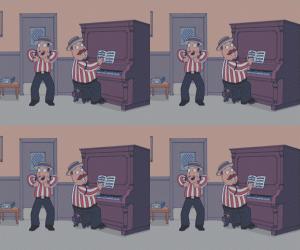
That’s not the first time that there’s been tension between musicians and technology. Back in the late 1920s and early 1930s, movies with sound were still new. Most films were “silent films” with the dialogue appearing on screen and music performed by live musicians in the theatre, a la Vern and Johnny, the vaudeville duo from Family Guy:
Here’s an ad that talks of the dangers of using recorded music in movies instead of musicans from 1931 titled The Robot at the Helm:
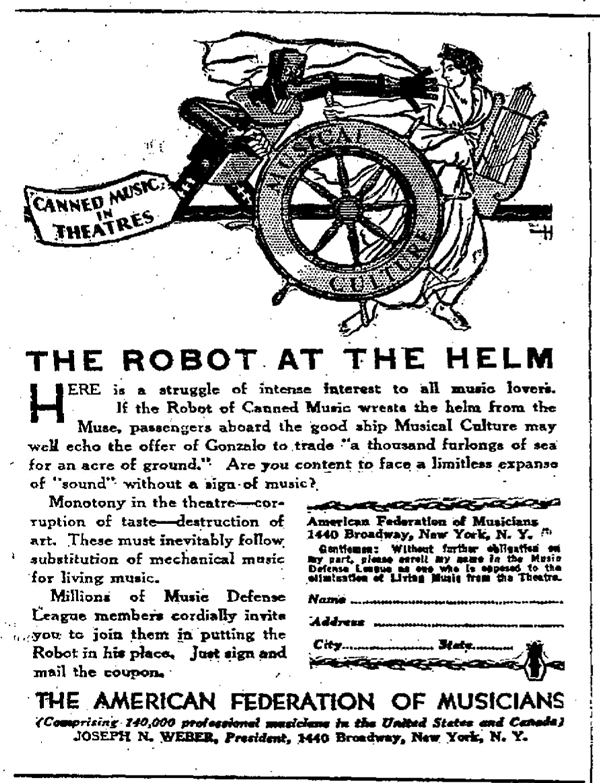
Image courtesy of the Paleo-Future blog. Click the picture to see the source article.
Here’s the text of the ad:
Here is a struggle of intense interest to all music lovers. If the Robot of Canned Music wrests the helm from the Muse, passengers aboard the good ship Musical Culture may well echo the offer of Gonzalo to trade “a thousand furlongs of sea for an acre of ground.” Are you content to face a limitless expanse of “sound” without a sign of music?
Monotony of the theatre — corruption of taste — destruction of art. These must inevitably follow substitution of mechanical music for living music.
Millions of Music Defense League Members cordially invite you to join them in putting the Robot in his place. Just sign and mail the coupon.
As neat as having live musicians performing in sync to films would be — and hey, there’s room for that sort of thing — if anything is killing art, I’d say it’s Hollywood’s lack of creativity.
Here are a couple of shots from a presentation made by Harmonix founder and CEO Alex Rigopoulos in which he talks about the pros and cons they considered when trying to decide whether or not to make a guitar game:
Photo courtesy of Miss Fipi Lele.
The “pro” argument is all you’d need to convince me!
Update: It [...]
The latest videogame to get featured on South Park — and lampooned a little to boot — is Guitar Hero, in an episode (in)appropriately titled Guitar Queer-o. The episode guide has this brief summary:
Stan and Kyle are hooked on Guitar Hero. But Stan’s superior skills on the video game damage his friendship with Kyle.
I’m working on an article (working title: Walled Garden…or BEER Garden?), so here’s something to keep you amused in the meantime…
My Obsessions, Circa 1980
Photo courtesy of Miss Fipi Lele.
The “Star Wars Trumpet” Video
Well, I can’t make a reference to Battlestar Galactica (the 80’s version) without making one to Star Wars, can I? How ’bout the [...]
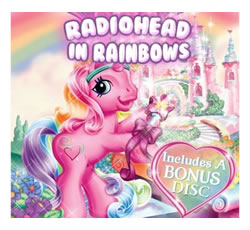
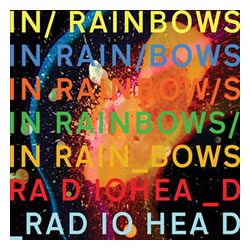
You’ve probably heard of Radiohead’s latest album, In Rainbows. They’re bypassing the record industry, and you can buy it directly from them, either as an audio CD or as downloaded MP3s. For those of you who have downloaded or ripped the album, here’s the album art for your enhanced listening enjoyment!*
Image courtesy of Miss Fipi [...]
A refrain we use quite often here at Global Nerdy is that Microsoft’s consumer offerings make you feel as though you’re dining from the table scraps from the dumpsters of the customers they really love: corporate drones running Office, Exchange and SQL Server. However, there are a couple of bright spots in their more recent [...]
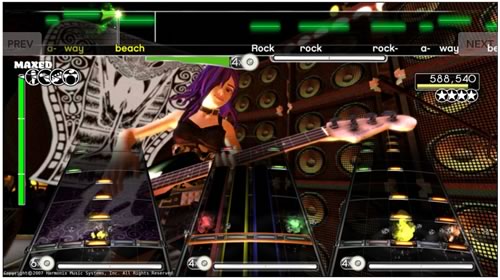
Screenshot from Rock Band. Click to see the screenshot on its original page at full size (it’s huge).
Let me get the tiny bit of disappointment that I have with the upcoming game Rock Band out of the way first: What? No keyboards? They’re the most computer-ready interface devices to make! You suck.
That little gripe aside, [...]
That’s the answer, courtesy of an Engadget interview with Apple VP Phil Schiller. Strangely enough, some thanks goes to those enemies of fair use, the RIAA:
Well, the RIAA wanted to be able to distribute ringtones of its artists without having to pay them big money to do so (surprised?), and it won a decision last [...]
Here’s an infographic explaining how a record gets leaked from a Spin article titled Days of the Leak:
Click the image to see it at full size.
According to the infographic, there are a number of opportunities for an album to make it into the public’s hands between its completion and release:
A Brief History of Payola
See the gentleman on the left? That’s Alan Freed, the “Father of Rock and Roll”. As a radio DJ and music television show host in the 50’s, he popularized the term “Rock and Roll”, turning it from an obscure euphemism for sex into a household phrase for a music genre. He [...]