Welcome Daring Fireball readers! In case you were wondering if I’ve prepared a response to the article titled The Types of Companies that Publish Future Concept Videos, take a look here.
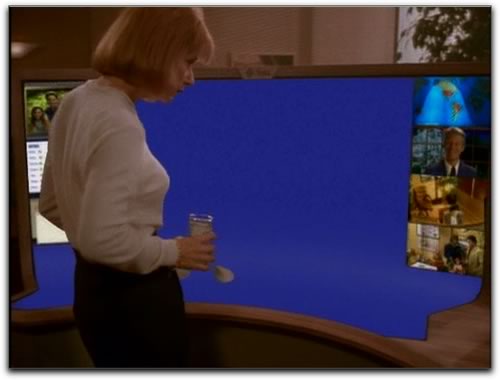
Pictured above is Microsoft’s most recent technology concept video. Here’s their description:
Watch how future technology will help people make better use of their time, focus their attention, and strengthen relationships while getting things done at work, home, and on the go.
As you might expect, John “Daring Fireball” Gruber, who’s often been called Apple’s freelance PR guy, viewed it with a jaundiced eye:
This video encapsulates everything wrong with Microsoft. Their coolest products are imaginary futuristic bullshit. Guess what, we’ve all seen Minority Report already. Imagine if they instead spent the effort that went into this movie on making something, you know, real, that you could actually go out and buy and use today.
Of course, he’d never say such a thing about Apple’s classic Knowledge Navigator video, which at the time it was made – circa 1987, when the Macintosh II and SE, IBM PS/2 series and Amiga 500 and 2000 were brand new machines – was at least as pie-in-the-sky as this newest Microsoft video. It’s contained within one of the segments of the video below, which features videos by Apple:
Now I’ll agree with Gruber that by and large, Apple technology is generally more enjoyable to use and feels more like “the future”. I will also agree that my former employer, whom a former coworker recently referred to as “The Fail Ship Microsoft”, seems a shadow of its former self and far less likely to be the company to create future industry-defining products than Apple — or at least the incarnation of Apple with Steve Jobs as Chief Tastemaker. Today’s Microsoft doesn’t have a keeper of the vision: Bill Gates has left to focus his on saving the world, Ray Ozzie, the guy who took on the role of “chief visionary” at The Empire, resigned last year along with the Entertainment and Devices division’s last, best hopes, Robbie Bach and J Allard. The people who remain are extremely skilled techies, astute suits who can continue to drive sales and “keep their managers’ scorecards green” (that’s a common expression within the company) and an evangelism team that’s second to none and of which I was a proud member, but they’re all hamstrung by decision-makers with the sense of vision that God gave oysters. That’s one of the reasons I left the company: to be an evangelist, you have to believe, and I didn’t believe anymore.
I part ways with Gruber in his declaration that Microsoft should spend more effort making some cool stuff today and less on creating concept videos. Concept videos aren’t promises of products coming in the next one or two years, but act as a star by which people can navigate the future and an inspiration to invent it. Working with technology means dealing with overwhelming amounts of minutiae, and it’s all too easy to get lost in the technology for technology’s sake and forget about what it’s all for. I would argue that if Microsoft wants to rehabilitate its image and regain its relevance in the hearts and mind of both the alpha geeks and the public at large, they should probably make more of these videos, not only for the public, but for their own benefit as well. Without visions like concept videos to guide them, especially with the lack of someone in the visionary role, they may remain stuck on their current course: doing well but effectively coasting, content to make incremental improvements to already successful products or playing catch-up as with Internet Explorer, phones and tablets in efforts that are in danger of being too little, too late.
Some other concept videos worth watching include these old AT&T ads from that played all the time between shows in the early 1990s. Many of the predicted devices and services in these ads came to be, but AT&T had little to do with their creation:
Bruce “Tog” Tognazzini was a user interface guy at Apple from 1978 to 1992, after which he worked at Sun and created the Project Starfire concept video, a little drama that illustrates his vision of the office of the future. Just as Apple’s Knowledge Navigator has the 1980s all over it, this video has all the earmarks of early 1990s television, right down to the incidental synth music that’s straight out of the better, earlier seasons of Beverley Hills 90210.
Here’s part one:
The first thirty seconds of the video shows how risky it is to try and add little “realistic” touches to a story about the future. In the first thirty seconds, Princess Di is mentioned as having joined the British House of Lords; in real life, she died seven years prior to the story’s setting of 2004. Also sad is the fact that while Sun existed in 2004, it would be absorbed by Oracle six years later.
Here’s part two:
Compare the Starfire video with this “vision of the future” video that Microsoft debuted at the TechReady conference in early 2009. Popular Science said that "The 2019 Microsoft details with this video is almost identical to the 2004 predicted in this video produced by Sun Microsystems in 1992." I’ll leave it to you to make the call: