Yesterday, I posted an article positing that WeWork’s CEO might just be indirectly and accidentally responsible for drastically changing the processor industry:
The article got a record number of pageviews, and I got a number of emails and direct messages asking all sorts of questions about Arm chips, from “What makes Arm processors so different?” to “Has anyone seen an Arm-based Mac in action yet?”
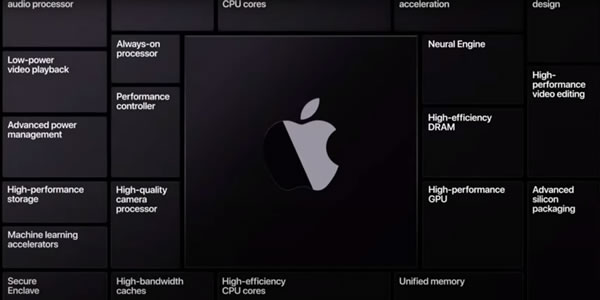
Here are some videos that should provide lots of background material to better help you understand Arm chips and Apple’s move to their own custom silicon.
Let’s start with this CNET supercut of the parts of the WWDC keynote where Tim Cook and company talk about Apple’s transition from Intel chips to their own Arm-based ones:
This is Max Tech’s best guess as to what the Arm-based Mac release timeline will look like:
Many people have a take on what Apple’s move to Arm means. Here are CNET’s top 5 guesses:
Here’s a video from a year ago that asks “Is Intel in trouble? Is ARM the future?”. It’s worth watching for its history lesson about Arm:
Here’s a really quick (under 6 minutes) look at Arm CPUs:
Here’s a more hardcore explanation of how CPUs (in general) work:
CPUs used to be stand-alone things, but we’ve been migrating to SOCs (systems on a chip) for some time. Here’s an explainer:
This Gary Explains video explains the differences between Arm’s and Intel’s architectures:
Here’s a reminder from Computerphile that Arm design chips — they don’t make them. There’s a difference:
Here’s a treat: an unboxing of Apple’s “developer transition kit”, which registered Apple developers can apply to try out to test their apps on Apple silicon. It’s a Mac Mini powered by an Apple A12z chip, which is the same processor that drives the iPad Pro.
Update: Newsy have put together a piece summarizing the tech news’ reaction to the Samsung Galaxy Note ad. It’s at the end of this article – check it out!
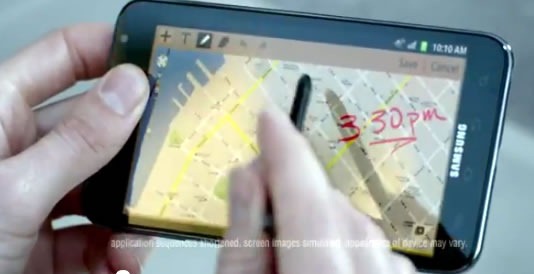
Even if you missed the big game, you can still catch the Superbowl ad for the Samsung Galaxy Note. Directed by Bobby Farrelly (one of the Farrelly Brothers, creators of high-larious films like Dumb and Dumber, There’s Something About Mary, and unfortunately, the upcoming Three Stooges Movie), it’s a continuation of the series of ads that poke fun at Apple fandom. It opens with a scenes from lineups outside Apple stores. The bored Apple fanatics are tethered to their white earbuds and awaiting their next gift from the gods when one of them sees a passer-by with a Samsung Galaxy Note.
“Whoa, whoa, whoa – what is that?” he asks.
“Here,” says the passer-by, walking towards soon-to-be-ex-Apple-worshipper. “It’s the new Samsung Galaxy Note.”
Then comes the kicker: “It’s got a pen?” That’s right: it’s bringing back the stylus, the very thing that iOS devices put out of style.
After that, the Apple fans break free of their self-imposed imprisonment in line – a line that Samsung probably wishes they had – and partying, powered by The Darkness’ hit I Believe in a Thing Called Love – ensues.
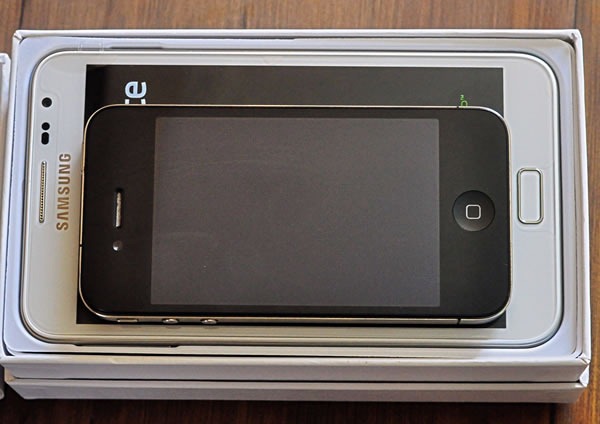
It’s a little hard to tell from the ad, but the Galaxy Note is bigger than your standard phone; in fact, it’s bigger than even the biggest of the notoriously oversized Samsung phones. Size-wise, it’s in Newton territory: smaller than a tablet, a tad too big to fit into most pockets. Perhaps they’re also trying to bring cargo pants back:
I’m reminded of this promotional photo, where Sony tried to convince you of how portable their smallest VAIO was:
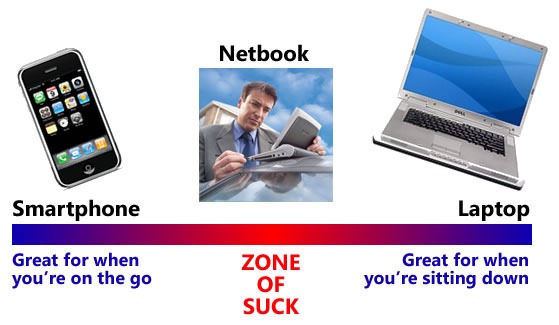
It sits somewhere in the “Zone of Suck” from my 2009 article, Fast Food Apple Pies and Why Netbooks Suck (I’m going to have to revise the graphic to include tablets as well as the Galaxy Note):
As for what it’s like to use the device, consider this review in TechInferno. The reviewer loves the Galaxy Note and says he’s never going back to an iOS device, but he damns it with his faint praise:
“Is the Galaxy Note as smooth as an iOS device? Not really, it still has the android signature stuttering when you scroll and the occasional semi-freeze here and there.”
“Is the Galaxy Note built as good as the latest iPhone? No, it is not, I think that a fair comparison would be to equal it to the build quality of the 3G/3Gs versions of the iPhone.”
“Sure you can expect some hiccups here and there, not everything is so custom tailored to the device and to bring it to full functionality you need to invest some effort but in my personal opinion this phone is worth it.”
“Who I would NOT recommend this device to:
People expect the device to “just work”
Women or men with small hands
People who like to operate the phone with one hand only.”
You know what they say about guys with big phones…
“Build quality is very good and the device feels solid in the hand althoughiPhone 4 build feels better.”
“Out of the box with all options at their defaults the device will eat through the 2500mA/h battery in less than 10 hours of normal usage.”
“The stylus needs a fair amount of pressure to operate, otherwise it doesn’t work.”
“I still haven’t found a keyboard that matches the precision of the iPhone, i can’t type as fast but maybe it’s a matter of getting used to it?”
“I keep accidentally pushing the Back or the Menu buttons especially in landscape mode when trying to type/interact with the screen – a big design flaw.”
“Expect surprised looks from people around when you put it to your ear to talk. It really does look a bit ridiculous, almost like holding an iPad to your ear.”
“The text to speech compared to Siri is awful.”
“Keep in mind that Ice Cream Sandwich update for the Note is around the corner and is expected to fix a lot of issues listed here and introduce lots of neat features.” That, and the Lord Jesus Christ is due back any day now, so look busy!
I think I’ll be sticking with my iPhone 4S and iPad 2 a little while longer, thanks.
After Shit Silicon Valley Says comes Shit Programmers Say. There’s a swear word at the end, so if you’re at an office that doesn’t tolerate salty language, make like the programmers in the video and switch to headphones!
I guess this is a lesson to people who make long-form ads with only music and no voice-over: someone’s going to take your ad and add their own, just like the YouTube user known as “Raboneable”, who did just that with the ad for Asus Eee Pad Transformer. Watch the video above and enjoy the lulz.
"Wat" is also the title of a funny demo of Ruby and JavaScript oddities presented by Gary Bernhardt at CodeMash 2012, a rather unlikely tech conference — it takes place in Sandusky, Ohio, in Ohio’s largest indoor waterpark. (If you just said "wat" right now, you’ve used the word correctly.)
In the video, you see this classic wat bit about undefined variables and assignment in Ruby:
You’ll also marvel at the way JavaScript treats (array + array) vs. (array + object) vs. (object + array) vs. (object + object):
Watch the video, and wait for that final slide, which is pure, hilarious wat!
HTML5/CSS guru, prolific webcaster and blogger, banjo player and all-round International Man of Mystery Chris Coyier is one of my fellow BarCamp Tour members and a friend of Shopify. He joined our friends at Wufoo, makers of web forms par excellence, who have since been acquired by SurveyMonkey.
If you get the chance to catch Chris at one of the upcoming BarCamps on the BarCamp Tour, do it! He’s a great presenter with lots of teach and an entertaining style in which to teach it. You can get a taste of a Chris Coyier presentation at CSS Tricks, where his 101st screencast, Let’s Suck at Github Together, walks you through Github with very little pain.


 You know what they say about guys with big phones…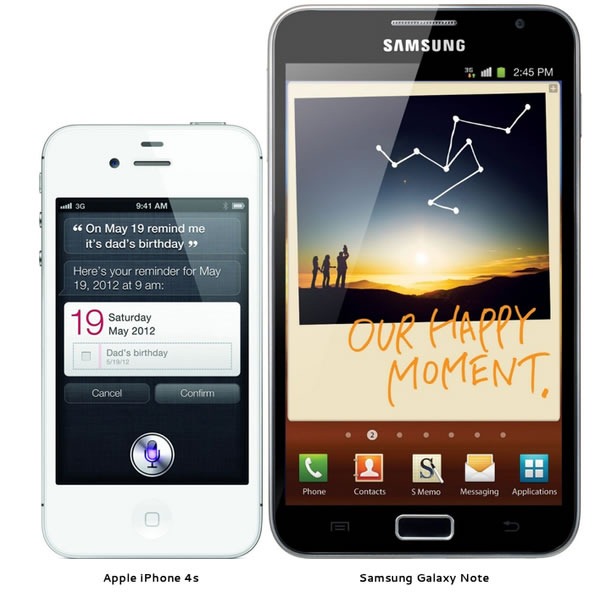
 After
After