
Makes sense.

Makes sense.

It’s happening today only — Wednesday, February 10, 2016 — but if you’ve got a Google Account, they’re offering 2 GB of free additional space on your Google Drive, just for double-checking the security on your account. Who these days can’t use an additional 2 GB of online accessible-anywhere storage space and the peace of mind from an account whose security credentials are up to date?
To take advantage of this offer, point your browser to Google’s Security Checkup site (if you’re not already logged into a Google account, you’ll be asked to do so). You’ll be taken to a page where you’ll be asked to confirm three different categories of security information:
I went through the process just now, and for less than half a minute’s worth of effort, I walked away with an extra 2 GB of cloud storage. Kudos to Google for incentivizing good security on online accounts. Now go, secure your Google account, and get some extra free storage!
It’s that time of year again: Tampa Bay Startup Week! The tech/entrepreneurial event, which this year runs from today, Monday February 8th, through Friday, February 12th, is focused on bringing techies, creatives, and entrepreneurs together to bring them together, provide ideas and inspiration, and help grow the city’s self-starter business scene.
You may not think of Tampa as an entrepreneurial hotspot, but according to the 2015 report of the Kauffman Index of Startup Activity for Metropolitan Areas, the Tampa/St. Petersburg/Clearwater area’s in top 25 (ranked #20), and ranked ahead of places you’re more likely to associate with entrepreneurship, including:
Chase doesn’t sponsor just any city’s Startup Week. To qualify, it’s got to meet the criteria of density, government regulations, culture, talent, and access to said talent. In Money’s 2015 roundup of the 5 best big cities, they named Tampa the best city in the southeast. It’s got great weather, an airport that punches above its weight class, low cost of living (moving here was like getting a big raise, there’s no state income tax, the median house price is $122K), and as I’ve posited before, the “Florida Man” factor is actually a blessing in disguise:
There will be all sorts of activities this week worth checking out, from presentations on technologies such as the Internet of Things, cryptocurrency, and mobile design, to business mentoring, networking, and even an opportunity to get a new headshot for your LinkedIn profile, to fun “intro to programming” events for kids, to mingling, networking, and enjoying the city’s excellent craft beer. Be sure to check out the Tampa Bay Startup Week page, follow the Tampa Bay Startup Week and organizer @thatgirlallie’s Twitter feeds, and come on down and take part!
This article also appears in The Adventures of Accordion Guy in the 21st Century.
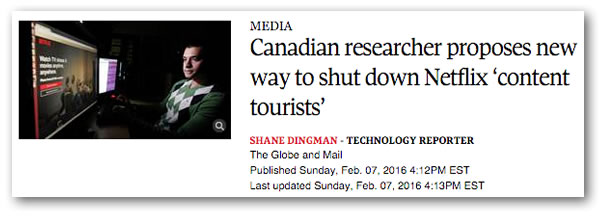
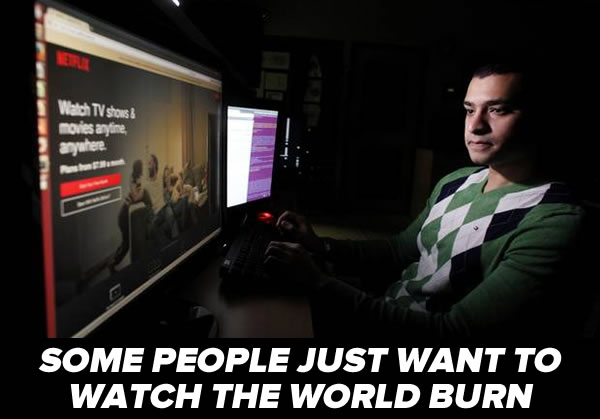
The Canadian newspaper The Globe and Mail recently published an article on AbdelRahman Abdou, a postdoctorate student at the Carleton University’s Computer Security Lab, whose work in network measurement is focused around getting a more precise fix on a user’s precise geographic location based on physical properties of the internet rather than indirect methods like using IP addresses.
The practical use of such research, as this article’s headline suggests, is that it’s a way to counter workarounds like VPNs, that people use to access streaming video services that aren’t available in their regions or countries. What the article fails to mention is that this technology will also find willing customers in repressive regimes that like to monitor, control, and limit their citizens’ access to the internet and information.
As my friend Sean Galbraith put it, “He’s going to be very popular in some awful places.”

I’m surprised that Abdou consented to a non-anonymous interview, but it’s quite possible that he thinks he is, in the words of Silicon Valley, making the world a better place, and he may not have been in a social situation where he’s had to answer the question “So what is it that you do?”.
I’ve shown the article to my friends, and the response has been the same: it’s the line that works as a replacement caption for just about every New Yorker cartoon ever made:

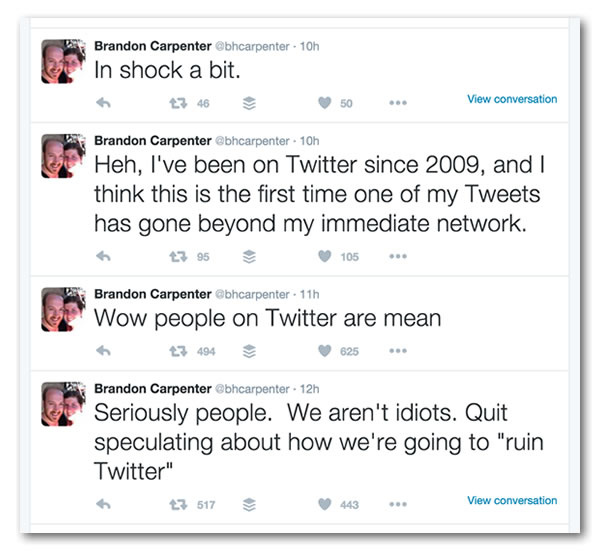
In a series of unintentionally hilarious tweets that sound more like something from an Onion article than real life, Brandon Carpenter, an iOS developer at Twitter, is getting an object lesson in what Twitter is like for the people who actually use it on a regular basis.
A quick look at his Twitter stream shows that he’s neither dumb nor short on empathy, but that he doesn’t post anywhere near as often as the sort of users who aren’t all that keen on the announced changes to the way the timeline is going to work. He certainly doesn’t post as often as I do, and in my circles, I’m sure I’m merely a moderate user. Working on one of the most heavily-used mobile apps on the market is a big cognitive load to carry, and I suspect that along with being a husband, dad, and someone who has to pay rent in San Francisco, his Twitter experience is different from those of the people who make their day, their name, or their living using it. I call this difference in experience between the people who developer applications and its heavier users “the developer-user gap”, something captured quite well in the line from William Gibson’s Neuromancer: “The street finds its own uses for things.”
The fact that the developer-user gap exists highlights an oft-forgotten role that a technical evangelist can play. Companies try to make sure that their evangelists, community managers, social media people, and the like are sending out the right message to their customers and partners, but forget that communication can work in the opposite direction. A good evangelist will make sure that users get the message, but a great one will make sure that the users’ messages get back to the company as well.
Kudos to Brandon for taking this tweet sent to him…
Don’t fuck with the one thing that people still like about Twitter then. https://t.co/PpFzfQKQib
— Nathaniel Higgins (@nathggns) February 6, 2016
…and responding with grace:
In all seriousness it’s an honor to work on a product that people feel this strongly about. https://t.co/kEOBVEwV95
— Brandon Carpenter (@bhcarpenter) February 6, 2016
It’s often a thankless job, but as a regular user of Twitter’s iOS client, thanks for all your work, Brandon. I salute you with a filet mignon on a flaming sword!
But fire up your Twitter client and use it a little more, willya? It’ll help you make a better app.

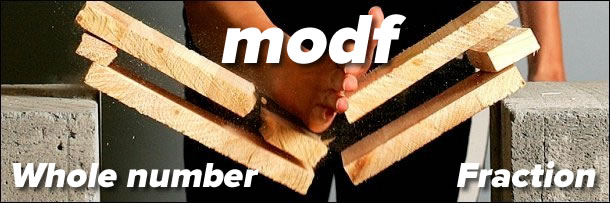
Lately, I’ve been seeing a number of half-baked implementations of a function that splits a floating-point number (Floats, Doubles, and the like) into a whole number and fraction part. For example, given the value 3.141592, it should return:
There’s no need to come up with your own implementation: there’s a function in C’s math library, and many programming languages, Swift included, give you access to it. It’s called modf, and in Swift, it works like this:
// modf returns a 2-element tuple, // with the whole number part in the first element, // and the fraction part in the second element let splitPi = modf(3.141592) splitPi.0 // 3.0 splitPi.1 // 0.141592
Since C doesn’t have a tuple type, you call modf differently. Here’s the function’s signature:
double modf(double x, double *integer)
Its return value is the fractional part, and the whole number value is put into an extra variable whose address you provide. If you’re working in Swift and feeling homesick for the pointer-y stuff you have to do in C, you can call modf this way:
var wholeNumberPart: Double = 0.0 let fractionalPart = modf(3.141592, &wholeNumberPart) fractionalPart // 0.141592 wholeNumberPart // 3.0
But seriously: do it the first way. It’s more Swift-like (Swift-esque? Swifty?).
Click the photo to see it at full size.
“Well, the Empire doesn’t consider a small one-man fighter to be any threat, or they’d have a tighter defense. An analysis of the plans provided by Princess Leia has demonstrated a weakness in the battle station. But the approach will not be easy. You are required to maneuver straight down this trench and skim the surface to this point. The target area is only two meters wide. It’s a small thermal exhaust port, right below the main port. The shaft leads directly to the reactor system. A precise hit will start a chain reaction which should destroy the station. Only a precise hit will set off a chain reaction. The shaft is ray-shielded, so you’ll have to use proton torpedoes.”
Click the photo to see it at full size.
For those of you who don’t remember the film, here’s the original still:

Click the photo to see it at full size.
For those of you who are insatiably curious (and hey, if you’re reading this blog, the odds are good that you are), here’s Larry Cuba explaining how he made the computer graphics for the Death Star briefing in Star Wars. Remember, this was the 1970s!