Categories
Uncategorized

40% off 128GB SanDisk microSD card – Was $100, now $60 until August 30th

sandisk microsd card sale

Here’s your deal of the day! If you’ve wanted to dramatically increase the storage on your Android device, needed to shoot a lot of video on your digital camera, or needed extra drive space on your laptop but don’t want to lug an external hard drive around, this deal’s for you. From now until the end of August 30th, Amazon has taken 40% off the $100 price tag for the older version of SanDisk’s Ultra 128GB UHS-I/Class 10 microSDXC memory card, knocking its price down to a mere $60. The card comes with an adapter so that it’ll fit into full-sized SD card slots (like those in your laptop or digital camera) as well as in microSD card slots like those in your Android smartphone or tablet.

Note that this is SanDisk’s older model of 128GB microSD card, with a maximum read speed of 48MB per second (and you can assume the write speed is slower). The newer model, which boasts a faster read speed of up to 80MB/second, normally sells for $150 and is currently listed on Amazon for $110.

Categories
Uncategorized

[Updated] “Dark Mobile” webinar with Enterprise Mobile: September 29th

dark mobile

On Tuesday, September 29th at 1:00 p.m. eastern (10:00 a.m. Pacific), GSG and Enterprise Mobile will host a webinar titled The Secrets Nobody Tells You About Dark Mobile. It’s free to attend, and you can register here.

In this webinar, Enterprise Mobile’s VP Sales Jay Gordon and GSG’s Platform Evangelist Joey deVilla will talk about that area of an organization’s mobile telecom environment that goes, unobserved, unknown, or unmanaged — the terra incognita that we call “Dark Mobile”. We look at the negative effects it has on a company’s…

  • spending,
  • management,
  • security, and
  • efficiency

Join us in this quick webinar (it’ll be about half an hour) as we look at the four kinds of Dark Mobile and how we can shed some light into this crucial area of your IT environment.

this article also appears in the GSG blog

Categories
Uncategorized

Alphabet explained

This chart is the quickest way to explain the companies under Larry Page and Sergei Brin’s new holding company, Alphabet:

alphabet explained

Click the graphic to see it at full size.

Categories
Uncategorized

Alphabet: Because “Umbrella Corporation” was already taken

umbrella corporation

I’ll bet their original motto was also “Don’t be evil”.

Larry Page has just announced that he’s creating a new holding company called Alphabet. In the latest post on Google’s official blog, he writes:

What is Alphabet? Alphabet is mostly a collection of companies. The largest of which, of course, is Google. This newer Google is a bit slimmed down, with the companies that are pretty far afield of our main Internet products contained in Alphabet instead. What do we mean by far afield? Good examples are our health efforts: Life Sciences (that works on the glucose-sensing contact lens), and Calico (focused on longevity). Fundamentally, we believe this allows us more management scale, as we can run things independently that aren’t very related. Alphabet is about businesses prospering through strong leaders and independence. In general, our model is to have a strong CEO who runs each business, with Sergey and me in service to them as needed. We will rigorously handle capital allocation and work to make sure each business is executing well. We’ll also make sure we have a great CEO for each business, and we’ll determine their compensation. In addition, with this new structure we plan to implement segment reporting for our Q4 results, where Google financials will be provided separately than those for the rest of Alphabet businesses as a whole.

Alphabet’s site is located at the clever URL abc.xyz:

alphabet web site

…which makes it the second .xyz domain I know. Here’s the first:

hooli xyz site

Categories
Uncategorized

If the Titanic sank today…

…the scene might look something like this:

if the titanic sank today

Click the graphic to see it at full size.

The illustration was created by Pierre Brignaud. It won third place out of 200 submissions to the visual arts contest for the Montreal-based Just for Laughs comedy festival.

Does anyone know what won second and first place?

Categories
Uncategorized

Big internet numbers

Still the biggest slice of the IT budget pie
largest-slice-of-the-it-pie-2015-07

Click the infographic to see it at full size.

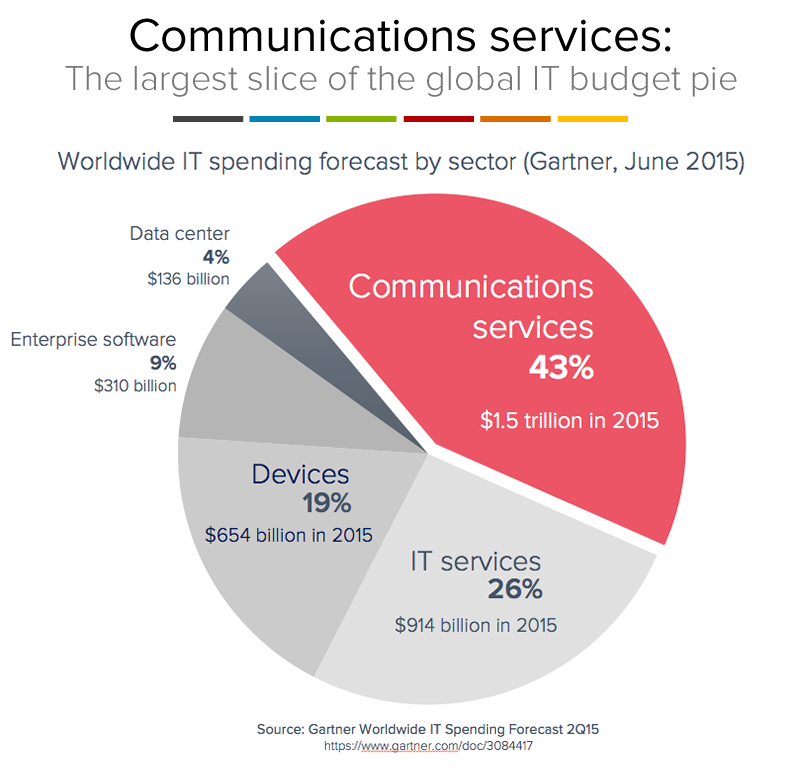
Communications services will remain the largest part of the global IT budget, according to Gartner’s 2Q 2015 Worldwide IT spending forecast. They predict that it will account for $1.5 trillion, or 43% of the total $3.5 trillion expected to be spent on IT this year. Compared to the other segments, communications services’ share is:

  • 40% larger than the next-largest segment, IT services
  • More than twice the amount spent on devices, including mobile devices
  • Over four times the share taken by enterprise software
  • More than ten times the spend for data centers

Gartner reports that global IT spending in 2015 will be 5.5% lower than in 2014. Their analysts say it’s due to the rising U.S. dollar, and if you look at the figures in “constant currency” terms — that is, if you account for the fluctuations in exchange rates — the market is expected to grow by 2.5%. Changes in the value of the US dollar relative to other currencies affect all manner of spending worldwide, and IT is no exception. Vendors who place a high priority on protecting their margins adjust their pricing in in response to currency fluctuations, which in turn affects IT purchase decisions worldwide.

Gartner’s report also points out that of the five IT spending segments, communications is experiencing the strongest decline. They attribute this to price erosion and an increasingly competitive market.

Wired broadband: Speeding up steadily
The-need-for-broadband-speed

Click the infographic to see it at full size.

If you’re reading this article, the odds are pretty good that you’re doing so with the aid of wireline broadband. Even if you’re reading this with your mobile device, you may be doing so through one of the 50 million publicly-accessible wifi hotspots worldwide, or through your office or home wifi access point (of which there are hundreds of millions —161 million wifi base stations were shipped in 2013).

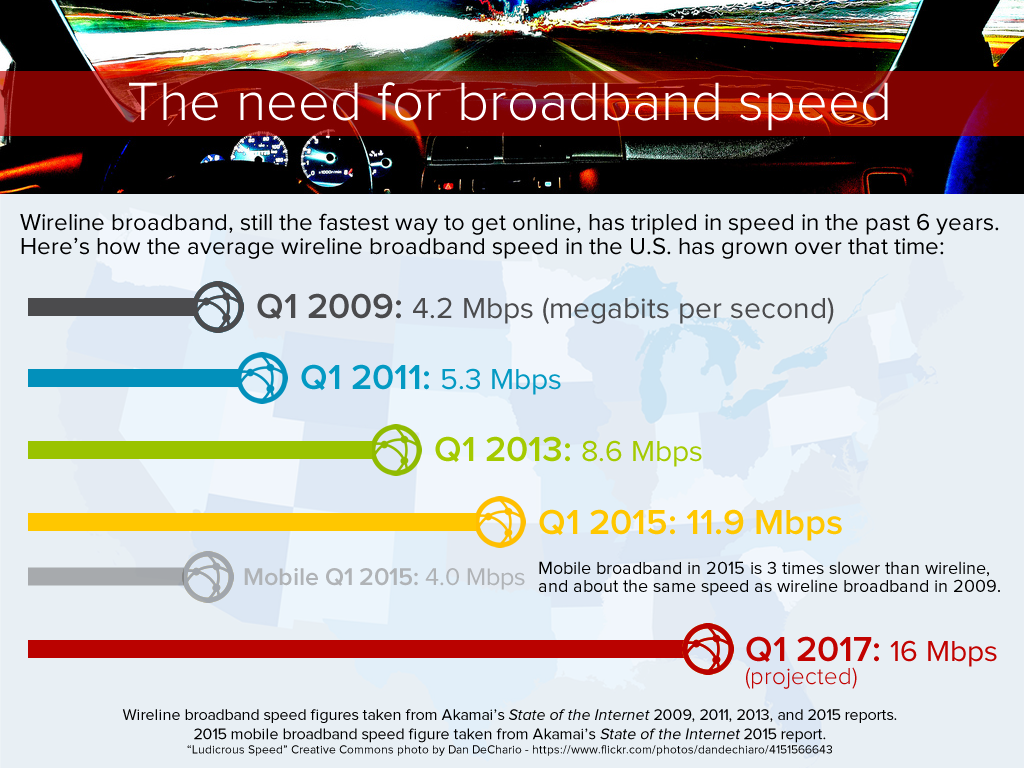
According to Akamai’s Q1 2015 State of the Internet report, wireline broadband speeds in the U.S. have tripled since 2009. In 2009, the average speed was 4.2 Mbps (megabits per second), and as of the first quarter of 2015, if Speedtest.net reports that your connection is faster than 11.9 Mbps, you’re doing better than the present average.

On average, wireline broadband is three times faster than cellular broadband, whose average speed in the U.S. is 4.0 Mbps. In other words, average cellular broadband speed today is the same as 2009’s average wired broadband speed. That makes for yet another dimension where 2015’s mobile devices have specs similar to 2009’s middle-of-the-road laptops.

In case you were wondering what these speeds mean in practical terms, the table below should help put things into perspective:

Speed
(in Mbps)
Email a picture
(1.5 MB, or
12 million bits)
Download a song or long PowerPoint presentation
(8 MB, or 64 million bits)
Download an ebook or short video
(20 MB, or 160 million bits)
Download a 720p TV 30-minute TV episode
(500 MB, or 4 billion bits)
20 less than 1 second <4 seconds 8 seconds 3.5 minutes
10 2 seconds 7 seconds 16 seconds 7 minutes
5 3 seconds 14 seconds 32 seconds 13 minutes
1 12 seconds 64 seconds 160 seconds 1 hour

On the edge of the zettabyte era

the-zettabyte-era

Click the infographic to see it at full size.

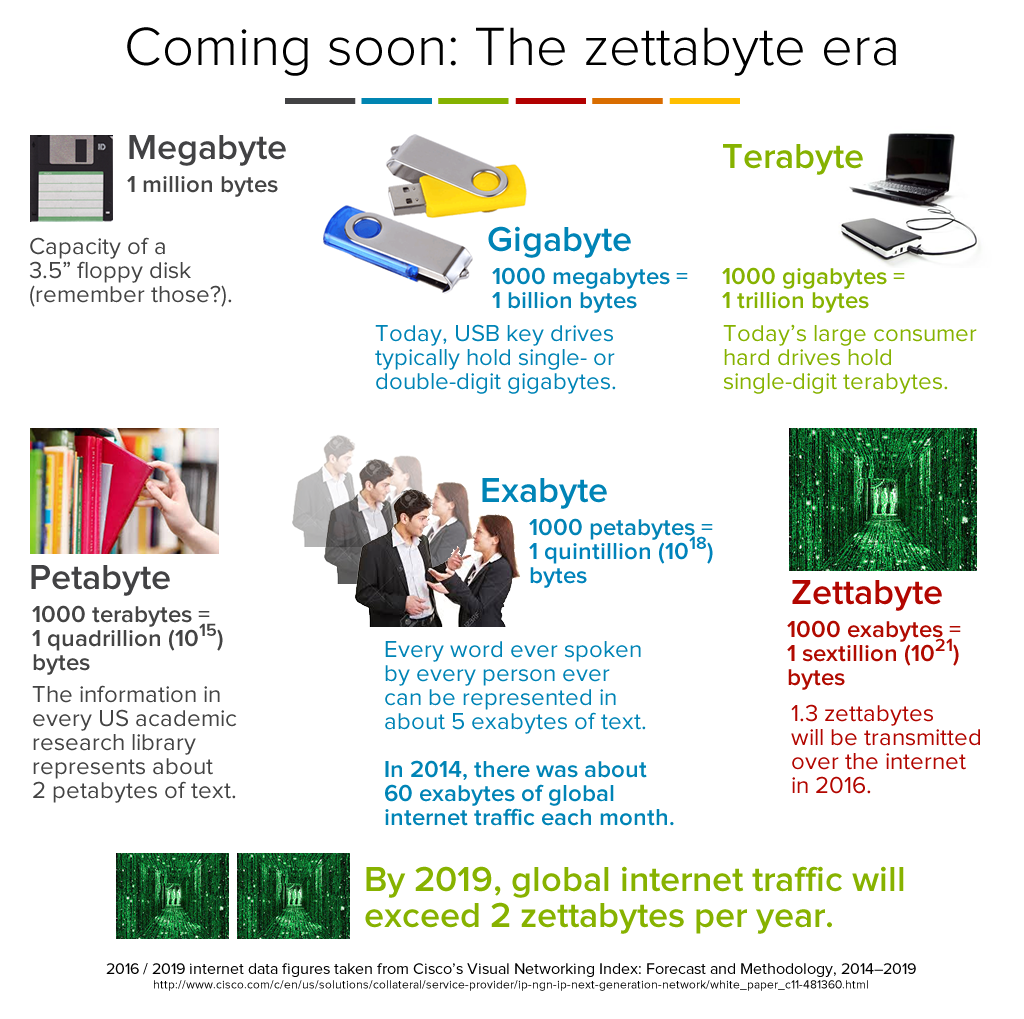
The faster the internet becomes, whether in wireline or wireless form, the more data we’ll send and receive. According to Cisco’s Visual Networking Index: Forecast and Methodology 2014 – 2019 report, global internet traffic has grown by over five times in the past five years. The next five years should continued growth at a slightly slower pace — about three times.

This growth has led us to the point that the total amount of data sent over the net this year can be measured in hundreds of exabytes, where an exabyte is 1 quintillion (1018) bytes. Next year, that amount will cross over into the next “illion”: in 2016, it’s expected that 1.3 zettabytes (where a zettabyte is a thousand quintillion, or 1021 bytes) will be transmitted over the net. We’ve included the infographic above to help you get a better grasp of the size of these numbers.

You can be certain that network carriers are planning for this growth, and you should be doing the same.


this article also appears in the GSG blog

this article also appears on the enterprise mobile blog

Categories
Uncategorized

Yours Truly in “Canadian Business” magazine: How to talk to the IT department

how to talk to the it department

Photo by Tamera Kremer. Click the photo to see it at full size.

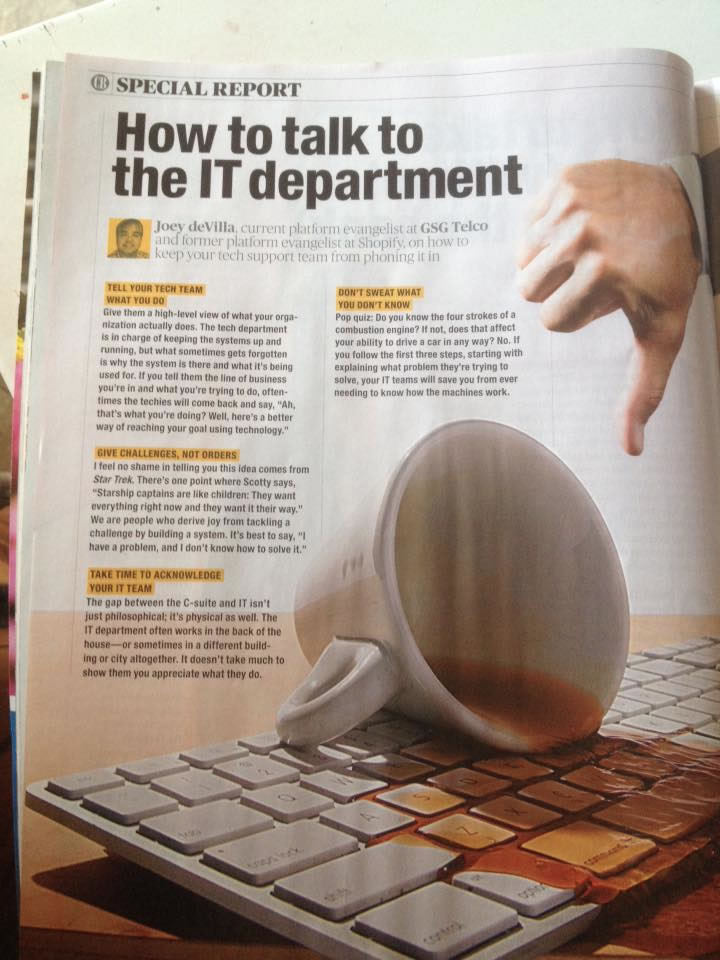
A few weeks ago, I did a phone interview with David Fielding, an editor at Canadian Business magazine, who was working on a quick piece that would be titled How to Talk to the IT Department. The end result is the one-pager pictured above, which appears in the July 2015 issue.

Unfortunately, at the time of this writing, the article isn’t posted online in Canadian Business’ How-To section. Here’s the text of the article:

How to talk to the IT department

Joey deVilla, current platform evangelist at GSG Telco and former platform evangelist at Shopify, on how to keep your tech support team from phoning it in

Tell your tech team what you do. Give them a high-level view of what your organization actually does. The tech department is in charge of keeping the systems up and running, but what sometimes gets forgotten in why the system is there and what it’s being used for. If you tell them the line of business you’re in and what you’re tying to do, oftentimes the techies will come back and say, “Ah, that’s what you’re doing? Well, here’s a better way of reaching your goal using technology.”

Give challenges, not orders. I feel no shame in telling you this idea comes from Star Trek. There’s one point where Scotty says “Starship captains are like children: They want everything right now and they want it their way.” We are people who derive joy from tackling a challenge by building a system. It’s best to say “I have a problem, and I don’t know how to solve it.”

Take time to acknowledge your IT team. The gap between the C-suite and IT isn’t just philosophical; it’s physical as well. The IT department often works in the back of the house — or sometimes in a different building or city altogether. It doesn’t take much to show them you appreciate what they do.

Don’t sweat what you don’t know. Pop quiz: Do you know the four strokes of a combustion engine? If not, does that affect your ability to drive a car in any way No. If you follow the first three steps, starting with explaining what problem they’re trying to solve, your IT teams will save you from needing to know how the machines work.

In case you were wondering about the four strokes in a four-stroke engine, they are: intake, compression, ignition, exhaust, or as any biker will tell you:

suck squeeze bang blow