For your lazy (or perhaps not-so-lazy…maybe you’re hitting that Erlang book — and good for you if you are!) Sunday reading, here are some Google stories for your enjoyment.

The Google Way: Give Engineers Room - A New York Times article in which Google software engineer Bharat Mediratta talks about the “Google 20%” — the portion of their working time in which they are encouraged to work on something company-related that interests them personally.
For another Googler’s notes on the 20%, see Joe Beda’s oft-cited blog entry, Google 20% Time.
Google Execs Really Do Hate Evil: It’s a tiny part of a roundup of the last day of O’Reilly’s Web 2.0 Summit that took place in San Francisco this past week, but it’s interesting:
During a panel of former Google employees, they confirmed to moderator and conference chair John Battelle that, yes, Larry Page and Sergey Brin do factor heavily into business and technology decisions whether they will have evil consequences.
Google likes to think of itself as “crunchy” – wholesome and worthy – and, walking into the Googleplex, it looks, at first sight, a pretty crunchy kind of place. There’s free coffee and muesli in the No Name breakfast cafe. Everyone gets around the campus on free bicycles. In the car park, the canopies that protect the neat ranks of hybrid Toyota Priuses from the sun are made from solar panels that power each building in the 1.5-million-sq-ft complex. There are swimming pools, massage chairs and free medical checkups. A model of Sir Richard Branson’s SpaceShipTwo prototype commercial spacecraft hangs from the rafters in the lobby. This is rocket science, after all.
…
But as it prepares to celebrate its 10th birthday, Google has developed serious engine trouble. A series of missteps have left it facing claims that it has gone from a benign project – creating the first free, open-all-hours global library – to the information society’s most determined Big Brother. It stands accused of plotting some sinister link between its computers and us: that it wants, somehow, to plug us into its giant mainframe – as imagined in The Matrix or Terminator.
Google Turns Out the Lights: Google turned their home page’s background black in support of the event Lights Out San Francisco, an event in which people in the city by the bay were encouraged to turn out their lights between 8 and 9 p.m. last night.
I think the suggestion in the ad goes double if you start pointing out what’s wrong with the code (“you == understand.this? get as an object name? Couldn’t they have hired a real programmer to write the ad copy?”).
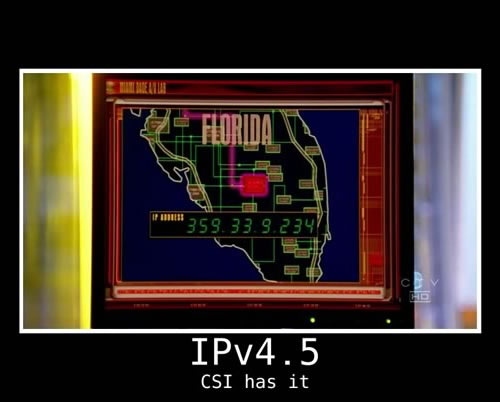
359 is the new 555
Fictitious phone numbers on many TV shows and movies begin with the number 555, which I presume is to avoid the legal hassles that arise when people try to call those numbers (I remember that a number of people whose phone numbers were actually 867-5309 had their phones ringing day and night when Tommy Tutone’s song Jenny became a hit).
The people behind the TV show CSI: Miami probably wanted to avoid similar legal trouble in an episode where an IP address was shown onscreen. I don’t think I’d go to the trouble of portscanning some IP address I’d seen on a fiction TV show, but somewhere, out there, someone just might. Hence their invention of an IP address whose first “octet” is 359. It’s IPv4.5!
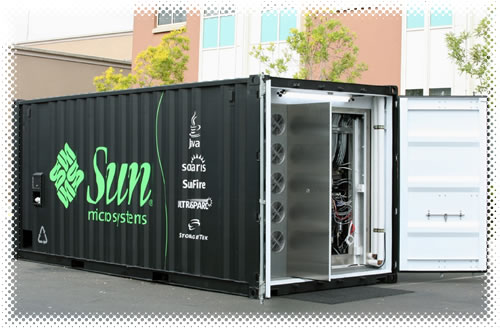
The idea of setting up a computing center in a shipping container isn’t new. Sun has Project Blackbox, “a prototype of the world’s first virtualized datacenter–built into a shipping container and optimized to deliver extreme energy, space, and performance efficiencies”. The idea is create a computing center that you could move anywhere in the world with relative ease:
If you’ve ever watch ships loading and unloading, you’ll know that nobody handles cargo containers gingerly. A shipping container full of computer equipment would have to be able to withstand a fair bit of abuse, and it looks as though the Blackbox container can take it — here’s a video of one in a simulated earthquake of a 6.7 magnitude on the Richter scale:
Sun’s not the only company working the the concept. Google have patented a similar idea. One major difference is that while Sun’s container-based datacenter would be a self-contained computing cluster, Google would treat their containers as very large rackmounts, where a container could operate on its own or as part of a cluster of other computing containers. Robert Cringely has some interesting speculation on the way Google might use these datacenters.
1337 H4X0RZ in a Shipping Container
“Invisigoth” from the X-Files episode Kill Switch
The idea of setting up a non-enterprise computing center in a shipping container isn’t new, either. Kill Switch, one of the X-Files episodes written by William Gibson, featured a hacker who went by the handle “Invisigoth” who lived and did her work in a shipping container.
The episode also featured a down-market version of a computing cluster in a shipping container: an old trailer, packed with computers, sitting in a remote field and connected to the internet through a T1 line, which was an even bigger deal back in 1998.
For the 52nd International Art Exhibition in Venice illycaffè is partnering with the Fondazione La Biennale di Venezia for the fourth time.
At the Biennale illy will provide art-lovers and coffee connoisseurs a beautiful space to relax, reflect and enjoy a perfect cup of espresso. Visitors to illymind, the rest and refreshment area founded by illy in 2003, will be introduced to the Push Button House which opens like a flower and transforms from a compact container into a fully furnished and functional space with the push of a button. View video.
After the preview at Art Basel Miami Beach, the Push Button House, a work designed by American artist-architect Adam Kalkin and redesigned for the presence of illycaffè at the 52nd International Art Exhibition, arrives for the first time in Europe.
Kalkin is known for designing comfortable spaces and placing them in unusual contexts. Visitors to the Push Button House will experience the artist’s ability to transform industrial materials into a domestic masterpiece, beautifully contrasting between the indoor and outdoor worlds, while enjoying complimentary illy espresso for a complete authentic Italian experience. The entire work was created from recyclable materials.
If I had the money, I’d take one of these things wherever I went.
I’m working on an article (working title: Walled Garden…or BEER Garden?), so here’s something to keep you amused in the meantime…
My Obsessions, Circa 1980
Photo courtesy of Miss Fipi Lele.
The “Star Wars Trumpet” Video
Well, I can’t make a reference to Battlestar Galactica (the 80’s version) without making one to Star Wars, can I? How ’bout the video that’s making the rounds right now — this so-bad-it’s-good performance of the Star Wars theme on trumpet for the “talent” portion of an old beauty pageant?
I work in TV Sports, this tape has circulated amongst our tape rooms for years, I figured it was only natural to be on YouTube. I’m of the understanding it was a statewide beauty pagaent, and Stacy is Miss Douglas County. I have no idea who she is, or if she even knew there was a talent portion of the contest.
It’s believed that the tape has origins in the Kansas City area, and I thought it was a Nebraska beauty pageant.
You’ve probably heard of Radiohead’s latest album, In Rainbows. They’re bypassing the record industry, and you can buy it directly from them, either as an audio CD or as downloaded MP3s. For those of you who have downloaded or ripped the album, here’s the album art for your enhanced listening enjoyment!*
Each user has an allotment of coins — extra coins had to be paid with cash
The scheme to make money through coin sales didn’t work — “In my experience, users will generally not pay for things.”
Across his apps — the big one being “My Aquarium” — the installed base progression was from 0 to 250,000 to 8 million installs across apps
Did not add ads until his installed base hit the 250,000 mark, and he regrets that
Why wait so long before adding advertising? He was worried that they might drive users away.
This was not the case: users are used to ads
There is a hidden upside to starting late: he didn’t get discouraged at the beginning when ad revenues would have been small.
The money he’s making covers costs of servers “definitely starting to mount”
“You really need large numbers to effectively monetize applications.”
Some demographics:
60% of the users generate of 90% of revenue
30% generate zero revenue
The country breakdown of his users:
U.K.: 20%
U.S.: 20% — These users represent the best monetization opportunities — try to increase them!
Canada: 20%
Other countries: 40%
Revenue basics:
Appsaholic (Social media) — pay per click — average $0.10/click
Adsense (Google) — pay per click — average $0.07/click
Adsense worked well with “My Garden”, since its theme tended to result in relevant ads — ads for florists and the like.
Adsense didn’t work well for “My Aquarium”, since “people don’t really send each other fish” in real life, and the ads weren’t relevant.
Incentivize your users to complete offers: give them rewards in exchange for their completing surveys, which generate revenue
Create a new want:
Most of the popular applications are entertainment-based
Revnues for apps go through a cycle: start / peak / decline / plateau
One way to avoid or at least forestall plateaus is to cycle through ads — change them up often
You have to keep putting new stuff up — both content and ads
Change things! Vary the order of ads, or run slightly different ads — any variation helps!
What else?
Cross-promote other apps in your app to generate new users — he does this
In his experience — he can deliver 50,000 installs for other apps because of his user base
If your app is a good fit, you have the opportunity to do custom advertising with large brands — such as the “Zombies” app, which got sponsored by Resident Evil
Use A/B testing to maximize revenue — show 2 different variations of an ad — see which performs the best
Selling your app
No major acquisitions just yet
There was talk of the “Where I’ve Been” app getting bought, but it hasn’t happened yet
Expect to get $1 per installed user or $10 per daily active user
You should:
Have a base of banners
Build incentivizable offers
Get surveys through affiliate networks
Note that a lot of offers are not incentivizable
Up until a week and a half ago — all users on 1 app server and 1 DB server
There are 10 rendering servers for Flash and jpegs
What his time to market? “Keep it to a week. More than a week? The odds of failure go up dramatically.”
How long to 250,000 users? “2 weeks”.
How long to 8 million users? “Been doing this for 3 months now.”
His operating costs? For servers — $2,500 a month
Secrets of PayPal interface used by Gift Cards Facebook Application (Steve Pritchard)
Background
His “Gift Cards” application was a convergence of business opportunities:
He had a Toronto business associate with abundance of gift cards to give
Toronto has a high density of active Facebook users (remember, it’s the #2 Facebook city after London)
Obvious application fit for his business
The application cried out for PayPal interface
Wanted to offer a simple payment scheme
Wanted to avoid complex HTTPS interactions
“Challenged by the challenge”
Challenges
PayPal data does not fit on Facebook Canvas
Required pop-up window
Had to be done with IFRAME; and the canvas and IFRAME cannot communicate
PayPal pop-up window must have specified dimensions
Have to update canvas under all PayPal termination conditions
Had to sync 3 threads on 4 subsystems
Solutions
Solution: Get user to click twice:
First click to start the PayPal/Facebook sync loop
Second click to open the PayPal pop-up window
Gift Cards server mediates
Again, a click-twice user interface:
First click to start Facebook canvas polling cycle
The canvas’ PayPal “checkout” button is replaced with an IFRAME version
Then, the intermediate step of asking user to confirm amount
Generates 2nd click
Q & A
How long did it to develop? “I was learning Facebook, I was learning Paypal…so about a week.”
Here’s part 2 of my notes from last night’s FacebookCamp Toronto 2 sessions. In case you missed part one, it’s here.
Building an App for Your Brand (Janice Diner and Michael Scissons, Segal Communications)
Segal Communications:
What they do: “Create experiences that help companies build brands and generate sales”
Showed video of Segal’s work:
Club kids
Hip hop soundtrack
Images of events and apps
Split it — testimonials
The advertiser’s view:
Brands are either on Facebook or thinking about getting on Facebook
They still get some calls along the lines of: “I want my ad put on people’s profiles”
They work with brands to figure out “how to engage in this space”
Facebook applications
Top 44 apps = 200M installations
16M daily active application users
Brands have these advertising options on Facebook:
Sponsored stories
Graphical ad units (a.k.a. “banners”)
Sponsored groups
Flyers
Branded app dev
Estimates:
100s of millions of dollars have already been spent by brands on Facebook (source: eMarketer)
It is expected that $1 billion will be spent by brands on Facebook by the end of 2009 (source: eMarketer)
There are more than 41 million active Facebook users
Inroducing Janice: Creative Director
She’s been “playing w/ brands on Facebook for close to a year”
Apps engage users in a number of ways, among them:
Social experience
Personal publishing
Branded apps they’ve worked on include:
A “Rock Paper Scissors” game for Red Bull called Roshambull
A political views survey for the Washington Post called The Compass
A college roomate expense-sharing assistant for TD Canada Trust bank called Split It
Brand Social Network
The idea is to link a brand to an experience that is social in nature
How? By connect brands with Facebook’s social graph
The hope is to create community of “brand ambassadors”
Brand opportunity
Facebook presents a new opportunity to connect brands with consumers
It may also present new revenue models
There aren’t many branded apps yet
Many are still in development
Red Bull’s Roshambull app:
360,000 installs
For the day of October 6th, 7000 people played it
“Our goal was to create an app that users would enjoy having on their profiles and would want to share with their friends”
Washington Post’s The Compass
A “political compass”-style app
TD Canada Trust’s Split It
Aimed at students, who have a hard time asking for/sharing money
Allows students sharing a residence to track expenses and split bills on Facebook
Launched August 2007, still looking to build user base
Brand apps get consumers talking:
More and more companies will be designing their own Facebook apps
Designing and spreading an app requires a unique set of skills
Success requires a solid understanding of consumer needs and wants
Segal: “Helping brands develop the ideal Facebook advertising solution”
Marketing Your Application Inside Facebook (Roy Pereira)
At the last FacebookCamp Toronto, Facebook rep Megan Marks said that there were “at least 12 different touch points for your application inside Facebook”.
What are these 12 ways?
Simple Advertising
Banners
Flyers (very cost-effective)
Sponsored news stories
Sponsored groups
Advertising in other applications
Banners in applications
Ads in profile box
Application Directory (”The boring way” / “Like going through the telephone book”)
What you say in the description, the name of your app, the icon — all go a long way
In Paul Graham’s latest essay — Why to Move to a Startup Hub (I don’t know why, but the title sounds a little “English as She is Spoke”, doesn’t it?) — he explains his reasons for stating that startups would do better if they moved to Silicon Valley. This is in spite of the fact that Boston is his home (and the home of his startup funding company, Y Combinator) half the year:
Y Combinator alternates between coasts every 6 months. Every other funding cycle is in Boston. And even though Boston is the second biggest startup hub in the US (and the world), we tell the startups from those cycles that their best bet is to move to Silicon Valley. If that’s true of Boston, it’s even more true of every other city.
Among Graham’s reasons for startups to move to the Valley:
Silicon Valley is a tech center. Just as you’d want to move to New York or L.A. to launch your entertainment company, you want to move to the Valley to launch your tech company.
Silicon Valley-based investors are more aggressive. Consider Facebook’s case: “Facebook was started in Boston. Boston VCs had the first shot at them. But they said no, so Facebook moved to Silicon Valley and raised money there. The partner who turned them down now says that ‘may turn out to have been a mistake’.”
The concentration of tech in Silicon Valley is also a plus: “In addition to the concentration that comes from specialization, startup hubs are also markets. And markets are usually centralized. Even now, when traders could be anywhere, they cluster in a few cities. It’s hard to say exactly what it is about face to face contact that makes deals happen, but whatever it is, it hasn’t yet been duplicated by technology.”