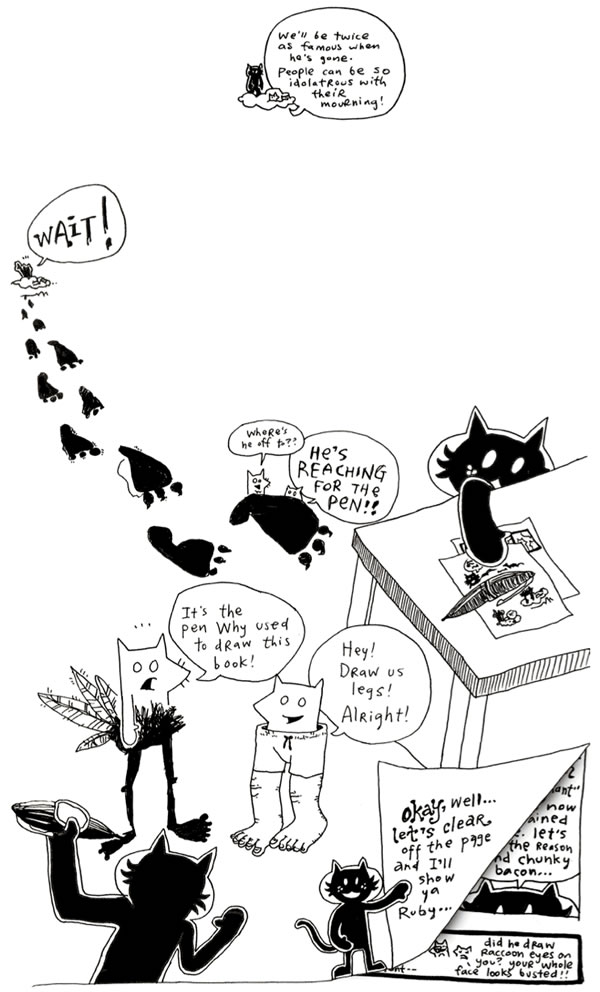
Today, August 19th, is “whyday.” It’s been a while since anybody’s made a fuss about this day (as far as I know), but I still think it’s a day worth celebrating, even in little ways. I’m performing a couple of whyday rituals today, and perhaps after reading this, you will too.
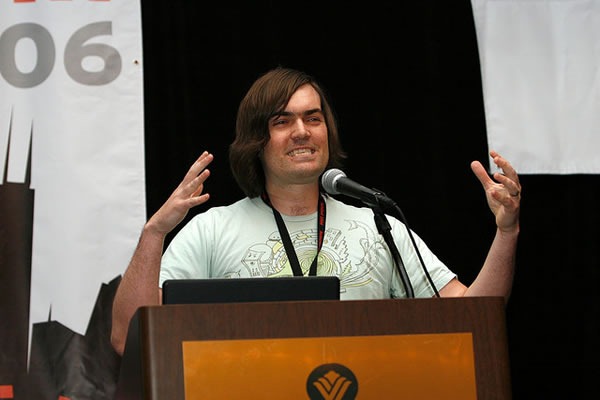
It’s called “whyday” after the programmer / artist / author / musician who went by the name “why the lucky stiff.” why the lucky stiff is a long name to keep saying (or typing) over and over, so we referred to him as why in spoken word, or _why (and yes, the leading underscore is intentional) in writing.
why’s (poignant) guide to Ruby
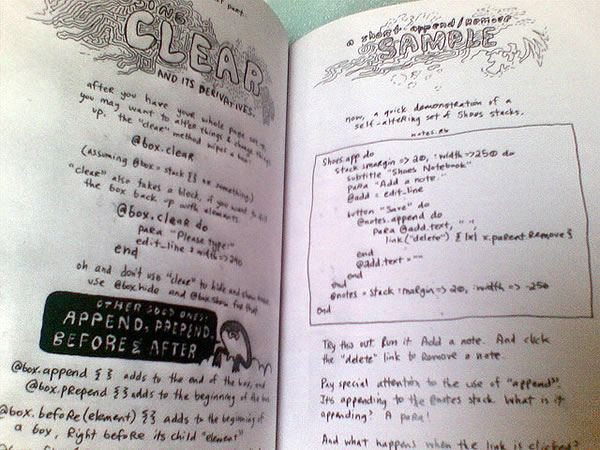
_why is best known for an odd little ebook titled why’s (poignant) guide to Ruby, which he published in 2004, and is quite possibly the most whimsical book about a programming language ever written — even more so than Carlton Egremont’s Mr. Bunny’s Big Cup of Java and Mr. Bunny’s Guide to ActiveX. As proof, here’s a snippet from its very first page:
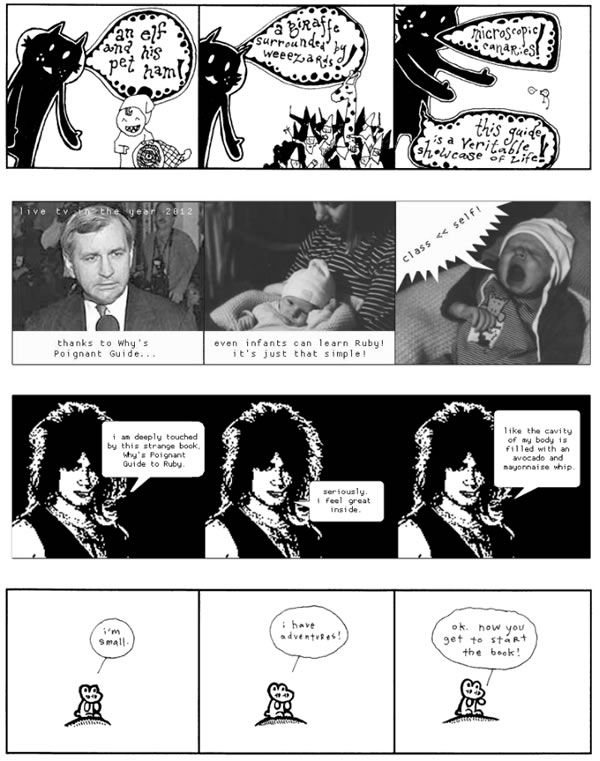
In the book’s first page with text, _why explained why the word “poignant” — which means “creating a sense of regret or sadness” — is included in the title:
I’ll be straight with you. I want you to cry. To weep. To whimper sweetly. This book is a poignant guide to Ruby. That means code so beautiful that tears are shed. That means gallant tales and somber truths that have you waking up the next morning in the arms of this book. Hugging it tightly to you all the day long. If necessary, fashion a makeshift hip holster for Why’s (Poignant) Guide to Ruby, so you can always have this book’s tender companionship.
And immediately after that, he tells the story of Bigelow, an apparently abandoned dog he found on the street, adopted, which then ran away five minutes later. This story takes up five paragraphs, none of which make any mention or Ruby, or even programming.
But it was all preamble:
It wasn’t much later that I pulled my own Bigelow. I printed out a bunch of pages on Ruby. Articles found around the Web. I scanned through them on a train ride home one day. I flipped through them for five minutes and then gave up. Not impressed.
I sat, staring out the window at the world, a life-sized blender mixing graffiti and iron smelts before my eyes. This world’s too big for such a a little language, I thought. Poor little thing doesn’t stand a chance. Doesn’t have legs to stand on. Doesn’t have arms to swim.
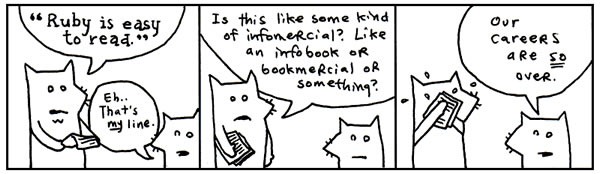
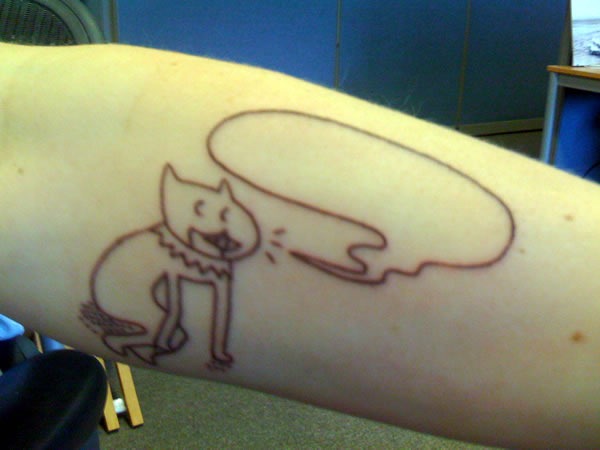
The intro was weird. It rambled and went into precisely the kinds of tangents that you weren’t supposed to put into a technical book. It was packed with comics featuring foxes lost in a large city, yelling out nonsense that — for a little while, at least — became catchphrases amongst Ruby developers:
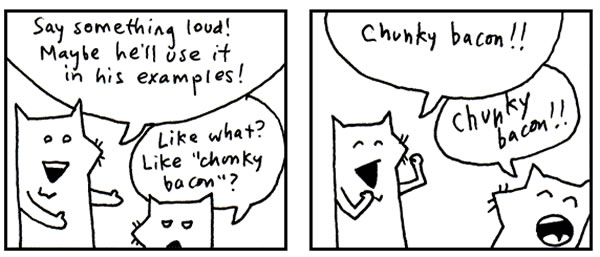
If you were the kind of person who always wanted their tech reading to just get to the damned point, you’d find reading the poignant guide an exercise in absurdity and frustration. But if you were new to programming, it was a friendly guide that didn’t look as intimidating as your standard programming book.
The foxes would go on crazy adventurers, and when they weren’t dynamiting retirement homes, they somehow managed to cover the teach you the basics of Ruby (and even programming in general).
The “Dr. Cham” chapter featured this illustration…
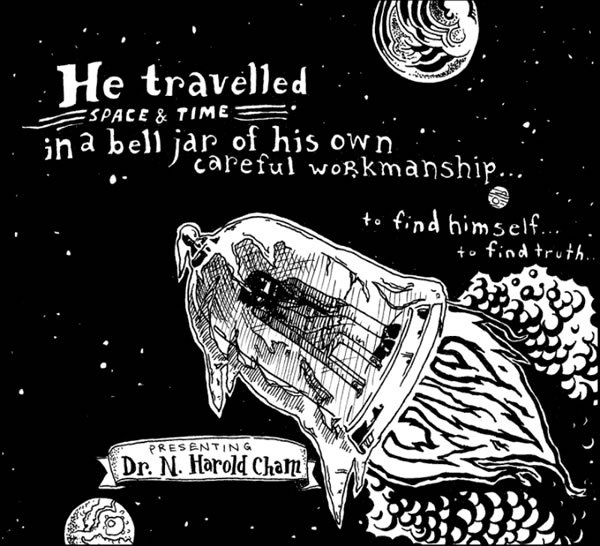
…and this example of Ruby’s case statement in action:
def dr_chams_timeline( year )
  case year
  when 1894
    "Born."
  when 1895..1913
    "Childhood in Lousville, Winston Co., Mississippi."
  when 1914..1919
    "Worked at a pecan nursery; punched a Quaker."
  when 1920..1928
    "Sailed in the Brotherhood of River Wisdomming, which journeyed \
     the Mississippi River and engaged in thoughtful self-improvement, \
     where he finished 140 credit hours from their Oarniversity."
  when 1929
    "Returned to Louisville to pen a novel about time-travelling pheasant hunters."
  when 1930..1933
    "Took up a respectable career insuring pecan nurseries.  Financially stable, he \
     spent time in Brazil and New Mexico, buying up rare paper-shell pecan trees.  Just \
     as his notoriety came to a crescendo: gosh, he tried to buried himself alive."
  when 1934
    "Went back to writing his novel.  Changed the hunters to insurance tycoons and the \
     pheasants to Quakers."
  when 1935..1940
    "Took Arthur Cone, the Headmaster of the Brotherhood of River Wisdomming, as a \
     houseguest.  Together for five years, engineering and inventing."
  when 1941
    "And this is where things got interesting."
  end
end
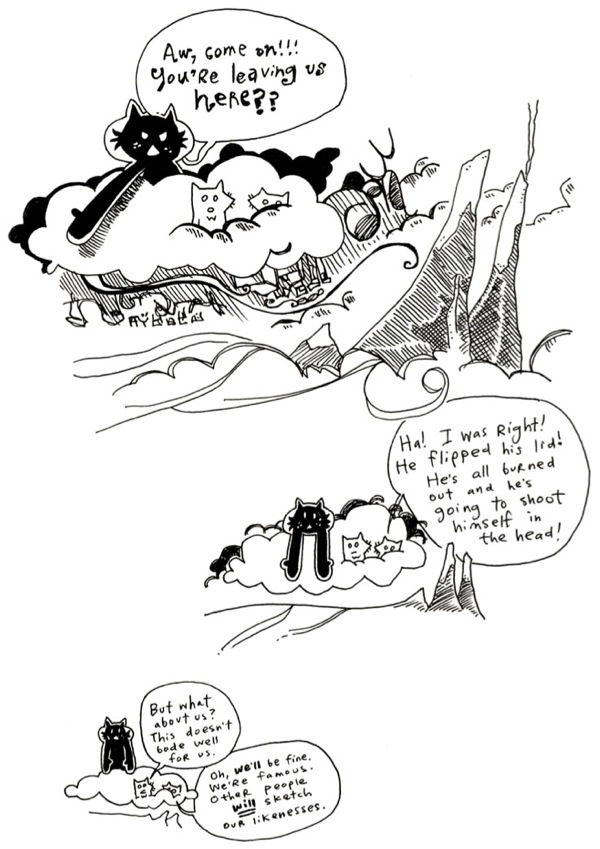
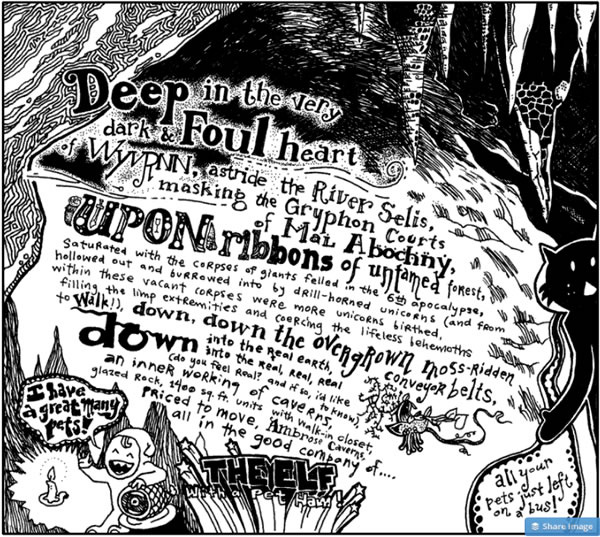
And let’s not forget the elf with a pet ham and the cat:
For new programmers, the poignant guide was an approachable book that didn’t try to bury you with jargon. For experienced developers, it provided a refreshing take on programming concepts. If you were looking for a Ruby reference, you were reading the wrong book. But whether you’d been a programmer for 20 minutes or 20 years, it was a fascinating, engrossing read that made you think about programming differently.
If that wasn’t enough, the book came with its own soundtrack. In addition to being a programmer and illustrator, _why was also a musician with a tendency towards the “indie rock”-style, and he wrote a song for each chapter.
Thankfully, the book and soundtrack preserved online. Go ahead and give it a look. I’ll wait for you here.
_why’s code
In addition to the poignant guide, _why also wrote a fair bit of code, some of which became de facto or even de jure Ruby standards:
- Hpricot, an HTML parser that became the Ruby de facto standard for a while. The current de facto standard parser (at least I still think it is; it’s been a while since I’ve done anything in Ruby) is Aaron Patterson’s Nokogiri, which uses Hpricot’s syntax.
- RedCloth, a module for using the Textile markup language in Ruby.
- Markaby — short for “markup as Ruby — which was a DSL to generate valid HTML using Ruby blocks and methods instead of tags.
- Camping, a Markaby-based microframework inspired by Rails. Its code amount to less than 4 kilobytes.
- Hobix, a YAML-based weblog application written in Ruby.
- MouseHole, a personal web proxy that can rewrite the web à la Greasemonkey
- Syck, a YAML library for C, Ruby, and several other languages. For a time, Syck was a part of Ruby’s standard libraries. It’s still available as a gem.
- unHoly, which converted Ruby bytecode to Python bytecode, which made it possible to run your Ruby applications on the Google Application Engine.
- bloopsaphone, a crossplatform chiptune-like synth, based on PortAudio with a Ruby frontend.
Of his creations, my favorites were the ones that were part of his mission to solve what he called “The Little Coder’s Predicament,” which is that in spite of the fact that we had better computers, software, and networks in the 2000s, the barrier to entry for programming — especially for kids — had become much higher:
In the 1980s, you could look up from your Commodore 64, hours after purchasing it, with a glossy feeling of empowerment, achieved by the pattern of notes spewing from the speaker grille in an endless loop. You were part of the movement to help machines sing! You were a programmer! The Atari 800 people had BASIC. They know what I’m talking about. And the TI-994A guys don’t need to say a word, because the TI could say it for them!
The old machines don’t compare to the desktops of today, or to the consoles of today. But, sadly, current versions of Windows have no immediately accessible programming languages. And what’s a kid going to do with Visual Basic? Build a modal dialog? Forget coding for XBox. Requires registration in the XBox Developer Program. Otherwise, you gotta crack the sucker open. GameCube? GameBoy? Playstation 2?
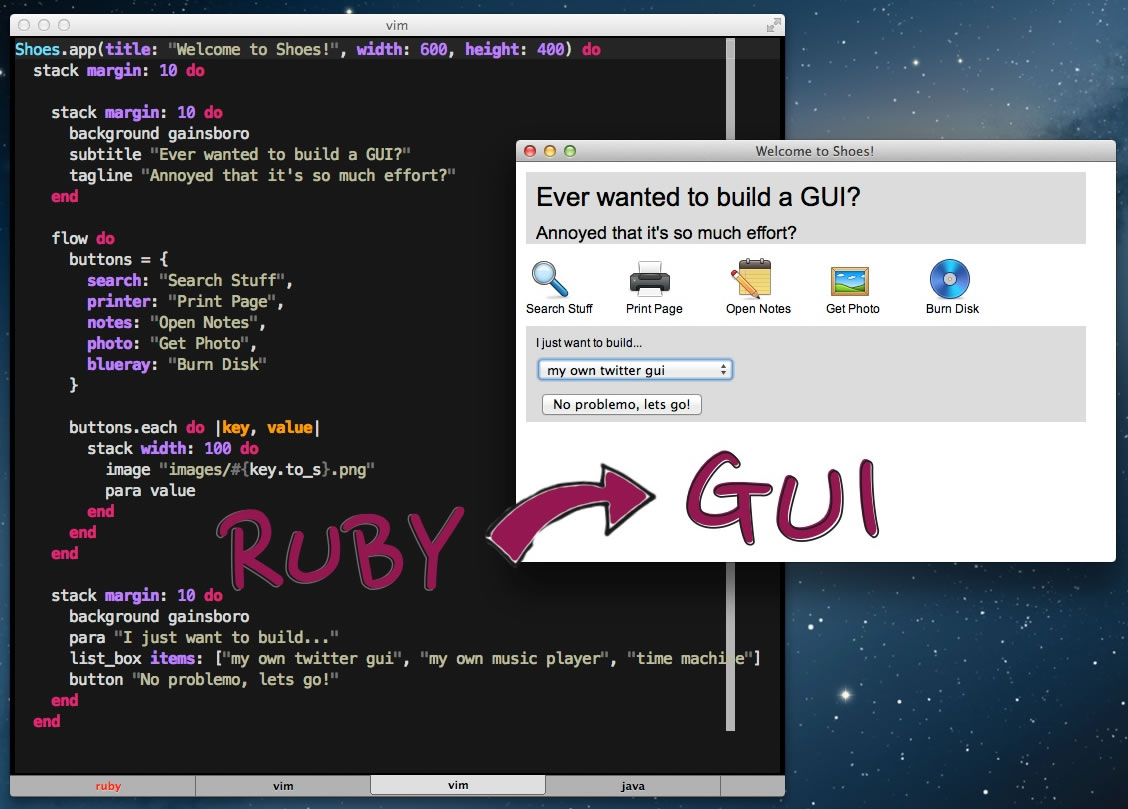
His solution to the Predicament was to first write Shoes, a simple toolkit for Ruby that use web page concepts to build desktop GUI apps for macOS, Windows, and Linux:
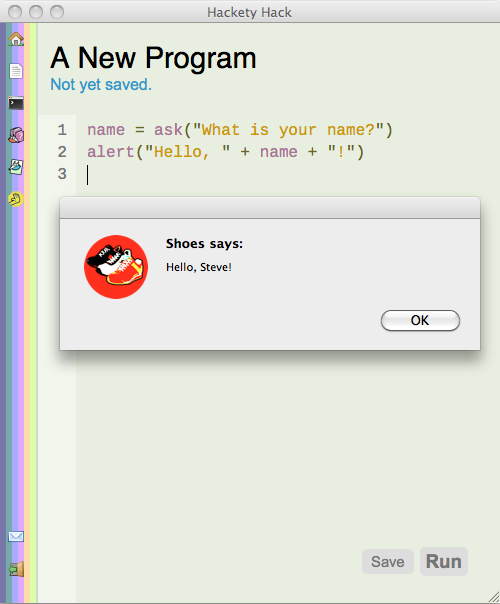
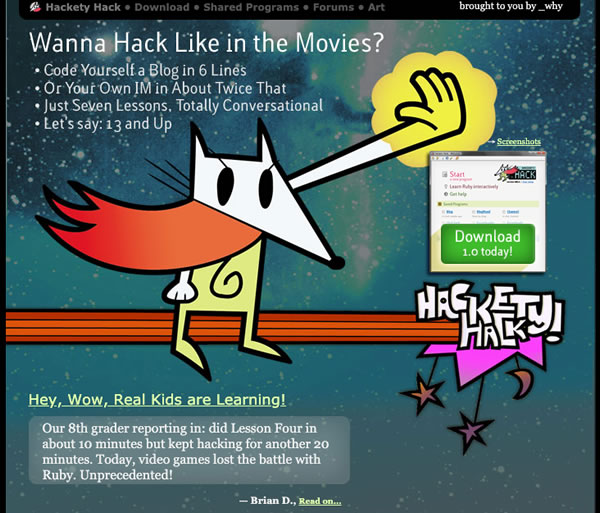
Shoes formed the basis of Hackety Hack, an IDE combined with a tutorials system that was a lot of fun to use. Here’s a screenshot of Hackery Hack in action, being used to write a “Hello, World!” program:
Since _why was developing this tool for children, he went straight to the subject matter experts: 25 children and their parents, whom he consulted and used as testers as he worked on the project.
(And because this was a _why project, it had a manifesto. Read it; it’s good.)
Here’s the Hackery Hack site:
_why’s performances
I was at RailsConf 2006, where _why gave a multimedia extravaganza of an evening keynote presentation. It was something I’d never seen before or since at a keynote: Part programming lecture, part video show, part concert complete with his band, the Thirsty Cups. You either left this performance either scratching your head or wanting to take programming to strange new heights.
After the show, I had a chance to hang out in an unexpected gathering of people that included both _why and Martin Fowler, which was an amusing, enlightening, and amazing experience.
Why’s performance at RailsConf 2006 probably opened the door to my own performance during RailsConf 2007’s evening keynote with Chad Fowler on ukulele:
_why’s disappearance

As you were reading this article, you may have noticed that I have only referred to its subject as “why the lucky stiff” or “_why”.
You may have wondered — quite fittingly — why?
There’s no definitive answer, but there are some hints.
Like a lot of creatives, the person behind the “why the lucky stiff” persona is an intensely private person. _why could be the out-there guy performing songs about how Ruby’s error handling just sounded so much more capable and effective with its rescue statement versus other languages’ try and catch (“try to catch me, I’m falling!” he’d joke), but the person lurking behind the mask wanted privacy during his downtime.
_why made it a point to reveal as little about himself as possible, and most of us were happy to indulge him. Most people were happy to simply know and address him as “why”, and in the community, it was a point of etiquette to not try and dig too deeply.
Of course, even in those pre-GamerGate, pre-“shitposting”, pre-chan-ruining-lots-of-the-net times, _why’s secrecy didn’t sit well with some people, who for some reason, just had to know the name of the person behind the _why identity was. So in 2009, they dug deep, and eventually found his name (as well as his wife’s) and publicized it.
_why may have also been a victim of Open Source Success, when a little project that you worked on in order to scratch a creative itch becomes so popular that many other projects depend on it. Suddenly, your project is no longer just a little thing you worked on, but a big thing that people expect you to maintain and upgrade. I’m reminded of a line from Byrne Hobart’s article, Working in Public and the Economics of Free, and it’s simultaneously hilarious and sad:
Running a successful open source project is just Good Will Hunting in reverse, where you start out as a respected genius and end up being a janitor who gets into fights.
As a result of the factors listed above, plus some others probably known to no one else but _why, the internet presence of Why the Lucky Stiff vanished on August 19, 2009. His sites, blogs, social media, and code repositories all vanished. I wrote about it the day after it happened.
Luckily for us, all of his work — well, the work that he’d released to the public, anyway — was open source, and with the effort of some dedicated Ruby and Rails developers, his projects were saved. Some people even took them over and expanded on them. Other projects became the basis of newer, improved projects.
Whyday

In 2010, a year after _why vanished into the night, Glenn Vandenburg declared that August 19 should be celebrated as Whyday.
Here’s what he wrote on the Whyday site:
On August 19, 2009, Why the Lucky Stiff withdrew from the online community. We in the Ruby community wish him well, but we really miss him.
Why gave us a lot of cool software and other things, but what he really gave to the Ruby community was a spirit of freedom, whimsy, and creativity. When Why took the stage at the first RailsConf, in 2006, he strapped on his guitar, walked to the microphone, and yelled “Put your best practices away!”
Discipline, care, and responsibility are important; we owe our customers, employers, team members, and families to take our work seriously. At the same time, though, we need to play. If we don’t occasionally break out of the mold of our “best practices,” we can easily miss many wonderful ideas, some of which can bear rich fruit (just as Camping and Hpricot led to Sinatra and Nokogiri).
On Whyday, we’re encouraged to borrow a page from _why’s book and creative, instructive, collaborative, and crazy. The site suggested doing things such as:
- See how far you can push some weird corner of Ruby (or some other language).
- Choose a tight constraint (for example, 4 kilobytes of source code) and see what you can do with it.
- Try that wild idea you’ve been sitting on because it’s too crazy.
- You can work to maintain some of the software Why left us (although Why is more about creating beautiful new things than polishing old things).
- On the other hand, Why is passionate about teaching programming to children. So improvements to Hackety Hack would be welcome.
- Or take direct action along those lines, and teach Ruby to a child.
The Whyday site lives on, but it’s been a while since I’ve seen anyone make a fuss about Whyday.
I thought that given that we’re in the middle of a pandemic and that we’re all spending more time at home (at least I hope we are), there’s no better time that now to bring back the spirit of Whyday.
Today, on this Whyday, I’m celebrating by working on a creative project that involves a mishmash of technology, comics, and possibly music. If you can, you should start one, too!
Recommended reading and viewing
Got eighteen and a half minutes? Then you’ll want to watch this documentary on Why the Lucky Stiff and how he inspired the Ruby developer community:
Articles on _why:
- Smashing Magazine, May 2010: _Why: A Tale Of A Post-Modern Genius
- Slate, March 2012: Where’s _why?
- TechCrunch, January 2013: After Disappearing For More Than 3 Years, Why The Lucky Stiff Returns To The Internet [Editor’s note: Not really.]
- Gizmodo, April 2013: Legendary Programmer Why The Lucky Stiff’s Strange, Fascinating Novel
- Kevin Watters, April 2013: Why Did why the lucky stiff Quit?
- Pricenomics, April 2016: Why The Lucky Stiff




![Clearfit [hearts] Rails, GitHub and Amazon Web Services](https://www.globalnerdy.com/wordpress/wp-content/uploads/2011/11/clearfit.jpg "Clearfit")