Posts tagged as:

Twitter

bruce johnson 1

This morning’s sessions in TechDays’ Developing for the Microsoft-Based Platform focuses on both the ASP.NET MVC web app framework and recommended object-oriented programming practices, namely the Model-View-Controller pattern with Colin Bowern’s presentation earlier this morning and now (at the time of this writing) the SOLID principles in Bruce Johnson’s session, SOLIDify Your ASP.NET MVC Applications.

Assless Chaps + Twitter = Business Opportunity

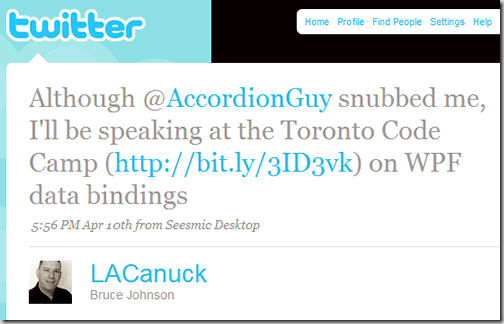
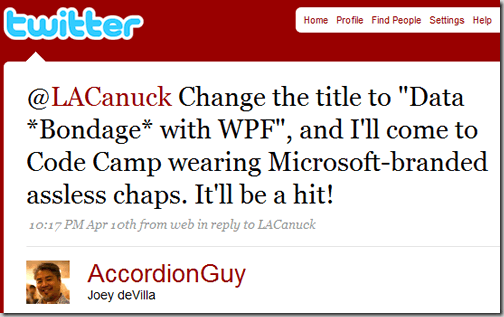
You might remember Bruce from the “Assless Chaps” story. The story can be summarized in the three tweets shown below.

First came Bruce’s response to my article about CodeCamp back in April, in which I forgot to mention the session he was doing:
lacanuck_tweet_1

I tweeted him back and then decided to throw in a jokey reply:
accordionguy_tweet_1

My thinking was: Hey, this is a conference of Microsoft developers! Yes, they’re a bright and talented bunch, and I like them, but they’re an older, corporate, more buttoned-down crowd. They’d never go for renaming a session from “Data Binding” to “Data Bondage”.

But Bruce and the Toronto Code Camp organizers surprised me – he changed the name of his session very quickly:
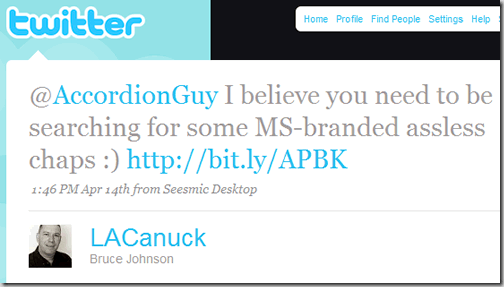
lacanuck_tweet_2

And since he responded to my challenge, I had to fulfill my end of the bargain:

assless_chaps_closeup

assless_chaps_behind

The “Assless Chaps” story doesn’t end there. Yesterday, while we were hanging out by the Windows 7 lounge and the “Assless Chaps” story came up. Bruce told me that our conversation on Twitter about the assless chaps actually landed his company, ObjectSharp, some business. A local developer got curious as to what the “assless chaps” business was all about in Bruce’s and my conversation on Twitter and the ensuing conversation got them talking about ObjectSharp’s services, which in turn became a contract.

The moral of the story: there’s actual business value in Twitter and assless chaps. I may have to go buy a pair (I rented the ones pictured above).

There’s a tamer version of this story in Canadian Developer Connection.
{ 0 comments }

Social Software Venn Diagram

by Joey deVilla on September 8, 2009

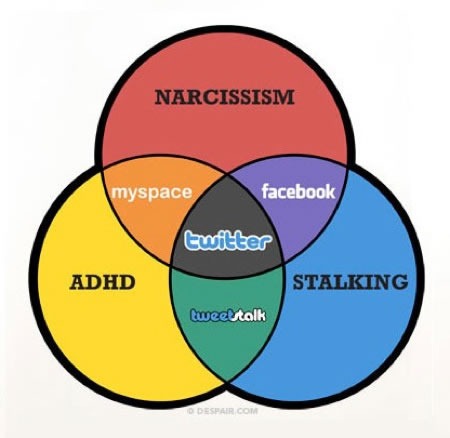
Yeah, that’s about right:

social_software_venn_diagram

And better yet, it’s available as a T-shirt!

venn_diagram_t-shirt

[Found via Kevin Kelly.]

{ 2 comments }

Chances are, as a reader of this blog, people ask you to explain Twitter to them. If that’s the case you might find this video in which Ben Stiller explains Twitter to Mickey Rooney amusing:

This article also appears in Canadian Developer Connection.

{ 1 comment }

My Question About the Twitter/Facebook DDOSing

by Joey deVilla on August 7, 2009

Matt Damon as Jason Bourne

When I read that Twitter and Facebook were attacked for the sake of targeting one guy, my first thought was “Who is this guy, Jason Bourne?”

{ 0 comments }

Iran is Taking Marc Stiegler’s Final Exam

by Joey deVilla on June 25, 2009

Marc Stiegler

earthweb I met science fiction author, software developer and computer security guy Marc Stiegler at the first incarnation of O’Reilly’s Emerging Technology Conference in 2002, but I’d been acquainted with his work prior to that. I’d heard of his programming language called E and had read his science fiction novel Earthweb, whose plot could be grossly oversimplified down to the summary “Twitter saves the world” (it’s a little bit more than that, but I think it conveys the idea nicely).

Marc’s Final Exam

However, when I think of Marc, what comes to mind first is the final exam that he gave to students at his “Future of Computing” course and published online in 1999. In it, he posed a set of problems and asked them how a specific set of proposed web technologies could be used to solve them. The course and exam have a very strong sense of “technology trumps legislation”, an idea that was surfacing in the late 1990s.

In the exam, students had to pick 5 out of 11 problems that Marc posed and then explain how any combination of the following technologies could be used to solve them:

  • Unforgeable pseudonymous identities
  • Bidirectional, typed, filterable links
  • Arbitration agents
  • Bonding agents
  • Escrow agents
  • Digital Cash
  • Capability Based Security with Strong Encryption

(If some of these ideas are unfamiliar to you, don’t worry. They’re not important in the context of this article, and you can always Bing them.)

Here’s a selection of the problems posed in the exam. Remember, this exam is from ten years ago!

1) Searching for a decision analysis tool on the Web, you find a review in which the reviewer raves about a particular product. You buy the product and discover it just doesn’t work. You desire to prevent this person’s ravings from harming anyone else–and you desire to prevent the product from disappointing anyone else.

4) You start receiving thousands of emails from organizations you don’t know, all hawking their wares. You want it to stop, just stop!

5) You wish to play poker with your friends. They live in Tampa Florida, you live in Kingman. This is illegal in the nation where you happen to be a citizen. You want to do it anyway.

6) You hear a joke that someone, somewhere, would probably find offensive. You wish to tell your precocious 17-year-old daughter, who is a student at Yale. The Common Decency Act Version 2 has just passed; it is a $100,000 offense to send such material electronically to a minor. You want to send it anyway–it is a very funny joke.

7) Someone claiming to be you starts roaming the Web making wild claims. You want to make sure people know it isn’t really you.

The Final Question

The most compelling question on the exam is the final one. It required a far more extensive answer than the other ten – so much more extensive that Marc actually suggested that it might be better not to answer the question in the exam, but to at least think about it:

But…if you can answer Question 11 in your own mind, even though you choose not to write up that answer for this examination, then a most remarkable thing will happen: you will walk out of this class with something profoundly worth knowing.

Here’s that final question:

11) You live in North Korea. Three days ago the soldiers came to your tiny patch of farmland and took the few scraps of food they hadn’t taken the week before. You have just boiled the last of your shoes and fed the softened leather to your 3-year-old child. She coughs, a sickly sound that cannot last much longer. Overhead you hear the drone of massive engines. You look into the sky, and thousands of tiny packages float down. You pick one up. It is made of plastic; you cannot feed it to your daughter. But the device talks to you, is solar powered, and teaches you how to use it to link to the Web. You have all the knowledge of the world at your fingertips; you can talk to thousands of others who share your desperate fate. The time has come to solve your problem in the most fundamental sense, and save the life of your daughter.

The final question really stands out. Unlike the other questions in the exam, this one really pulls at the heartstrings, and it sparked a lot of discussion among geeks back around 1999 and 2000, in settings both online and real-life.

Iran and the Final Question

If you follow the American news cycle, the mental distance between North Korea and Iran is a short one; both are countries in the “Axis of Evil” (a term invented by a Toronto guy, by the way) run by repressive regimes and working on their nuclear weapons capabilities. What if we changed the final question’s setting from North Korea to Iran?

Unlike North Korea, Iran’s people have access to technology and communications with the outside world (there’s a recent Daily Show segment in which Jason Jones finds people in Iran who know Jon Stewart’s George Bush “I’m the decider” schtick). They don’t need to have Marc’s hypothetical iPhones delivered to them in care packages; they have things like Twitter and YouTube at their disposal. So I propose another slight modification to the final question: What if we changed the hypothetical hardware into actual working software like Twitter and YouTube?

(It’s another “software, not hardware, is really the trick” situation. Just as we found out in Terminator 3 that SkyNet was really software, it turns out that what might save Iran was social networking software, not portable internet-accessing hardware dropped by parachute.)

With my two suggested changes, it becomes very apparent that we’ve moved from theory to practice. The people of Iran are taking Marc Stiegler’s final exam, and they’ve picked its most difficult question.

Let’s hope they pass.

{ 2 comments }

Using the Twitter API with PHP and PEAR

April 15, 2009

The Zend Developer Zone article Using the Twitter API with PHP and PEAR covers the Services_Twitter PEAR package, which the articles describes as follows:
Services_Twitter works by providing a full-fledged, object-oriented interface to the Twitter API. This interface insulates you from the nitty-gritty of working directly with REST requests and, by representing responses as SimpleXML [...]

Read the full article →

“betbot” Makes the Dick Tweet of the Mesh Conference

April 8, 2009

It looks as thought the Twitter user going by the handle of betbot is going to spend the next little while absorbing a very important lesson about managing one’s online persona after making this tweet at the Mesh Conference:

betbot’s profile vaingloriously proclaims that he has three Master’s degrees:
Self-proclaimed marketing guru trying to put my [...]

Read the full article →

Old Man Stewart and Young Man Williams Talk About Twitter on TV

March 3, 2009

Here’s the bit from last night’s Daily Show called Old Man Stewart Shakes His Fist at Twitter, courtesy of VentureBeat (at least until the folks at YouTube have to remove the video):

And for those of you who missed it, here’s Twitter co-founder and chief exec Evan Williams talking about Twitter on Charlie Rose, once again [...]

Read the full article →

Future Man Tried to Warn Us

February 23, 2009

Click the photo to see its source.

Read the full article →

Maybe It’s Time to Update Your Twitter Password

January 5, 2009

First, there were the Twitter phishing attacks that looked like direct messages from your friends offering you a chance to win an iPhone. Now some big-shot Twitter accounts appear to have been accessed by pranksters: FOX News’, CNN’s Rick Sanchez’ and Britney Spears’ accounts have all had tweets posted to them by unauthorized parties.
These tweets [...]

Read the full article →

The Air Force’s Rules of Engagement for Blogging [Updated]

December 30, 2008

Update, January 5, 2008: Captain David Faggard, Chief of Emerging Technology for the U.S. Air Force, sent me an updated version of their chart, whose changes are based on your comments. The chart appears in this article, and you can click on it to download a full-sized PDF version.
You’ve probably seen many articles on companies [...]

Read the full article →

Is Canada Becoming a Digital Ghetto?

November 27, 2008

Over at CBC’s Search Engine, Jesse Brown asks an important question: Is Canada Becoming a Digital Ghetto? I’m reproducing the article in its entirety below.

Here are three things that suck about being Canadian right now:

Last week the CRTC sided with Bell against a group of small Internet Service Providers who want to offer their [...]

Read the full article →

Warren Ellis on Twitter Overload

May 28, 2008

Warren Ellis on Twitter overload: “You know, when Twitter hits capacity, they could just cut off the Bay Area’s usage and let the rest of the planet use the service…”

Read the full article →

My Take on Sarah Lacy’s Take on Twitter’s New Term Sheet

April 28, 2008

I must admit that my reaction to Sarah Lacy’s article, Twitter Raises $20 M? That’s News, Why? was “Sarah Lacy still has a job? Why?”

Read the full article →