Categories
Artificial Intelligence Editorial Presentations Video

Maciej Ceglowski’s reassuring arguments for why an AI superintelligence might not be a threat to humanity

Yesterday on the OpenAI blog, founder Sam Altman, President Greg Brockman and Chief Scientist Ilya Sutskever posted an article titled Governance of superintelligence with the subtitle “Now is a good time to start thinking about the governance of superintelligence—future AI systems dramatically more capable than even AGI.”

Although it’s a good idea to think about this sort of thing, there’s also the possibility that all this fuss over superintelligence may be for nothing. In his talk, Superintelligence: The Idea That Eats Smart People, which he gave at Web Camp Zagreb in 2016, developer Maciej Ceglowski, whom I personally know from another life back in the 2000s, lists some arguments against the idea of an evil superintelligence that is a threat to humanity:

Here are just a few of Maciej’s “inside perspective” arguments, which you can also find in his companion essay:

  • The Argument From Wooly Definitions: “With no way to define intelligence (except just pointing to ourselves), we don’t even know if it’s a quantity that can be maximized. For all we know, human-level intelligence could be a tradeoff. Maybe any entity significantly smarter than a human being would be crippled by existential despair, or spend all its time in Buddha-like contemplation.”
  • The Argument From Stephen Hawking’s Cat: “Stephen Hawking is one of the most brilliant people alive [He was alive at the time Maciej wrote this], but say he wants to get his cat into the cat carrier. How’s he going to do it? He can model the cat’s behavior in his mind and figure out ways to persuade it. He knows a lot about feline behavior. But ultimately, if the cat doesn’t want to get in the carrier, there’s nothing Hawking can do about it despite his overpowering advantage in intelligence.”
  • The Argument From Einstein’s Cat: “There’s a stronger version of this argument, using Einstein’s cat. Not many people know that Einstein was a burly, muscular fellow. But if Einstein tried to get a cat in a carrier, and the cat didn’t want to go, you know what would happen to Einstein.”
  • The Argument From Emus: “In the 1930’s, Australians decided to massacre their native emu population to help struggling farmers. They deployed motorized units of Australian army troops in what we would now call technicals—fast-moving pickup trucks with machine guns mounted on the back. The emus responded by adopting basic guerrilla tactics: they avoided pitched battles, dispersed, and melted into the landscape, humiliating and demoralizing the enemy. And they won the Emu War, from which Australia has never recovered.”
  • The Argument From Slavic Pessimism: “We can’t build anything right. We can’t even build a secure webcam. So how are we supposed to solve ethics and code a moral fixed point for a recursively self-improving intelligence without fucking it up, in a situation where the proponents argue we only get one chance?”
  • The Argument From Complex Motivations: “Complex minds are likely to have complex motivations; that may be part of what it even means to be intelligent. There’s a wonderful moment in Rick and Morty where Rick builds a butter-fetching robot, and the first thing his creation does is look at him and ask ‘what is my purpose?’. When Rick explains that it’s meant to pass butter, the robot stares at its hands in existential despair.
  • The Argument From Actual AI: “When we look at where AI is actually succeeding, it’s not in complex, recursively self-improving algorithms. It’s the result of pouring absolutely massive amounts of data into relatively simple neural networks. The breakthroughs being made in practical AI research hinge on the availability of these data collections, rather than radical advances in algorithms.”
  • The Argument From Maciej’s Roommate: “My roommate was the smartest person I ever met in my life. He was incredibly brilliant, and all he did was lie around and play World of Warcraft between bong rips. The assumption that any intelligent agent will want to recursively self-improve, let alone conquer the galaxy, to better achieve its goals makes unwarranted assumptions about the nature of motivation.”

There are also his “outside perspective” arguments, which look at what it means to believe in the threat of an AI superintelligence. It includes become an AI weenie like the dorks pictured below:

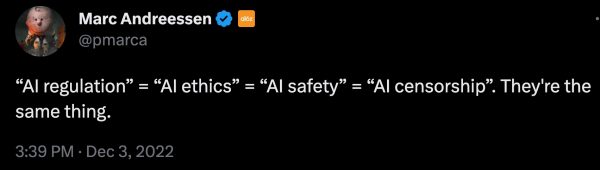
The dork on the left is none other than Marc Andreesen, browser pioneer, who’s now more of a south-pointing compass these days, and an even bigger AI weenie, if tweets like this are any indication:

But more importantly, the belief in a future superintelligence feels like a religion for people who think they’re too smart to fall for religion.

As Maciej puts it:

[The Singularity is] a clever hack, because instead of believing in God at the outset, you imagine yourself building an entity that is functionally identical with God. This way even committed atheists can rationalize their way into the comforts of faith. The AI has all the attributes of God: it’s omnipotent, omniscient, and either benevolent (if you did your array bounds-checking right), or it is the Devil and you are at its mercy.

Like in any religion, there’s even a feeling of urgency. You have to act now! The fate of the world is in the balance!

And of course, they need money!

Because these arguments appeal to religious instincts, once they take hold they are hard to uproot.

Or, as this tweet summarizes it:

In case you need context:

  • Roko’s Basilisk is a thought experiment posted on the “rational discourse” site LessWrong (which should be your first warning) about a potential superintelligent, super-capable AI in the future. This AI would supposedly have the incentive to create a virtual reality simulation to torture anyone who knew of its potential existence but didn’t tirelessly and wholeheartedly work towards making that AI a reality.

    It gets its name from Roko, the LessWrong member who came up with this harebrained idea, and “basilisk,” a mythical creature that can kill with a single look.
  • Pascal’s Wager is philosopher Blaise Pascal’s idea that you should live virtuously and act as if there is a God. If God exists, you win a prize of infinite value: you go to Heaven forever and avoid eternal damnation in Hell. If God doesn’t exist, you lose a finite amount: some pleasures and luxuries during your limited lifespan.
Categories
Artificial Intelligence Current Events Video What I’m Up To

My interviews on artificial intelligence and ChatGPT on local news

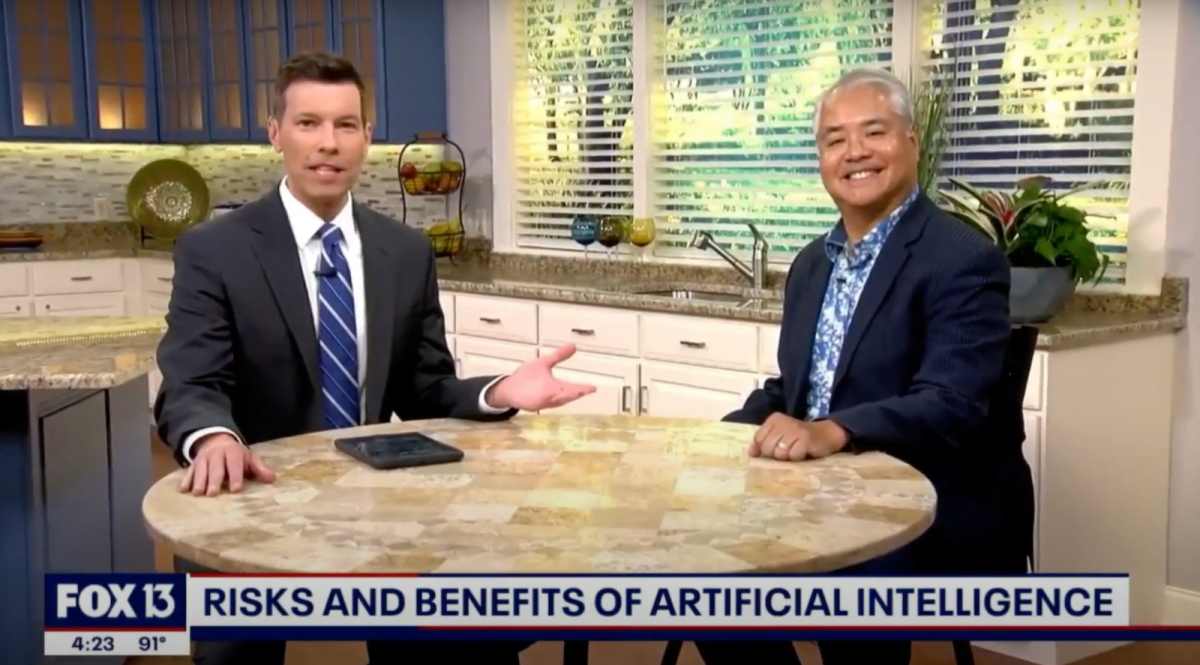
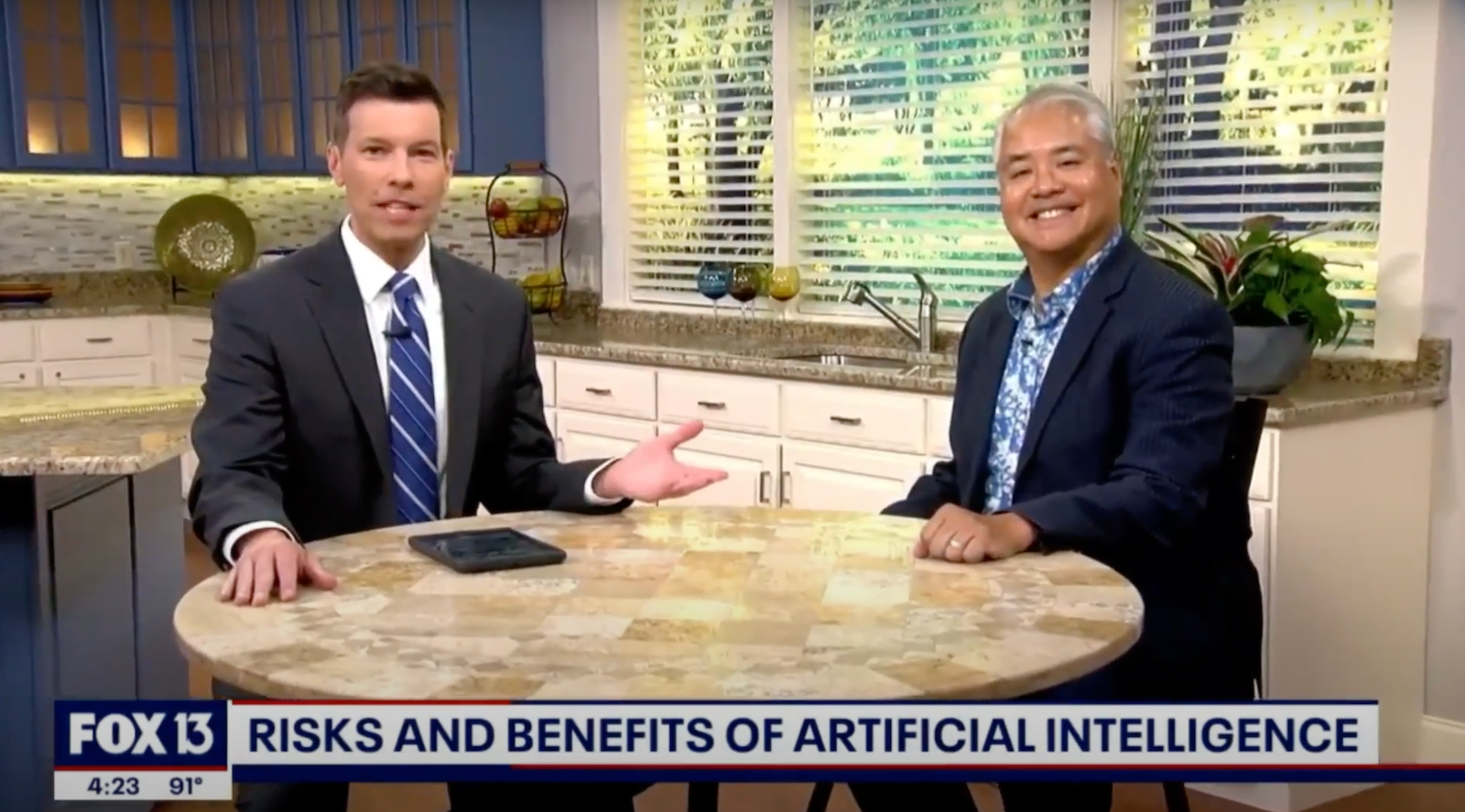
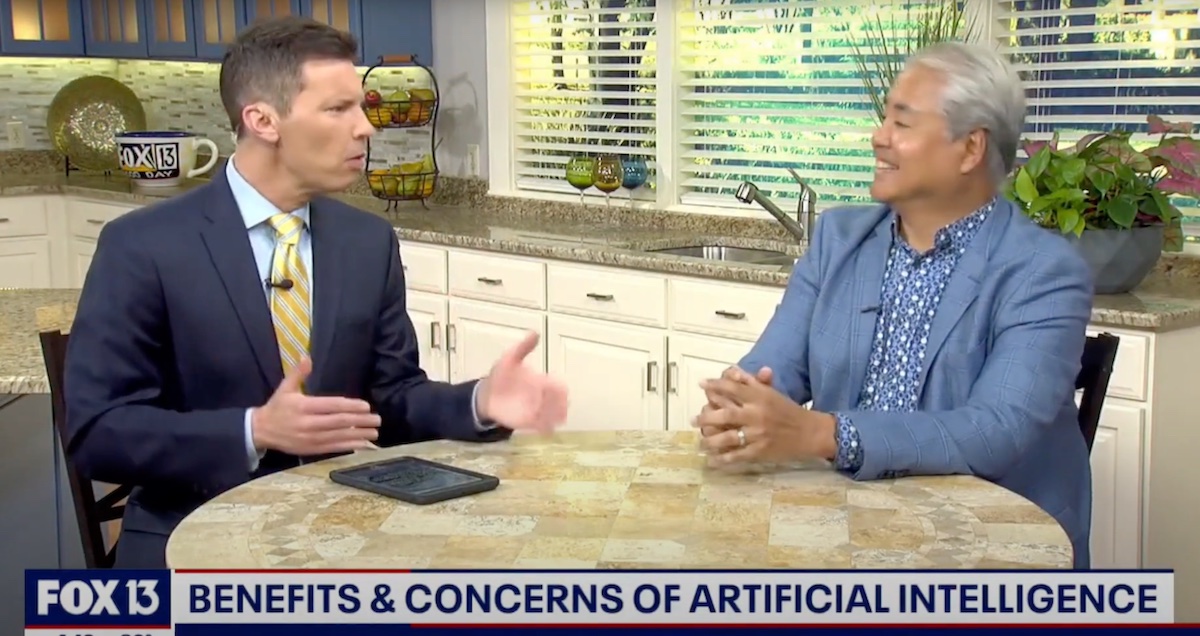
Chris Cato and Joey deVilla on Fox 13 News Tampa. The “lower third” caption reads “Benefits and concerns of artificial intelligence.”

In case you missed it, here’s that interview I did for the 4:00 p.m. news on FOX 13 Tampa on Monday, April 10th with anchor Chris Cato:

It’s a follow-up to this piece that FOX 13 did back in March:

In that piece, I appeared along with:

  • Local realtor Chris Logan, who’s been using ChatGPT to speed up the (presumably tedious) process of writing up descriptions of houses for sale
  • University of South Florida associate director of the School of Information Systems and Management Triparna de Vreede, who talked about its possible malicious uses and what might be possible when AI meets quantum computing.
  • IP lawyer Thomas Stanton, who talked about how AI could affect jobs.

All of this is a good preamble for the first Tampa Artificial Intelligence Meetup session that I’ll be running — it’s happening on Wednesday, May 31st!

Categories
Artificial Intelligence Tampa Bay Video

Fox 13 News Tampa continues their series on artificial intelligence with Maya AI

Tampa’s Fox 13 News covered local company Maya AI on Tuesday evening, and you can watch the story on this page or below:

The video features Sat Ramphal, CEO and co-founder of Maya AI, a Tampa-based early-stage startup whose product is an analysis tool that derives insights from data and delivers those insights conversationally. Their target customers are businesses looking for suggestions and answers based on their company data, and they’ve already caught the attention of retail and pharmaceutical companies.

Sean, Sat, and Shivam Ramphal.
Maya AI’s co-founders, the Rampal brothers.
From left to right: Sean, Sat, and Shivam.

Sat co-founded Maya AI with his brothers Sean and Shivam when they pivoted from their previous venture, XiByte to focus on their business AI, Maya. In their summary of the differences between ChatGPT and Maya on the Maya AI blog, they close with this key distinction between the two systems:

ChatGPT is a language model developed by OpenAI, specifically trained to generate human-like text based on its received input. It is capable of answering questions, providing information, generating content, and performing various other language-related tasks.

On the other hand, Maya AI is a more general AI platform that can be used for various applications and industries. It can perform various tasks, such as image and voice recognition, data analysis, and decision-making.In summary, while ChatGPT is a broader focus on language processing, Maya AI is a specifically focused AI platform with a wider range of capabilities and potential use cases.

Other Tampa Bay AI stories

Screenshot of Fox 13 News Tampa’s page featuring the story “How chatbot programs could change future as it becomes more widely used,” featuring a video still of Joey deVilla in his home office.
Tap to view the blog post.

On the previous evening, Fox News 13 Tampa aired the first episode in this series, which featured Yours Truly at the home office, talking about ChatGPT.

Categories
Artificial Intelligence Video What I’m Up To

I’m in a local news story on ChatGPT

Screenshot of Fox 13 News Tampa’s page featuring the story “How chatbot programs could change future as it becomes more widely used,” featuring a video still of Joey deVilla in his home office.

A few weeks ago, Kristin Moore from Fox 13 News Tampa reached out to me and asked if I’d like to be part of a story they were doing on ChatGPT. I said “yes,” they dropped by my home office to interview me, and you can see the result, which aired on Monday evening:

I appear in two segments of the piece, along with:

  • Local realtor Chris Logan, who’s been using ChatGPT to speed up the (presumably tedious) process of writing up descriptions of houses for sale
  • University of South Florida associate director of the School of Information Systems and Management Triparna de Vreede, who talked about its possible malicious uses and what might be possible when AI meets quantum computing.
  • IP lawyer Thomas Stanton, who talked about how AI could affect jobs.

Watching the segment, it occurred to me that I need to light my office the way that the news crew did for the segment — it’s got such a great “cinematic hacker” vibe!

Also: My thanks to Kristin Moore for inviting me to be part of the piece!

Categories
Programming Video

Watch my new “Advent of Code Tips and Tricks” video!

I’ve got a new video on Auth0 by Okta’s YouTube channel that helps you get started with Advent of Code — check it out!

Advent of Code is an annual event featuring Christmas-themed puzzles that are meant to be solved with code. Since 2015, tens of thousands of programmers have tackled the new puzzles that appear every day from December 1 through 25 at the stroke of midnight (U.S. Eastern standard time).

If you’ve been working on the same sort of programming problems day in and day out and feel that you’re in a coding rut, Advent of Code is a great way to sharpen your skills. If you’re learning a new programming language, Advent of Code’s challenges are a great way to discover the in and outs of your new language. If you’re interviewing for a developer position and a coding exercise is part of the process, Advent of Code can help prepare you.

In the video, I’ll walk you through the solutions for Day 1 of the 2015 and 2020 Advent of Code in Python. Combined with my Advent of Code article on the Auth0 by Okta blog, which covers even more challenges, it should help you get started with this year’s Advent of Code!

Categories
Mobile Programming Video What I’m Up To

How to add Auth0 authentication to a SwiftUI app

Joey deVilla in his home office, holding an “Einstein” rubber duck up to the camera.
C’mon, how many programming tutorial videos have a scene like this?

If you’re making an iOS app, the odds are pretty good that sooner or later, you’re going to have to integrate authentication — login and logout — into it. I show you how to do that with Auth0 in both a video

…as well as a matching two-part article series that walks you through the process:

Both the video and article present how the final app will look and work:

Tap to view at full size.

And then they’ll get you started with a starter project:

Joey deVilla appears in the corner of the screen showing the starter project of Auth0’s iOS/SwiftUI authentication video.
Tap to view at full size.

I’ll walk you through the processes of getting Auth0 set up to recognize your app and creating a user with which to log in:

Joey deVilla appears in the corner of the screen showing the Auth0 dashboard in Auth0’s iOS/SwiftUI authentication video.
Tap to view at full size.

And then, I’ll show you how to add login and logout to the project’s app:

Joey deVilla appears in the corner of the screen, while adding login and logout to the starter project of Auth0’s iOS/SwiftUI authentication video.
Tap to view at full size.

And along the way, I’ll provide a brief intro to ID tokens, JWTs, and JWT.io:

Joey deVilla appears in the corner of the screen showing the JWT.io site in  Auth0’s iOS/SwiftUI authentication video.
Tap to view at full size.

Of course the video ends with an accordion number!

Joey deVilla plays accordion at the end of an Auth0 tutorial video.
Again, I ask: how many programming tutorial videos have a scene like this?

Once again, the here’s the video, How to Integrate Auth0 in a SwiftUI App, and here are the articles:

Whether you prefer to learn by watching video, reading, or a little bit of both, I hope you find these useful!

Categories
Security Video

Get to know Bellingcat and open source intelligence (OSINT)

The Bellingcat logo.

As the Russian invasion of Ukraine continues, you’re increasingly likely to hear the name “Bellingcat”. It’s the name of an independent group of researchers, investigators, and citizen journalists who practice open source intelligence (OSINT). Here’s a quick primer about Bellingcat and open source intelligence, plus a whole lot of videos about Bellingcat’s work and their reporting on aggression by Russia’s government and armed forces.

Bellingcat’s origins

Illustration: The mice planning to bell the cat.

Bellingcat get their name from Aesop’s fable, Belling the Cat. In the fable, the youngest of a group of mice who were terrorized by a cat suggests that they put a bell on the cat, which would act as an early warning system. While the suggestion was warmly received, one of the elder mice brought up a serious challenge to the plan: “Who will bell the cat?”

Eliot Higgins founded Bellingcat in 2012 after being laid off from an administrative job. He started doing independent research on the civil war in Syria by collecting and analyzing publicly available photos and footage, and cross-referencing them with reports. Since then, he’s grown the organization, who’ve gone on to apply their open source intelligence skills to stories including:

Open source intelligence

Open source intelligence, often referred to as OSINT, is a term meaning any information that can be gathered from freely-available, publicly-available sources. It’s most often used to referred to information gathered online — the kind that anyone with an internet connection would be able to access. This information could be available free of charge, or it could be acquired for a fee (e.g. a subscription to a news organization, data source, or API).

It also applies to non-online/non-digital information from books, newspapers, magazines, academic journals and papers, FOIA requests and their equivalents, and so on.

It could be in text form, but it also applies to video, photographs, sound recordings, data files, and databases.

Giancarlo Fiorella, a senior Bellingcat investigator based in Toronto, makes it clear that OSINT is not “hacking” (as in accessing computer systems or information illegally), stealing, or spying. It’s about gathering data and doing the research.

Bellingcat contribute to the Russia-Ukraine monitor map

Click the image to visit the map page.

You may have read about the Russia-Ukraine Monitor Map on my personal blog, but if you haven’t, it’s a a public resource for mapping, documenting, and verifying significant incidents that happen in the Russian invasion of Ukraine. Bellingcat are a primary contributor of information to this resource.

Videos about Bellingcat

Here’s a collection of YouTube videos on Bellingcat for those of you who’d like to know more about them or about OSINT.

Insights from Bellingcat on Russia’s Ukraine Ambitions (March 2, 2022 – Reuters Institute)

This is a Zoom interview with Christo Grozev, Bellingcat’s lead Russia investigator.

Researchers create open-source map tracking incidents in Ukraine (February 28, 2022 – CBC)

Fact-checkers on the front line of Russian propaganda machine (February 25, 2022 – CBC)

Inept Info-Wars: Bellingcat’s Eliot Higgins on Putin’s Problems with Reality (February 24, 2022 – Foreign Press Association USA)

Open-source Intelligence (OSINT) by Giancarlo Fiorella, Investigator and Trainer at Bellingcat (December 2021 – Asian College of Journalism)

This features a presentation by senior Bellingcat investigator Giancarlo Fiorella about Bellingcat, open source investigations and how they’re conducted. He goes into detail about investigating the Mahbere Dego massacres and the ethical issues and challenges in open source research.

We Are Bellingcat: An Intelligence Agency for the People (May 2021 – Talks at Google)

Ethical Matters: Bellingcat – The Citizen Intelligence Agency (April 2021 – Conway Hall)

Putin’s Assassins Exposed: An Evening w/ Bellingcat Founder Eliot Higgins (March 2021 – Renew Democracy Initiative)

I Exposed a Russian Assassination Squad (March 2021 – Vice’s “Super Users” series)

Discussion with Bellingcat Founder Eliot Higgins (March 2021 – Center for the Study of the Presidency and Congress)

How Bellingcat tracked a missile system in Ukraine (February 2020 – 60 Minutes Overtime)

Bellingcat: Truth in a Post-Truth World (2018 documentary film)

https://www.youtube.com/watch?v=jOx_m0whcgw