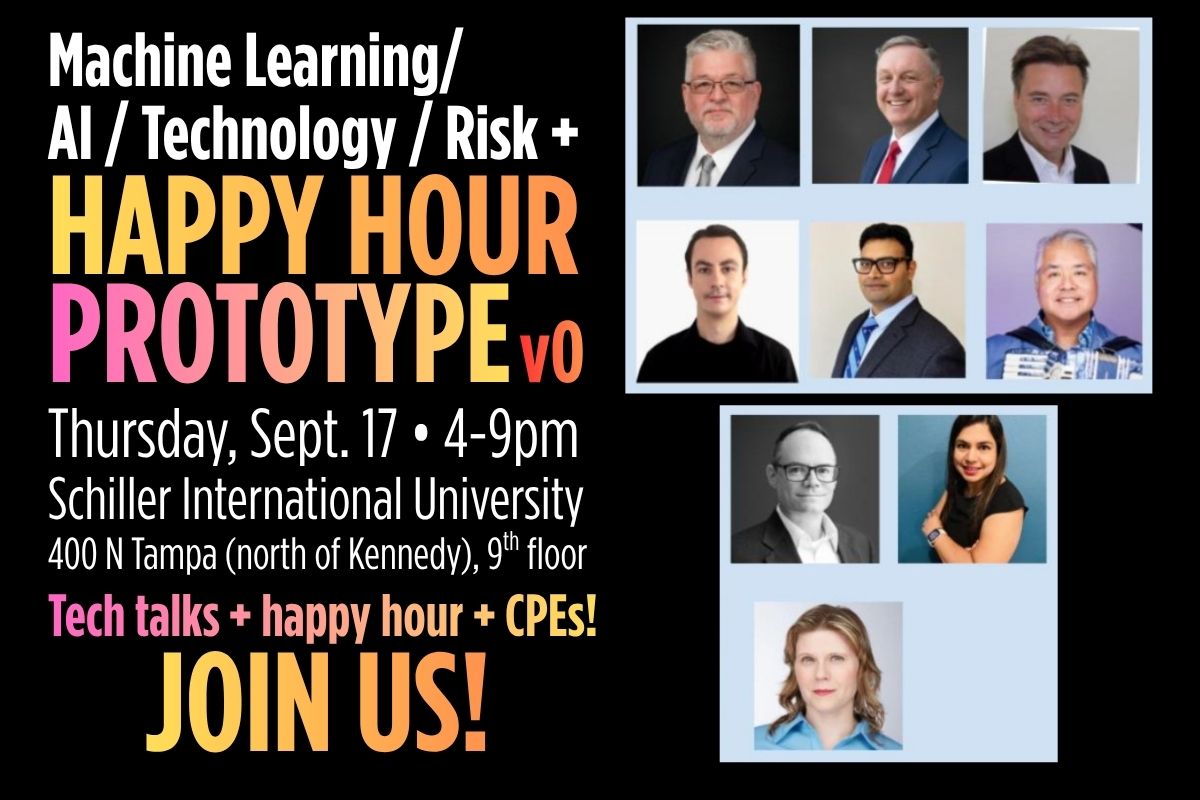
Yes, it’s short notice, but if I can do a talk on short notice, perhaps your schedule might allow you to show up TONIGHT (Thursday, September 17) to attend the first Machine Learning / AI / Technology / Risk + Happy Hour event, taking place from 4 – 9 p.m. at Schiller International University in downtown Tampa!
Calling all devs, designers, AI and data geeks, cyber and everyone in the “tech-ish” orbit!
This event brings together technologists and technology-adjacent professionals to connect, share knowledge, learn and grow together.
Yes, it’s last minute, but a lot of people have signed up already, and for those of you collecting cybersecurity CPEs, attending this one will earn you 2!
The agenda
AI Panel – Revisiting AI Transformation opportunities due to the rapid evolution of capabilities
With AI model performance and tooling evolving at a breakneck pace, the lifecycle of technical feasibility has compressed. Solutions deemed impractical just months ago are frequently production-ready today. We will examine how enterprise leaders and practitioners are navigating this shifting baseline—reassessing former roadblocks, managing risk, and executing sustainable AI transformation strategies.
Panelists:
Talk: Detection of Confounders in Computed Tomography Datasets
Computed Tomography (CT) scans are used to train machine learning models to predict cancer outcomes. Datasets are frequently composed of images collected using different devices or settings, which can reduce classifier accuracy.
This talk covers an automated method for screening CT datasets to detect features that make models learn spurious associations – called confounders – and other unwanted variations in data. By understanding what affects data quality, we can mitigate these issues or adjust image acquisition processes to prevent them from happening in the future.
Speaker: Nikolai Fetisov
Talk: The chart is already multimodal. Why isn’t the model?
Every clinical decision draws on labs, coded history, notes, and imaging at once. Most deployed models read one. The work began as an ONC engagement, built as a physician assistant and trained with split learning, so records never left the institutions holding them. Asked which task would earn a place in their day, physicians answered consistently: help with the differential. The 2015 National Academies report found that most people will experience at least one diagnostic error in their lifetime. These are usually failures of consideration rather than knowledge: the right diagnosis was never placed on the list.
Solution is valuesets governed data trained with multimodal model built with fusion architecture. Each branch is projected to a shared width, given its own self-attention, and combined in one late fusion feeding condition heads that share a representation. Results are early with no prospective study with clinicians yet, but the validation metrics looks promising. Future improvements with contrastive learning and focal loss will drastically increase recall and additional testing is carried out by analyzing Krippendorf alpha.
The opportunities of this engine serve six workflows: diagnostic support, risk adjustment, trial recruitment in phase3, quality measurement, Hedis scoring, and rare disease detection. Only the label set, the threshold, and the recipient change.
Differential diagnosis is the capability. The opportunity remains open.
Speaker: Sravan K. Elineni
Talk: AI-Powered Defense for PHI: Smarter Cybersecurity for Healthcare Compliance
As cyber threats targeting patient data grow more sophisticated, healthcare providers are turning to AI to stay ahead. Rather than reacting after damage is done, AI-powered tools spot unusual activity early, streamline HIPAA compliance, and speed up incident response—helping protect EHRs, medical devices, and telehealth systems while preserving the trust patients place in their care.
Speaker: Yukti Goyal
Talk: ADios: Breaking up with Active Directory
(previously presented at 2026 BSides Tampa)
Active Directory (AD) became the de facto standard for Windows-centric organizations to add security, but today, removing AD or minimizing its footprint is considered a security enhancement.
More than a technical optimization, switching from hybrid-AD to cloud-native Entra ID is a risk reduction strategy. Have the capabilities of cloud native reached a tipping point where more organizations can seriously consider reducing or eliminating AD? This session will discuss a regulated organization’s journey to cloud native, reasons to do so, challenges, and lessons learned.
Speaker: Daniel Jarboe
Talk: The Market is Trying to Tell You Something
The tech job market has been sending signals for two years. Most of us have been too busy surviving it to read them. After 15+ years in tech and a recent job search that took me across a couple dozen companies, I came away with both a new role and something just as valuable: a pattern.
Job descriptions have quietly shifted. Hiring panels are asking different questions. “ROI” means something specific now that it didn’t mean in the zero-interest 2010s or the Great Resignation era of a couple of years ago. The skills companies say they want versus the skills that actually get you hired don’t look like they come from the same list.
This talk is an honest, experience-based, practitioner-level read of what the market is telling us about where tech is headed. It doesn’t have any LinkedIn takes or recycled frameworks; just patterns from the front lines, with implications for how you position yourself, make the case for your team, and think about the next few years of your career.
Speakers: Joey de Villa (and maybe Anitra Pavka)
A bit of singing and creativity:
Singer: Kat Casperson
The venue
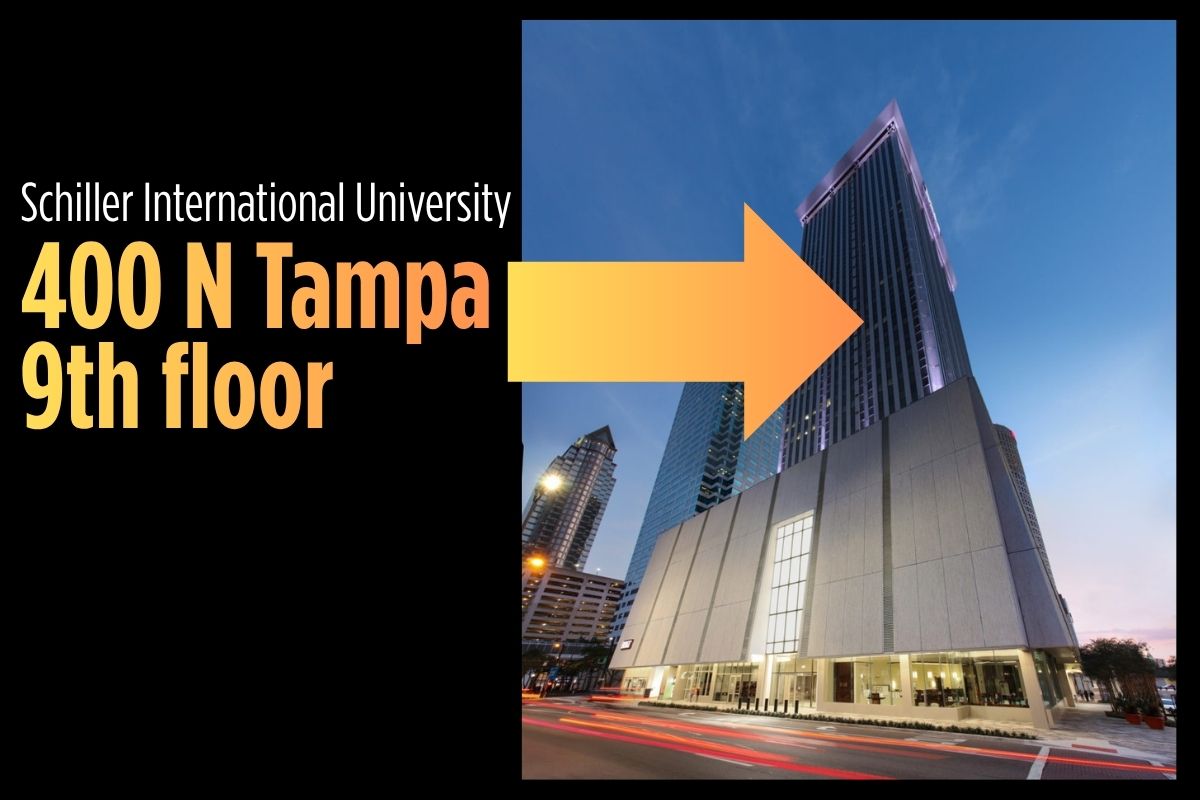
The event will take place at Schiller International University, which is located in Park Tower, located in downtown Tampa at 400 N Tampa St, on the 9th floor.
There will be food and drink, sponsored by ISACA West Florida Chapter.