If you watch the Star Trek original series, you’ve probably already internalized what’s in this flowchart created by Stephanie Fox for the sci-fi blog io9.com:
Click the chart to see it at full size.

{ 0 comments }
Tech Evangelist Joey deVilla's blog on startup life and ecommerce/mobile/web development
If you watch the Star Trek original series, you’ve probably already internalized what’s in this flowchart created by Stephanie Fox for the sci-fi blog io9.com:
Click the chart to see it at full size.
{ 0 comments }
This article originally appeared in Canadian Developer Connection.
If you’re a developer who’s either into building games or has been meaning to try out game development, you’re in luck this weekend. From Friday, January 30th through Sunday, February 1st, the Global Game Jam will be held in various cities all over the world, giving people a chance to collaborate on the design, building and presentation of a videogame in a single weekend.
The participating Canadian cities and their Global Game Jam venues are:
{ 0 comments }
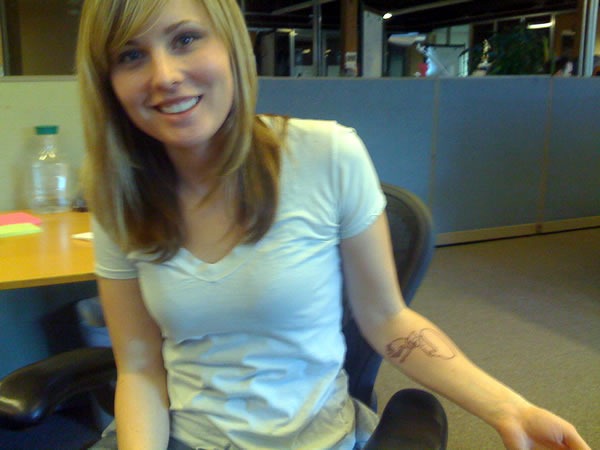
At CUSEC 2009, some of the attendees attempted to psychoanalyze the speakers out of concern for what seemed to be obsessions. The IRC backchannel during my presentation expressed concern for what they believed to be my fixation on butts, what with mentioning the movie Deliverance and showing the “Bottle Rocket in the Butt” video from my blog entry Assrockets and Opportunities.
Other speakers had their own obsessions. Free Software Foundation founder Richard Stallman’s twin obsessions were with the level of lighting in the room and his “Four Freedoms” ethics. Pownce lead developer/co-founder and now Six Apart developer Leah Culver (who was on the conference’s other end of the scruffy/slinky spectrum) was obsessed about getting a tattoo based on designs created by the enigmatic Rubyist known only as why the lucky stiff (or _why for short). Leah somehow managed to contact _why – who is notoriously J.D. Salinger-esque in his reclusiveness – to commission him to create some tattoo designs, which she showed me at the CUSEC speaker dinner last Thursday night.
A message on Twitter from _why has confirmed that she did indeed get the tattoo. Here’s a close-up:
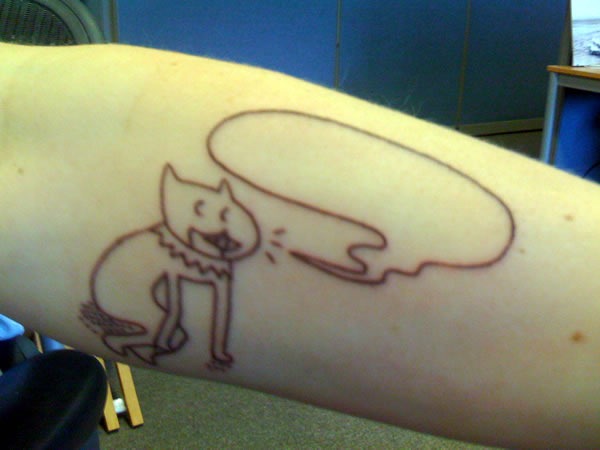
The blank word bubble above the cartoon character is there to let her fill it in with whatever she feels like having it say for the day.
“Late binding for tattoos!” I said, regretting that uber-nerdy statement mere moments later.
{ 4 comments }
TechCrunch points to a news report from San Francisco-based TV station KRON that dates all the way back to 1981, when home computers were 8-bit wonders like the era of the Apple ///, TRS-80 and Atari 400 and 800. The piece on how some people are reading their newspapers by logging into Compuserve, and how someday, we’ll all be reading our newspapers and magazines on our computers:
Back then, a computer in the home was very unusual, hence their underscoring of this interviewee’s name with “owns home computer”. It seems quaint now, but back then, that was pretty 1337:
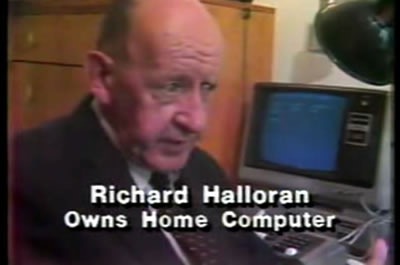
The TechCrunch article points out a couple of lines in the piece that stand out given our 2009 perspective. The first is from the San Francisco Examiner’s David Cole:
This is an experiment. We’re trying to figure out what it’s going to mean to us, as editors and reporters and what it means to the home user. And we’re not in it to make money, we’re probably not going to lose a lot but we aren’t going to make much either.
The other memorable line is from the reporter:
This is only the first step in newspapers by computers. Engineers now predict the day will come when we get all our newspapers and magazines by home computer, but that’s a few years off.
This is Joey deVilla, signing off from one of those Dynabook-style computers.
{ 4 comments }
That reason? The two pictured above, and their blog, Dating a Banker Anonymous. For more, see this entry in The Adventures of Accordion Guy in the 21st Century.
{ 0 comments }
This article was originally posted in Canadian Developer Connection.
From looking at Microsoft’s surveys of Canadian developers and plain old talking to people (something I love to do), it seems that many people who call themselves “developers” wear many hats, one of which is “manager”. If this is the case, I’ll bet that the title of this article has piqued your curiosity.
I won’t keep you in suspense any longer. According to the Harvard Business blog, the interview question you should always ask is:
“What do you do in your spare time?”
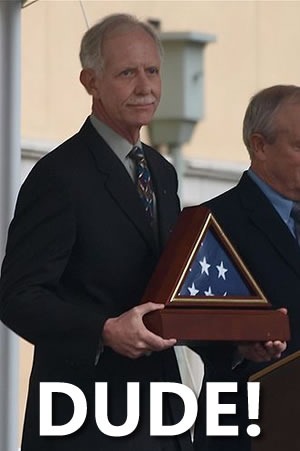
The example they cite is Captain Chesley “Sully” Sullenberger, the celebrated and heroic captain who successfully landed an Airbus A320 in the Hudson River after both engines were knocked out by what pilots call “bird strikes”. What does he do in his spare time, when he’s not flying passengers around?
In short, “Sully” is all about flying – and doing so safely. You might even say it’s an obsession of his.
Here’s what the Harvard Business blog article has to say about one’s obsessions:
Obsessions are one of the greatest telltale signs of success. Understand a person’s obsessions and you will understand her natural motivation. The thing for which she would walk to the end of the earth.
The article goes into more detail, but its general gist is that what a candidate does in his or her spare time might be a good indicator of his or her fit for the position. Looking for a star developer? It’s probably one who’s got a hobby programming project on the side. Seeking an ace IT pro? Someone who’s converted an old computer into a home entertainment unit might be a good pick.
You might want to go beyond the article’s focus on hiring others and turn it around: what do you do in your spare time? Do any of you extracurricular activities suggest that you’d be good at your job?
[The photo of Captain Chesley Sullenberger is courtesy of Wikimedia Commons and was taken by Ingrid Taylar. It is under a Creative Commons “Attribution 2.0” licence.]
{ 20 comments }
I wouldn’t mind having a setup like Videocrab’s:
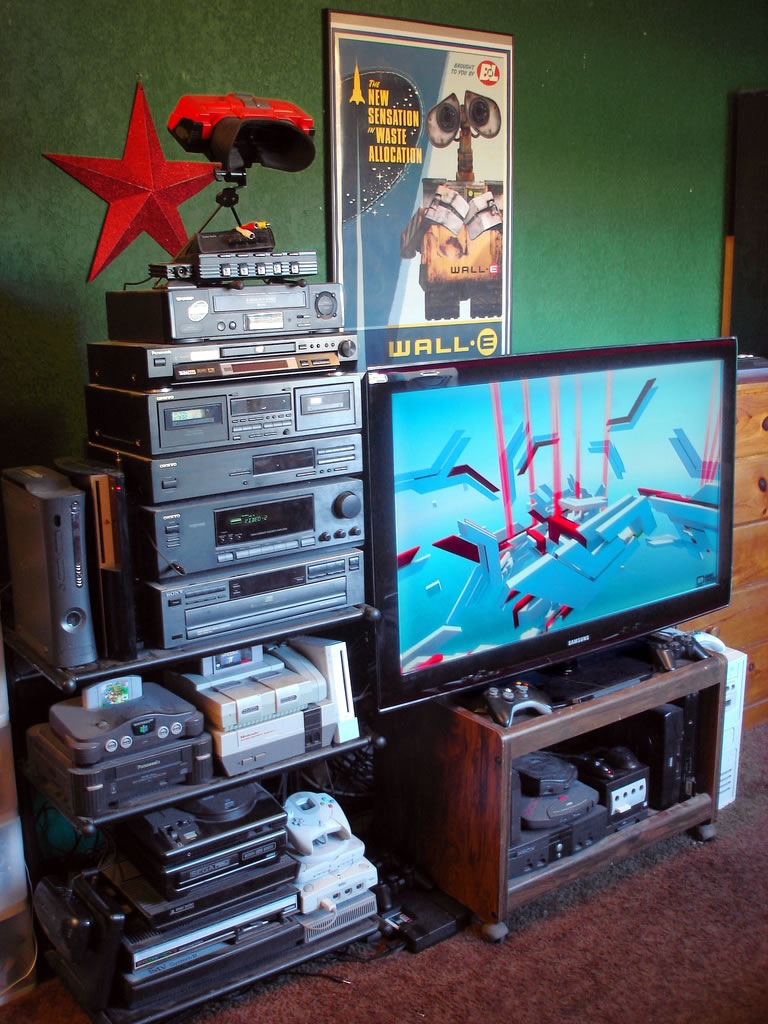
Photo by Videocrab.
Click here to see its Flickr page.
{ 3 comments }
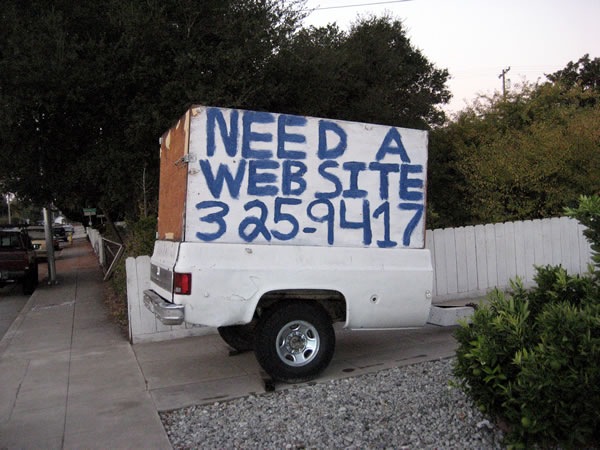
I know that you shouldn’t judge a book by its cover, but this promotion doesn’t exactly inspire confidence:
{ 3 comments }
Once again, it’s time for another Developer Lunch here in Accordion City! This is going to be the ninth in the series of lunches organized by Kristan "Krispy" Uccello, and it will be held at the usual location, Sky Dragon restaurant (on the 5th floor of Dragon City mall at the corner of Spadina and Dundas).
These lunches give Toronto-area developers and other techie types to get together for some delicious dim sum and conversation. I’ve been to several of these, and they’ve always been fun. The bill gets split on a per-table basis, and it’s typically worked out to about $12 a person, and everyone leaves full.
If you’re a developer – and that means anyone who practices or is interested in programming – you should come on over to Sky Dragon and join us for lunch! I’ll be there, and you’ can ask me about anything, whether it’s development, Microsoft, accordions, whatever!
The Developer Lunch takes place today (Tuesday, January 27th) at noon and runs until about 1:30 p.m.. Just look for the tables with the geeks!
{ 2 comments }
Suppose you’re a plush Free Software Foundation animal and you’ve just arrived in Montreal and “gnu” in town. What do you do? You hang out the with speakers and university delegates from the CUSEC conference for a night on the town!
For dinner, we went to L’Academie on Crescent Street, a restaurant where the food is prepared by student chefs training to work in three- and four-star restaurants. Here’s the gnu enjoying some Masi:

Afterwards, it was off to Brutopia for an evening of fun and drinking games:
Brutopia make a wonderful oatmeal stout. I think the gnu’s glad he joined the Dark Beer Side!
I’m going to take the gnu on my trip to Seattle next week, where I’ll be attending Microsoft’s Techready internal conference (after searching him for FSF listening devices, of course). Watch this blog for photos of the gnu’s tour of the city, and maybe even the offices in Redmond!
{ 5 comments }
Before I forget, let me wish you all a happy Chinese New Year! This year, it’s the Year of the Ox, so it’s only fitting that I post a picture of him:
Jon "The Ox" Entwistle, bassist for The Who.
For more on the Year of the Ox and Chinese astrology, this article at SFGate.com should help get you started.
{ 0 comments }
After winning the auction for the Free Software Foundation plush gnu, I hung out in the hotel lobby, checking my email. I talked with some passers-by, and occasionally Richard Stallman, who sat at the couch across from me, cracked the occasional (and very painful) pun.
In these conversations, I was approached by no less than three people who asked me if the gnu – the animal mascot of the Free Software Foundation — was a real creature or a mythical one.
Doesn’t anyone watch Animal Planet, nature shows or The Great Space Coaster (starring Gary Gnu) anymore?
They’re real. Here’s the first line of their Wikipedia entry:
The wildebeest (plural wildebeest or wildebeests), also called the gnu (/gəˈnuː/ or /ˈnjuː/), is an antelope of the genus Connochaetes. It is a hooved (ungulate) mammal.
Maybe it’s time to organize a bus trip of geeks so that we can all go to the zoo.
{ 5 comments }
Beer and science have always gone together!
I’m going to speaking at tonight’s Nature Network Pub Night here in Toronto on the topic of blogs, how they’ve helped me both do and find work, and how people in the sciences can make use of them.
The pub night is being held at Fionn MacCool’s at University and Adelaide (the full address is 181 University). People will start assembling there for dinner, drinks and conversation at 6:00 p.m. with the presentations starting at 7:00 p.m..
If you’re interested in getting to know your fellow science-types in town or want to catch up with me and talk about blogging, programming, science, accordion playing or anything else, please drop by tonight!
{ 2 comments }
The CUSEC convention’s last keynote speech was Richard Stallman’s presentation titled Copyright vs. Community in the Age of Computer Networks. It’s similar to the one he gave at the University of Toronto in the summer of 2007; you can see my detailed notes on that presentation here.
At the end of his keynote, he declared an auction, the proceeds of which would go to the Free Software Foundation (I heard a couple of people say “Yeah, right” behind me). The first item up for auction was a hardcover copy of his book Free Software, Free Society. I already own an autographed edition, so I wasn’t interested in bidding.
He started the bidding at CAD$40; someone from the audience yelled out “we’re students!”. Oblivious to the remark, the bidding continued and the book sold for somewhere close to a hundred dollars.
With the book sold, he then showed the audience the next item for auction: a plush gnu, the mascot of the Free Software Foundation:
Stallman shows off the plush gnu for auction.
Photo by Matthew Gallant.
“You should totally bid for that!” someone behind me said. I’d been thinking the same thing.
As with the book, the bidding started at student-unfriendly 40 dollars. When the price hit $60, I threw my hat in the ring.
“Sixty-five!”
The room burst out in laughter. They’d seen my presentation yesterday and knew I worked for Microsoft, long a major figure in the Free Software Foundation’s demonology.
“You should know that he’s with Microsoft!” someone in the audience said to Stallman.
“There are anti-animal cruelty laws,” said Stallman, facing in my direction.
“You have The Empire’s assurance that no harm will come to him,” I replied.
The bids continued. For every bid that came in, I immediately countered with one that was $5 higher.
“Seventy!”
“Seventy-five!”
“Eighty!”
“Eighty-five!”
By this point, the room was really getting into the bidding war. Would the Microsoftie actually win the auction for the symbol of the organization that views it as The Great Satan?
And up the bids went until I said “One hundred.” Just to underscore my intent on getting that gnu, I bid again. “One hundred five.”
“Going once…” said Stallman, “…twice…SOLD! For one hundred and five dollars.”
I walked up to the stage to loud applause.
I go onstage to claim my prize.
Photo by Andrew Louis.
Stallman seemed a tiny bit confused as to why someone from Microsoft would even want a gnu, never mind pay that much money for one.
“You do promise to obey anti-animal cruelty laws?” he asked again, as if it were a real flesh-and-blood gnu.
“I won’t harm a hair on its head. I do come from the Free Software world,” I replied, being careful not to call it the “Open Source” world. I didn’t want to give him any reason to cancel the sale.
I give Stallman my word that no harm will come to the GNU.
Photo by Andrew Louis.
I pulled out my Microsoft corporate credit card. I held it up and asked the audience: “D’you think I should pay with this?”
“Can I pay for it with my Microsoft corporate credit card?”
Asking the audience if I should pay with my Microsoft corporate credit card.
Photo by Andrew Louis.
That got a good laugh from the audience.
(In the end, since I was buying the gnu for myself and not Microsoft, I paid for it in cash. But as long as I was up there, why not milk the event for all it was worth?)
“The Microsoft corporate card. Don’t culture-jam the FSF without it.”
Photo by Andrew Louis.
Using my best Darth Vader impression, I extended my hand out to Stallman and said “Join me, Stallman, and together we shall bring order to the galaxy!”, which got a good laugh.
"Join the Dark Side, Stallman, and together we shall bring order to the galaxy!"
At the end of the conference, I walked up to Stallman, who was selling Free Software Foundation paraphernalia at the registration table. I asked him for his autograph, which he gladly provided on the plush gnu’s tag. “Happy hacking! Richard Stallman,” it read.
Getting Stallman’s autograph after the keynote.
Photo by Andrew Louis.
I did it all in the name of fun and also to show that Microsoft people have a sense of humour. I was also more than happy to hand over some money to the Free Software Foundation as a way of saying thanks for all the things they’ve done for developers – myself included – over the years.
As for the gnu, I plan to take it out from time to time, posing it for photographs just as the travelling garden gnome is.
I’ll close with a couple of close-up shots of the gnu:


{ 35 comments }