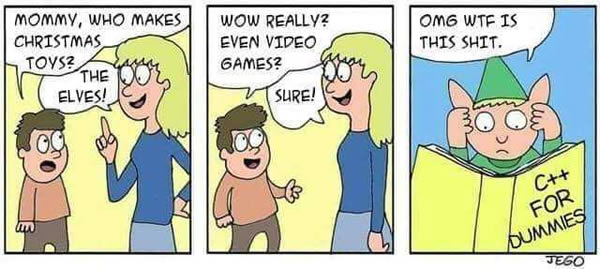
As its own creator says: “In C++ it’s harder to shoot yourself in the foot, but when you do, you blow off your whole leg.”
Thanks to Jennifer Newsome for the find!
As its own creator says: “In C++ it’s harder to shoot yourself in the foot, but when you do, you blow off your whole leg.”
Thanks to Jennifer Newsome for the find!
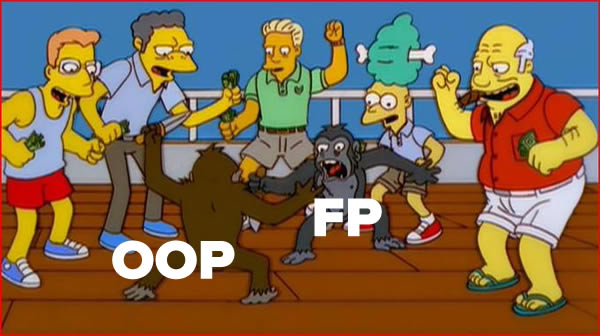
Watching programmers debate can sometimes be like watching a monkey knife fight.
Even in this day and age, when programming languages freely mix object-oriented and functional features, there are still arguments over which approach is “better”, or at least which one should be used in a given situation. Here are some videos that cover these paradigms; they might event give you some insight on how you can use them in your day-to-day coding.
Here’s a nice overview of four programming paradigms: object-oriented, functional, procedural, and logical, including the strengths of each. Start with this one.
Functional programming is actually the earliest programming paradigm, but it’s not the primary paradigm of any of the top ten programming languages that programmers are using in 2019.
In this video, Brian Will — an OO skeptic — takes four examples of “proper” object-oriented code and rewrites them using a procedural approach, resulting in what he considers to be “better” code. He’s not a big fan of the philosophy where data and code grouped together — he says “Let data just be data; let actions just be actions.” I leave it to the viewer to make their own call as to whether he’s right or wrong. (Hey, I figured I should throw in at least one curmudgeon into the list!)
When it comes to FP vs. OO, I’m of the “Why not both?” school of thought, and so in Brian Goetz.
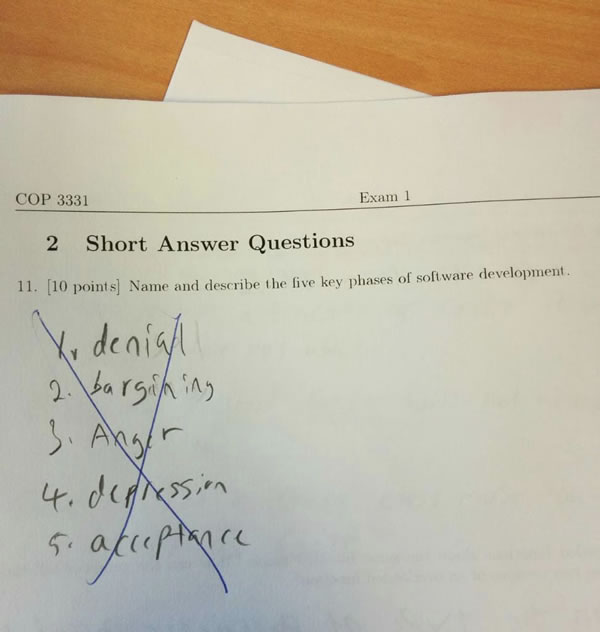
It wasn’t the answer the professor was looking for, but I’d have given it at least 6 out of the 10 points the question was worth.
If you search for “5 phases of software development”, you’ll find that there isn’t a complete consensus on what those phases are, or even if it’s just five.
…it’s time to revive this video that New Relic put out way back in 2011 to promote their application monitoring service.
Titled We Love Developers, it features some of the brightest lights in the industry:
At the end of the video, they wanted to use the image of a more “everyman” developer to represent you, their customer. Guessed who they picked:

My photographer friend Adam P. W. Smith (my old business partner; together, we were datapanik software systems and we worked on some pretty interesting projects back in the late ‘90s) took the picture back in August when I was visiting him in Vancouver. I’d arrived a day early for the HackVAN hackathon and was sitting in his kitchen getting some work done when he decided to get a couple of shots. He poured me a glass of scotch, set it on my accordion, which I’d set down on the chair beside me, and staring taking pictures.

In case you were wondering, you can find out more about my new gig in the article titled — appropriately enough — The new gig.
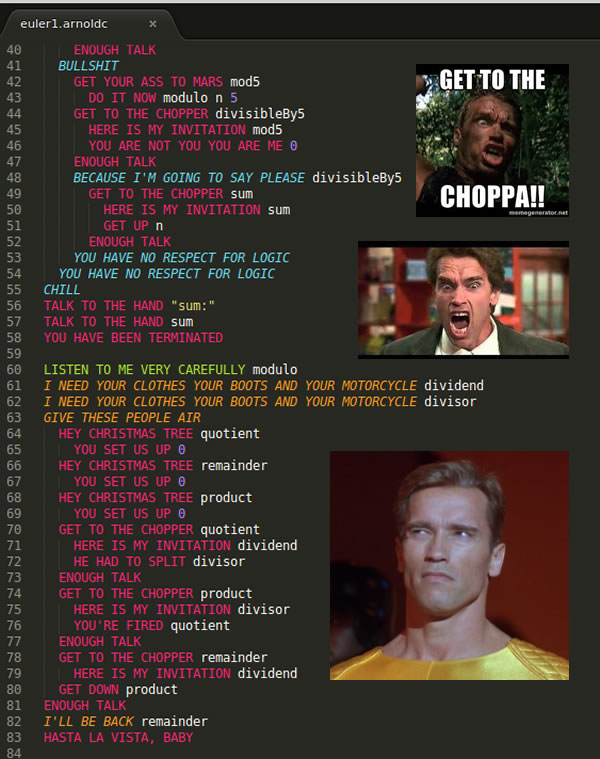
Do you like programming? Do you like Arnold Schwarzenegger movies? If so, ArnoldC is the programming language for you!
ArnoldC will never make the TIOBE list, but then again, no other programming language is based on Arnold Schwarzenegger’s movie one-liners! Better still, there’s an ArnoldC syntax highlighting package for Sublime.
Here’s “Hello, World!” in ArnoldC:
IT'S SHOWTIME
TALK TO THE HAND "hello world"
YOU HAVE BEEN TERMINATED
It compiles down to Java bytecode. Running the program above is as simple as saving it as hello.arnoldc and entering the following on the command line:
java -jar ArnoldC.jar hello.arnoldc
java hello
Find out more about ArnoldC on its GitHub page, and once you’ve been impressed, download it, start coding, and GET TO DA CHOPPA!
Since we’re on the topic of Arnie, enjoy this video:
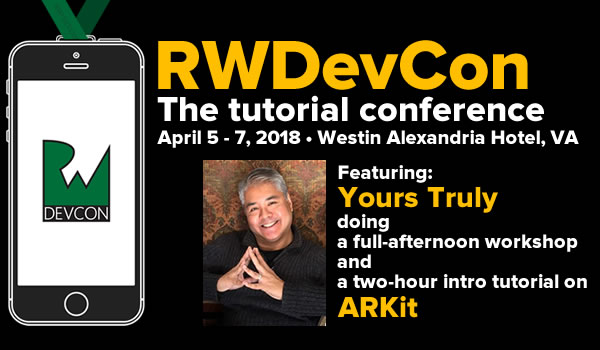
If you’re interested in iOS development and are looking for a conference to attend next year, I highly recommend RWDevCon, the all-tutorial, mostly-iOS conference run by the fine people at the tutorial site RayWenderlich.com!
It takes place during April 5 through 7, 2018 in Alexandria, Virginia, and will feature…
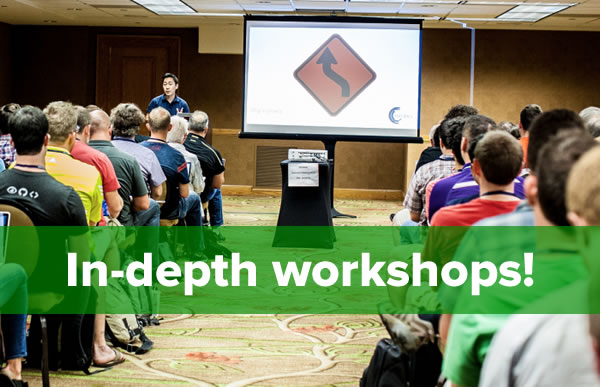
…four in-depth workshops…
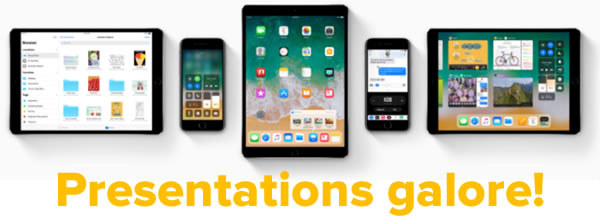
…and all these presentations…

…and a party every night…

…all in a great venue:

Want to find out more? Visit RWDevCon.com!
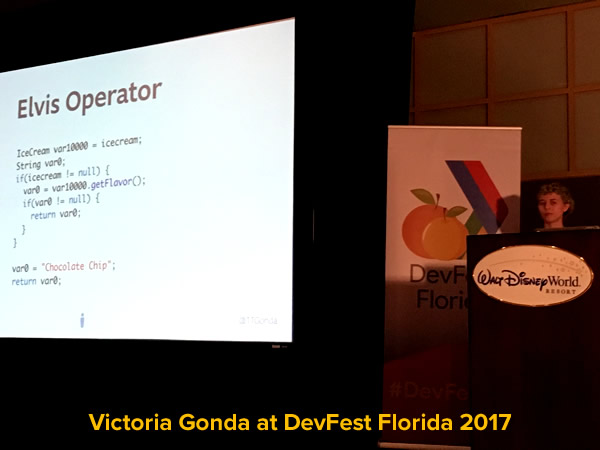
At Victoria Gonda’s presentation on Kotlin at DevFest Florida 2017, she talked about many of Kotlin’s language features. (Be sure to check out the slides from her presentation, Kotlin Uncovered!)
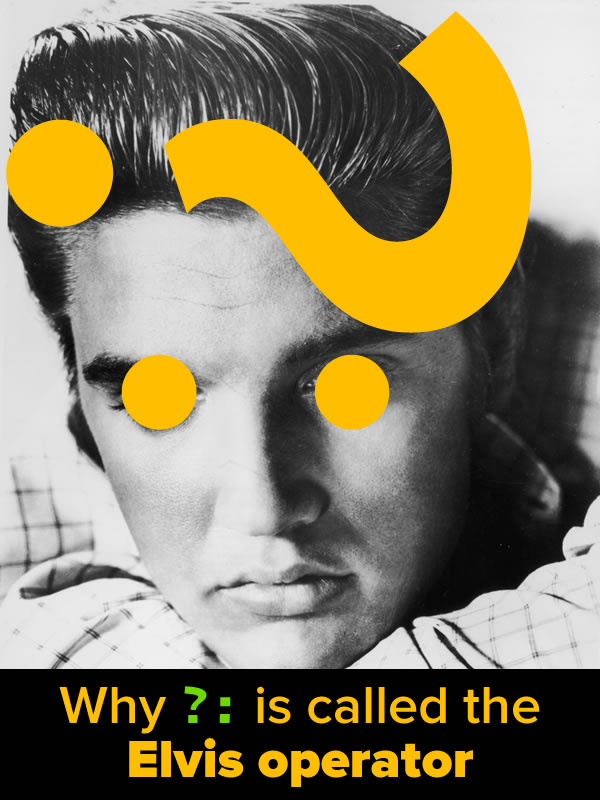
When she got to the “Elvis operator” — ?: — there were murmurs in the crowd, and I could hear people whispering “why’s it called that?”. Hopefully, the photo above answers the question: it looks like an emoticon for Elvis.
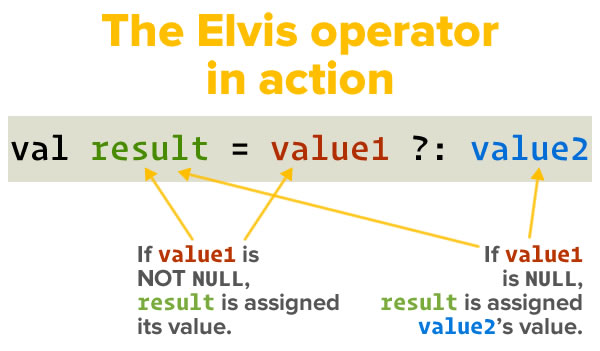
The more formal name for the Elvis operator is the null coalescing operator, and it’s a binary operator that does the following:
It’s far more elegant to write
val result = value1 ?: value2
than
if (value1 != null) {
  result = value1
} else {
  result = value2
}
And in case you iOS developers were wondering, Swift has a null coalescing operator: it’s ??.