In case you missed it, here’s that interview I did for the 4:00 p.m. news on FOX 13 Tampa on Monday, April 10th with anchor Chris Cato:
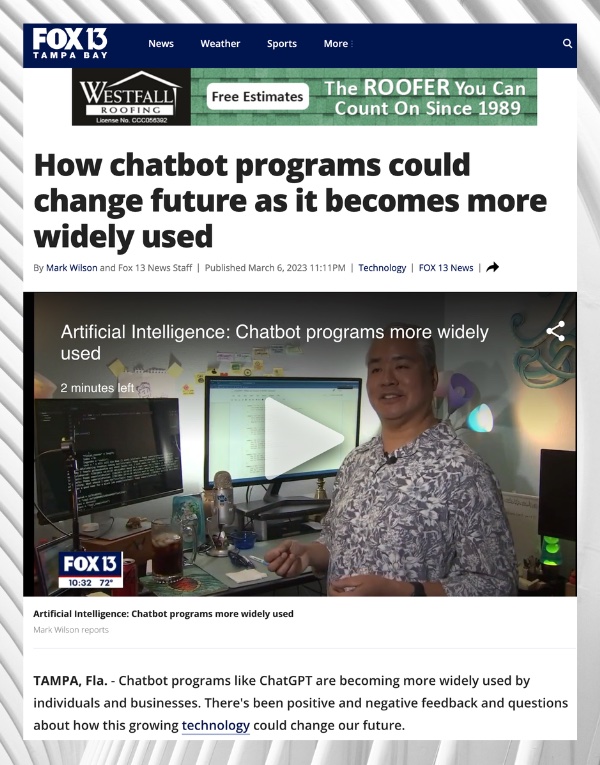
It’s a follow-up to this piece that FOX 13 did back in March:
In that piece, I appeared along with:
Local realtor Chris Logan, who’s been using ChatGPT to speed up the (presumably tedious) process of writing up descriptions of houses for sale
University of South Florida associate director of the School of Information Systems and Management Triparna de Vreede, who talked about its possible malicious uses and what might be possible when AI meets quantum computing.
IP lawyer Thomas Stanton, who talked about how AI could affect jobs.
All of this is a good preamble for the first Tampa Artificial Intelligence Meetup session that I’ll be running — it’s happening on Wednesday, May 31st!
The video features Sat Ramphal, CEO and co-founder of Maya AI, a Tampa-based early-stage startup whose product is an analysis tool that derives insights from data and delivers those insights conversationally. Their target customers are businesses looking for suggestions and answers based on their company data, and they’ve already caught the attention of retail and pharmaceutical companies.
Maya AI’s co-founders, the Rampal brothers. From left to right: Sean, Sat, and Shivam.
ChatGPT is a language model developed by OpenAI, specifically trained to generate human-like text based on its received input. It is capable of answering questions, providing information, generating content, and performing various other language-related tasks.
On the other hand, Maya AI is a more general AI platform that can be used for various applications and industries. It can perform various tasks, such as image and voice recognition, data analysis, and decision-making.In summary, while ChatGPT is a broader focus on language processing, Maya AI is a specifically focused AI platform with a wider range of capabilities and potential use cases.
I appear in two segments of the piece, along with:
Local realtor Chris Logan, who’s been using ChatGPT to speed up the (presumably tedious) process of writing up descriptions of houses for sale
University of South Florida associate director of the School of Information Systems and Management Triparna de Vreede, who talked about its possible malicious uses and what might be possible when AI meets quantum computing.
IP lawyer Thomas Stanton, who talked about how AI could affect jobs.
Watching the segment, it occurred to me that I need to light my office the way that the news crew did for the segment — it’s got such a great “cinematic hacker” vibe!
Also: My thanks to Kristin Moore for inviting me to be part of the piece!
Advent of Code is an annual event featuring Christmas-themed puzzles that are meant to be solved with code. Since 2015, tens of thousands of programmers have tackled the new puzzles that appear every day from December 1 through 25 at the stroke of midnight (U.S. Eastern standard time).
If you’ve been working on the same sort of programming problems day in and day out and feel that you’re in a coding rut, Advent of Code is a great way to sharpen your skills. If you’re learning a new programming language, Advent of Code’s challenges are a great way to discover the in and outs of your new language. If you’re interviewing for a developer position and a coding exercise is part of the process, Advent of Code can help prepare you.
In the video, I’ll walk you through the solutions for Day 1 of the 2015 and 2020 Advent of Code in Python. Combined with my Advent of Code article on the Auth0 by Okta blog, which covers even more challenges, it should help you get started with this year’s Advent of Code!
C’mon, how many programming tutorial videos have a scene like this?
If you’re making an iOS app, the odds are pretty good that sooner or later, you’re going to have to integrate authentication — login and logout — into it. I show you how to do that with Auth0 in both a video…
…as well as a matching two-part article series that walks you through the process:
As the Russian invasion of Ukraine continues, you’re increasingly likely to hear the name “Bellingcat”. It’s the name of an independent group of researchers, investigators, and citizen journalists who practice open source intelligence (OSINT). Here’s a quick primer about Bellingcat and open source intelligence, plus a whole lot of videos about Bellingcat’s work and their reporting on aggression by Russia’s government and armed forces.
Bellingcat’s origins
Bellingcat get their name from Aesop’s fable, Belling the Cat. In the fable, the youngest of a group of mice who were terrorized by a cat suggests that they put a bell on the cat, which would act as an early warning system. While the suggestion was warmly received, one of the elder mice brought up a serious challenge to the plan: “Who will bell the cat?”
Eliot Higgins founded Bellingcat in 2012 after being laid off from an administrative job. He started doing independent research on the civil war in Syria by collecting and analyzing publicly available photos and footage, and cross-referencing them with reports. Since then, he’s grown the organization, who’ve gone on to apply their open source intelligence skills to stories including:
Open source intelligence, often referred to as OSINT, is a term meaning any information that can be gathered from freely-available, publicly-available sources. It’s most often used to referred to information gathered online — the kind that anyone with an internet connection would be able to access. This information could be available free of charge, or it could be acquired for a fee (e.g. a subscription to a news organization, data source, or API).
It also applies to non-online/non-digital information from books, newspapers, magazines, academic journals and papers, FOIA requests and their equivalents, and so on.
It could be in text form, but it also applies to video, photographs, sound recordings, data files, and databases.
Giancarlo Fiorella, a senior Bellingcat investigator based in Toronto, makes it clear that OSINT is not “hacking” (as in accessing computer systems or information illegally), stealing, or spying. It’s about gathering data and doing the research.
Bellingcat contribute to the Russia-Ukraine monitor map
Click the image to visit the map page.
You may have read about the Russia-Ukraine Monitor Map on my personal blog, but if you haven’t, it’s a a public resource for mapping, documenting, and verifying significant incidents that happen in the Russian invasion of Ukraine. Bellingcat are a primary contributor of information to this resource.
Videos about Bellingcat
Here’s a collection of YouTube videos on Bellingcat for those of you who’d like to know more about them or about OSINT.
Insights from Bellingcat on Russia’s Ukraine Ambitions (March 2, 2022 – Reuters Institute)
This is a Zoom interview with Christo Grozev, Bellingcat’s lead Russia investigator.
Fact-checkers on the front line of Russian propaganda machine (February 25, 2022 – CBC)
Inept Info-Wars: Bellingcat’s Eliot Higgins on Putin’s Problems with Reality (February 24, 2022 – Foreign Press Association USA)
Open-source Intelligence (OSINT) by Giancarlo Fiorella, Investigator and Trainer at Bellingcat (December 2021 – Asian College of Journalism)
This features a presentation by senior Bellingcat investigator Giancarlo Fiorella about Bellingcat, open source investigations and how they’re conducted. He goes into detail about investigating the Mahbere Dego massacres and the ethical issues and challenges in open source research.
We Are Bellingcat: An Intelligence Agency for the People (May 2021 – Talks at Google)
How to Business is a new YouTube channel created by Tampa Bay-area techie Frederick Weiss of Thunder Nerds fame that features quick video interviews (typically around 10 minutes in length) that show techies how to tackle business tasks that they may need to take on.
While there’s no shortage of resources that teach you how to use a particular technology, there is a need for how-tos aimed at techies who need to know how to do things related to money, business processes, sales, and other topics outside our main areas of expertise. That’s what How to Business is for!
Here’s How to Business’ promo video:
Here’s the first interview, How to Make Websites Accessible. It features Todd Libby, accessibility engineer at WebstaurantStore and host of the Front End Nerdery podcast.
The most recent interview, How to Implement Authentication and Authorization with Auth0, features Yours Truly, where I’m operating in my capacity as a Senior Developer Advocate at Auth0, and I talk about not rolling your own authentication and authorization but going with an experienced provider instead: