 I spent the morning and early afternoon of 813 Tech Day at Hotel Haya in Ybor. I’m still thinking about the Fortifying the Digital Frontier: Cybersecurity at the Forefront of Fintech Innovation session, largely because of the twist that host Michael Hall introduced, which made it different from every other “Cyber is important, yo!” panel I’ve sat through. About two-thirds of the way in, he stopped running the panel and turned it into a consulting engagement. On stage, for free, for a random attendee. And it worked!
Read on, and you’ll see.
A show of hands
Michael started by asking everyone who runs a company or product that touches money, customer data, or both to raise their hands.
Some hands went up, which wasn’t surprising.
Then he asked: “Keep them up if you have a single person whose actual job is nothing but security.”
All hands down.
And that moment was the panel in summary. A room full of people founding or working at companies (or hoping to found and work at them) handling money and PII, and essentially zero dedicated security headcount among them. To be fair, a number of them were solopreneurs. Still, Michael’s follow-up question was an important one: “So what are you going to do about cyber warfare?”
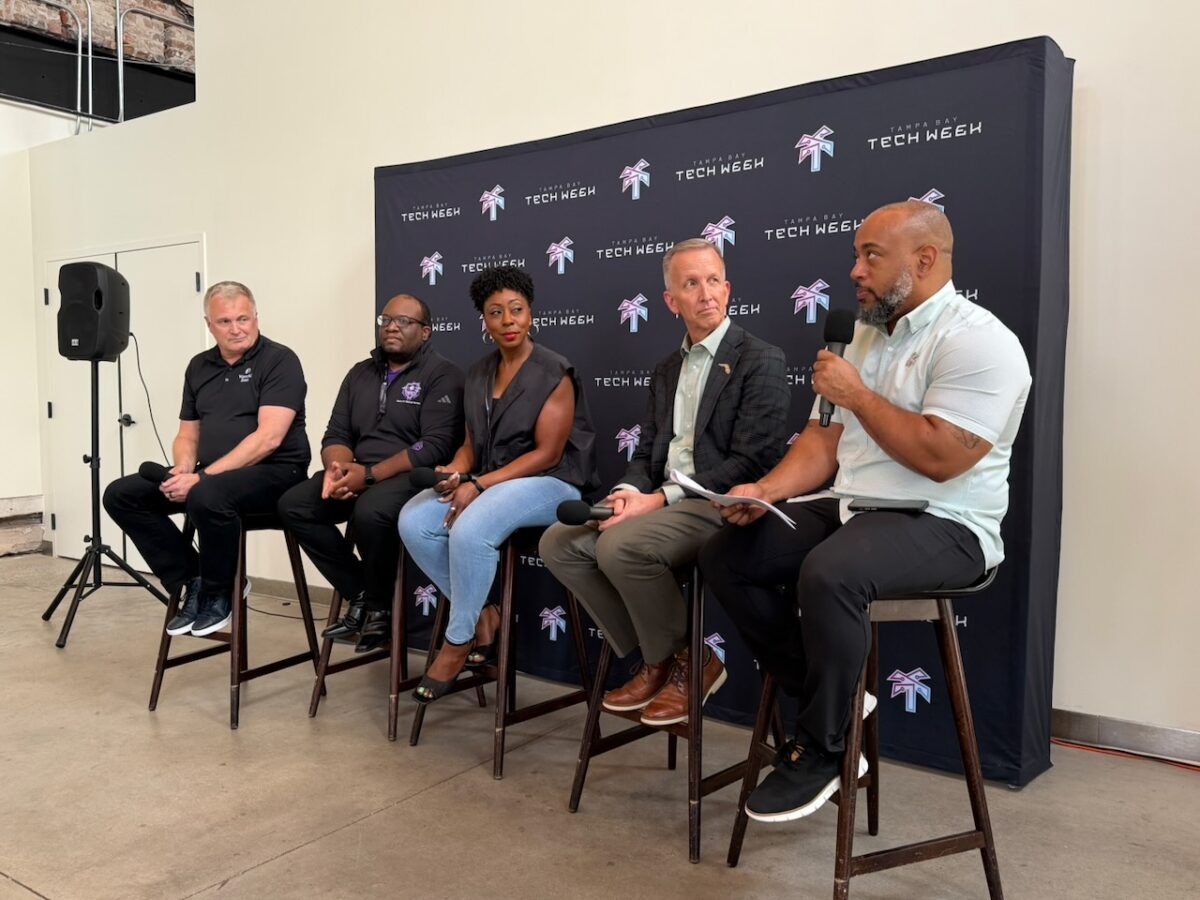
Introducing the panel
The panel had unusually good coverage of the problem space: economic development, defense-grade compliance, offensive security, and someone who actually runs a bank.
They were, from left to right onstage:
- Alexei “Alex” Chirokikh, CTO of Waterfall Bank, with a couple of decades of building core banking platforms across a dozen-plus countries
- Aaron Butler, founder of BlackHack Society, who builds security and compliance programs for SaaS companies and had just flown back from DEF CON the week before
- Candace Williams, Associate Director of Cybersecurity Leadership at Raytheon, Tampa-based, and author of No Experience Required: Your Cybersecurity Career Kickstart Guide
- Paul Sohl, CEO of the Florida High Tech Corridor, which spans 23 counties, three research universities (USF, UCF, UF); he’s also a retired Navy Rear Admiral
The gap between passing the audit and actually defended
Michael’s next question was a good one: “What’s the widest gap between how secure fintechs think they are and how secure they actually are?”
Alexei’s answer was the cleanest formulation of the compliance trap: compliance does not equal security. You can check every box and still be wide open. His diagnosis of why startups get this wrong:
“We identify the target, then we fire, and then we aim.”
Speed first, aim later. But in banking, “later” can be expensive in ways founders don’t model. He mentioned that for an average-sized bank, a single day of downtime can put the bank’s license at risk.
Candace, coming from the defense side, made it concrete with the ATO, the Authorization to Operate. You bring in an assessor, they verify you’ve got your asset labeling and your SSO and your password policy, and you get the shiny gold star.
And then what?
“Are you updating your AV definitions after you have the ATO? Are you patching on a specific cadence? Are you continuously monitoring the controls you got a check box for?”
Compliance is a still-frame snapshot. Security is the whole movie. Everyone optimizes for the snapshot because that’s what gets audited, but forgets about the movie.
“Too small to matter” is not a security posture
Michael asked Aaron to scare the room, and to Aaron’s credit, he skipped the horror stories and reached for stats.
An attacker can get into essentially any internet-facing machine at almost any company inside an hour. Depending on whose telemetry you’re reading, that number is more like a few minutes. Someone in the audience called out CrowdStrike’s breakout-time figure, which is measured in seconds now.
Aaron’s framing:
“A breach is inevitable. Not if, but when. Your worst day is my every day. If it’s going to rain, you bring a raincoat, not an umbrella.”
That’s why “we’ll deal with it when it happens” isn’t a plan.
What AI did and didn’t change
Aaron summarized it well:
“AI lowered the skill floor for attackers and accelerated the execution timeline. It did not invent new attack classes.”
Phishing, smishing, and credential reuse: these are the same failure modes we’ve had for a couple of decades now. Attacks are just cheaper, faster, and automated now. All this means that your unpatched, password-shared, over-permissioned environment didn’t get more vulnerable; it just got found sooner.
He also had a nice riff on password policy whiplash. We spent years pushing everyone to 15–16 characters, guidance loosened again, and meanwhile the real-world state of the art is that password123 became password12345.
Alexei’s defensive take was the one that fintech founders in the room needed: his bank is doing “baby steps” on AI. Instead of a tool, the first step an AI policy and an AI strategy with actual guardrails. Because the failure mode isn’t anything as melodramatic as a rogue superintelligence, but something more mundane, such as an employee pasting client data into a public chatbot:
“Yes, you can get the answer. But now you’ve already lost that client data. It’s somewhere, and you don’t know who can get it.”
He also noted, matter-of-factly, that some of the adversaries in this space are state-funded. A small bank in Tampa versus a government-backed team is not a fair fight, which is precisely why the guardrails have process over motivation; policy and architecture over vigilance.
The compliance question founders actually care about: Which one pays?
When Michael asked which single compliance framework a founder should chase this year to unlock the most enterprise revenue, Aaron flagged it as a contentious opinion and we got the most useful ninety seconds of the panel:
- SOC 2 Type II is the one. Depending on your market, it can move your ability to capture revenue by somewhere between 5% and 40%. Nearly everyone selling to enterprise ends up needing it anyway.
- HIPAA is self-assessed. Draw your own conclusions about how rigorously that’s happening across the industry.
- PCI DSS: If you’re doing payments and processing, you can largely offload it. Stripe already has it. Use their pipes; as a startup you can’t afford to build that infrastructure yourself.
- Then there’s the practitioner’s trick: security people maintain crosswalks that map controls across frameworks. Do SOC 2 first and you’re roughly 70% of the way to ISO 27001. Do them in order and stop paying for the same control four times.
Candace added the necessary caveat: the right framework depends on your industry, and in defense you don’t get to choose; there are non-negotiable requirements.
Alexei pointed out that PCI DSS matters for finance the way HIPAA matters for healthcare, so “which framework” is downstream of “which industry.”
Candace’s advice for taking this to a board is deceptively simple: explain it in their language…
- Bad: “We need to implement AC-2.”
- Better: “We sell Cracker Jacks, here’s the system that keeps the Cracker Jack business running, here’s why this control protects it.”
The panel turned into a live advisory board
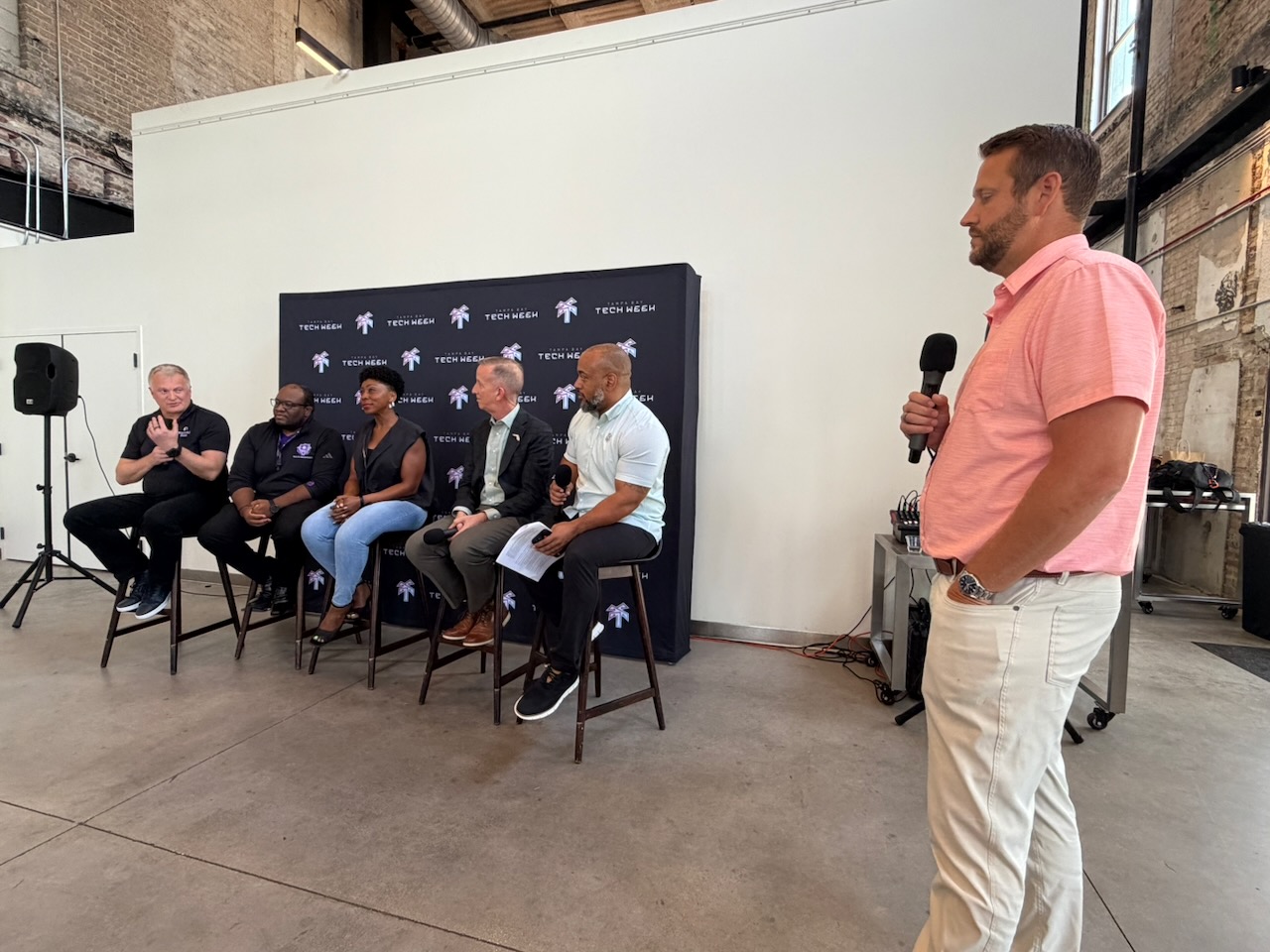
This is the part I’ve never seen at a conference.
An audience member who’s a consultant mentioned he’s got a client (transfer agents, handling bank relationships and a mountain of shareholder PII) who wants to point an agentic AI system at their overflowing email inbox.
The debate: should they be cloud-based, or reverse twenty years of industry momentum and go back to on-prem so they can hot-swap open-weight models without token costs and keep everything whitelisted?
Michael stopped the panel, brought the consultant to the front, declared the panelists a pop-up advisory board, and made them answer.
The responses split about how you’d expect from their backgrounds:
- Alexei: Going on-prem relocates risk rather than eliminating it. It also means you’re now defending on two fronts: not just outsiders, but also insiders! You’re paying for infrastructure, security, and people. The “cheaper” assumption usually doesn’t survive contact with the invoice. When Microsoft ships patches every week, that’s a vendor doing work you’d otherwise be doing yourself, maybe badly.
- Aaron: Go hybrid, on the grounds that nobody has a crystal ball about second- and third-order downstream constraints, and hybrid preserves optionality for next year.
- Candace: Her world is mostly on-prem and air-gapped, so that’s where her instinct goes, insider threat and hiring burden included.
- Paul: He’s a retired Rear Admiral, so he followed the Navy adage “A ship’s a fool to fight a fort” and declared the question outside his expertise and deferred to the other panelists. In my opinion, that earned him even more credibility.
Michael then asked for the consultant’s contact info so they can follow up in 60 days and report back to the room on what he actually decided. That’s the accountability loop conferences never close. I’ll keep tabs on this and let you know how it turned out.
After that, they did it again, this time with an attendee trying to break from defense-sector BDR work into commercial cybersecurity account management. They brought her to the front and gave her a live career consult.ation.
Candace’s advice was to stop being invisible on LinkedIn and start advertising the specific role she wants.
Aaron also had good cybersecurity-specific advice:
“Cybersecurity is one of the most arrogant professions on the planet. If you’re the one person they want to have a beer with afterward, you’ve already won.”
(I work in cyber. He’s right. In this field, being able to communicate humility is a cheat code.)
 And finally, in a fit of audience participation, and after quickly consulting NetFoundry’s careers page (I work there and love it!), I stood up and asked her “How about starting with a Sales Development Rep role that works with Account Management? We have an opening at NetFoundry.”
She said “yes,” and Michael yelled “Joey’s got to get her the job!”
(She and I chatted afterward. Our conversation will be ongoing, and I guess I’ll have to follow up with Michael in 60 days…)
Tampa Bay resources you should know about
Paul’s whole reason for being there was to make people in the room aware of resources they might not have tapped:
- The Florida High Tech Corridor spans 23 counties from Tampa Bay to the Space Coast, and deliberately plays Switzerland across all of them; there are no favorites among universities.
- USF’s Bellini College of AI, Cybersecurity and Computing is teaching ethics at the beginning of the degree rather than bolting it on senior year, on the theory that security is fundamentally a judgment-call discipline, not a checklist one. Elizabeth Nelson is the Corridor’s point of contact at USF.
- SBIR/STTR grants are available from eleven different federal agencies, it’s non-dilutive funding, and the Corridor can help you go after it and match on top of it.
- Don’t forget places like Embarc Collective, Tampa Bay Wave, and spARK Labs!
- Florida’s structural advantage is dual-use! The military and commercial sides are unusually well connected here, and the biggest buyer in the world is a short drive away.
Closing round: What’s the one thing you can’t get wrong?
Michael went down the line and asked each panelist for the single thing a founder walking out with one weekend and a small budget can’t afford to get wrong:
- Paul: Take the first step. Just do something. Anything.
- Candace: “Culture eats cyber strategy for breakfast.” If your people haven’t internalized cyber hygiene, none of the rest matters. Her running metaphor all afternoon was brushing your teeth: you don’t deliberate about it, you just do it. Security should feel like that.
- Aaron: Get business insurance, make sure it has carve-outs for cybersecurity, and make sure those carve-outs cover AI-driven attacks. That’s the one I hadn’t heard before and the one I’d act on tomorrow.
- Alexei: Hire the right people. (Michael made him clarify for the audio: right people.)
My four take-aways from this session
- Compliance is a snapshot, security is a movie. If your controls aren’t monitored continuously, your ATO or SOC 2 report describes a company that existed on one Tuesday.
- The framework question has an actual answer: SOC 2 Type 2 first, offload PCI to your payment processor, use a crosswalk so you’re not re-implementing the same control in four vocabularies.
- AI didn’t create new attacks; it created new attackers. The skill floor dropped. The people who couldn’t do this eighteen months ago can do it now, at scale, cheaply. Your threat model didn’t change; your threat volume did.
Take-away number four is so good that I wanted to separate it from the rest:
4. Turning a panel into a pop-up advisory board bit was brilliant! Michael took real attendee problems, put them in front of a panel of experts, made them answer in public, and asked them to follow up in 60 days. This moved what the panel said from the rhetorical to the practical.
Let’s see more of this, please, and nicely done, Michael!
 813 Tech Day