It’s a completely counterintuitive concept, but that’s the thesis of API Gateway Security: A Zero Trust Approach, an article we just refreshed on the NetFoundry blog.
Read the article here: https://netfoundry.io/devops/api-gateway-security/
It’s written by Tod Burtchell, Associate Director Service Planning & Development in Management & Operations Platform (long title, dude!), whom I had the pleasure of meeting at a planning meeting last week.
Most API security spend goes into inspecting inbound traffic (WAFs, rate limiting, an API gateway parked out front), and all of it inspects traffic that has already arrived at your infrastructure. The exploit is already inside the door even before the door can do anything.
The general gist of the article leans on NetFoundry CEO Galeal Zino’s earlier article, Squaring the Circle: How to Make Public APIs Private, where he describes APIs as “snowflakes”. They’re snowflakes in the sense that they’re always changing, and each change quietly opens a new attack vector that signature-based defenses haven’t seen yet.
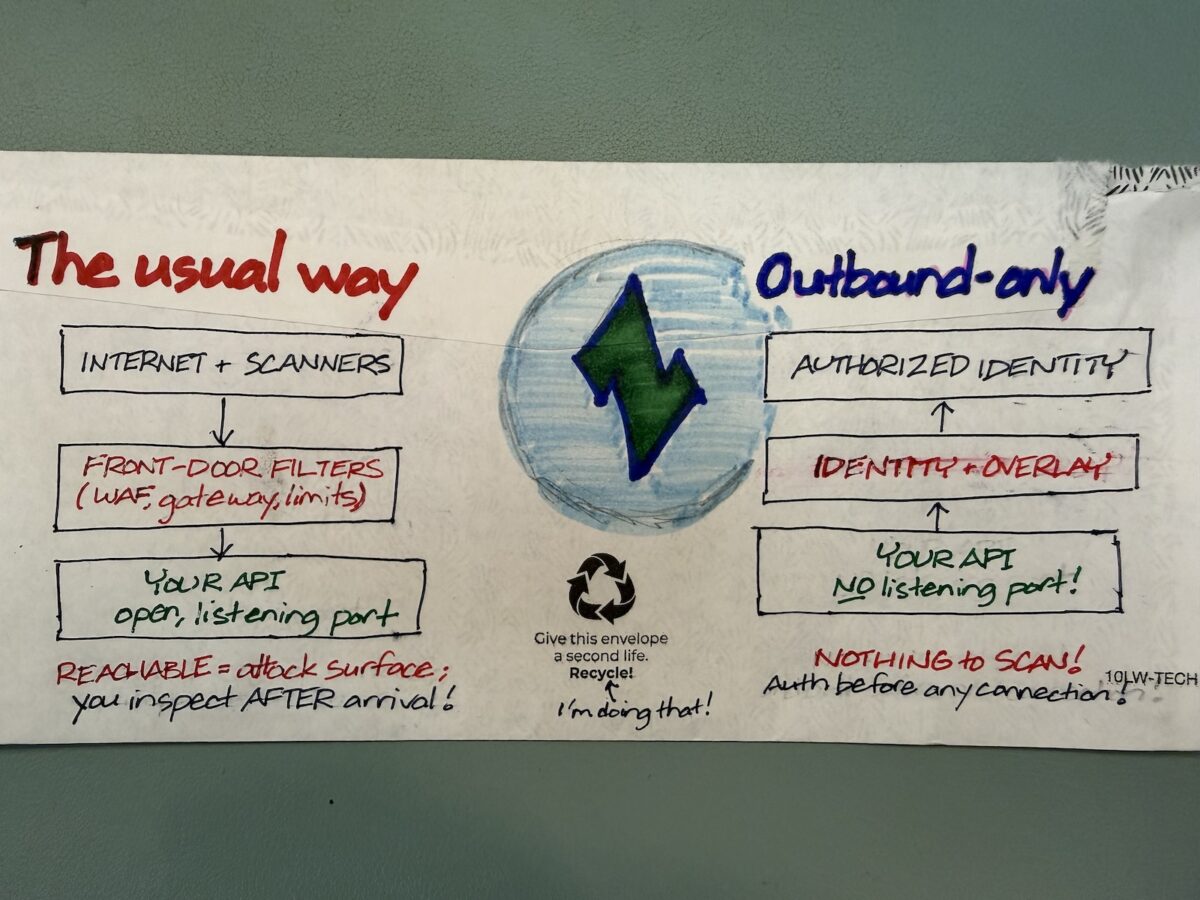
The tl;dr: Hardening the front door is one thing, but why not remove it instead? Picture and API with outbound-only connections, no listening ports, and identity-and-auth before anything connects. As a result, the API stays usable for the people who should reach it and is simply invisible to everyone else. OpenZiti is the open-source plumbing underneath if you want to see how it actually works.
I thought I’d make another “back of the envelope” diagram showing the difference between the usual way of building APIs, and the OpenZiti-powered outbound-only approach.
Once again, here’s the article: https://netfoundry.io/devops/api-gateway-security/