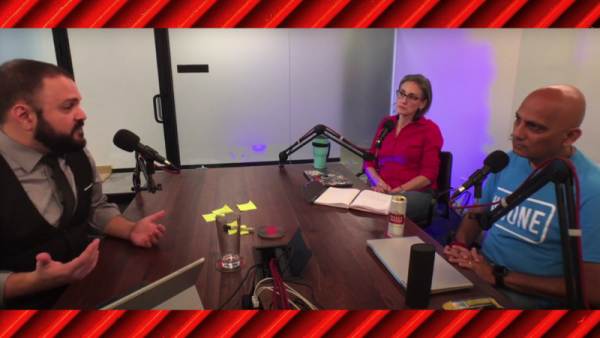
If you work on a team that produces software, and especially if it’s supposed to be an agile team, do yourself a favor and check out Arguing Agile, the YouTube channel and podcast produced and presented by Tampa Bay’s own Brian Orlando and Om Patel.
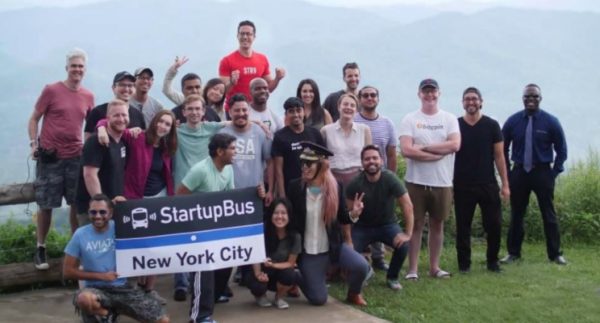
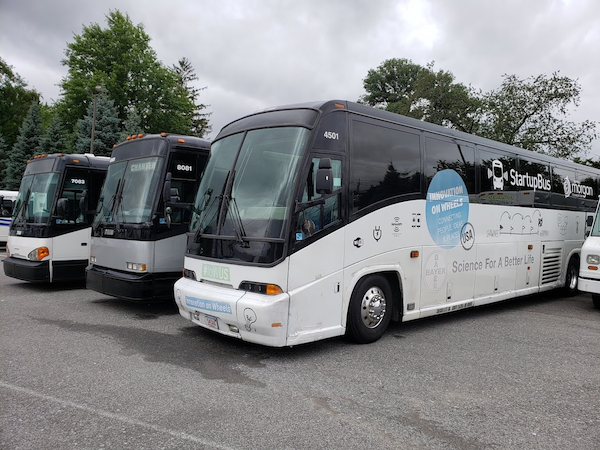
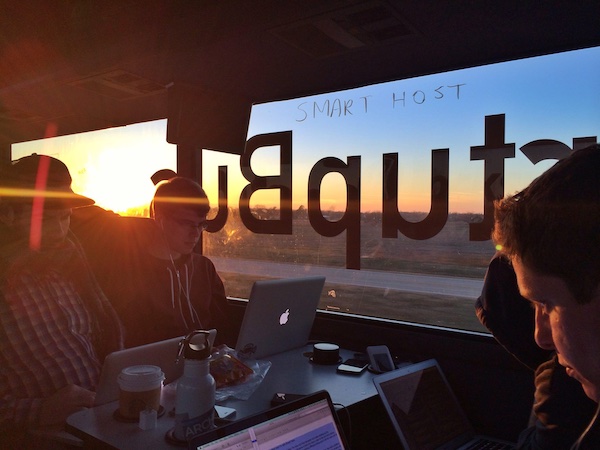
The title of this post should be a big hint: Everything you need to know in order to win StartupBus North America 2022 is contained within a podcast. This is the third in a series of posts covering the “Startup Bus” series of episodes from Gimlet Media’s Startup podcast, which covered the New York bus’ journey during StartupBus 2017.
Did you miss the first four articles in this series? Here they are:
…and here are the lessons I took away from this episode:
A lot of what makes success is just showing up. At the start of the episode, podcast host Eric goes for an early morning walk with Colleen Lavin of team Daisy and discovers that she was nce the Illinois Knights of Columbus free throw champion for girls age 14. Here’s how she tells the story:
COLLEEN: I was like getting my school volunteer hours, helping my dad at the free throw contest, and I was in the right age range, so he made me compete. I made two baskets, because I was not a basketball player. But no other girls in my age range showed up, and he made me go to the next competition and no other girls my age range showed up. Finally, I was almost sent to D.C to compete in the nationals after making a total of like four baskets.
ERIC: Because nobody had showed up?
COLLEEN: In my age competition!
Be prepared for possible twists in the finals.Elias Bizannes, the creator of StartupBus, loves drama. In the 2017 competition, even though there were five finalists, Elias decided to create a sixth team made up of people from teams who didn’t make it into the finals. The team would create a blockchain-powered voting app. Why did he do it? In his own words…
To mess with people to be honest. Because that’s what we do with StartupBus, we push them and we break them. And what happens is this remarkable thing comes out when people go beyond the limits they think they can, they actually step up. And so by introducing a new team, it was gonna add another level of competitive threat to the finals.
The finals will feature far more polished pitches and apps: “From the moment the pitches begin, it’s apparent. This is a very different level of competition than yesterday. The presentations are all well-crafted. Each of the products makes sense. You could imagine people making these pitches to actual investors.”
The title of this post should be a big hint: Everything you need to know in order to win StartupBus North America 2022 is contained within a podcast. This is the third in a series of posts covering the “Startup Bus” series of episodes from Gimlet Media’s Startup podcast, which covered the New York bus’ journey during StartupBus 2017.
…and here are the lessons I took away from this episode:
If you can find teammates that are on your wavelength, you can achieve a lot. Although they’re on the Florida StartupBus and not the bus that the podcast is covering, they remain a source of fascination for Eric, the host. Not only do Robert Blacklidge and Trey Steinhoff get along so well, but they also work so well together, and the synergy will take them far together. (Full disclosure: I worked with Trey at Lilypad, and can vouch for the fact that he is a great teammate. I also know Robert and can understand why he and Trey got along so well.)
A conflict within the team doesn’t have to destroy the team; in fact, not only can conflicts be resolved, but they can even strengthen a team. Ash from the Denari team had rubbed many of his teammates the wrong way, and there was talk of kicking him off the team. Things have turned around in this episode: everyone’s getting along, and Ash is considerably less acerbic — even optimistic-sounding.
The StartupBus format borrows some of its ideas from reality TV game shows, which means that there can be intentional confusion. “The teams have been getting different information about the competition all day. They’re hearing conflicting things about timing, about whether or not pitch decks are allowed. And this confusion, it all feels weirdly intentional.”
StartupBus is supposed to be a challenge. It’s not supposed to be easy, and as anyone who’s done it before will tell you, it can be gruelling at times. And that’s a good thing — if StartupBus works as designed, you shouldn’t be exactly the same person at the end of the ride. As one of the Denari people puts it: “This is a Navy SEAL training program for startups. This is like we’re going to push you to that to the limit of your mental strength, like every single person on their team is that like living in a role that’s very different from what they walked on the bus wanting to do.”
Speaking about come out of StartupBus a little different, you can see some of the buspreneurs’ change — they’re more certain, more directed, more convinced of their ability to change their personal course through life.
You can most definitely incorporate singing and music in your pitch. The pitch for singing telegram startup Yeti featured one of their buspreneurs in a full Marilyn Monroe costume, singing Katy Perry’s Firework, but with StartupBus-specific lyrics. I also did that with the accordion at StartupBus 2019.
You can also use audience participation in your pitch. Tampa-based CourseAlign did that by asking the audience for a show of hands, using questions that would get a specific kind of result.
Be ready for tough questions. During the Q&A section of their pitch, Denari — the Blockchain-powered GoFundMe-like startup — is asked how they plan to prevent their system from being turned into a money-laundering platform.
Don’t be too hard on yourself. After getting that tough money-laundering question, Colleen Wong, who’s been leading Denari, felt bad about her answer and said that she didn’t feel that she was a good leader. Eric the host had to reminder her that she did the near-impossible — “Are you kidding me?! Have you, like, seen yourself this week?! …You, like, pulled together the, like, craziest team on the bus. It was a great thing.”
Anything can happen in the judging room. Eric the host was invited into the judging room to record a reenactment of judges’ discussion as they tried to decide who would move the next round. But as they reenacted their discussion, they started changing their minds. The judging process can turn on a dime.
There is a downside to making it into the finals: It means that although you’re in a party town, you can’t party. You’re going to be working on your product and your pitch for the finals. Trust me on this one — I was in New Orleans, one of the best party towns in the country, and I spent Saturday night with my team working on our startup.
Arguing Agile is new addition to this list, and it’s also the newest podcast on this list. Hosted by Brian Orlando and Om Patel, two mainstays of the Tampa Bay agile community and familiar faces at local agile events, this podcast features discussions — sometimes just between the hosts, sometimes with a local guest — and they cover all sorts of subjects, all centered around the process of making software in a timely fashion.
Their podcast has been around only a year, but Brian and Om have been absolute podcasting powerhouses, cranking out nearly 70 full episodes in that time, covering such topics as:
If you’re on a software team and you’re looking for ways to improve the way you and your team get things done, you’ll want to check out Arguing Agile.
Here are their 5 most recent episodes:
Episode 67: Team Topologies: Organizing Business and Technology Teams for Fast Flow — On this episode, Product Manager Brian Orlando pitches Enterprise Agile Coach Om Patel on the team optimization suggestions from the book, Team Topologies: Organizing Business and Technology Teams for Fast Flow (2019), by Matthew Skelton and Manuel Pais.
Episode 66: Personal Agility & the Great Resignation, with Joey deVilla — When we think about unmitigated optimism and unwavering positivity, we think of none other than the unflappable – Joey deVilla! On this episode, we talk about how the great resignation has affected us and how a commitment to personal agility helps people and companies through tough times.
Episode 65: A Better Sprint Review Agenda — Does a perfect Sprint Review agenda exist? On this episode, Brian Orlando and Om Patel ask this very question and try to figure it out! Using some original content from one of our favorite Agile Coaches out there, Vibhor Chandel, we review, discuss, and revise our way toward a Sprint Review agenda that we are excited to try with our teams, and that we hope you’ll try with yours.
Episode 64: Bad Agile Experiences, with Curtis Lembke — What creates bad experiences with agile; what do they look like, and how to we deal with them? On this episode of Arguing Agile, Curtis Lembke is back, joining Brian Orlando and Om Patel to talk through Bad Agile Experiences and why some people just totally against agile.
Episode 63: Get More Value from Your Scrum — Do you feel Scrum is not helping you to more effectively create software or solve problems? Do you feel Scrum is just another form of managerial control? Do you feel Scrum is not helping your organization be or remain agile? On this episode, Brian Orlando and Om Patel discuss experiences and share tips to make scrum more effective – thereby producing more value.
Space and Things is the newest podcast on this list, and it’s probably the most comprehensive podcast about space science, research, and exploration. It’s hosted by Emily Carney of Space Hipsters fame, and singer/songwriter/space fan Dave Giles.
STP92 – ‘For All Mankind’ Season 3 Preview – with Krys Marshall — This week we’re joined by one of the stars of AppleTV’s ‘For All Mankind’ – the one and only Krys Marshall who plays Danielle Poole. Season 3 premieres on June 10th, so this is a perfect time for a look back at seasons 1 and 2, plus a little preview into season 3, but don’t worry, there are no season 3 spoilers.
STP91 – Becoming Off-Worldly – with Laura Forczyk — This week we’re joined by Laura Forczyk to discuss her new book: Becoming Off-Worldly: Learning From Astronauts To Prepare For Your Spaceflight Journey.
…a show dedicated to helping developers to grow their career. Topics include Test Driven Development, Clean Code, Professionalism, Entrepreneurship, as well as the latest and greatest programming languages and concepts.
Here are their 5 most recent episodes:
Episode 245: Releasing Software with Tommy McClung — A software engineer by trade and multiple time entrepreneur, Tommy was the CTO at TrueCar for a number of years and is Co-founder and CEO of Release.
Episode 244: Eric Potter on F# and .NET Interactive Notebooks — Eric helps companies succeed by finding the right custom software solutions to their business problems. He has been a Microsoft MVP since 2015, and is currently Director of Technical Education at Sweetwater.
Episode 242: Temporal with Maxim Fateev & Dominik Tornow — Maxim has worked at companies such as Microsoft, Google, and Amazon, and is currently CEO and cofounder of Temporal. Dominik is a Principal Engineer at Temporal. He focuses on systems modeling, specifically conceptual and formal modeling, to support the design and documentation of complex software systems.
Episode 241: gRPC in .NET 6 with Anthony Giretti — Anthony is a passionated developer, Microsoft MVP, and MCSD. He is currently senior developer @ Sigma-HR, specializing in Web technologies. We’re giving away several copies of Anthony’s new book, “Beginning gRPC with ASP.NET Core 6”. Leave a comment below for your chance to win!
Of the podcasts in this roundup, Thunder Nerds — “A conversation with the people behind the technology, that love what they do… and do tech good” — has been around the longest, with nearly 300 episodes to date. You’ve probably seen the hosts at local meetups and conferences; they’re Frederick Philip Von Weiss, Brian Hinton, and Vincent Tang.
Thunder Nerds is sponsored by a company that’s near and dear to me, Auth0! That’s partly because they have a great authentication, authorization, and identity service, and partly because I work there in my role as a Senior Developer Advocate!
293 – 💻 Remote Work & Top Talent With Zack Gottlieb — We talk with Zack Gottlieb, VP Head of Design platform at Atlassian. We discuss Zack’s career journey and what it takes to make it to Atlassian. Our main topic of discussion is the Great Resignation in the tech industry. We start the conversation by asking why so many people are leaving in the first place. Then we explore why companies want their employees back in the office. Additionally, we examine what companies are doing to retain their top talent.
292 – 🎯 Paid Media Strategies with Michelle Morgan — In this episode, we talk with Michelle Morgan: International Paid Media Consultant, Writer, and Speaker. We explore the realm of advertising on the most popular social platforms and investigate the unforeseen opportunities in others. Additionally, we discuss Michelle’s organization, Paid Media Pros, which provides PPC videos for advertisers with any level of experience.
290 – 🎵 Little Music Boxes with Travis Neilson — In this episode, we talk with designer, musician, Travis Neilson. We discuss Travis’s career at YouTube Music. We dive into his day-to-day and what it’s like to work at YouTube. Then we explore Travis’s music, specifically his channel Little Music Boxes.
289 – ⚱️ The Digitization of Deathcare with Faisal Abid — In this episode, we talk with Faisal Abid: Speaker, Entrepreneur, Google Developer Expert, and co-founder of Eirene cremations. Eirene provides high-quality, affordable cremation services. Eirene allows families to plan an affordable cremation entirely online or over the phone. Leveraging technology to help provide a better funeral experience to families. Additionally, Faisal walks us through the unique business and technology challenges he faced at the beginning of Eirene.
You should be a regular listener/viewer of the Arguing Agile podcast, a YouTube show hosted by Tampa Bay techies Brian Orlando and Om Patel that features local techies talking about software development, agility, and everything in between, completely unscripted and unrehearsed — just real conversations about real tech work. In the past year, they’ve published 66 episodes, the latest of which features…me!
In this episode, titled Personal Agility and the Great Resignation, we talk about doing work in the brave new world of post-2020 and discuss things such as:
The power of team-building ceremonies and exercises, and why they have to be meaningful and not just “doing team stuff for team stuff’s sake.”
In the past couple of months, I’ve had my first chances to meet with my team at Auth0 (Developer Marketing) after working with them for a year and a half — first at a small summit in Salt Lake City, and last week in London.
Earlier in your life, it’s much easier to work ultra-hard in the quest to advance your career, but you can’t do it for an extended period. This is the exact thing that generates mid-life crises, and physical and mental health issues.
We talk about my time at Microsoft where I was a Windows Phone Champion, Albert Shum’s design for its “Metro” UI, and Microsoft’s thinking during the Ballmer era: “The mobile platform is the desktop platform, but lamer.”
I was at a gathering of P2P people at Microsoft in 2001 that was attended by Tim O’Reilly and Dave Winer, where we were told that “IE6 will be the last browser, because the future is applets.”
A story from my time at Cory Doctorow’s startup where how I show how hard it is to predict the future.
The importance of communication when working remotely and keeping Conway’s Law in mind.
Strip away the technology, and a teacher from hundreds of years ago would still recognize a present-day classroom and the lecture format.
We share stories about learning by doing, with Om talking about his daughter at med school and me talking about a story about the Logo programming language, where children learned beyond what they were being taught.
Our first computers: I had an Apple //e and Om had a Spectrum ZX, two serious Generation X machines.
I learned how to program at a computer store that tolerated my hanging out: Batteries Included, in Toronto.
Learning new languages: Python and Lingo, and picking up new languages to get the job done. This may be the first time on the podcast series where the languages Lisp and Prolog get mentioned.
A question that Brian asks during interviews: “Tell me about a time in the last 18 months where you did something to update your skills.”
Software isn’t a what, it’s a how. If you make software for an industry or field, you’re not in the software industry, but the industry or field that you’re making the software for.
About not participating in what Scott Galloway calls “the menace economy”: “I want to earn fair profit for my effort, but I don’t want to do it by stepping on somebody’s neck.”
There’s so much traditional culture force behind the way work is done. Ebenezer Scrooge’s accounting office in A Christmas Carol isn’t all that different from its modern-day counterpart.
Om: “I like to see a sitcom called The Home Office.”
The title of this post should be a big hint: Everything you need to know in order to win StartupBus North America 2022 is contained within a podcast. This is the third in a series of posts covering the “Startup Bus” series of episodes from Gimlet Media’s Startup podcast, which covered the New York bus’ journey during StartupBus 2017.
…and here are the lessons I took away from this episode:
If you run into a difficult person in the morning, you ran into a difficult person. If you run into difficult people all day, you’re the difficult person. I don’t want to reduce Ash, one of the buspreneurs, to a single quality — difficult person — but his “hey, I’m just being real” approach to everyone and everything is one of the hallmarks of difficult person-ry. One of the challenges of being a difficult person is that people will work with you only if you provide value that outweighs your difficulty, and that’s not easy to accomplish. This episode gives us a deeper look at Ash. While he can be a difficult person, we get a better understanding of who he is. Which leads me to me to my next observation:
“The thing about StartupBus is that it really is like a reality TV show. It’s so intense that every interaction, every personality can feel like a caricature of real life.”In the previous episode, Eric the narrator observed that StartupBus feels a lot like one of those “reality TV” competition shows. In this episode, he takes the observation one step further by noting that in a high-pressure setup like StartupBus, it’s all too easy to reduce your busmates to the most obvious aspect of their personality. Remember that people are more than what you see on the surface.
Even though the company you’re creating on the bus isn’t “real,” it helps to get real users, and you either get them through your social network or through advertising. It’s more impressive to the judges at the finals when you can say “Even at this early stage, we already have x users for our product.” You may be working under a compressed timeline, but it’s still doable, and not only do users give you cred with the judges; users can also give you valuable feedback.
Pay attention to the details when you’re spending money. One of the teams paid for Facebook ads, but clicking on the ads took users to https://phishly.io when their site actually lived at plain old http://phishly.io. That was 65 dollars down the drain.
StartupBus may be the “wild card” that you need in your life. As Madelena Mak, one of the conductors on the bus says: “I think like lot of people who join the bus have that same feeling I felt, like that they want to be dealt a wildcard. That they want to be pushed to the limits so they can break out of their own old molds. Like they want to be something more than who they think they can be. It’s not about the bus. It’s about learning something about yourself.”
The pitching gets tougher. As the bus approaches the destination city — New Orleans in the case of StartupBus 2017, Austin in this year’s case — you’ll be pitching in front of judges who’ll ask questions that will require you to have thought through more angles. For example:
Team Daisy — the folks behind the funeral-planning app — were asked if they’d considered handling issues beyond just the funeral, such as death certificates.
Team Denari — the team with the app for sending cryptocurrency to people in need — got stuck on a question that exposed their blockchain-induced blindness. When they said that they could outdo GoFundMe because it services only 19 countries, one of the judges countered with “You are talking about now securities exchange over multiple countries. Maybe there are reasons GoFundMe only deals with 19. Which I haven’t heard you guys say. Is it cause they don’t want to? Because that’s kind of what it comes off as. It’s like, ‘GoFundMe is the largest one, they’re only in 19 countries.’ Why is that?”
As the title of this post puts it: Everything you need to know in order to win StartupBus North America 2022 is contained within a podcast. This is the second in a series of posts covering the “Startup Bus” series of episodes from Gimlet Media’s Startup podcast, which covered the New York bus’ journey during StartupBus 2017.
Eric the narrator discovers the secret of StartupBus: it’s like a reality TV show, but in real life! “When I was growing up, my family was very into a particular kind of reality tv—competition shows… I thought I’d be reporting on a hackathon. I’d find one person, going through something interesting, and we’d just see how their week played out. Pretty simple. But when I woke up in a hotel in Raleigh, North Carolina that Tuesday morning, and I saw a giant “StartupBus” decal on the charter coach outside my window, I had this realization that would have thrilled my younger self to no end: “Holy shit. I’m not just reporting a story about a hackathon, I have landed inside a real life competition show.”
The lesson you should take from Eric’s realization: if you think you wasted your time watching Survivor, The Amazing Race, or similar shows, guess what…you didn’t! A lot of the personal dynamics on those shows is pretty much like those on StartupBus.
Be prepared to pitch constantly. Eric observes: “To get the day started, each team sends one person to the front of the bus to practice their pitch over the intercom. This is something that happens a lot on StartupBus—people are practicing their pitches constantly.”
Be prepared for surprise challenges and surprise obstacles. StartupBus borrows a big trick from reality TV shows: surprise obstacles. When the bus pulls into Charlotte, North Carolina, the New York team finds out that they’ll be pitching against two other teams — a bus that started in Akron, Ohio and another that started in…Tampa!
Don’t limit yourself to just software, because there’s a chance that some team on another bus isn’t limiting itself to just software. “And the Ohio bus is impressive in its own way. It turns out they teamed up with some people from San Francisco, and they’re manufacturing physical products. So they have 3D printers and computer aided design software. The whole thing feels like that scene in “The Sandlot” when the other team shows up in their actual jerseys and matching converse sneakers, and all of a sudden you realize, ‘Oh… this is some real competition.’”
Try not to fall into the trap of traditional gender dynamics. On one team, there’s a good news/bad news thing going on because they’re electing one of the women to be CEO; the bad news is that it’s a job that none of them particularly want, and a lot of it will be about reining in unruly behavior.
Have a plan for managing conflict. On another team, a “that’s just who I am” kind of guy butts head against a woman on his team. This is a pretty big topic, and I’ll write more about it in a later post. Just know that you may have to manage conflict within the team.